
Remembering Route 66
By Gary Moore

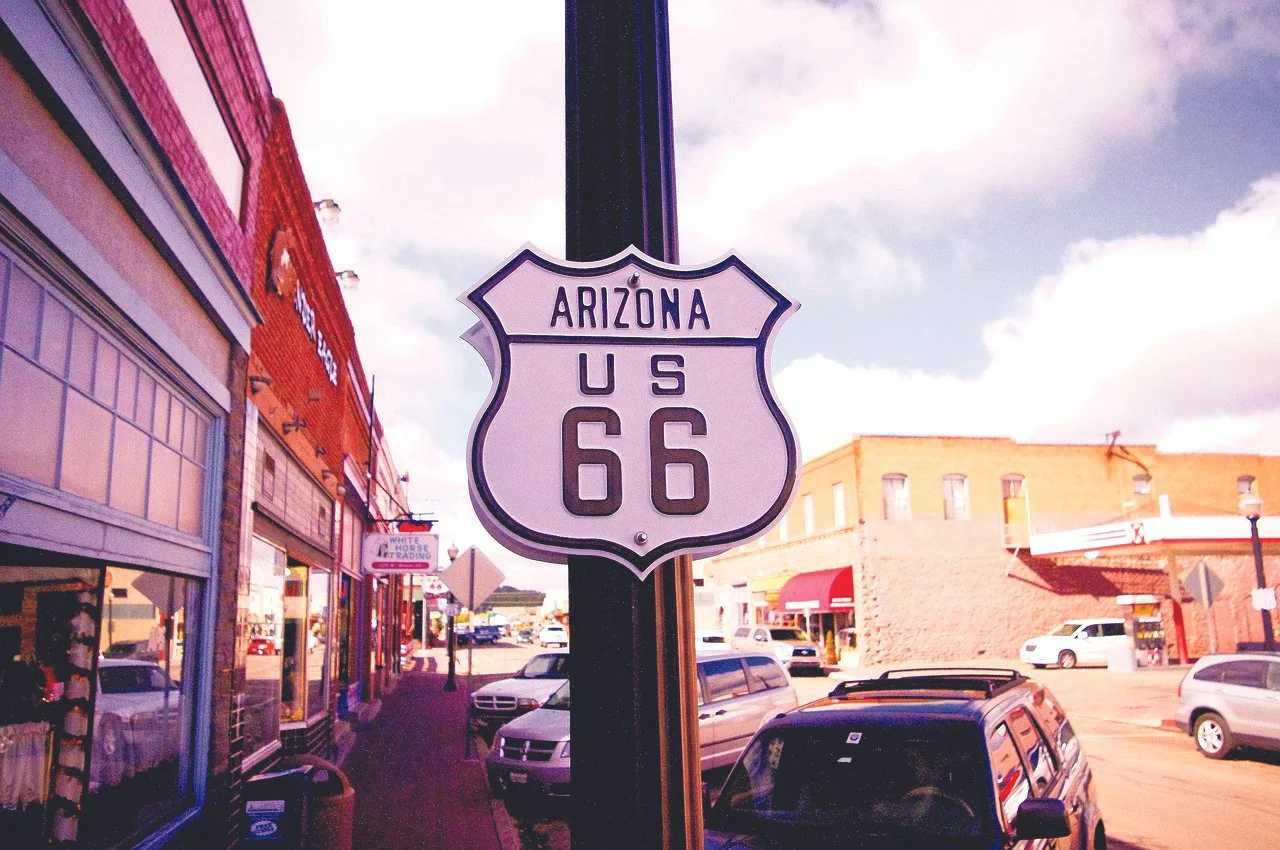
Known as the “Mother Road,” Route 66 celebrates its centennial this year. Officially designated on November 11, 1926 and decommissioned on June 27, 1985, the highway draws renewed attention this year.
So many have fond memories of taking Route 66 to California. I am among them for it was September 1964 when Neil Oaks and I having just graduated from Bradford Academy joined Jim Terrill, class of 61, for a trip across the county to Los Angeles. Neil and I had enrolled at Northrup Institute of Technology and Jim was just out for a new experience.
I remember well the AAA TripTik we used to navigate our route west. It was about eight inches long and four wide with a map page for every section of the route along with lists of things to do and see.
One highlight of the trip was the detour we took to go up to the south rim of Grand Canyon, a place I have visited several times since, always reminded of the awe I experienced that first time.
I was not enamored of Los Angeles and after a short time, returned home to Vermont with Bob Poutre also via Route 66. Bob had moved to California with his wife Betty a year or two before and was moving back to Vermont.
Route 66 turns 100 in this year, with its official designation on November 11, 1926. There will be widespread celebrations, events, and preservation projects across the eight states it traverses, spearheaded by the U.S. Route 66 Centennial Commission and the Route 66 Road Ahead Partnership, focusing on tourism, history, and revitalizing the iconic “Mother Road”.
The U.S. 66 Highway Association advertised the new highway as the “shortest, best, and most scenic route from Chicago through St. Louis to Los Angeles.”
Many will drive at least part of the route this summer and fall, some for the first time and others who will relive the experiences they had decades ago. I wish I was able to be one of them.
Thanks to pop-culture appearances in films like Easy Rider and songs like Nat King Cole’s “Route 66” as well as the John Steinbeck novel The Grapes of Wrath, in which the author nicknamed the highway the “Mother Road,” many have heard of Route 66 even if they have never experienced it.
Some 85 percent of the original Route 66 can still be driven. There are a few gaps in the old alignments where the old roadway is cut by the Interstate and in the places where it is overlaid by the alignments of the interstates, I-55, I-44, I-40, and I-15. In these cases, you have to drive the freeway to bridge the gaps.
It was finally completely eliminated when it was decommissioned on June 27, 1985 by the American Association of State Highway and Transportation Officials’ vote to decertify it.
Although Route 66 no longer exists as a U.S. Highway, the efforts of the communities along “America’s Main Street” have kept it alive. Many organizations and associations are dedicated to promoting Route 66 and preserving it, so that we can drive it today and in the future.
Bits and Pieces
The Vermont Fish and Wildlife Department will be offering Junior Warden Weekend to be held at the Kehoe Green Mountain Conservation Camp in Castleton on August 1 and 2.
“We are pleased to continue this fun and exciting opportunity for teens ages 15-17. Junior Warden Weekend allows us to provide teens with a window into what we do as wardens and how we contribute to conservation in Vermont,” said Lieutenant Wes Butler. “Our job duties are incredibly varied depending on the time of year and specific needs of our communities, and we are excited to share some of these experiences with the participants in this program.”
Campers will arrive on Saturday morning and immediately jump into K-9 demos, mock crime scene investigations, game processing, and more. “We are thrilled to be able to partner with the Warden Service on this exciting new program,” says Hannah Lafont, Green Mountain Conservation Camp Coordinator. “This weekend is a great opportunity to engage with local game wardens while also getting a weekend at camp—there will be no shortage of campfires, fishing, swimming, and other camp activities throughout the weekend program.”
The weekend is open to ages 15-17 and is the perfect way for teens to unplug and engage with peers outdoors while exploring a potential career in conservation law enforcement. The weekend is capped at 25 participants, but there is still space for new registrants. Arrival time is 10:00 a.m. on Saturday, August 1 with departure at 4:00 p.m. on Sunday afternoon.
The cost for the weekend is $150, which includes all meals. Sponsorships are available on a limited basis.
To register for the weekend, email a completed application found on Fish and Wildlife’s website. Click on Learn More and then Conservation Education. You can also email Hannah.Lafont@vermont.gov for the registration or for more information.
***
Vermont’s antlerless deer permit applications are now available online at Vermont Fish and Wildlife’s website and from license agents.
The Fish and Wildlife Board met on May 20 and set antlerless deer permit numbers for the fall deer hunting seasons.
An antlerless permit allows a hunter to take one antlerless deer during the muzzleloader seasons on October 29-November 1 and November 30-December 13 or during the regular deer season on November 14-29. Antlerless permits are available for 19 of Vermont’s 21 Wildlife Management Units.
Landowners who do not post their land may apply for a landowner priority antlerless deer permit. Landowners who do post are still eligible to apply in the regular lottery for an antlerless deer permit.
The deadline to apply for an antlerless deer permit is July 22, and the lottery drawing for permits is August 19.
Antlerless deer may be taken statewide during the archery season and the youth and novice weekend using the respective tags for those seasons. Antlerless permits are not valid during these seasons.
“The number of antlerless permits available this year is much lower than recent years,” said Nick Fortin, deer and moose project leader for the Fish and Wildlife Department. “Due to new regulations taking effect this fall and some uncertainty about how those regulations will affect antlerless harvests, we’re taking a conservative approach and reducing permit allocations in all WMUs.”
***
You can learn the skills necessary to become a first-time trapper, including the many ways to use your harvest, at a free workshop being offered at the New Hampshire Fish and Game Department’s Owl Brook Hunter Education Center in Holderness. The workshop will take place from 9 a.m.–1 p.m. on Saturday, June 13. Space is limited and pre-registration is required. To reserve your place, visit Events | New<> Hampshire Fish and Game.
This workshop will feature New Hampshire Fish and Game’s Furbearer Biologist Jacob DeBow, an expert trapper who will provide participants with an introduction to the Granite State’s furbearer species and the various techniques that can be used for successful and ethical harvests on land and in the water.
The workshop will cover topics such as trapping safety and equipment, selective trapping techniques, best management practices, trap preparation and care, and the many products that can be utilized from furbearers.
***
For more information on Fish and Game’s Owl Brook Hunter Education Center, visit Owl Brook Hunter Education Center | State of New Hampshire Fish and Game.
Free youth day programs will be offered again this summer at the Owl Brook Hunter Education Center in Holderness. These programs give boys and girls ages 10–15 the chance to learn about shooting sports, bowhunting, and other outdoor skills. Sessions will be offered in July and August at Owl Brook, which is operated by the New Hampshire Fish and Game Department. Pre-registration is required and will be conducted on a first-come, first-served basis. Space is limited to 20 participants per day, so register now by visiting www.wildlife.nh.gov/hunting-nh/hunter-education/owl-brook-hunter-education-center. There is no charge for these sessions.
Day programs will be held on Tuesdays and Thursdays, unless otherwise noted, beginning July 7 and ending July 30. Tuesdays will be for youth ages 10–12, and Thursdays will be for youth ages 13–15. Participants may register for one or more sessions and should bring their own bag lunch. All required forms should be downloaded during the registration process and returned to Owl Brook Hunter Education Center prior to attending.
***
Mark Breen reported in the May weather records in Fairbanks Museum’s Skywatch Almanac.
Warmest: 61.6°F/1911 Coldest: 47.0°F/1917
Wettest: 11.12”/2011
Driest: 0.04”/1903
Parting Shots
Schlitz, the beer that made Milwaukee famous, is no more.
Many my age have fond and not so fond memories of Schlitz. I being in the later category.
When I was in Vietnam in 1967-68 beer came to our base camp in pallet loads. The choice to order was premium or regional beer but no brand. It seems like we either got Schlitz or Miller for premium and when in base camp we drank prodigious amounts. In my case, so much I swore to never touch another of either brand once I returned to the states. I have stuck to that pledge these 58 years later.
Pabst Brewing Co. is ending production of Schlitz, which began as a Milwaukee tavern brewery in 1849 and was once America’s largest brewer.
Schlitz was founded by August Krug. Joseph Schlitz, then a company bookkeeper, acquired and renamed the brewery Joseph Schlitz Brewing Co. following Krug’s death in 1856.
In 1870, Schlitz built a giant brewery on what is now King Drive and Galena Street. Schlitz died at sea five years later, and the Uihleins took over the company just as Milwaukee’s brewing industry experienced massive growth. By the end of Prohibition, it was America’s biggest beer company and one of Milwaukee’s largest employers.
In the 70s the brewer had fallen to fourth place and behind two of its Milwaukee competitors, Miller and Pabst. Company leaders attempted to cut costs by changing its ingredients, but the move only alienated loyal Schlitz drinkers.
Schlitz then targeted its Milwaukee brewery for cost cutting, reportedly looking to eliminate up to 200 jobs starting in 1981. More than 700 workers went on strike in response. But in July 1981, the company announced it would shut down the brewery for good.
Schlitz was sold in 1982 to Stroh Brewing Co., which shut down all remaining Milwaukee operations. After more than 130 years, Schlitz left the city it helped make famous.
Schlitz was acquired by Pabst in 1999 and relaunched in 2008, but its presence in Wisconsin remained relatively small.
Syndicated columnist Gary W. Moore may be reached by e-mail at gwmoore1946@icloud.com or at Box 454, Bradford, VT 05033. copyright 2026 Gary W. Moore