
Leave Fawns Alone
By Gary Moore

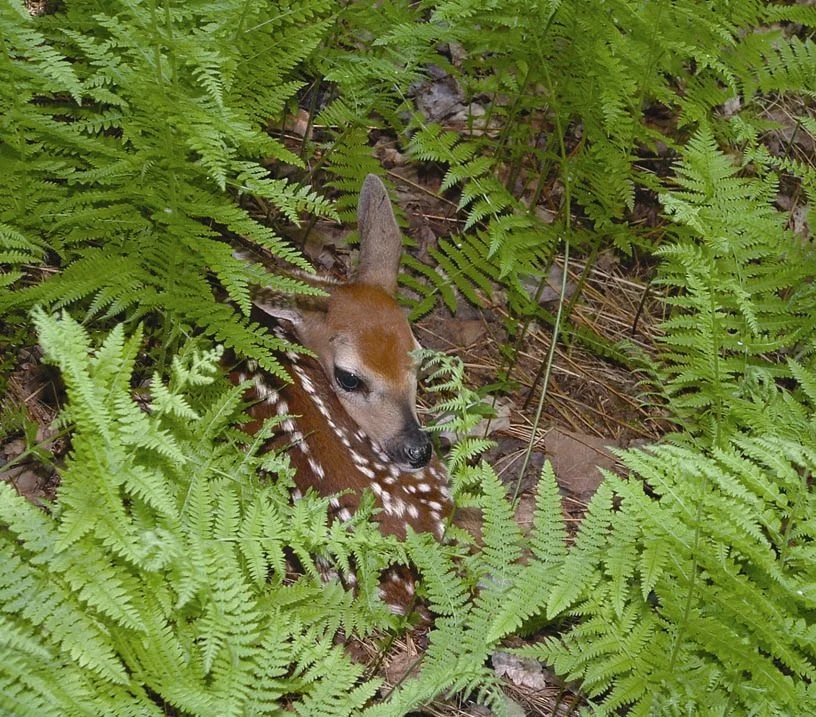
The Vermont Fish and Wildlife Department and New Hampshire Fish and Game say deer fawns are being born this time of year and asks that people avoid disturbing or picking them up.
Most deer fawns are born in late May and the first and second weeks of June, according to Vermont deer biologist Nick Fortin.
Fortin says it is best to keep your distance because the fawn’s mother is almost always nearby. When people see a small fawn alone, they often mistakenly assume it is helpless, lost or needing to be rescued.
Fawns do not attempt to evade predators during their first few weeks, instead relying on camouflage and stillness to remain undetected. During these times, fawns learn critical survival skills from their mothers. Bringing a fawn into a human environment results in separation from its mother, and it usually results in a sad ending for the animal.
New Hampshire Fish and Game has similar advice. “If you believe a fawn or other young wildlife has been abandoned, injured, or orphaned, do not move the animal. Contact the New Hampshire Fish and Game Department by emailing wildlife@wildlife.nh.gov or calling 603-271-2461 to initiate a report. Department staff can assess the situation and help determine the best course of action. In most instances, it is advisable to leave the fawn or other animal alone and allow time for the mother to return.
“Do not approach, pet, or feed wildlife, and never remove any animal from its habitat.”
“It’s in the best interest of Vermonters and the wildlife that live here, for all of us to maintain a respectful distance and help keep wildlife wild,” added Vermont’s Fortin.
For the safety of all wildlife, taking a wild animal into captivity is illegal in Vermont.
New Hampshire said, “Please remember, the best way to help young wildlife is by keeping them wild. For more information, visit www.wildlife.nh.gov/wildlife-and-habitat/white-tailed-deer-new-hampshire"
Bits and Pieces
Tune in to WYKR 101.3 FM or 1100 AM on Thursday at 6 p.m. for The Outdoor Edge. Thoughts on the Out-of-Doors airs as a segment of the program on the 1st and 3rd Thursday of every month
***
The Caledonia Forest & Stream Club’s annual kids fishing derby for ages up to 12 will be held this Wednesday, May 20 from 5-7 p.m.
For questions call derby chair Beulah Mcginnis at 802-748-2155.
***
The Vermont Fish and Wildlife Department says keeping native turtles as pets is prohibited because it can harm the turtle and pose threats to wild turtle populations.
“Capturing a wild turtle and keeping it as a pet, even if only for a short time, is not only bad for that individual but it could hurt turtle populations as well,” said Vermont Fish and Wildlife herpetologist Luke Groff. “Releasing captured turtles back into the wild can spread wildlife diseases and also affect the genetics of the local population.”
“Many of Vermont’s turtle species do not reproduce until they are at least 10 years of age,” says Groff, “and older, sexually mature females are critical to the long-term persistence of some of Vermont’s turtle populations. Older females have already beaten the odds by reaching maturity and, because they are typically larger than younger females, they tend to produce more eggs.”
Two common species you are likely to see are the Painted Turtle and Snapping Turtle. The Wood Turtle, Spotted Turtle, Spiny Softshell, and Eastern Musk Turtle are rare in Vermont, and the Vermont Fish and Wildlife Department urges you to report sightings of these species to theVermont Reptile and Amphibian Atlas (vtherpatlas.org). If you see some of Vermont’s native turtles in the wild, feel free to take a photo home with you, but leave the turtles in the wild.
For more information on Vermont’s native turtle species, visit Vermont Fish and Wildlife’s website or contact Vermont Fish and Wildlife herpetologist Luke Groff at Luke.Groff@vermont.gov.
***
New Hampshire’s 2025 deer season resulted in the harvest of 14,387, deer marking the largest harvest in the state’s history going back to 1922. The adult (antlered males age 1.5+) buck harvest of 8,673 was also the highest documented in the state during that same period. Archers took 4,922 deer, the youth weekend accounted for 375 animals, and muzzleloader and regular firearm hunters took 2,375 and 6,715 deer, respectively.
The 2025 bear take, totaling 1,097 bruins, represented the fourth highest historic harvest and the fifth time since 2018 that the annual harvest has exceeded 1,000 bears.
***
The 2025 New Hampshire Wildlife Harvest Summary is now available. The publication presents final data on the 2025 New Hampshire hunting seasons as summarized by New Hampshire Fish and Game Department wildlife biologists. The annual publication provides a complete analysis of hunting season statistics, including information organized by town and by Wildlife Management Unit (WMU).
The 2025 NH Wildlife Harvest Summary is now available online at www.wildlife.nh.gov/hunting-nh/hunting-reports-harvest-summaries. A limited number of printed copies will be available at New Hampshire Fish and Game Department headquarters in Concord and at regional Fish and Game offices.
***
The New Hampshire Fish and Game Department has set final season dates and bag limits for the 2026–2027 waterfowl hunting season after considering comments from the sporting community provided at a recent public meeting and through email correspondence.
The regular duck season is 60 days long with a bag limit of six birds daily. The regular Canada goose season is 60 days long with two birds allowed in the daily bag. The 2026–2027 season dates, bag limits, and a map of the waterfowl zones may be viewed by visiting www.wildlife.nh.gov/hunting-nh/waterfowl-and-migratory-bird-hunting-new-hampshire.
***
New Hampshire wildlife biologists are asking for help from volunteers who have bats in their barn or other outbuilding to conduct bat counts this summer. As part of the New Hampshire Bat Counts project to help monitor summer bat colonies in the Granite State, volunteers are asked to conduct at least one count in June and one count in July. It’s easy to participate.
Volunteers interested in learning more can visit the New Hampshire Bat Counts website at https://www.wildlife.nh.gov/wildlife-and-habitat/nongame-and-endangered-species/bats-new-hampshire/nh-bat-counts for information on conducting a count and submitting data.
There is an opportunity on June 4 from 7–9 p.m. at the Squam Lakes Natural Science Center in Holderness to learn more about the bat species found in New Hampshire, the threats leading to population declines, how you can help to conserve bats, and how to participate in this summer’s NH Bat Counts project. For more information and to register visit https://extension.unh.edu/event/2026/06/nh-bat-counts-training
***
If you need to complete a Hunter Education class, sign up today to reserve space in an online class this spring or summer. Register at www.huntnh.com/hunting/hunter-ed.html and choose Start Online Course. Once you complete the online Hunter Education course, the next step is to attend an in-person field day, which includes a written exam and skills testing. Field days are now available in May and June for individuals who have successfully completed their online course.
***
Mark Breen reports in the Fairbanks Museum's Skywatch Almanac that on
May 23, 1964: “Early season heat wave for all of New England, 90° or more in each state; 90° in Burlington and St. Johnsbury; 93° in Bellows Falls, VT.”
Parting Shots
Tragedy has struck the Maine Warden Service. Maine Game Warden pilot Joshua Tibbetts was killed when his plane crashed last Tuesday. He was air stocking fish into remote lakes in western Maine near Avon.
Tibbetts was 50 years old and lived in New Gloucester. He had served as a Game Warden for 18 years and as a warden service pilot for three years. His father, Doug Tibbetts, is a retired Warden Lieutenant.
Syndicated columnist Gary W. Moore may be reached by e-mail at gwmoore1946@icloud.com or at Box 454, Bradford, VT 05033. copyright 2026 Gary W. Moore