
Women & Our Woods
By Gary Moore
Women are an increasingly significant part of Vermont's landowner population, making critical land-use decisions on nearly 1.6 million acres of the state’s forests. They own about 20% of Vermont's private forestland (475,000 acres) and co-own another 44% (1.1 million acres), providing vital public benefits such as clean water, climate change mitigation, wildlife habitat, and forest products. National trends indicate that the number of women owning forestland will continue to increase.
I learned the above figures when researching for my interview with Tunbridge resident Kate Forrer, Executive Director Vermont Woodlands Association and Townshend resident Tessa McGann, County Forester southwestern Vermont, both members of the Women & Our Woods steering committee.
They pointed out that despite their growing presence, women are still less likely to engage in forest management activities because of lack of support and access to information. This is where the Women & Our Woods (WOW-VT) program comes in, supporting women in their role as forest stewards and providing the tools and community they need to succeed.
Women & Our Woods previously known as Women Owning Woodlands-Vermont is a collaborative initiative committed to empowering women landowners and woodland enthusiasts. The goal is to create inclusive opportunities for women to engage in thoughtful forest stewardship that ensures Vermont’s woodlands remain healthy, connected and well-managed for generations to come.
According to Kate and Tessa the collaborative WOW-VT program is led by professionals from Audubon Vermont, Forest Stewards Guild, Vermont Coverts, Vermont Forests Parks and Recreation, Vermont Fish and Wildlife, Vermont Land Trust, UVM School of Forestry and Vermont Woodlands Association.
They said, “We aim to bridge the gender gap in forestry by offering women-focused outreach and education across Vermont. We believe in the power of women to make a lasting impact on the future of Vermont’s forests and recognize that not everyone is able to or interested in owning land.”
Kate said, “WOW started 2014 when it was determined programs centered on women’s interest were lacking.”
Tessa was a founding member of the Women’s Foresters Colaborative and found WOW a way to help women land owners.
The website, https://vermontwoodlands.org/women-and-our-woods/, proclaims, “Our community includes women landowners as well as ‘woodland enthusiasts,’ women who don't own land but care deeply about our forests. We are committed to providing the knowledge and skills needed to manage land confidently and sustainably by enhancing the coordination and delivery of women-focused outreach and education statewide.”
Kate and Tessa told me WOW supports the interests and growth of individual landowners and woodland enthusiasts by providing an array of interactive educational programs, skill-building workshops, and peer-to-peer learning opportunities. “Whether you're just starting or have years of experience, our goal is to support your growth as a land steward.”
A very popular offering is a day long chainsaw course. Others such as tree identification, invasive species and bird identification are also popular.
I was impressed with what I learned about WOW and urge any women with an interest in forest management to check out the offerings at, https://vermontwoodlands.org/women-and-our-woods/.
To listen to my interview with Kate and Tessa go to: https://www.wykr.com/women-leading-the-way-in-vermonts-forests.
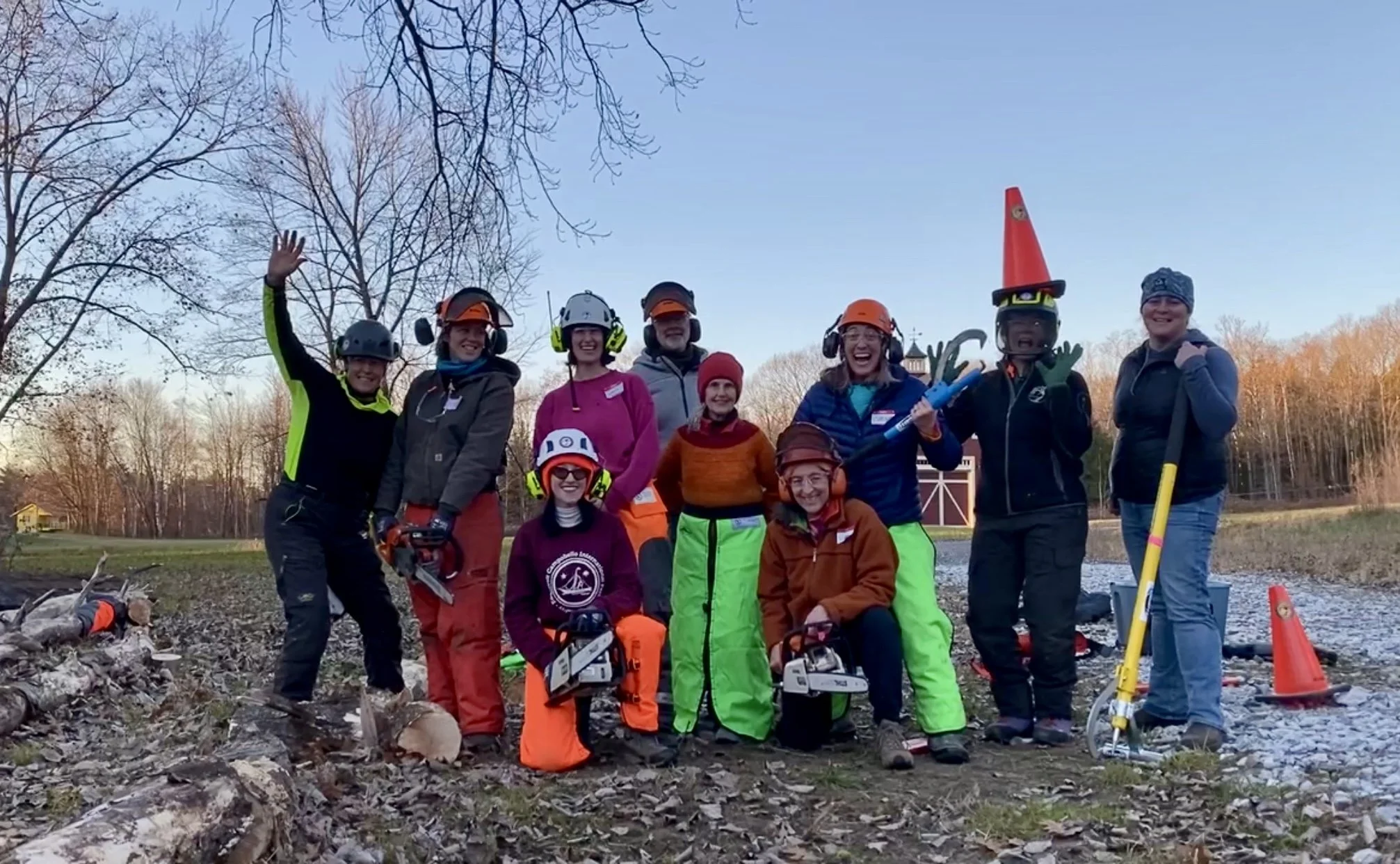
Enthusiastic participants pose during WOW chainsaw class or Teaching chainsaw safety in WOW class
Photo credit Vermont Woodlands Association.
Bits and Pieces
The Caledonia Forest & Stream Club’s annual kids fishing derby for ages up to 12 will be held Wednesday, May 20 from 5-7 p.m.
For questions call derby chair Beulah Mcginnis at 802-748-2155.
***
Catch & Release bass fishing with artificial flies or lures began the second Saturday in April on Vermont lakes and ponds.
“Spring catch-and-release bass fishing is a really special time to be on the water in Vermont, and the fishing can be truly spectacular,” said Bernie Pientka, state fisheries biologist with Vermont Fish and Wildlife. “Combine warming weather, minimal boat traffic and feeding largemouth and smallmouth bass, and spring bass fishing is hard to beat.”
Vermont’s catch-and-release bass fishing runs until June 13, when the regular bass season opens, and the harvesting of bass is allowed.
For catch-and-release bass fishing, all bass must be immediately released after being caught and only artificial lures may be used. Bass can be persnickety when it comes to artificial lures, but live bait is prohibited when targeting them during catch-and-release season.
***
The Vermont Fish and Wildlife Department says hunters who took a bear in the 2025 bear hunting seasons can now look up the age of their bear on the department’s website.
A total of 886 usable bear teeth were received from successful hunters in 2025. The department was able to get accurate ages for 822 bears.
“Successful bear hunters help in our management of this magnificent big game animal by providing a small premolar tooth from their bear,” said Jaclyn Comeau, bear project leader for Vermont Fish and Wildlife. “We have collected pre-molar teeth from harvested bears annually since 1968 to evaluate age composition of the harvest and to estimate the size of the population. The teeth are sent to a laboratory in Montana for aging by cementum analysis. The oldest female in 2025 was 19 years old, and the oldest male was 18 years old.”
Hunters harvested 1,022 black bears in Vermont in 2025 -- the second highest in history and 232 above the 10-year average as well as 14 less than the record harvest in 2025. The 2025 Vermont Black Bear Harvest Report is available on Vermont Fish and Wildlife’s website.
***
The 2026 New Hampshire moose hunt lottery closes Friday, May 29. The lottery entrance fee is $15 for New Hampshire residents and $25 for nonresidents.
A total of 33 permits will be issued this year. Visit www.wildlife.nh.gov/hunting-nh/moose-hunting-new-hampshire to enter the New Hampshire moose hunt lottery online or print out a mail-in application. You can also pick up an application at any Fish and Game license agent, New Hampshire Fish and Game Department headquarters, or at Fish and Game regional offices
***
Applications for the 2026 Maine moose permit lottery are only accepted through May 18. Go to: https://mooselottery.web.maine.gov/online/moose/.
***
Registration is open for a half-day course for women who want to develop the skills necessary to better understand how New Hampshire’s resident and migratory birds help foster relationships with both nature and local community. The New Hampshire Becoming an Outdoors Woman (BOW) Program presents “Birds as Connectors: Fostering Relationships with Nature and Community” on June 6, from 9 to 11:30 a.m. at the Owl Brook Hunter Education Center, Holderness, NH.
Taught by Kelly Dwyer, founder of Nature Education Opportunities, this workshop will cover new research behind bird behavior and communication, tips and techniques to identify birds through field marks, song, and habitat location; nesting, migration, and winter survival strategies of our resident and non-resident birds; and easy techniques for daily connection with our natural world to help manage stress and overwhelm, increasing our overall wellbeing. The class is for anyone who is interested in learning more about avian identification in every habitat, and in every month of the year.
To sign up, visit nhbow.com. The workshop fee of $50 is due with registration and includes instruction, program materials, and use of binoculars. Registration is limited to 15 participants and is for those 18 years and older.
***
Mark Breen reports in the Fairbanks Museum's Skywatch Almanac that on
May 12, 1945: “After record warmth in March and April, 15 inches of snow piled up in Wilmington, and 13 inches in Cavendish, VT.”
May 12, 1876: “The CT River was “higher than ever known” according to W. Minot diary in West Bath, NH. Much damage to railroad in Wells River, VT.”
May 17, 2025: "Intense thunderstorms produced downpours and damaging winds from Bristol, east to White River Junction; 1 inch of rain in 30 minutes, and wind gusts to 80 mph.”
Parting Shots
This is the time of year that ephemerals appear in our woods brightening an otherwise drab forest floor. Their bright flowers remind us that our world is awakening from a long winter’s sleep. I love to wander around the woods this time of year admiring the spring flowers that will soon disappear until next year.
Among the spring ephemerals that appear are flowers like trillium, trout lily, bloodroot, hepatica, and early blue cohosh. Also spring beauty, dutchman’s breeches, blue cohosh, and wild ginger.
As the name ephemerals implies, these early spring wildflowers appear but for a brief time, taking advantage of sun for photosynthesis before trees’ leaves emerge.
Spring ephemeral wildflowers are perennial woodland plants that sprout from the ground early, bloom fast and then go to seed, all before the canopy trees overhead leaf out. Once the forest floor is deep in shade, the plant’s leaves wither away leaving only the roots, rhizomes, and bulbs underground. It allows plants to take advantage of full sunlight levels reaching the forest floor during a short time in early spring.
Syndicated columnist Gary W. Moore may be reached by e-mail at gwmoore1946@icloud.com or at Box 454, Bradford, VT 05033.
copyright 2026 Gary W. Moore