
Addition to Newbury Tucker Mountain Town Forest Being Considered
By happenstance, just prior to Mr. Bailey’s offer two brothers managing their parents’ estate had informed the committee that they wanted to donate $50,000 toward a land purchase to honor of their parents. With the asking price (after the 30K reduction) of $235,000, taking away the 66% grant and the donation of $50,000, the Friends of Tucker Mountain, the town forest’s fundraising organization, is left with $29,000 to raise. Friends believes that is quite doable.
By Tom Kidder
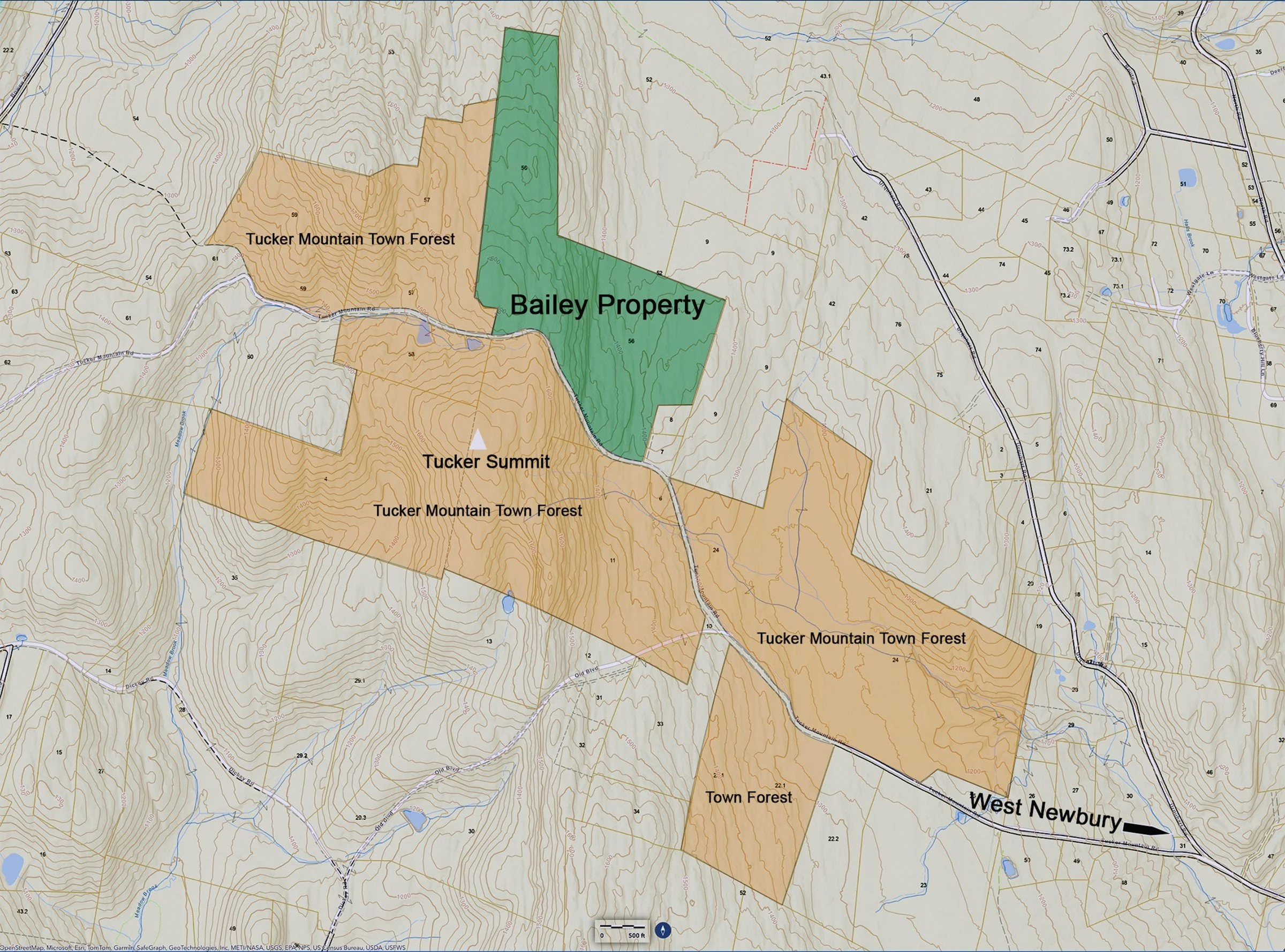
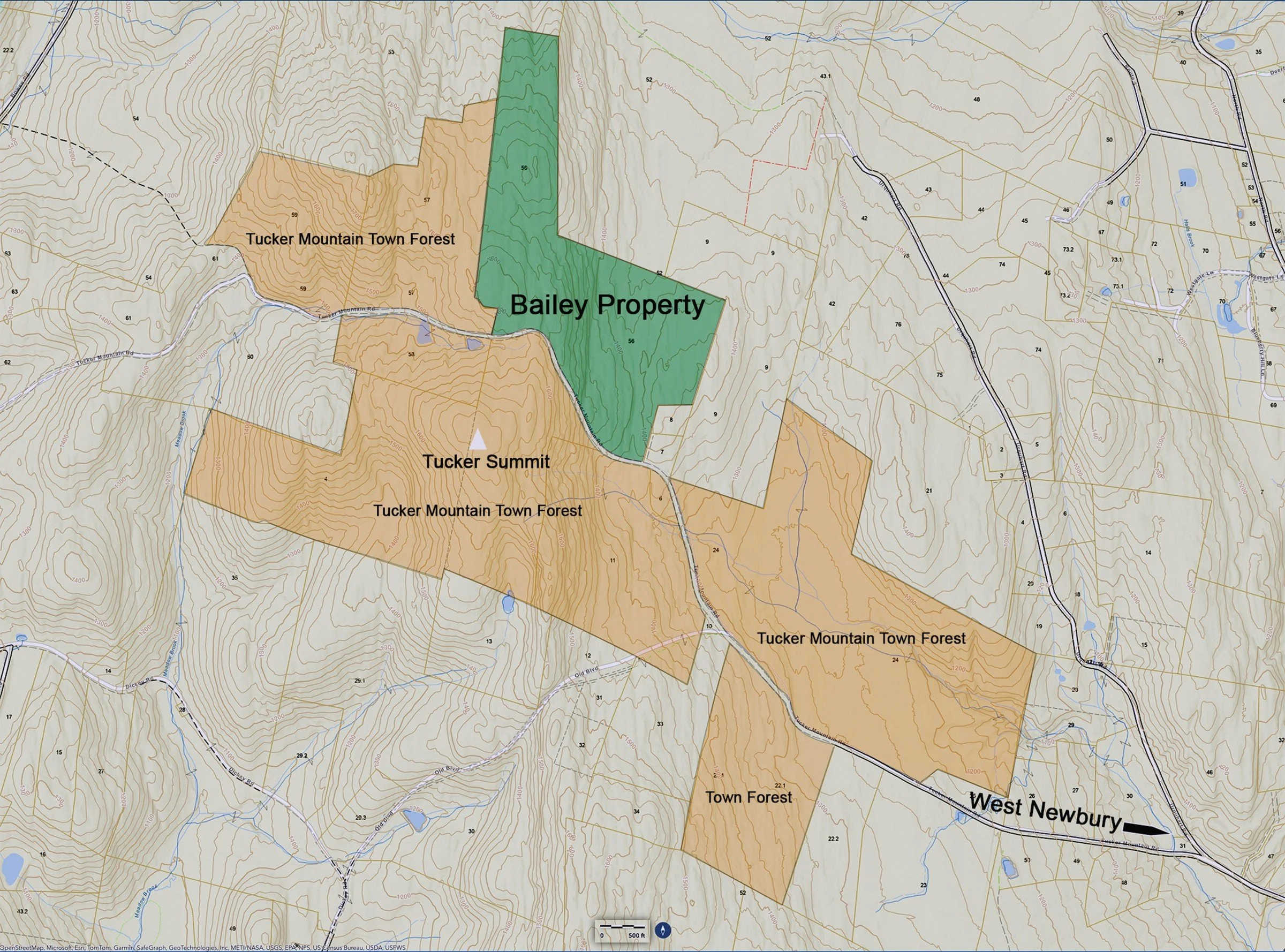
The Bailey Property Map plus the Tucker Mountain Trust Fund (Courtesy Image)
Newbury - The town of Newbury is considering an offer of 127 acres of forested land as an addition to the Tucker Mountain Town Forest. The land is north of the Tucker Mountain summit and follows the same high ridgeline.
Last March, town forest neighbor Bob Bailey notified the management committee that he was planning to sell the land and wanted to first offer it to Newbury as an extension of the town forest. He offered the land at a $30,000 discount as a contribution to what he sees as a thriving town forest project. Mr. Bailey is a direct descendent of General Jacob Bayley and has a strong attachment to Newbury.
Aside from the original purchase of the original 635 acres for $25,000, all funds for the development of trails, parking lots, kiosks, benches have come from grants and donations from individuals and businesses. Tom Kidder, chair of the management committee, said, “We knew right away that we were not about to ask the taxpayers to pay for this new parcel, but we felt that since the property was offered to the town, it should be up to the town to decide if they want to accept it, and we explored other ways to fund it.”
What seemed impossible suddenly became possible with a call to the Vermont Land Trust, the original partners in helping the town acquire the forest. VLT approached the Vermont Housing and Conservation Board who said that since the property bordered the town forest and because the seller had offered a discount, then the town could very likely qualify for help with the purchase, covering 66% of the cost and contributions to an appraisal, closing costs, and a maintenance fund.
By happenstance, just prior to Mr. Bailey’s offer two brothers managing their parents’ estate had informed the committee that they wanted to donate $50,000 toward a land purchase to honor of their parents. With the asking price (after the 30K reduction) of $235,000, taking away the 66% grant and the donation of $50,000, the Friends of Tucker Mountain, the town forest’s fundraising organization, is left with $29,000 to raise. Friends believes that is quite doable.
The property would be purchased by Friends of Tucker Mountain and given to the Town of Newbury.
If the land becomes part of the Town Forest, Newbury will forgo municipal taxes which were $994 in 2025. To counter this, the Newbury Selectboard will again be asking the town if they are willing to sell what is known as the Ski Tow Property in West Newbury. Money from the sale of this 24-acre parcel would go to the town treasury and, having transferred to private ownership, the Ski Tow property would be added to the tax rolls.
The Ski Tow Property was purchased using Federal Funds tied to a recreational easement and cannot be sold unless that easement is passed on to another piece of recreational land. The new parcel on Tucker Mountain would qualify as recreational.
The vote for the town to accept the property as a gift is not a commitment to purchase the land. Should the Vermont Housing and Conservation Board grant fall though, the Friends of Tucker Mountain purchase would likely not take place unless other outside funding sources stepped in.
There are two articles on the warning: one is whether the town will accept the property as a gift, the other is whether the town will be allowed to sell the Ski Tow Property.
Lying north of the current summit and bordered on two sides by the town forest, Mr. Bailey’s land fits into the town forest map like a keystone. On the boundary is the State’s Woodchuck Mountain property that’s being sold to the Upper Valley Land Trust for preservation.
The wildlife corridor that passes through the town forest and enters the Woodchuck property would be enhanced with the preservation of the new parcel. This corridor extends to Groton State Forest to the northwest, the Fairlee Town Forest to the south, and into the White Mountain National Forest to the east. The land’s remote, wilderness characteristics make it key wildlife habitat
The forest has a diversity of tree age with a mix of hardwood and softwood that hasn’t been logged in over 35 years. There is at least one majestic stand of legacy oak trees that look to be over a century old. Much of it was cleared for agriculture some 200 years ago and stone walls that outlined fields remain throughout the woods. Along the height of land, directly north of Tucker Mountain, cleared meadows spread out over the ridge.
The new property would be added to the town forest conservation easement held by Vermont Land Trust.
This and other articles will be part of the discussion at an informational meeting prior to the Town Meeting. The public is encouraged to attend.
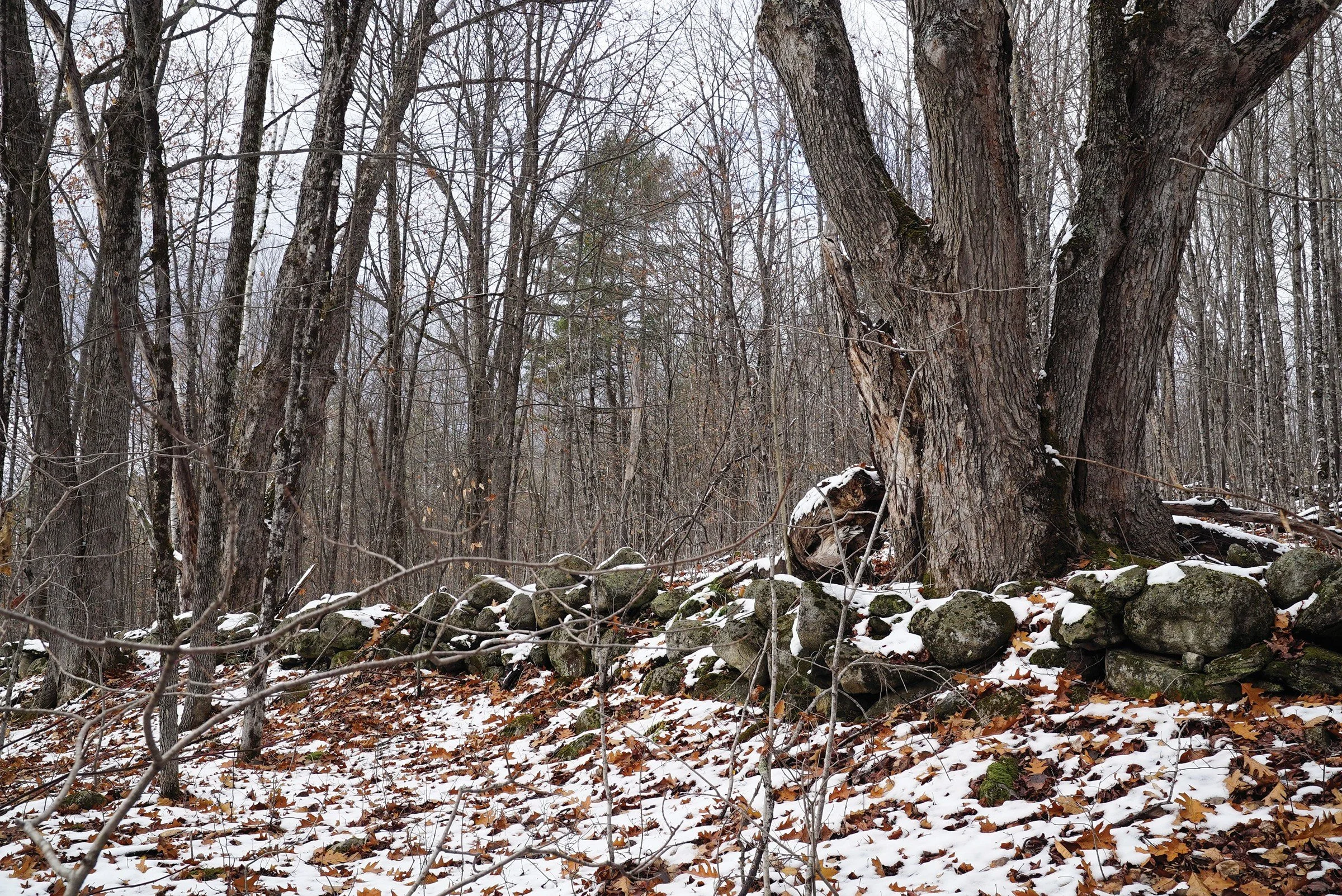
Legacy maple and old stone wall on the Bailey property (Courtesy Photo)
Cohase Chamber hosts busy night of events; board names Moore and Robie Farm as best of the year
It all happened under the chandeliered ceiling of Haverhill Corner’s historic Alumni Hall, once an early New Hampshire courthouse and school gymnasium. As in the past, a special meal was served and it was another splendid night of honoring local people, in a room full of friends, business leaders and community officials.
By Bernie Marvin
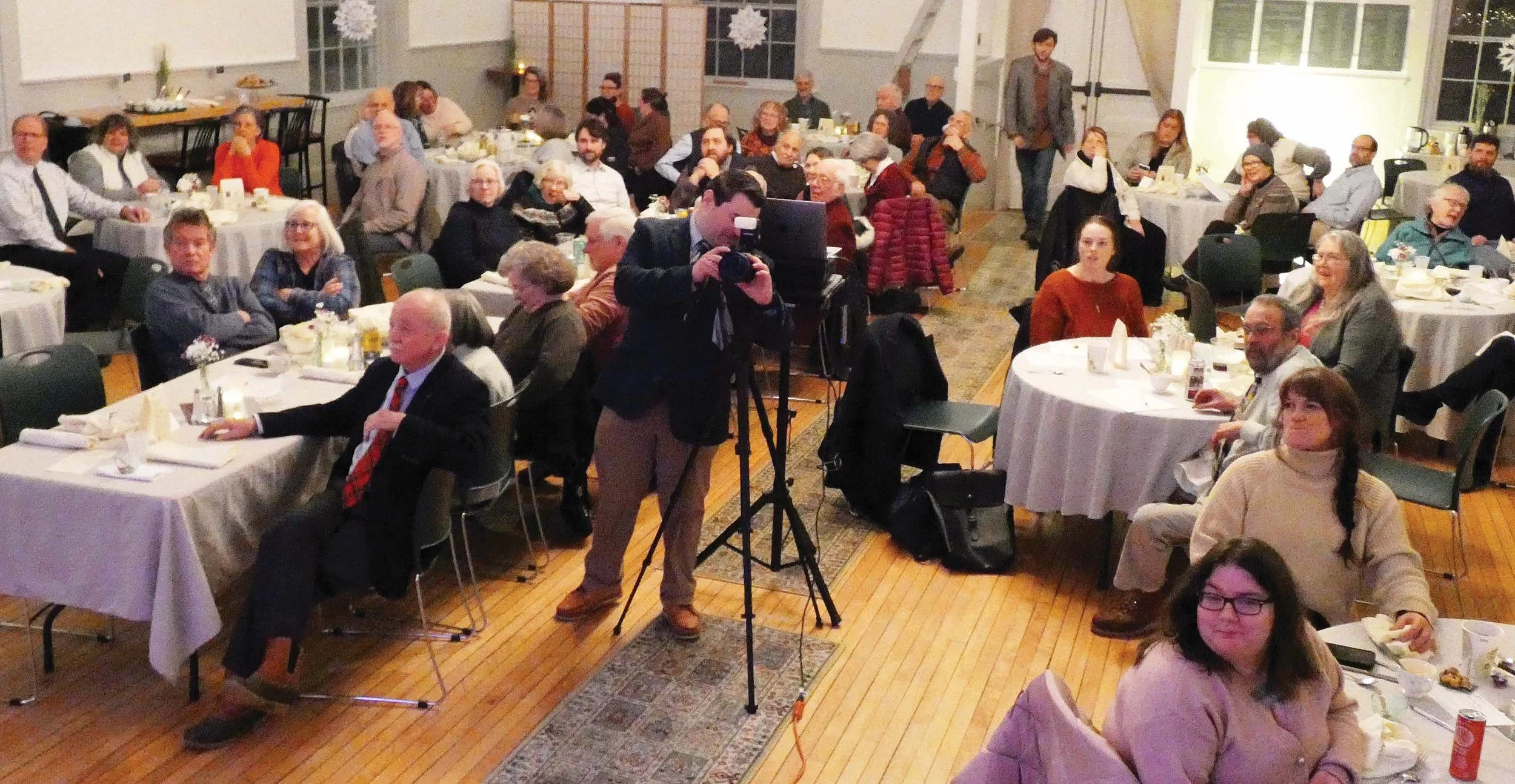
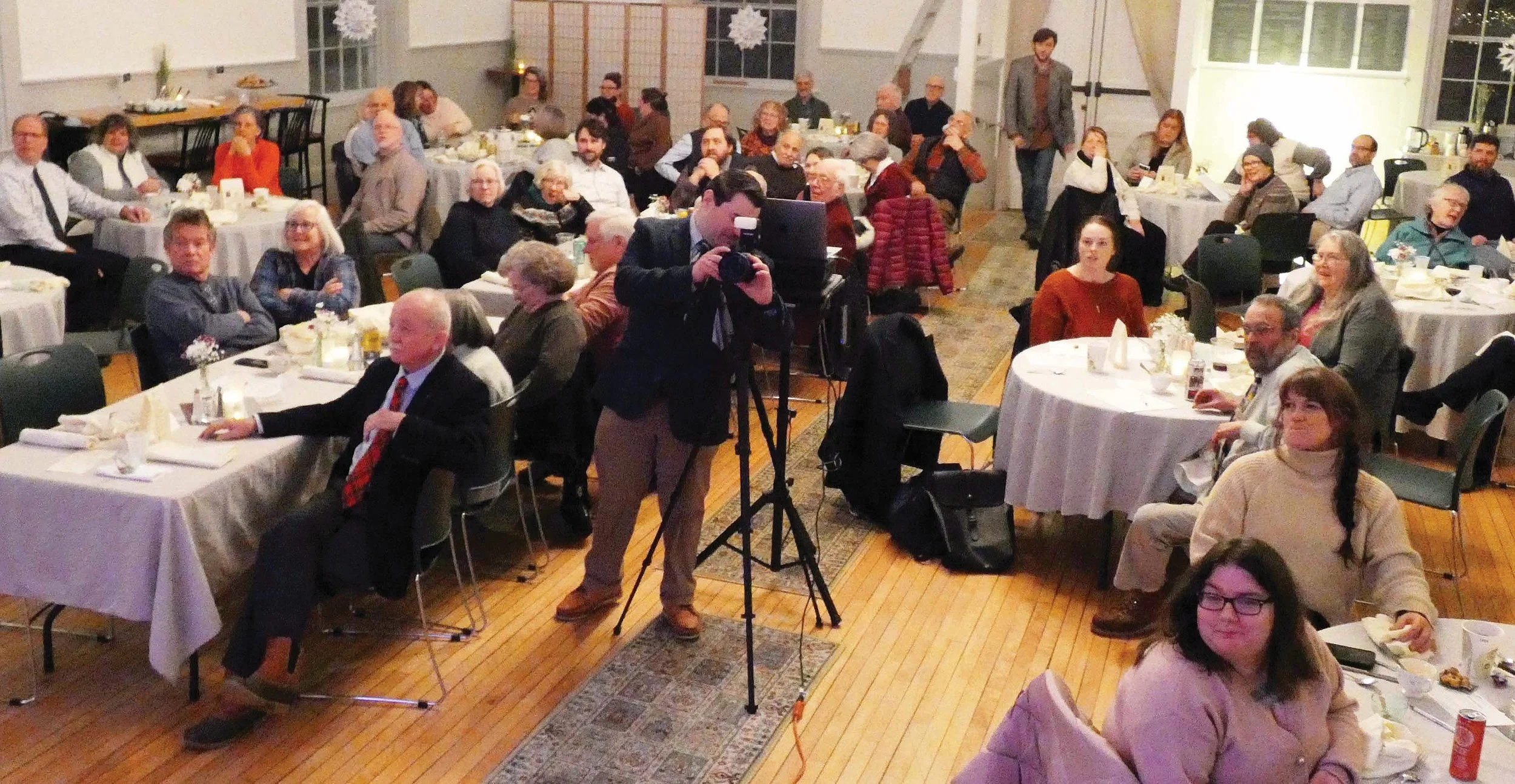
A full Alumni Hall in Haverhill Corner greeted the superb dinner and program of events last week for the Cohase Chamber of Commerce Annual Dinner and Annual Meeting. The Bridge Weekly/Bernie Marvin
Haverhill, NH – A near-capacity crowd came to Alumni Hall last week to celebrate two well-known names in the community, Bradford’s Gary Moore as Citizen of the Year and Piermont’s Robie Farm as Business of the Year.
It all happened under the chandeliered ceiling of Haverhill Corner’s historic Alumni Hall, once an early New Hampshire courthouse and school gymnasium. As in the past, a special meal was served and it was another splendid night of honoring local people, in a room full of friends, business leaders and community officials.
Gary Moore is well known throughout the area and was honored by the chamber for his many contributions to the community, to the field of emergency management and hazardous materials, also to police and fire services, locally and at the state level.
While receiving the tributes, he said “I have received many awards and honors over the years, but none have meant as much to me as this one. This is where I was born and raised and where Linda and I chose to live, moving back in 1973. Being named Citizen of the Year by those from this special region of the Twin States just makes it very special.”
In his comments, Moore mentioned a personal note, one of many he received upon the honors being made public, from Peggy Hewes and Larry Scott saying they were sending congratulations not only to Gary for his being named Citizen of the Year, but to his wife, Linda, “because you are so clearly and inspirationally a team.”
Moore agreed, saying “Nothing I have accomplished could have been possible without the support of my wife of 55 years.”
Moore’s involvement with the community includes a long list of positions held over the years as an educator, state official, member of the military intelligence in Vietnam, and everything from the Chief of the Bradford Fire Department to the Commissioner of the State of Vermont Fish and Game Department.
His background and professional development documents, including professional employment and appointments, more than 75 individual listings were made including his hobbies which are hunting, fishing, hiking, sailing, cross-country skiing, snowshoeing, canoeing, photography and reading.
The interesting evening included a media panel of local news hounds who were included in a roundtable discussion on the value of having local media in the community who are aware of the territory and publishing stories, photographs and advertisements that mean a lot to local readers.
Those personalities included Darren Sherburne, who represented his mother, Michelle Sherburne, owner of the Journal Opinion. Also, Gary Scruton, owner of The Trendy Time newspaper and this writer, Senior Writer/Photographer for The Bridge Weekly.
Moderating the panel was Joshua Smith, owner of WYKR Radio in Wells River and also owner of The Bridge Weekly newspaper, now based in Wells River.
Publisher-Owner Smith sought to show the direct connection between a strong local media such as there is in this area, strong local businesses and a strong community/nonprofit organization (especially in the digital world where social media can be noisy and polarizing.)
Plaques were presented to Citizen of the Year Gary Moore and to Mark Robie, of the Robie Farm, voted Business of the Year.
Robie Farm is a popular family farm business located in nearby Piermont. As mentioned on their internet web home page “At the Robie Farm, we’re dedicated to producing the highest quality milk, cheese, eggs, beef, pork, and chicken.”
“We work with nature – not against it – carefully considering every environmental impact along the way. The result is food raised with a clear conscience and the exceptional flavor our customers know and love.”
Since 1870, the Robie Farm has taken pride in producing high-quality, nutritious and flavorful meats that reflect our dedication and sustainability, animal welfare, and honest farming. Located along the Connecticut River and Piermont, New Hampshire, our 150-acre family farm has been continuously operated for over seven generations – each committed to maintaining healthy, productive livestock and responsible stewardship of the land.”
According to information available, farm owner Lee Robie and his sons decided to transition from selling milk to a large cooperative to offering bottled raw milk, selling directly to customers at their on-farm store on Route and in Piermont. This change opened the door to new diversifications. Using that raw milk they developed their own Farmstead cheese line and expanded offerings to include a wide variety of meats including beef, pork, poultry and more.
Today, there is a full line of those products and more at their farm store and in their online shop. Accepting a handsome plaque from Chamber officer Joe Mitchell was Mark Robie, one of the sons involved with the success of Robie Farm’s endeavors.
Long time Chamber of Commerce member and officer for many years since the chamber was created 25 years ago, Marvin Harrison was busy during the chamber event coordinating various activities. His popular “Marvin’s Trivia Program” has always been a big hit during previous chamber dinners.
At the conclusion of the ceremonies, Harrison told The Bridge Weekly that “It felt really nice to be able to celebrate two great families in the Moores and the Robies who are such wonderful examples of what community is all about. And the 'local media' panel added further credibility to the importance and effectiveness of the sense of community here in the Cohase region.”
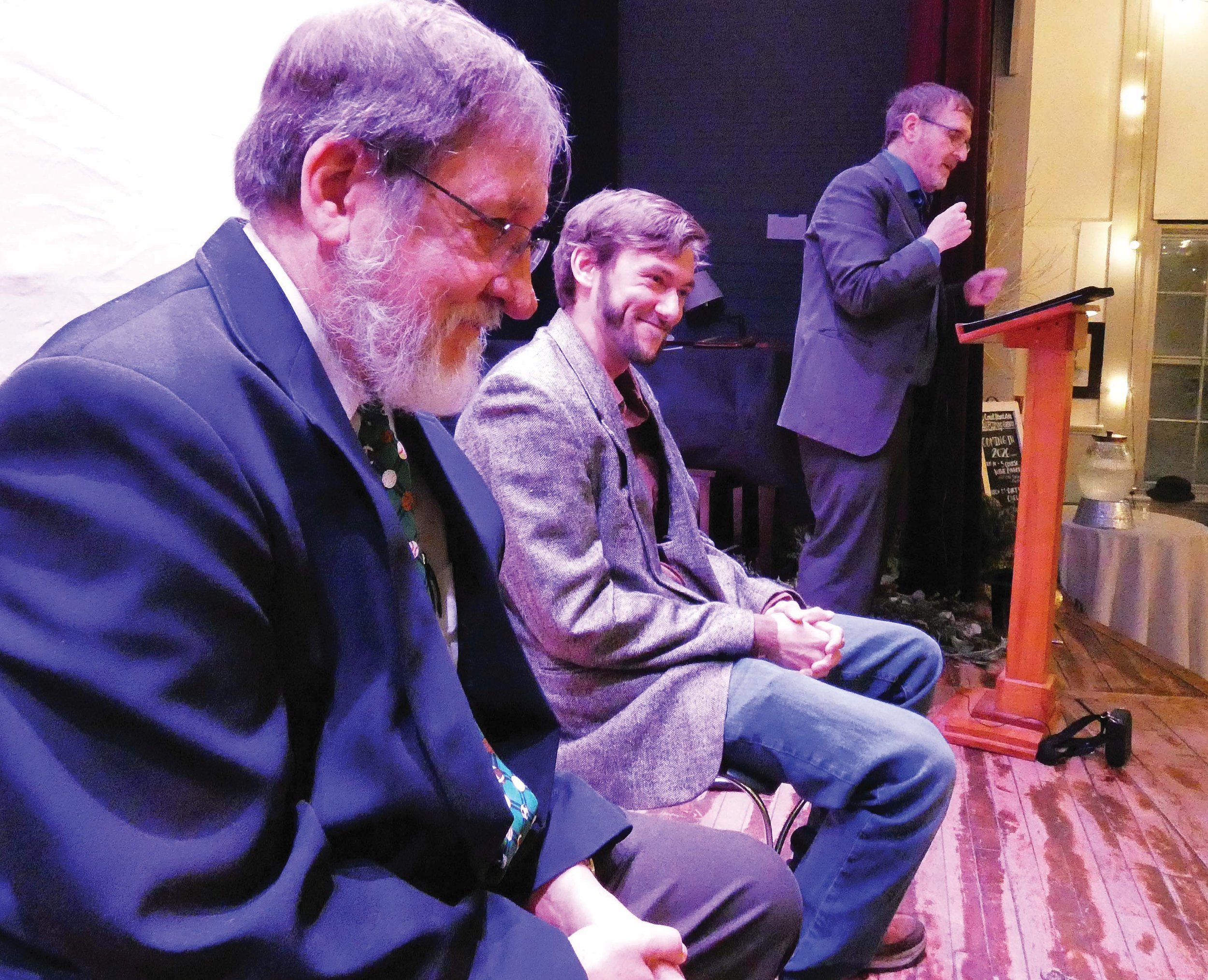
Three newspaper radio writers and advertising personnel presented a program during the Chamber’s Annual Meeting. Seen left to right are Trendy Times Editor and creator Gary Scruton, real estate advertising and sales personality Darren Sherburne, representing the Journal Opinion and Publisher/Owner of the Bridge Weekly and WYKR Radio Joshua Smith, who moderated the program. The Bridge Weekly/Bernie Marvin
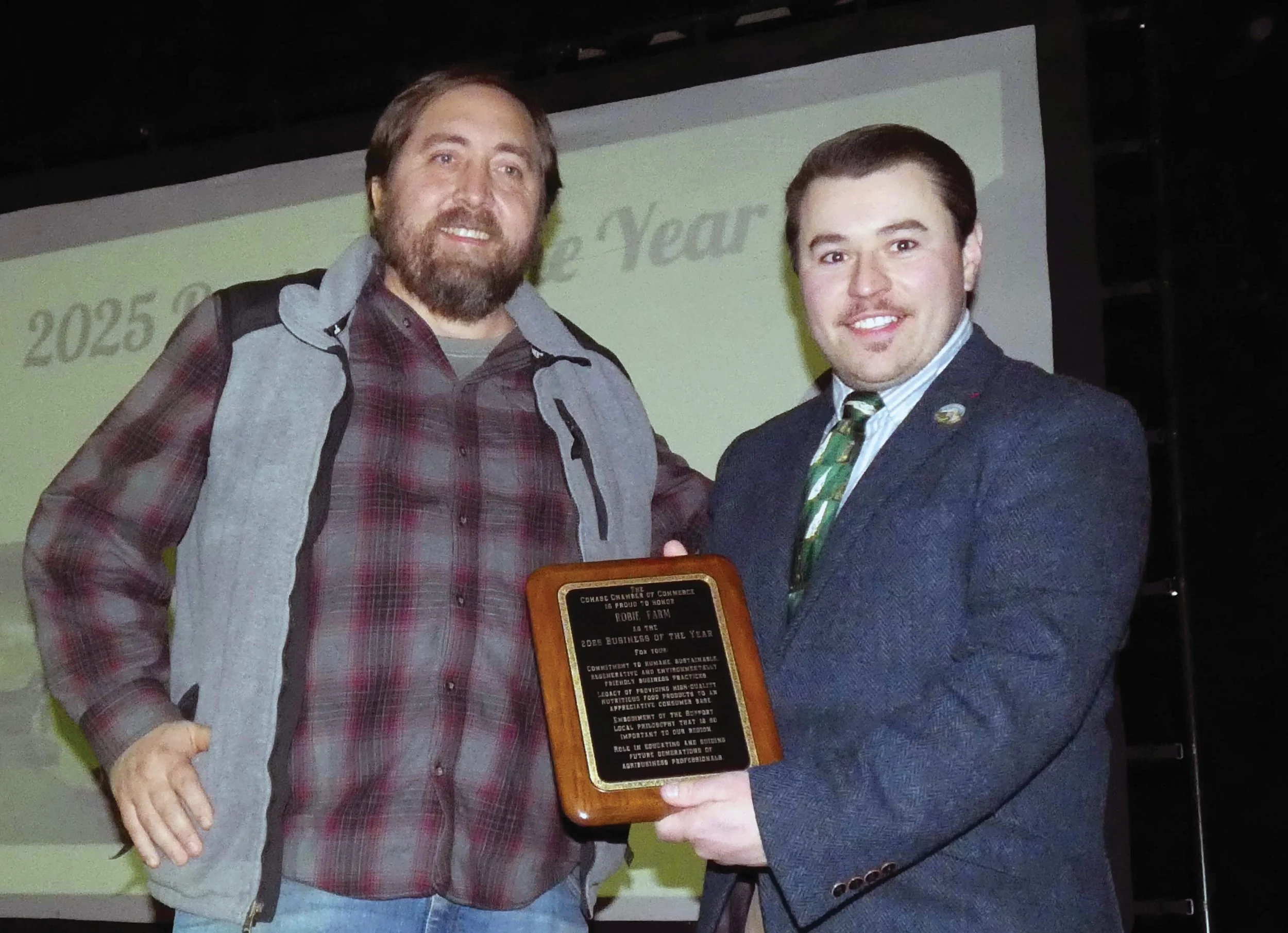
Cohase Chamber of Commerce official Joe Mitchell, at right, presented a Chamber of Commerce Business of the Year Award to the Robie Farm, represented by Mark Robie of Piermont. The Bridge Weekly/Bernie Marvin
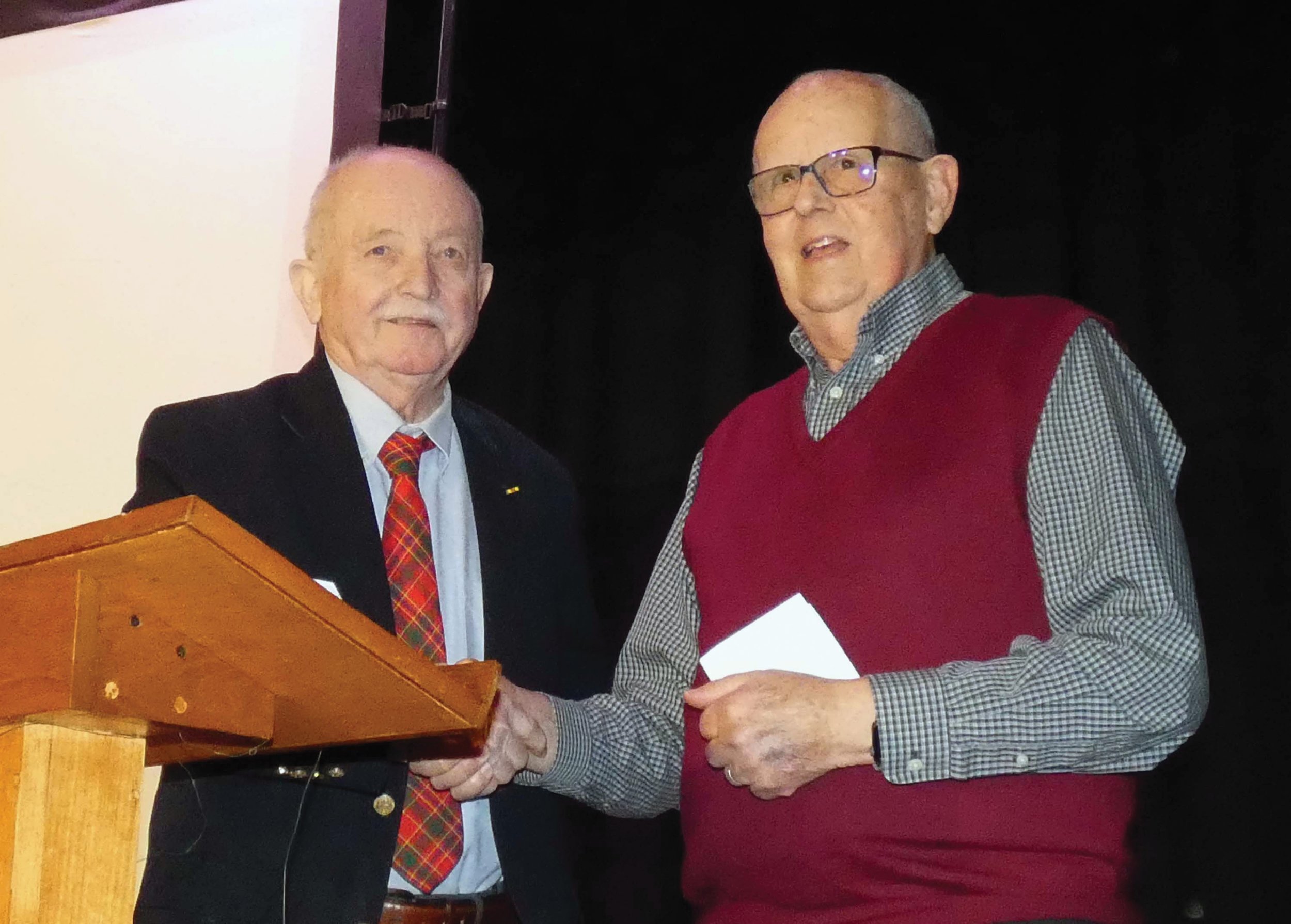
Cohase Chamber of Commerce Citizen of the Year Award was bestowed on Bradford resident Gary Moore, at left by Bradford historian Larry Coffin. The Bridge Weekly/Bernie Marvin
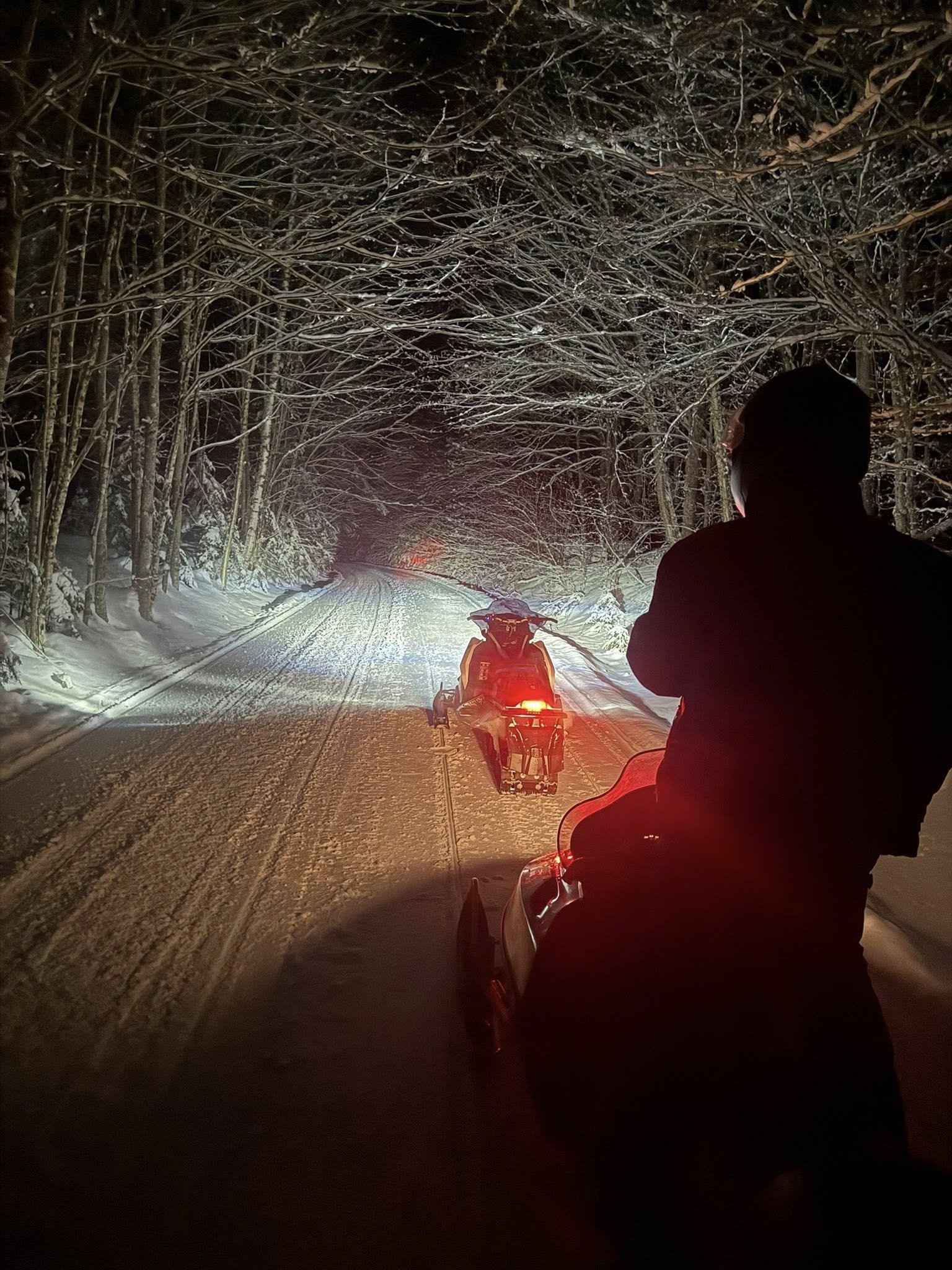
Riding Strong: How Local Snowmobile Clubs Keep Outdoor Recreation Alive in Our Region
Across the Vermont and New Hampshire borderlands, snowmobile clubs like the Buckaroos of 302 and the Connecticut Valley Snowmobile Club are working tirelessly to maintain trail systems, adapt to weather conditions, and bring communities together through winter recreation.
By Joshua Smith
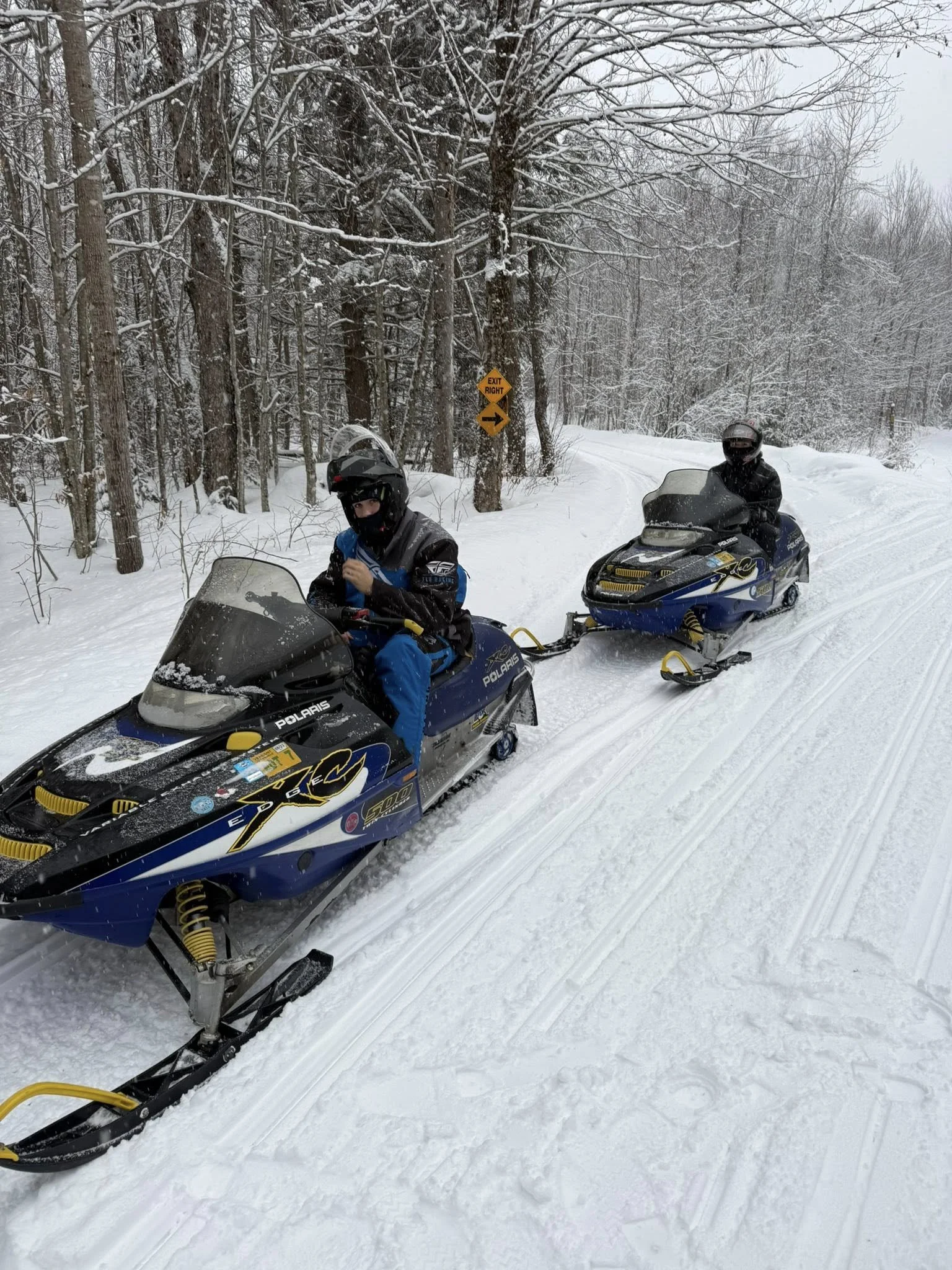
Locals enjoying the Groton forest trails maintained by the Buckaroos of 302 (photo by Jared Mclure)
In the heart of winter, while much of the region settles in under heavy coats and warm fires, a dedicated network of volunteers and outdoor enthusiasts revs up to keep the spirit of outdoor adventure alive. Across the Vermont and New Hampshire borderlands, snowmobile clubs like the Buckaroos of 302 and the Connecticut Valley Snowmobile Club are working tirelessly to maintain trail systems, adapt to weather conditions, and bring communities together through winter recreation.
These clubs, powered almost entirely by volunteers, represent the best of our region’s outdoor tradition — combining land stewardship, collaboration, and a deep love of snowmobiling.
Buckaroos of 302: Trails in Top Condition
In Groton, Vermont, the Buckaroos of 302 have hit peak season stride. According to Trail Master Gary Lamberton, trail conditions are better than ever.
“All our surrounding clubs are now open up,” said Lamberton in a recent interview. “Bailey Hazen Club, Twinfield, The Tops, Ridge Runners, Snow Bees — they’re all open. You can now ride to all destinations right from Groton, Vermont.”
Using a color-coded trail map system, the Buckaroos identify trail status with green (open), yellow (caution), and red (closed). Right now, nearly the entire map is green.
“Everything that’s green is a 10,” Lamberton said proudly. “Jesse Lambert from Lambert Farm's Grooming has put over 1,000 miles on the groomer this season, making sure trails are perfect.”
This level of grooming requires both dedication and endurance. Volunteers spend countless hours navigating snowy forests in heavy equipment to keep trails smooth and safe for riders. “It’s a labor of love,” Lamberton said. “We do it for the riders and for the region.”
Adapting on the Fly
Snowmobiling depends not only on weather but also on landowner cooperation. When a section of corridor 232 between Peacham Pond and Cabot was temporarily closed due to a landownership transition, the Buckaroos didn’t waste time.
“I worked closely with Ross Page of the Bailey Hazen Club,” said Lamberton. “We rerouted the trail through old logging roads and fields. We just cut it out and signed it yesterday.”
These quick pivots are only possible thanks to strong partnerships among clubs and a mutual respect between snowmobilers and landowners. It’s a testament to the cooperative spirit that keeps the VAST (Vermont Association of Snow Travelers) system running smoothly across the state.
Upcoming Event: A Buckaroo Tradition
The Buckaroos are also gearing up for their 47th Annual Dick Page Ride-In, a long-standing community tradition scheduled for Saturday, February 14, starting at 11:00 a.m. at the Groton Highway Garage, near Upper Valley Grill.
“It’s my kind of date,” joked Lamberton, referring to the Valentine’s Day timing. The Groton Fire Department will be serving chicken, and riders from across the region are expected to attend. It’s a time for camaraderie, great food, and celebrating a deep love of the sport.
Connecticut Valley Snowmobile Club: Making the Most of Every Inch
Just across the border in Haverhill, New Hampshire, the Connecticut Valley Snowmobile Club (CVSC) is also working hard — despite challenging snowfall this season.
“We’ve got 65 miles of trails,” said Vice President Dan Ingerson, who helps oversee operations stretching from Bath to Glencliff and over toward Landaff. “It’s been thin in places, but we’re hoping the next storm delivers.”
CVSC trails remain open, though grooming has been paused due to a lack of snow depth. “We need eight inches to start grooming again,” Ingerson explained. “That’s also the state minimum for funding eligibility.”
Despite equipment challenges — including a groomer that recently broke down — spirits remain high. “We got it out of the woods,” Ingerson said, laughing. “Still waiting on parts, though.”
Events that Bring Riders Together
CVSC is also looking forward to two signature winter events.
First up is their Annual Poker Run and Radar Run, taking place Sunday, February 15 from 9 a.m. to 2 p.m. This event offers a special New Hampshire permit allowing non-residents and unregistered machines to join the loop trail and radar run — a fun way to experience the club’s territory and test your sled’s speed.
The following weekend, on February 21, the club hosts the beloved Clunker Sled Classic, a celebration of vintage and quirky snow machines. “Gates open at 7:00 a.m., green flag drops at 10:30,” Ingerson said. The event includes nine different classes, from juniors to women’s races and the ever-popular “Double Clunker” challenge.
A Region Rooted in Outdoor Tradition
Both of these clubs demonstrate what makes our region so unique: a deep-rooted passion for the outdoors, a commitment to preserving trail systems for future generations, and the kind of volunteer spirit that brings communities together.
Snowmobiling, for many, is more than recreation — it’s a lifestyle, a family tradition, and a powerful connection to the land. Without the dedication of volunteers like Gary Lamberton and Dan Ingerson, or the hard work of groomers like Jesse Lambert, this vital piece of our winter culture would be at risk.
Get Involved
If you're a snowmobiler, landowner, or simply someone who loves winter and wants to support local outdoor initiatives, consider joining a club, volunteering, or donating. Trail maintenance is expensive and labor-intensive, and every bit of support helps.
You can learn more about these clubs or become a member through their websites:
Buckaroos of 302: buckaroosof302.com
Connecticut Valley Snowmobile Club: ctvalleysnowmobileclub.com
Or follow them on Facebook for trail conditions and event updates.
As winter continues, these local snowmobile clubs will be out there — in the cold, in the woods, and on the trails — ensuring that snowmobiling in our region remains as strong and thrilling as ever.
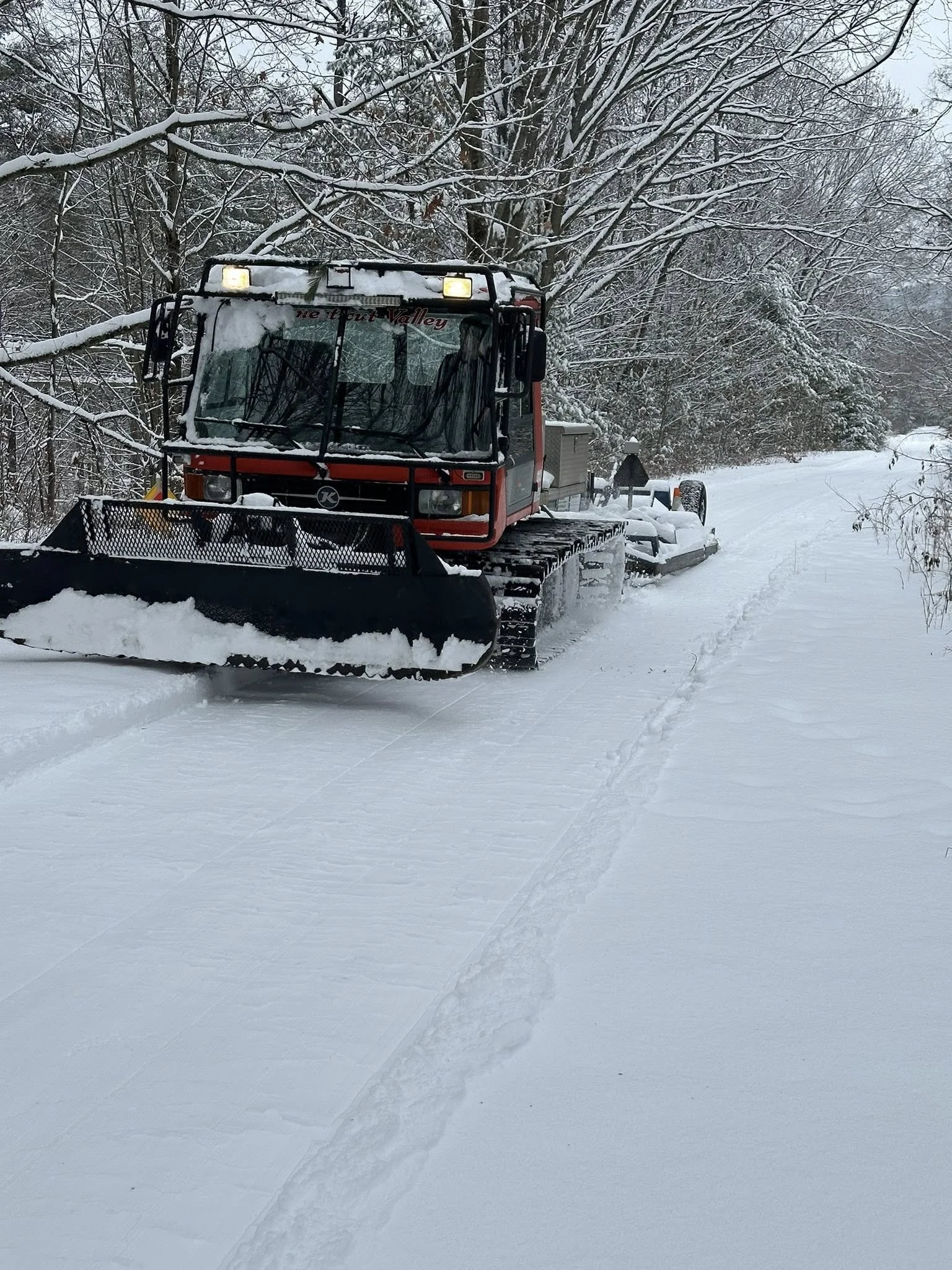
On the New Hampshire side, the groomer worked the trails on January 7th (photo courtesy of the Connecticut Valley Snowmobile Club)
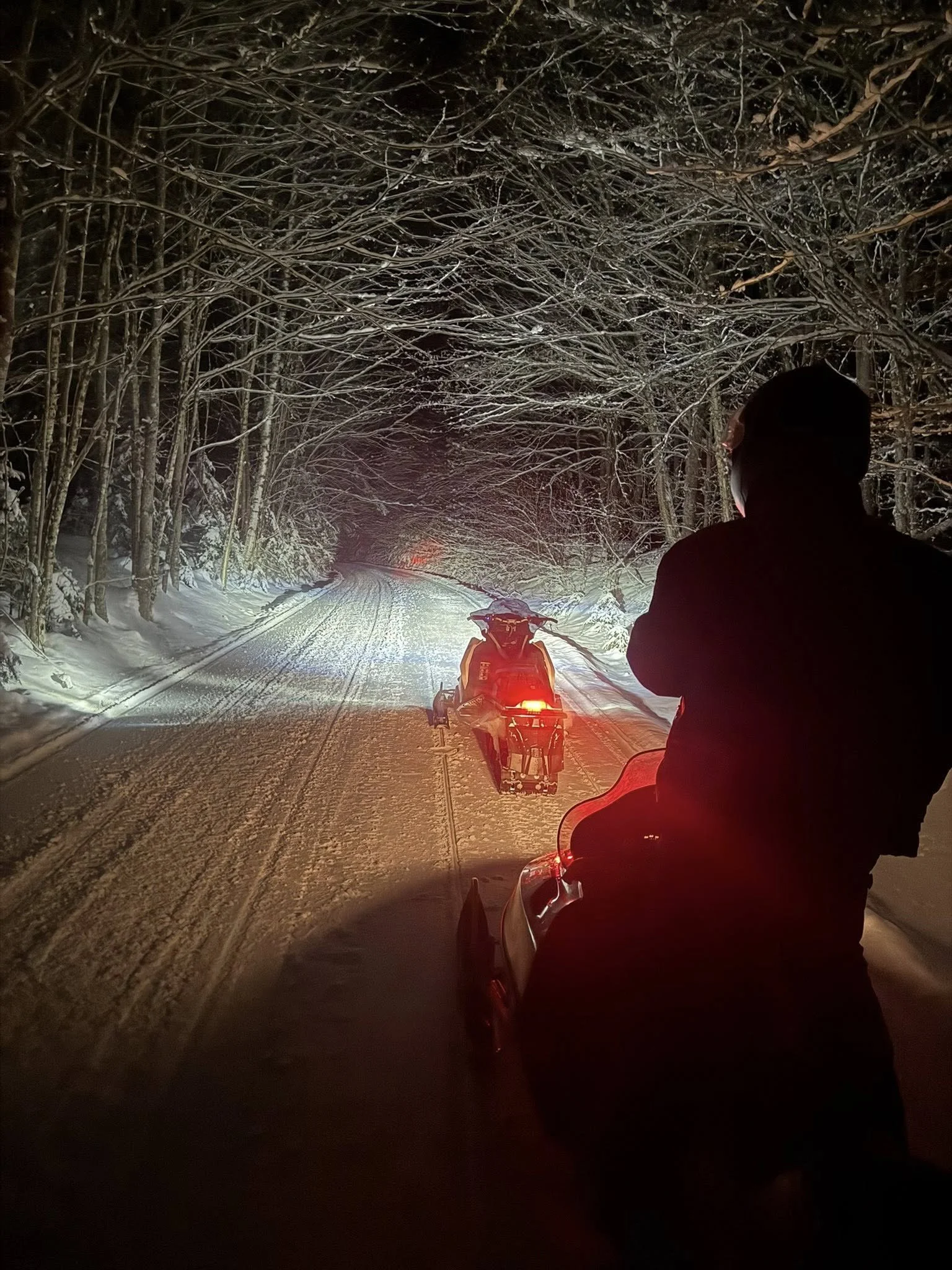
Safety is important, but does not distract from the beautiful trails in the evening in Groton State Forest (photo by Jared Mclure)
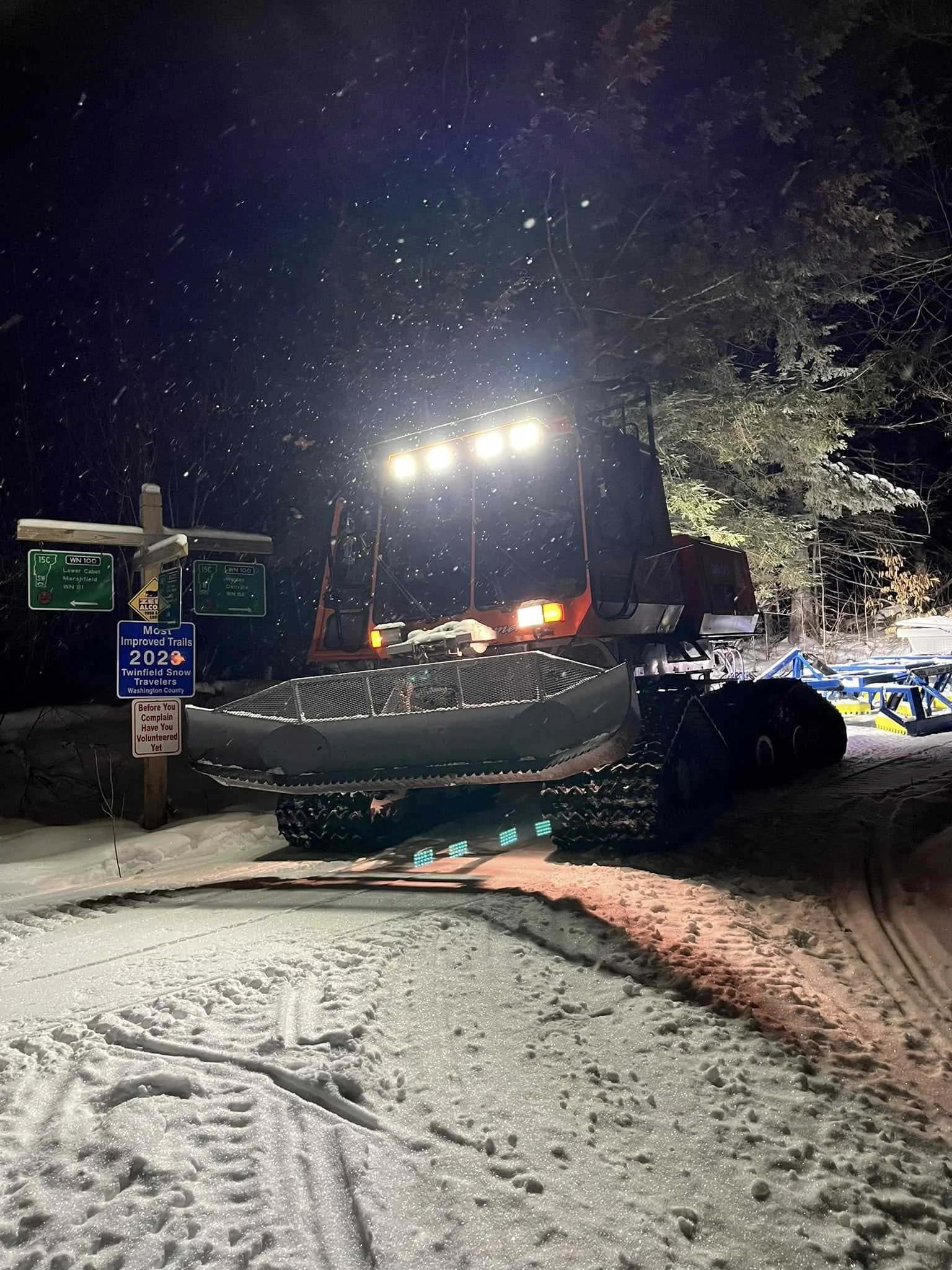
Day or night, the groomers are out maintaining the trails in Vermont and New Hampshire. (Courtesy Photo)
ROBERT LAWRENCE SALON AND SPA: WOODSVILLE’S ONE-STOP SHOP FOR SELF-CARE AND WELLNESS IN THE NEW YEAR
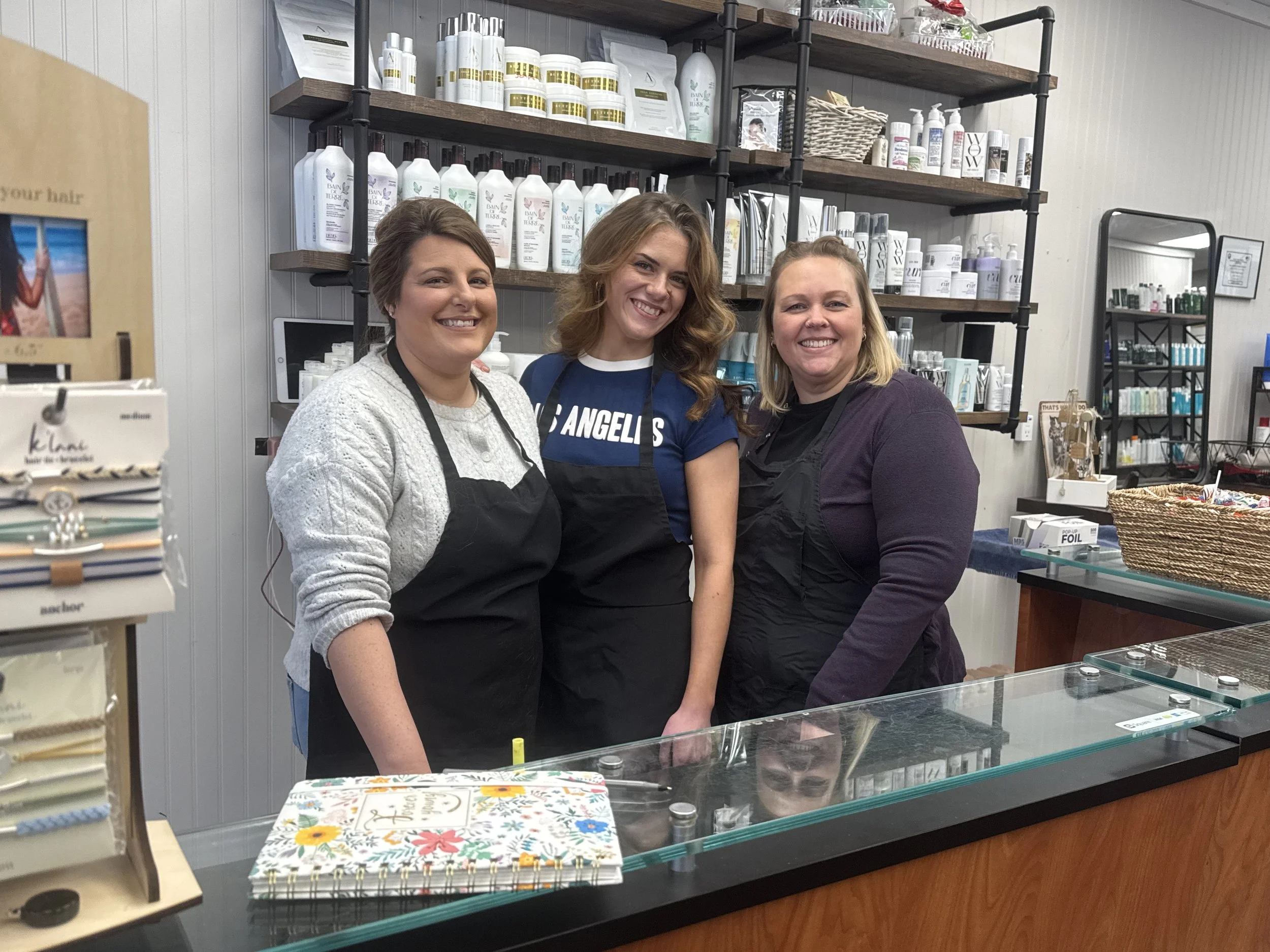
Since then, the salon has grown to include five more practitioners: Kristy Odiorne, Carmen Graham, Carrie Vogt, Hillary Deschamps, and Mallari Young. They each have their own specialty areas and are self-employed, giving them the autonomy to make their own schedules; however, they share one common thread: a love for what they do.
By Trish Griswold
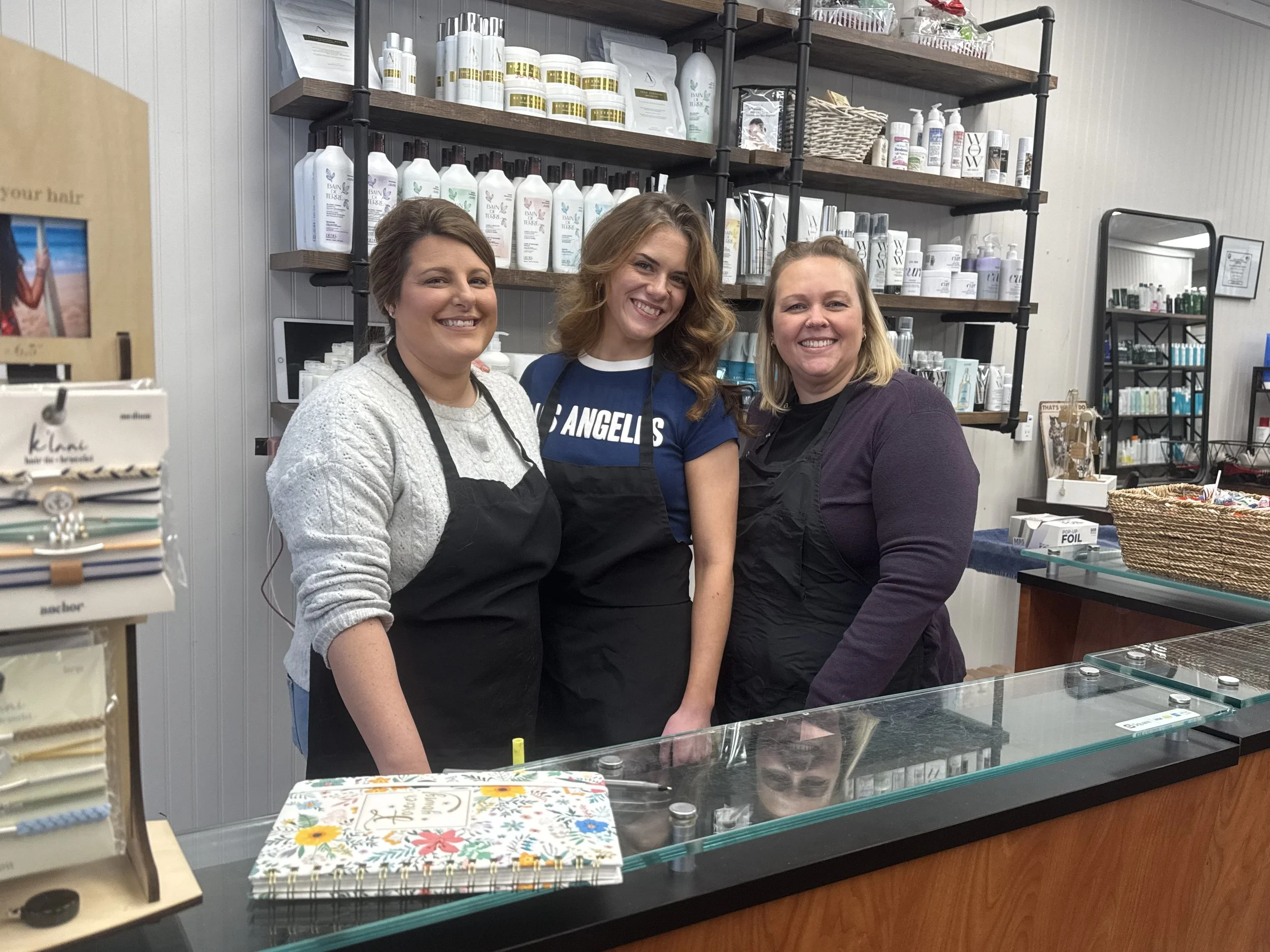
Robert Lawrence Salon and Spa is Woodsville’s hub for self-care and well-being. They offer a vast array of beauty products and therapeutic services including hair, nail, and skin care. Bridgid Risteen, Hillary Deschamps, and Cassandra Lemieux (pictured L-R) are three of the salon’s five licensed cosmetologists. TBWS/Trish Griswold
WOODSVILLE, NH - Each new year presents an opportunity to reflect on the past and set meaningful intentions for the future. While many New Year’s resolutions are centered around eating better and exercising more, the licensed professionals at Robert Lawrence Salon and Spa in Woodsville understand that living a happy, healthy lifestyle also includes self-care and personal wellness.
According to Bridgid Risteen, owner of Robert Lawrence Salon and Spa, in 2016, when Everything But The Cook merged with The Party Store: An Affair To Remember, commercial space in Suite 2 at 91 Central Street became available. Her parents, Kevin and Liz Shelton, owners of the building, began the process of looking for new renters. Bridgid and her friend/personal stylist Cassandra Lemieux were interested in relocating closer to home. One conversation led to another, and a new business venture named in honor of Bridgid’s grandfathers, Robert Shelton and Lawrence Gilbert, opened in November of that same year.
Since then, the salon has grown to include five more practitioners: Kristy Odiorne, Carmen Graham, Carrie Vogt, Hillary Deschamps, and Mallari Young. They each have their own specialty areas and are self-employed, giving them the autonomy to make their own schedules; however, they share one common thread: a love for what they do. Their passion is unmatched, and their kindness and compassion are unwavering as they take great pride in being an integral part of each client’s journey toward improved self-care and overall well-being.
“Being a massage therapist, I feel strong empathy and intuition. It's about trust, being present, and creating connections with my clients,” licensed massage therapist Kristy Odiorne explains. “It reminds me daily of the power of human touch. Helping others feel better, both physically and mentally, is not just my job; it's a purpose that I am very blessed to share.”
For nearly a decade, Robert Lawrence Salon and Spa has been offering clients a vast array of options, adding new, innovative products and services along the way. They currently offer facials, waxing, ear piercing, spray tanning, manicures, pedicures, reiki, massage, lash lifts and tints, dermaplaning, red light therapy, and hair care for the entire family. Product lines include Loma, Paul Mitchell, Moroccan Oil, Matrix, Color Wow, Olaplex, Bain De Terre, Goldie Locks, Redken Brews, It’s a 10, Kenra, Wet Brush, AGlow, Keyano, Dermalogica, and Image Skincare.
However, the personal connections they have with their clients are what make Robert Lawrence Salon and Spa second to none. “This year marks 23 years of doing what I love, helping people, and making them feel heard and safe. My job is so much more than just body work or skincare,” Kristy emphasizes. “It's listening [to my clients] and explaining things in a way they understand. We talk through injuries and body mechanics, and I try to give them the tools to help facilitate movement and manage pain or stress…or maybe it's helping them learn to allow themselves to relax and leave all their worries and stress at the door.”
“When someone is having a crappy day and they sit down to either get their hair done or have a mani-pedi and then leave feeling so much better, it’s like a therapy session,” Cassandra adds. “Sometimes that’s what you need for your mental health.”
This premiere level of care and compassion reverberates throughout the salon, the community, and beyond as the professionals at Robert Lawrence Salon and Spa are actively involved in supporting local school groups, fundraising events, community organizations, and more. They network with Riverbend Career and Technical Center’s cosmetology program in Bradford, VT, offering a high-quality, hands-on apprenticeship experience to promising young cosmetologists.
Most recently, they assisted Brynn Bogie, an eighth grader at Blue Mountain Union School in Wells River, VT, with her science fair project focusing on “Which lasts longer - professional grade hair dye or box dye?” Bridgid donated hairpieces, professional-grade hair dye, foils, applicator brushes, and other supplies. She also spent time with Brynn at the salon, helping her learn the steps to conduct her experiment. “I couldn’t have completed my project without her,” Brynn explains, grateful for the resources and the opportunity afforded to her.
When asked to reflect on the success of her business, Bridgid says, “I like that we can be a resource and a hub for anyone. I love that it’s not the same every day. It’s always something different. Everyone’s personality is different. Everyone's hair is different. Everyone’s needs are different, and we’re always there for them, through the good times and the bad times.”
Author’s Note: Robert Lawrence Salon and Spa is open six days a week with walk-ins and same-day appointments available Tuesday through Friday. Hillary and Mallari are accepting new haircare clients, and Kristy is accepting new skincare clients. For more information about products and services, “like” them on Facebook, reach out via Facebook Messenger, or call the salon at (603) 747-3500. Online booking options are available for some stylists.
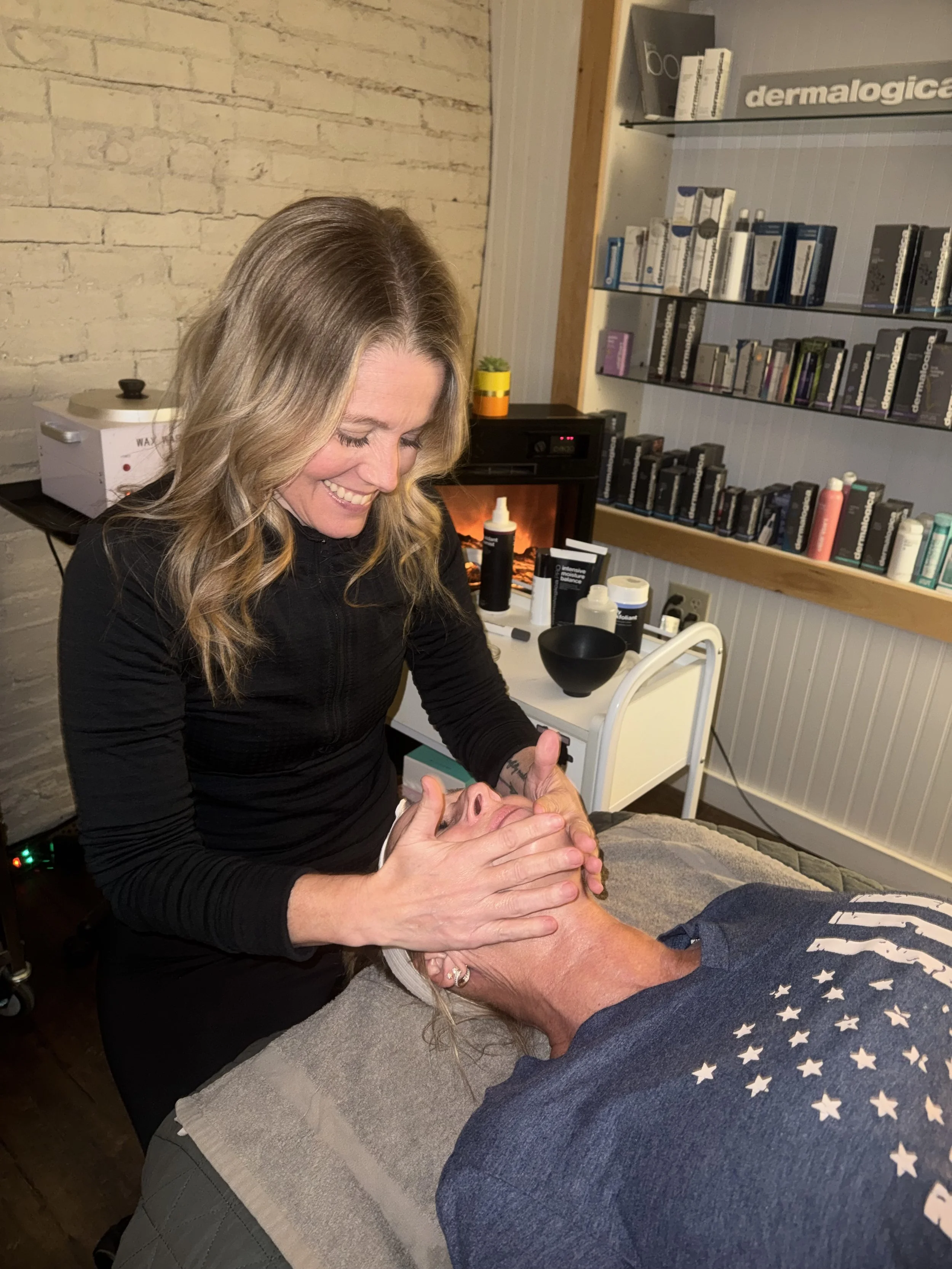
Kristy Odiorne specializes in massage therapy (Swedish, deep tissue, warm stone, reflexology, and cupping), facials, extractions, dermaplaning, dermabrasion, high frequency, skin care, spray tanning, red light treatments, lash lift and tint, brow tinting, and waxing. She is seen giving a facial massage to Laurie Dirienzo of Woodsville. TBWS/Trish Griswold
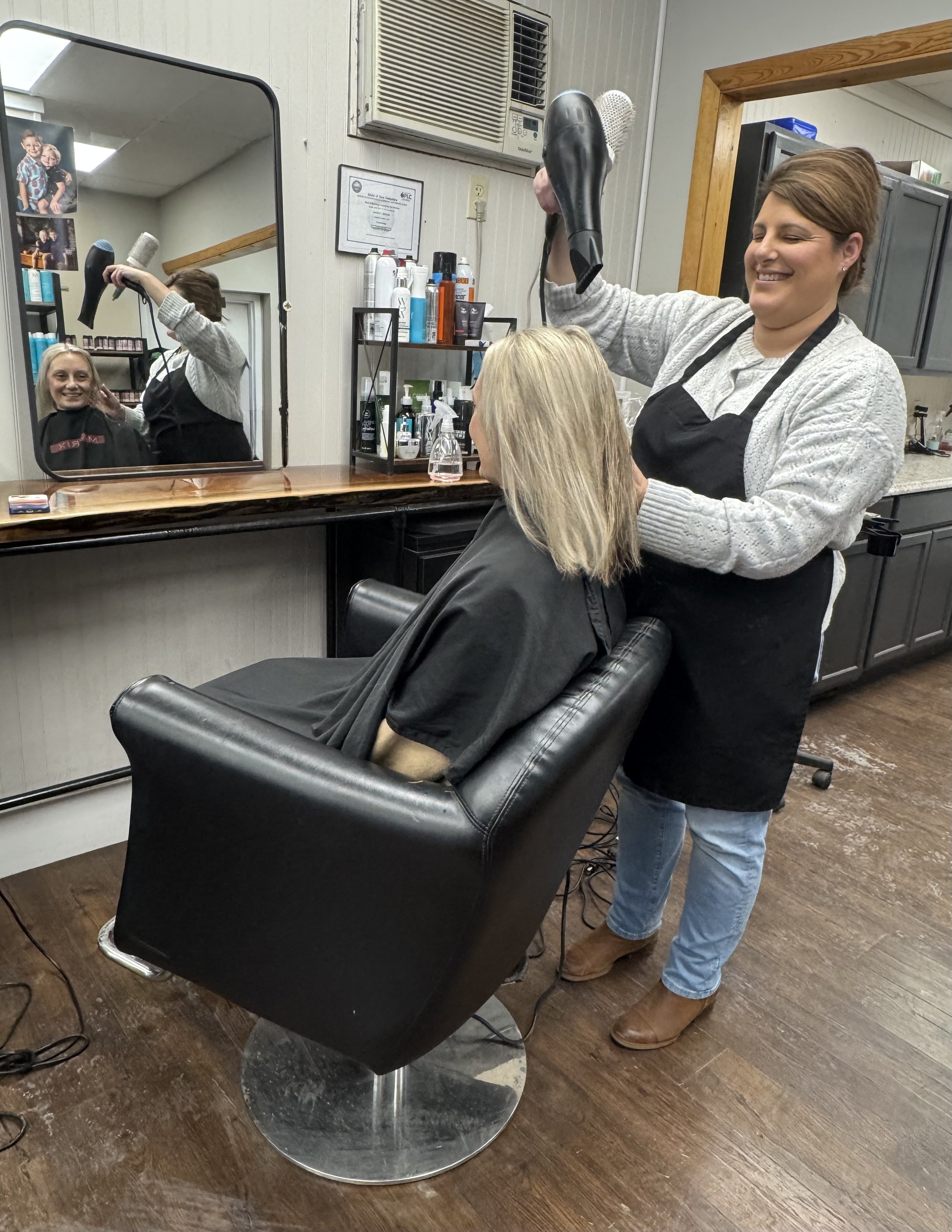
Sara Lang (seated) is a long-time client of Robert Lawrence Salon and Spa owner Bridgid Risteen. “It is a great example of a community business,” Sara says. “The reach of Bridgid’s salon isn’t just within the walls of this salon; it’s outreach and supporting community events. It in itself is a community. When you come here, you see people that you know, and there’s something here for everyone.”
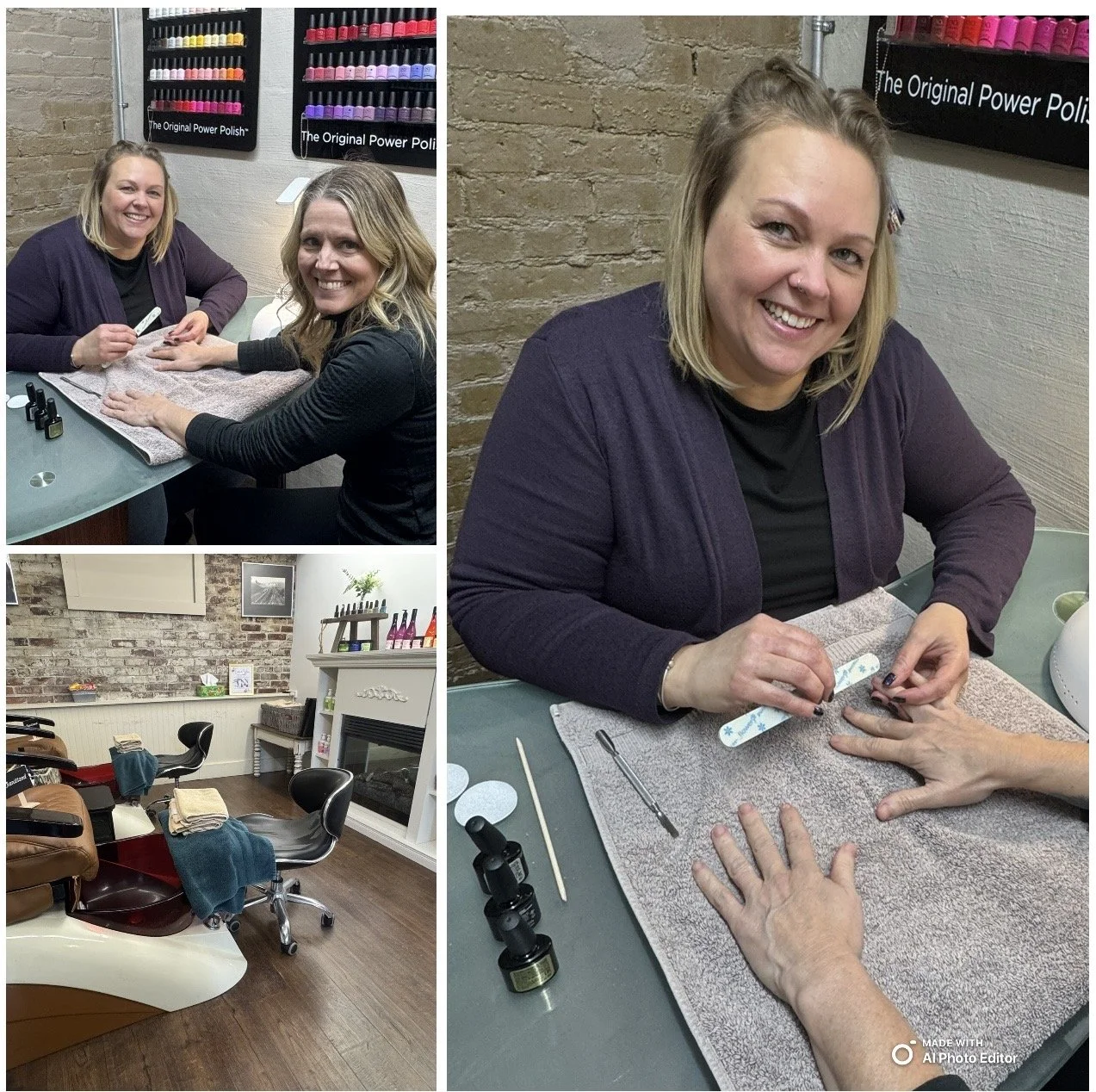
Cosmetologist Cassandra Lemieux is the salon’s mani-pedi specialist. She offers shellac gel polish, gel overlay on natural nails, regular polish, and nail art in an assortment of colors, patterns, and styles.
South Newbury native Molly Gray is going for the Vermont Lt. Governor job, again
She also told the gathering that she plans to push back on President Donald Trump's immigration program. Gray has plenty of experience in state government. Before her Lieutenant Governor stint, she held the office of Assistant Attorney General in the Vermont Criminal Division from 2018 to 2021.
By Bernie Marvin
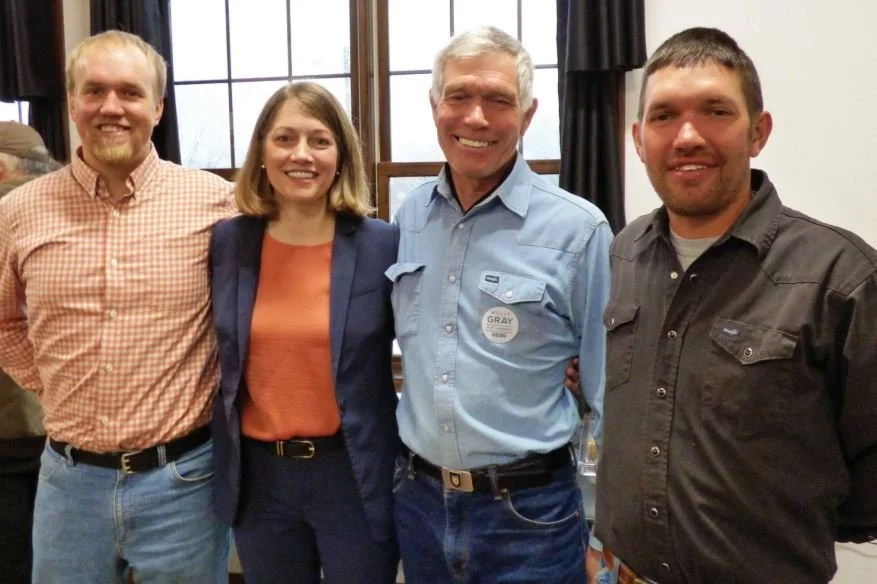
Coming together for a family group at the former Space on Main in Bradford are Vermont Lieutenant Governor candidate Molly Gray and her brothers and father. (Mom, Kim was absent that day.) Seen left to right are Charlie, Molly, Bob (Dad), and Peter Gray. The Bridge Weekly file photo/Bernie Marvin.
South Newbury, VT – Molly Gray, a well-known former South Newbury schoolgirl athlete and vegetable farmer, has announced her intentions to run again for her old job as Lieutenant Governor of Vermont.
Gray, daughter of Bob and Kim Gray of the 4 Corners Farm fame, announced her bid for the position at a reception held in Burlington on Monday, January 5, 2026. A Burlington lawyer, she formerly served as Green Mountain's Lieutenant Governor from 2020 to 2022, then ran an unsuccessful campaign for a Congressional seat as a US Representative, losing the primary election to victor and eventual office-holder Becca Balint in 2022.
At her recent announcement, Gray said she will be fiercely supporting the Vermont legislature in their focus on what matters most, building more housing, lowering costs, strengthening public schools, all while addressing rising costs and making sure every Vermonter can access a good job with al livable wage that will allow them to stay in the state, she told the crowd on hand to herald her announcement.
She also told the gathering that she plans to push back on President Donald Trump's immigration program. Gray has plenty of experience in state government. Before her Lieutenant Governor stint, she held the office of Assistant Attorney General in the Vermont Criminal Division from 2018 to 2021.
According to her background information and comments from friends and the campaign's literature, Molly Gray is a Democrat and is married to airline pilot Mike Palm. The couple has a son, Jack Francis Palm, who was born in July 2023.
Molly Gray and her South Newbury brothers, Charlie and Peter and parents, Bob and Kim, are no strangers to folks living in the circulation range of The Bridge Weekly. At any reasonable hour of a bright early spring, summer or fall day, a stop by the 4 Corners Farm just off route 5 in South Newbury, you could see the farm hands in action and members of the Gray family as they go about their daily chores as they plant, grow, harvest and market their quality fruits and vegetables, tend to their small herd of Jersey milk cows, Scottish highland beef cows and their 50 acres of beautiful farmland.
Molly Gray's first time around the political election circuit in 2020 worked well for her and during an early campaign appearance in Bradford (during her campaign for her first Lieutenant Governor election) she cast aside the intense cold temperatures of that February morning, and trudged Main Street, first for coffee at the former Bradford Perfect Buzz restaurant, then to amble down Main street a few doors to the Space on Main building, then owned by Monique Priestley, a Molly supporter.
There, a house full of support, local friends, school chums, and other supporters were all there to say hello to Molly and wish her well in the future.
On the home front for the later election, folks were also happy with Molly's results, which saw her capture most towns in Vermont, especially in small and rural areas of the state.
Bradford supporter Monique Priestley, founder and then-owner of the Space on Main, where the "Molly Gray for Lieutenant Governor" campaign all started, said that "I could not be happier about Molly's win! Molly's team has run an intelligent, classy, and respectable campaign, and I am so proud of them. I cannot wait for the future in which I step onto the balcony of the Senate and get to see Molly in action. As a young woman, I find Molly inspirational. It is a powerful moment for Vermont."
Since the election that put Molly Gray into the Vermont Lieutenant Governor's seat, Monique Priestley has been elected to the Vermont House of Representatives and is now seeking a Senate seat made available upon the resignation of former Vermont State Senator Larry Hart.
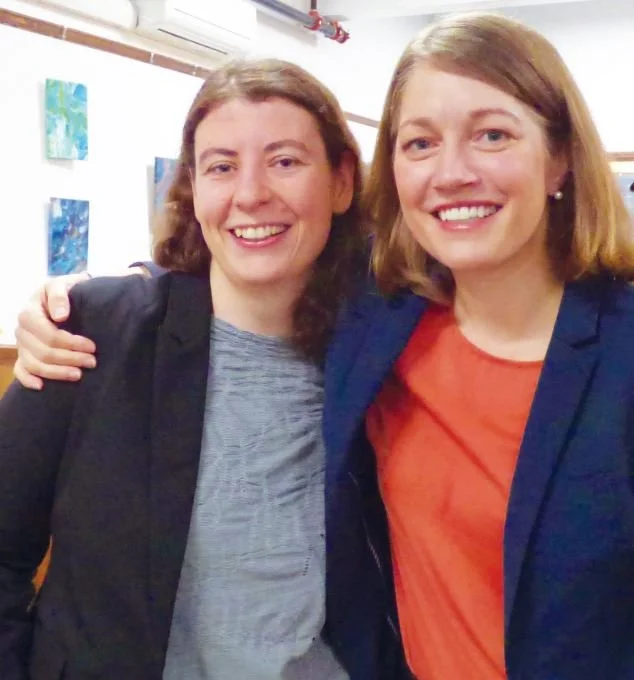
Two friends came together during candidate Molly Gray's first campaign opening at The former Space on Main in Bradford in 2020, when she was seeking the Lieutenant Governor's position that she won. The Bridge Weekly file photo/Bernie Marvin.
Late Mountain Lakes tax filings held up rate setting to the DRA
Mountain Lakes Commissioner Bob Long told The Bridge Weekly on Sunday, January 4, 2026, and he indicated that he "was working on this with our auditor and was hoping to have this completed a couple of weeks ago. As of now, I hope to have it completed over the next couple of days."
On Tuesday, January 6, 2026, Mr. Guy explained to The Bridge Weekly that the lateness of the filing interferes with the town's ability to obtain the funds it needs to borrow as it waits for revenues to come in.
By Bernie Marvin
Haverhill, NH – A delay in completing the Mountain Lakes financial reports for the Department of Revenue Administration (DRA) has been holding up the filing so that the Haverhill tax rate can be set and residents can pay real estate taxes.
This beginning of the year news has begun been featured on the local Haverhill social media page resulting in a few critical comments from the public and an inquiry from a Haverhill Advisory Budget Committee (ABC) member has prompted comments from Chairman Richard Guy who told The Bridge Weekly that the ABC has a budget total of $35,000 for Tax Anticipation Notes, a fund that is available in anticipation of tax revenues that will be coming into the town treasury to pay town bills.
ABC Chair Guy said last week that $35,000 was considered reasonable at the beginning of December 2025. He noted that with the date now being the middle of January, there had been no hint about when Mountain Lakes would complete their annual submittals to the DRA."
He said that "borrowing this magnitude of money is an unreasonable burden to the whole of us taxpayers." He also noted to The Bridge Weekly that his ABC did make a formal recommendation that each part of the town that reports to the DRA be brought together early each year to identify any potential delays going forward."
Mountain Lakes Commissioner Bob Long told The Bridge Weekly on Sunday, January 4, 2026, and he indicated that he "was working on this with our auditor and was hoping to have this completed a couple of weeks ago. As of now, I hope to have it completed over the next couple of days."
On Tuesday, January 6, 2026, Mr. Guy explained to The Bridge Weekly that the lateness of the filing interferes with the town's ability to obtain the funds it needs to borrow as it waits for revenues to come in.
He said that many people in Haverhill had already filed their tax payments in anticipation of the bill being late, so they paid without waiting. "That has helped quite a bit, he said.”
He said that the ABC formal recommendation is that all town sub-entities and the Town itself come together by August 15 annually to identify and resolve any issues that might interfere with tax billings. The DRA should have it all in their system in October. Bills should be sent out by the town in November and paid for the first part of December.
He said once all the figures come together, the DRA can set a tax rate in very short time, and he notes that it will not take the town long to get the tax bills out to residents. He said as it looks now to him, the tax monies flowing into the town will probably end up as much as three months late, with payments being two months late.
A notice in the Haverhill NH Discussions Forum! Facebook entry last week identified as being from the Haverhill Administration:
It notes that “Tax Bill Delays Explained: The Town of Haverhill has been receiving a lot of calls regarding when Tax Bills will be going out. The reason bills have not gone out yet is that we are waiting for Mountain Lakes District (MLD) to complete all required filings. The Selectboard has no options at this time to move forward with setting the tax rate to issue 2025 Tax Bills without the MLD filings. We hope MLD will complete their forms this week. Please be patient with our Tax Collector, as the Town has no control over this delay. The Town will notify residents as soon as the rate has been set.
For questions regarding the process at the Mountain Lakes District, they can be reached at 603-787-6180."
In an interview just prior to last Friday, January 9, 2026, with Haverhill Select Board member Ron Hurlburt, he said the select board was tired of seeing town employees and Tax Collector Melinda Boutin taking the heat from the public over something that is not their fault.
He said the late tax numbers and the long overdue subsequent filing (whenever it is made) are solely the fault of the Mountain Lakes commissioners who are holding back the process by not having their numbers ready for the DRA.
He said, “the select board’s hands are tied until Mountain Lakes comes up with the needed figures,” during the interview late last week. He said he has no idea what the problem with the late figures is and he has not been told but hopes he finds out so it will never happen again.
He said the past year and one-half, possibly longer, there have been problems with the town clerk’s office being open in a timely manner. In an effort to reduce that workload, especially in the motor vehicle registration business of the town, the select board is moving toward appointing a municipal agent/deputy town clerk position.
Select board member Hurlburt said the job description was discussed again by the board at their most recent meeting on Monday night, January 12, 2026.
The published job description is as follows:
The Haverhill Selectboard is pleased to announce they have authorized the Town Administrator to research the creation of a new part-time position as a Municipal Agent. The role is intended to increase Department of Motor Vehicle registrations to 5 days a week and include evening hours. The Selectboard recognizes the challenges many of us are facing with registrations and renewals and is working to increase the consistency of services to residents. The position will be under the direction of the Selectboard and will be using funds previously intended for a Deputy Town Clerk, now directed toward this position for better oversight and transparency.
The Selectboard has been working for the past two years to support the Town Clerk with their needs and to increase hours and services for residents. The Selectboard has no authority over the Town Clerk's Office or the services they provide. For this reason, the Selectboard feels strongly to better provide these services; it should be done under their supervision. The Selectboard will continue to support the Town Clerk while providing similar services.
We're all looking forward to the increased hours and opportunities, stay tuned!
Cohase Chamber 2025 Citizen & Business of the Year Awards
As 2025 was winding down the Board of Directors of the Cohase Chamber of Commerce was gearing up. It is at this time of year that members of the public are encouraged to submit nominations for Citizen of the Year or Business of the Year. The final decisions were made at a recent meeting of the Board.
By Joe Mitchell
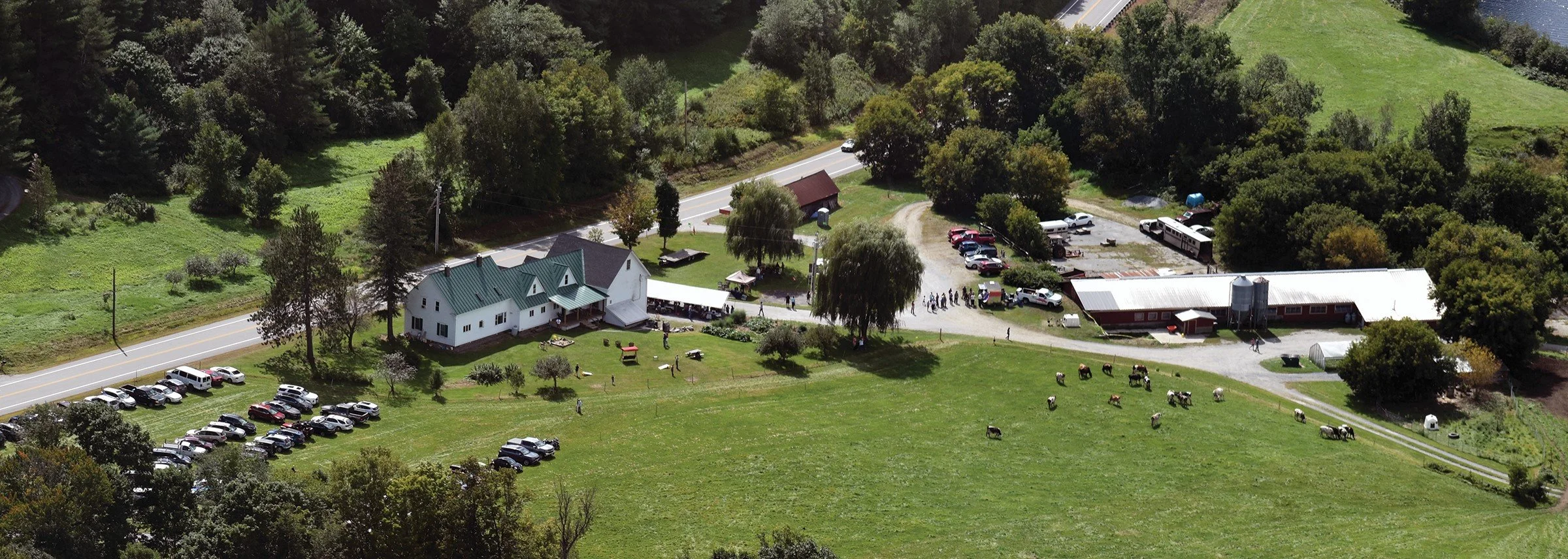
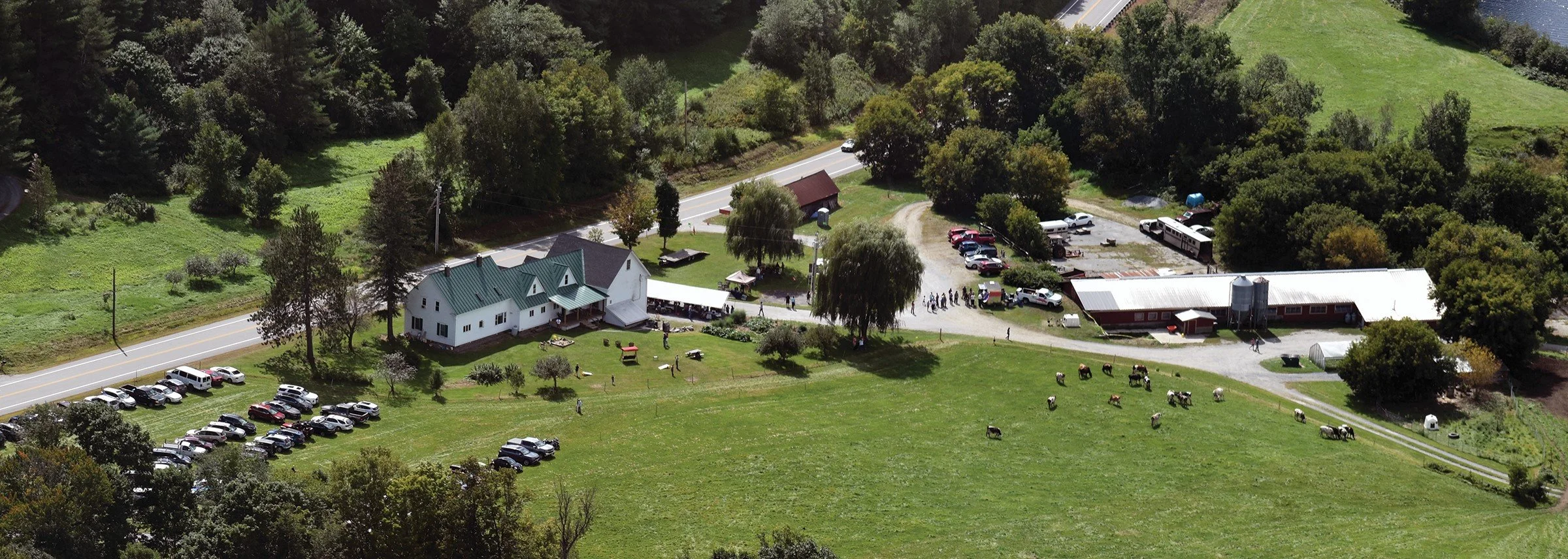
The 2025 Cohase Chamber Business of the Year . The Robie Farm of Piermont, NH farmstead is shown during their 150th Anniversary Celebration held on September 11, 2021. The Bridge Weekly File Photo
New Hampshire & Vermont - As 2025 was winding down the Board of Directors of the Cohase Chamber of Commerce was gearing up. It is at this time of year that members of the public are encouraged to submit nominations for Citizen of the Year or Business of the Year. The final decisions were made at a recent meeting of the Board.
It is true that sometime the Citizen of the Year award seems more like a Lifetime Achievement Award, and that is certainly true this year. Gary Moore of Bradford has spent most of his lifetime giving to many while ad leading others. In Bradford, he is possibly best known for his endless hours of volunteering as a member of the Bradford Fire Department, the Public Safety Commission and the Board of Civil Authority. He has also been the leader of the Bradford Emergency Management team for decades. More broadly Gary has written a weekly column entitled Moore Outdoors, providing important information to those who enjoy outdoor activities. On the Vermont level Gary was the Commissioner of the Fish and Game Commission, and Chair of the Vermont Water Resources Board. He also travels throughout the nation providing hazmat preparation training. With all these items on his resume, Gary Moore makes an excellent Citizen of the Year award winner for 2025.
The 2025 Business of the Year award also has some “long term” connotations to it. The Robie Farm in Piermont is now boasting of its seventh generation of family farming on ground located between Route 10 and the Connecticut River at the southern end of Piermont. Through those generations much has been learned and passed down to the next generation which in turn also learns new ways to provide for the family as well as the community. From their famous cheese to Robie Farm beef, poultry and pork, not to mention the sincere home town feeling, the Robie Farm has earned its way into the history and the culture of the Cohase Region. They represent what is a well-earned reputation of doing things right.
Both of these awards will be handed out at the annual Cohase Chamber of Commerce Annual Meeting and dinner on Tuesday, January 20 at Alumni Hall in Haverhill Corner. Tickets are available at www.Cohase.org for $35 each. A cash bar will be available as well. Reservations and prepayment are most greatly appreciated.
The evening’s program will also include the awarding of prizes to the winners of the Holiday Decorating Contest. Plus there will be a panel discussion regarding the local media consisting of members from our local media outlets.
The Board of Directors invites all members of the public to make plans to attend the annual meeting and to celebrate Gary Moore and the Robie family, as well as all the others who contribute to making the Cohase region a great place to live, work and play.

Gary W. Moore of Bradford, VT is the 2025 Cohase Chamber of Commerce Citizen of the Year. (Courtesy Photo)
Delivering Holiday Cheer By The Truckload
“We’ve never made a dime on the trees. I buy them, bring them down, and sell them to whatever group at the same price I bought them for. We sell the trees at cost and never charge a penny to truck them.”
By Trish Griswold
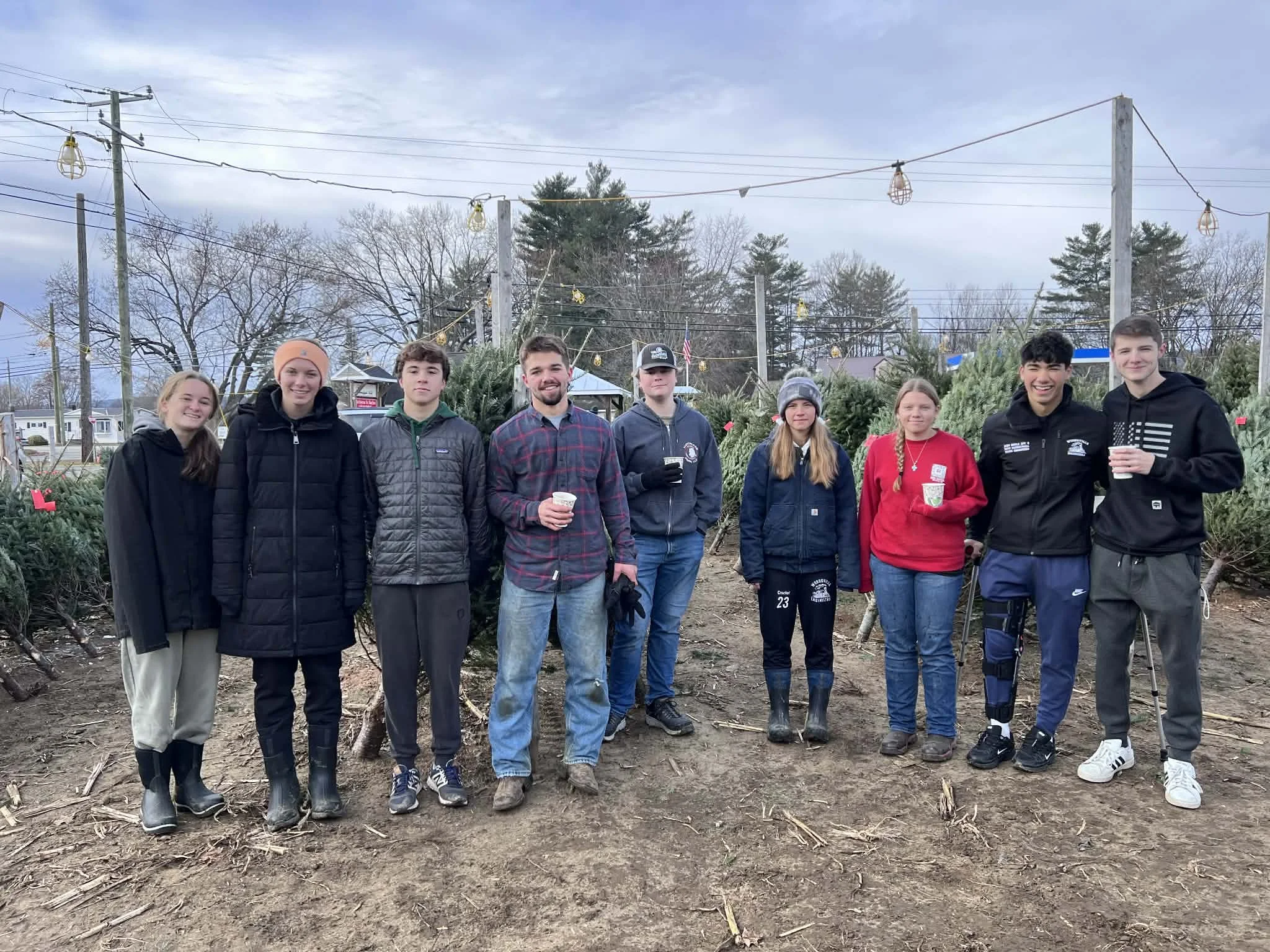
Members of the Woodsville High School Class of 2026 helped unload, set up, and tag trees on opening weekend of tree season. Pictured (L-R) are: Makayla Walker, Katie Houston, Ryan Walker, Gabe Roy, Michel Plachetzki, Morgan Crocker, Jillian Roy, Cowan Kimball, and Dylan Marshall.
NORTH HAVERHILL - For the Lackie family of North Haverhill, NH, delivering goodwill and holiday cheer is a tradition that spans many generations. “It's just what we do,” remarks David “Peanut” Lackie, a retired truck driver who has been transporting Christmas trees to the area for decades.
According to Peanut, he took over the family business in 1989 when his father, Leslie Lackie, passed away. For many years, Leslie transported cargo, including Christmas trees from as far away as Canada and as close by as northern New Hampshire. “Mountain Star Tree Farm in Swiftwater (formerly known as the Olsen Tree Farm) - that’s where Dad got started,” Peanut recalls. “He hauled trees for 15 years before I took over. Actually, he went to Wisconsin and got the first tree baler that was in this area.”
In the early 1990s, Peanut’s brother, Norman “Smiley” Lackie, started a small tree stand at the Lackie homestead on the corner of Dartmouth College Highway and Route 116. Peanut’s daughters, Amy (Lackie) Crocker and Jennifer (Lackie) Barkley, kept the tree stand going from 1994 to 1996 before passing it along to the Woodsville High School (WHS) ensemble band as a fundraiser for their trip to Annapolis, MD, to participate in a regional competition. Over the years, many other school groups and local non-profit organizations have been recipients of the fundraiser, including the WHS Class of 2000, the North Haverhill Fire Department, the Haverhill Area Youth DC Trip, the WHS Class of 2023, and the WHS Class of 2026. All of the aforementioned school-related groups, Peanut says, have included a member of the Lackie family.
“We’ve never made a dime on the trees. I buy them, bring them down, and sell them to whatever group at the same price I bought them for. We sell the trees at cost and never charge a penny to truck them.”
The Lackies also donate trucking and provide trees at cost for holiday decorating efforts in North Haverhill and Woodsville, NH, and in Wells River, VT, spreading holiday cheer on both sides of the Connecticut River. “We’ve always donated our time and trucking, and we’re happy to do it,” comments Peanut’s wife, Leslie (Pierson) Lackie, who has supported her husband in continuing both the family business and the tree stand.
The most recent recipient of the tree stand fundraiser is the WHS Class of 2026. “There are really no words that can express how appreciative our class is for the Lackies/Crockers. For the past three years, our success has been rooted from their efforts, and we couldn’t be more grateful for them,” remarks Class President Makayla Walker. “They’ve given us the Christmas tree and craft fair fundraisers that have played a significant role in making prom and our class trip possible, but it has also given us the opportunity to give back to those who have given so much to us.”
“Apart from the financial opportunities,” Makayla continues, “their generosity has brought our class together; freshman year, when we didn’t have these fundraisers, fundraising participation was absent. Now, I’d say close to 75% or more are participating. It’s obvious how committed they are to our class, and we are forever indebted to the Lackies for guiding us, supporting us, and ultimately handing us success; it’s going to be difficult figuring out how to pay them back.”
Managing the Christmas tree stand, which was relocated in 2023 to the parking area at Augie’s Rest Stop is more labor intensive than one might think. “It’s a lot of work,” says Amy, who, together with her husband, Todd Crocker, took over Peanut’s trucking company in June of 2022 and has continued the Lackie family’s time-honored traditions. “You have to set up the racks, hang the lights, bring the trees into town, unload them, set them up on the racks, cut the strings, and price them.”
Equally time-consuming is maintaining the trees after every snowstorm. “You have to shake them off every time it snows. Some years when it was down to Mother’s, we had some serious snow,” Peanut recalls. “In fact, one year we got rain, and the trees froze so we had to take some up to the fire station, thaw them out, and bring them back down. It can be a challenge.”
Except on the weekends, the tree stand is set up to use the honor system, which “works for the most part,” Amy says. “Most people are honest, and it all evens out. Some people put extra in, and some don’t. People’s generosity covers what doesn’t get paid for.”
In fact, some members of the community donate faithfully every year, including Harley Vance of Groton, VT, who purchases two trees, one for himself and one for his mother, Betty Oakes, also of Groton. “We like to support local youth organizations. Plus, they have a wide selection, the trees are well-trimmed, and the prices are more than reasonable.”
When asked about the future of the tree stand, Leslie explains that, in June, their granddaughter, Morgan, a member of the WHS Class of 2026 and this year’s recipient of the tree stand fundraiser, will graduate from high school. The Lackie family will need to decide which school group or community organization will inherit the tree stand project next. “We’d like it to continue to go towards fundraising, a scholarship, or benefit the community in some way. That is what it’s all about. The kids and the community.”
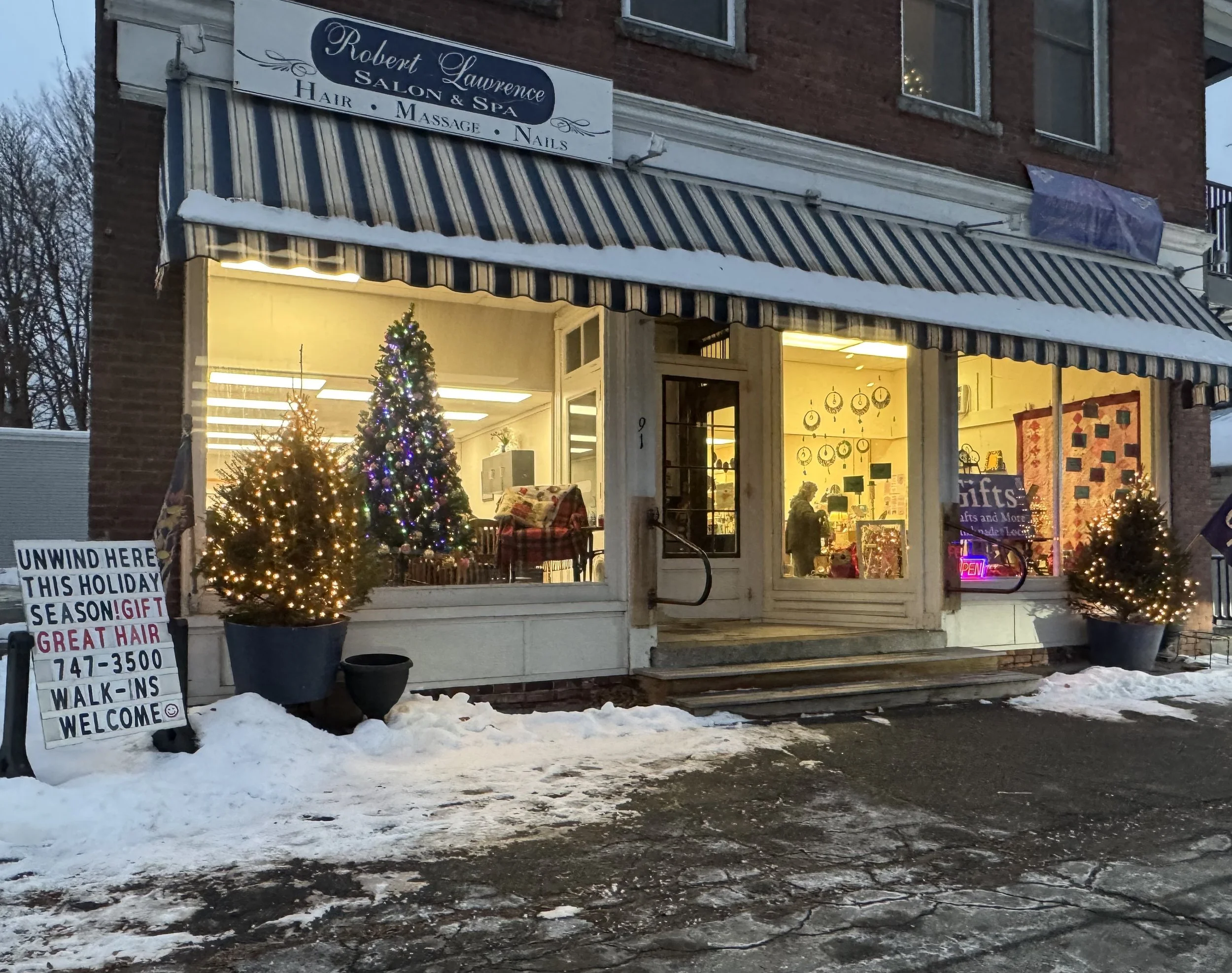
Christmas trees nestled in whiskey barrels outside Robert Lawrence Salon & Spa in Woodsville provide a festive glow during the holiday season. The Lackie Family provides more than 100 trees at cost to businesses in Woodsville and North Haverhill, NH, and Wells River, VT.
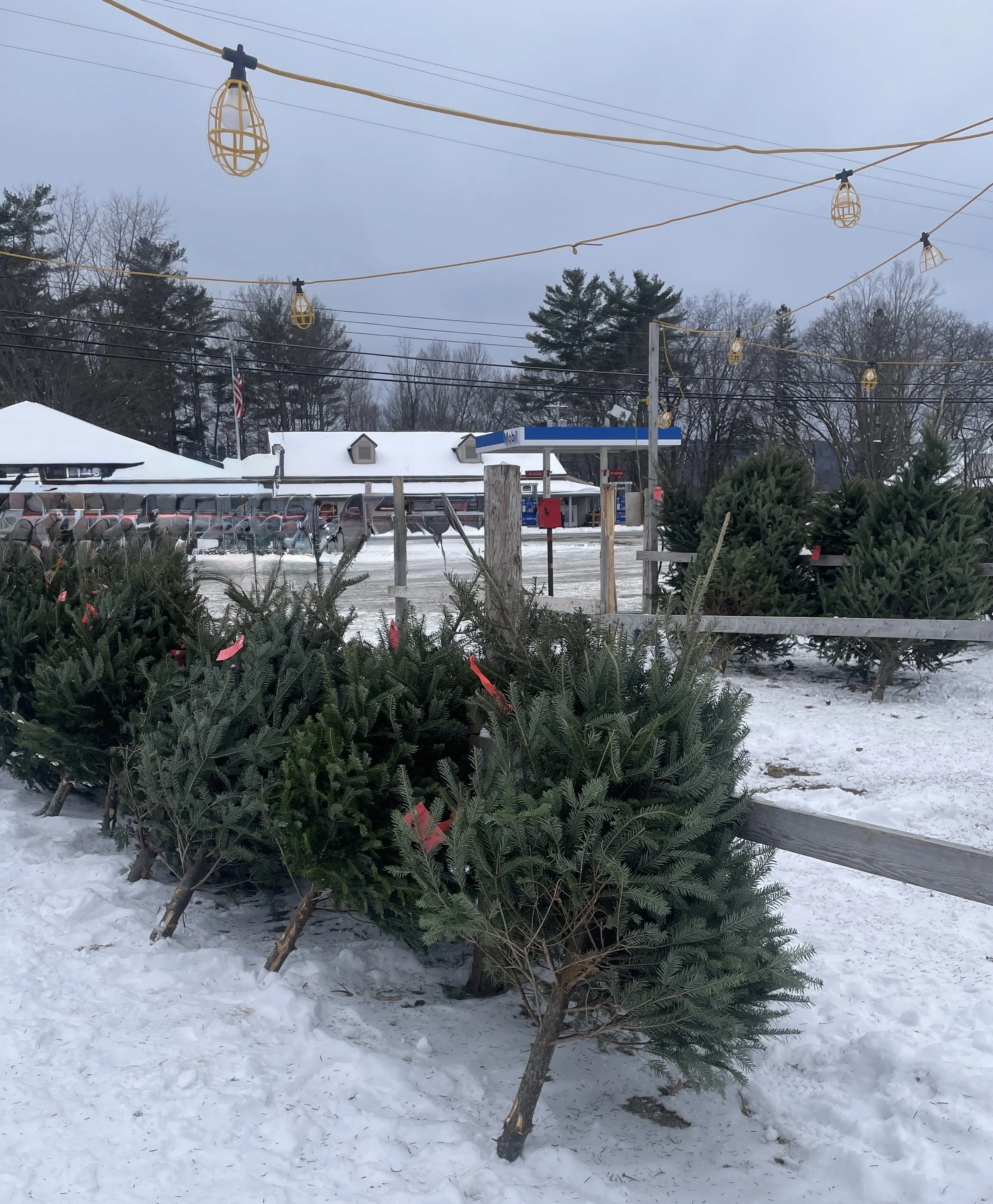
The Lackie Family tree stand located at Augie’s Rest Stop just south of Hatchland Dairy in North Haverhill provides a wide selection of balsam fir at an affordable price.
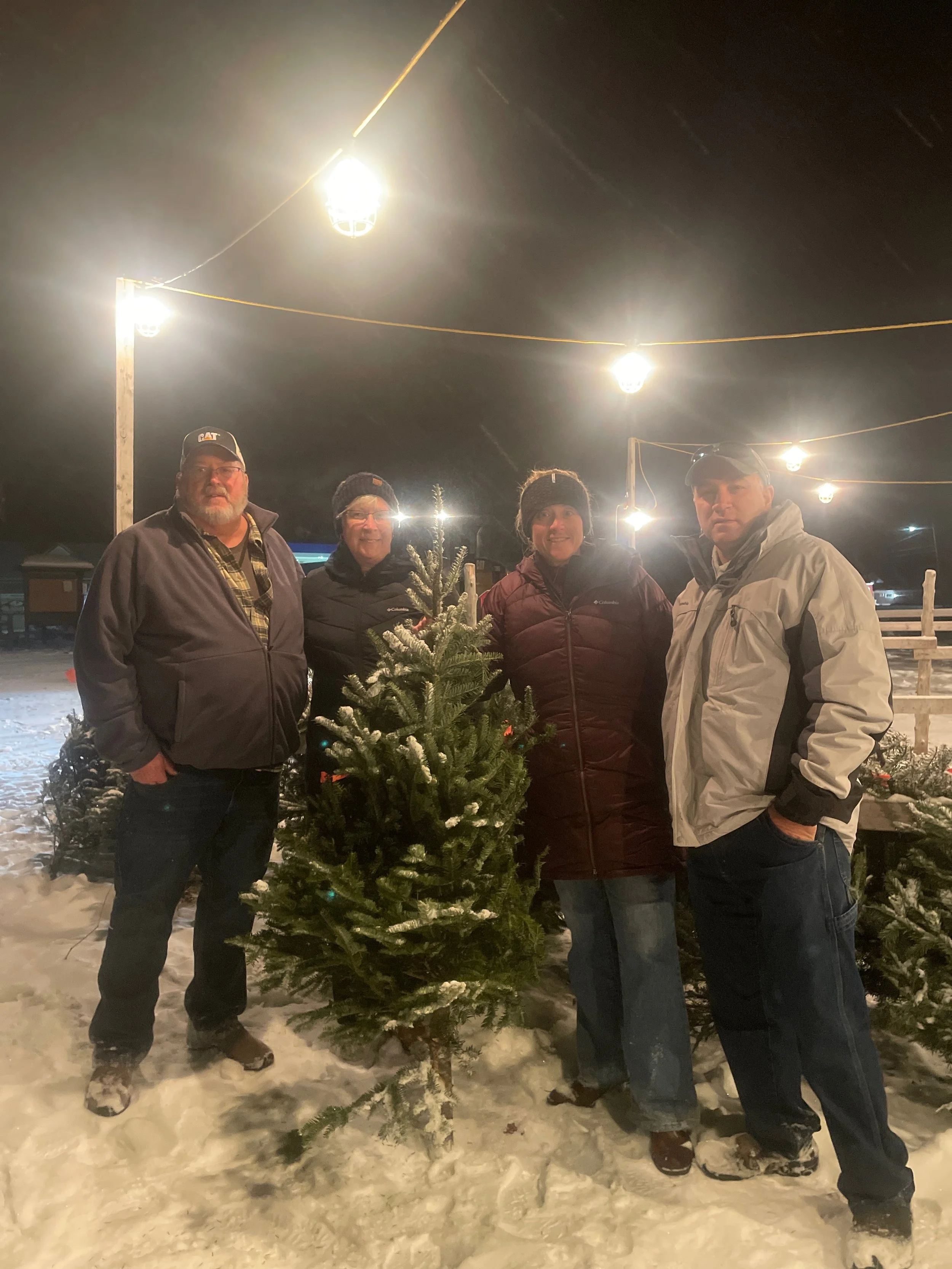
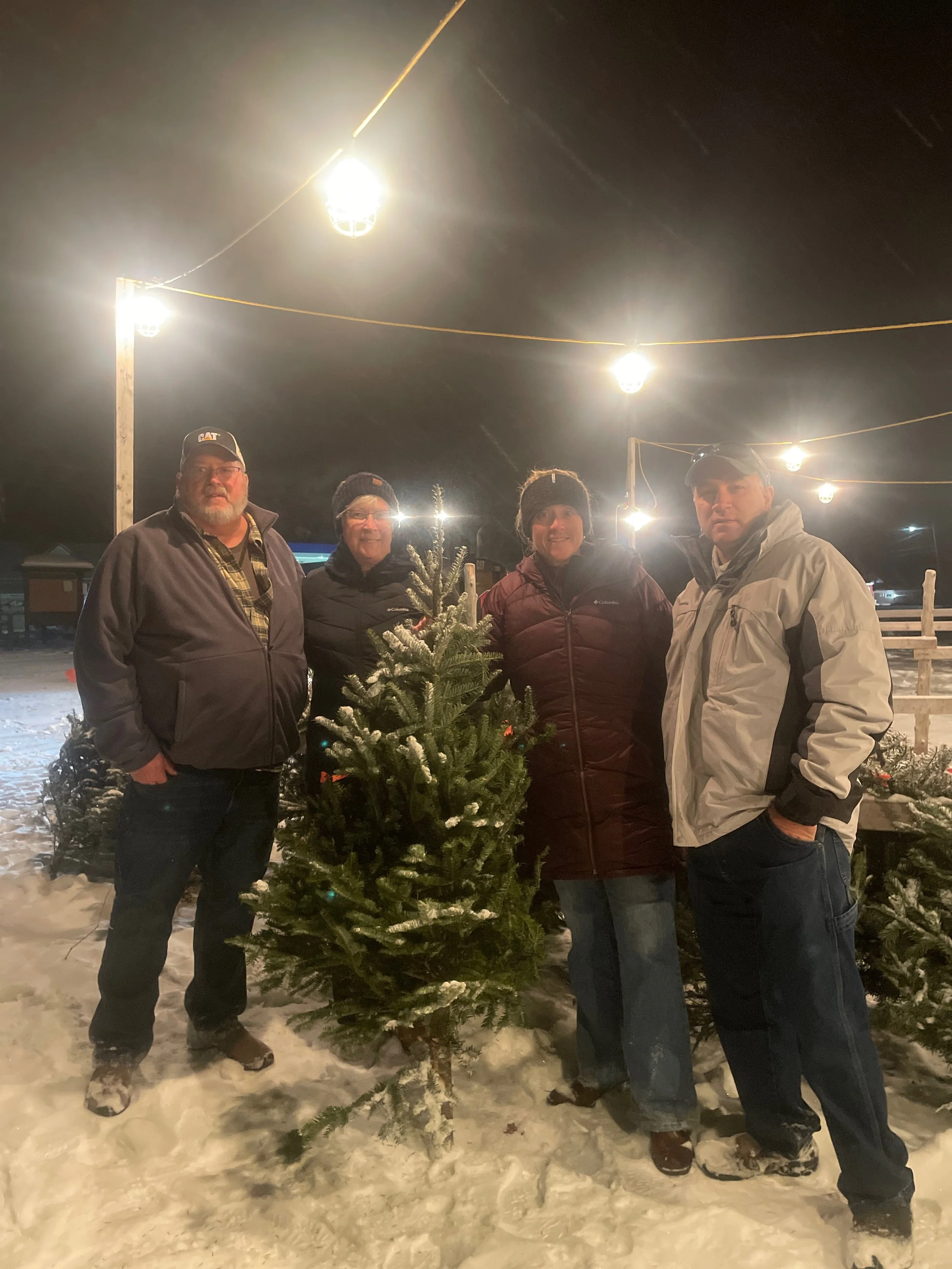
The Lackies have been delivering Christmas trees to the North Haverhill area for decades. They donate the trucking fees and provide the trees at cost to a local school group or organization for fundraising purposes. Pictured (L-R) are David “Peanut” Lackie, Leslie Lackie, Amy Crocker, and Todd Crocker.
After 31 years, Barbara's Red Stocking still helping others at Christmas time
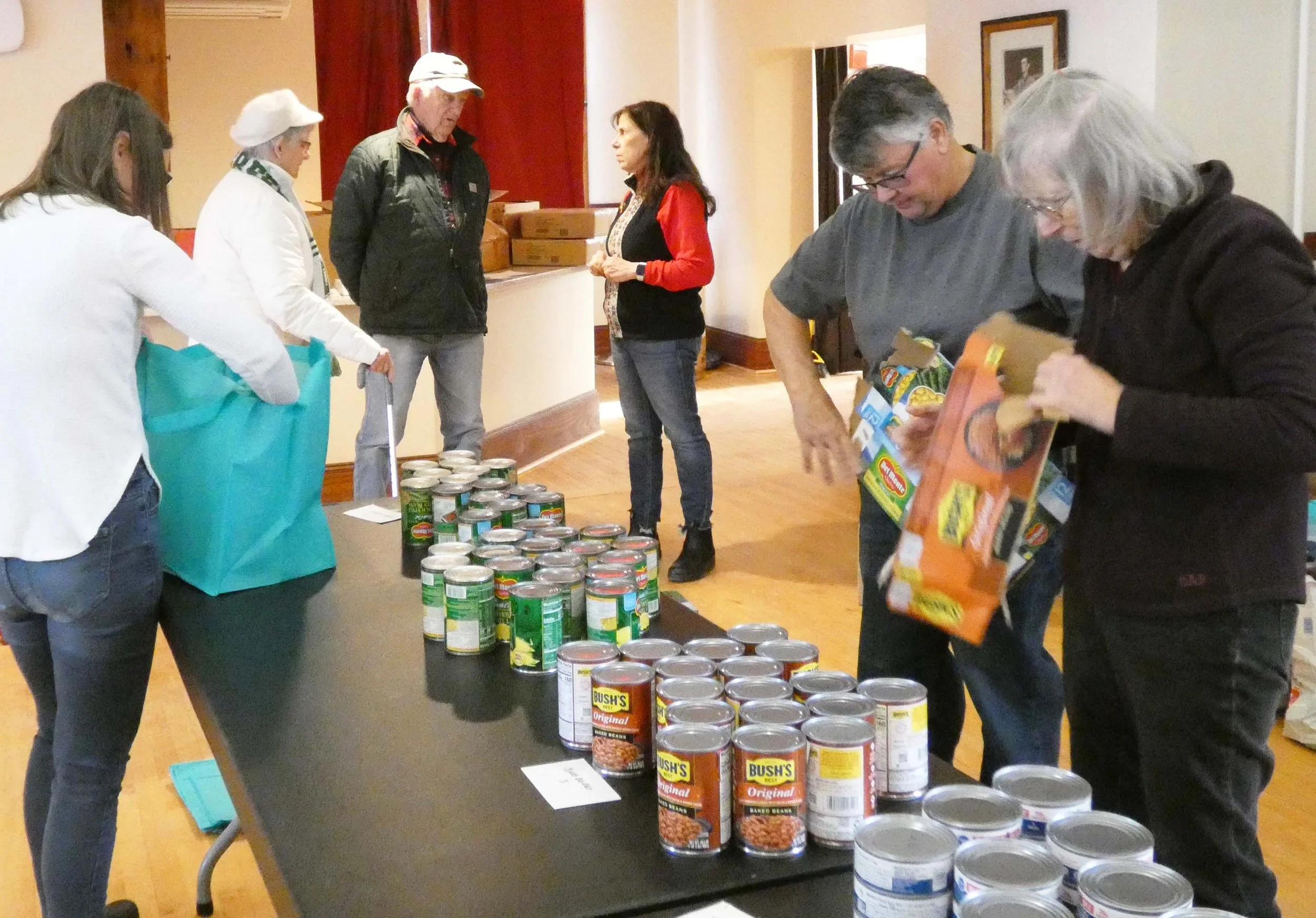
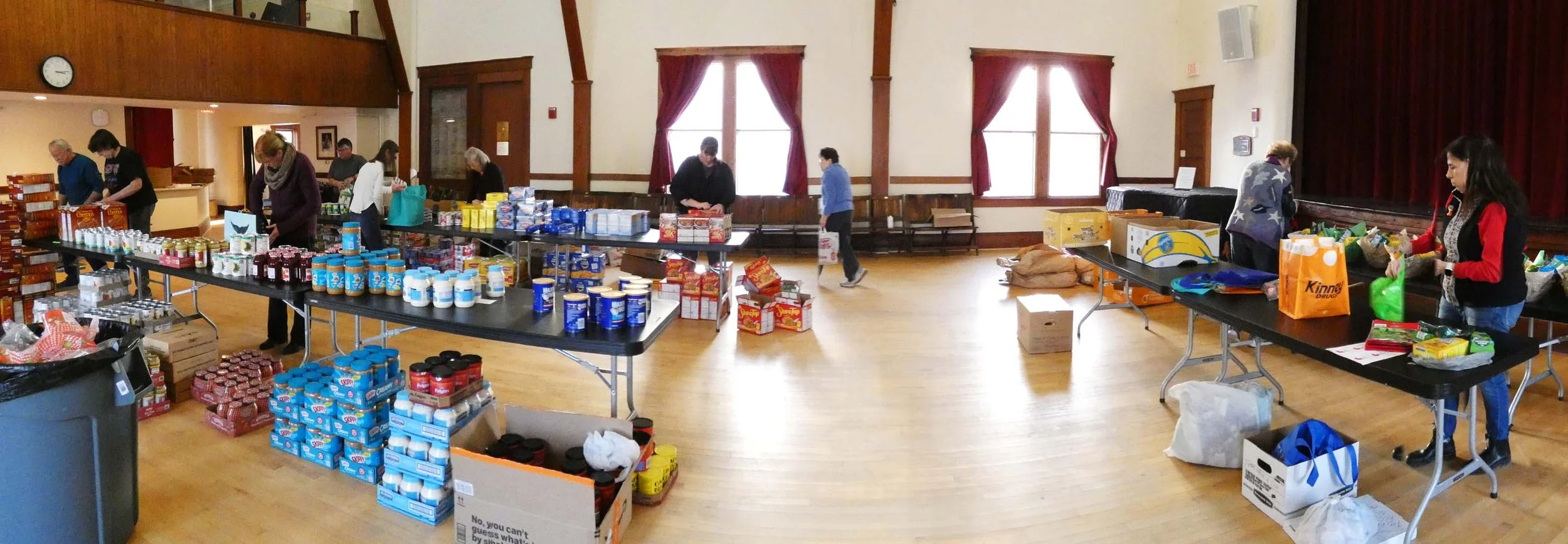
Here, Barbara's Red Stocking team came together and jumped right into assembling the many parts that make this Christmas holiday food program so important to the communities on Santa's list to receive these generous food contributions.
A person who has been with the program since its second year is Town Clerk Georgette Wolf-Ludwig, who told The Bridge Weekly during the recent busy assembly session that volunteers last year delivered food items to 56 households, serving 101 adults and 72 children.
By Bernie Marvin
Packing cans, boxes, and fresh foods for distribution through the 32-year-old program Barbara's Red Stocking at the Fairlee Town Hall recently are, left to right, Bette Nunez, Ann Hoag, Paul Dalton, Georgette Wolf-Ludwig, Judy Franklin, and Sue Taylor. The Bridge Weekly/Bernie Marvin
Fairlee, VT – On a cold winter’s afternoon earlier this month, a group of volunteers gathered at the Fairlee Town Hall to begin their annual tasks of filling bags and cartons with food items that were, by this time, to have been distributed out to families in five different area towns that include Fairlee, Orford, West Fairlee, Vershire, and Piermont.
For the gathering of food items so that other residents in the selected towns will be feted with wholesome foods distributed by a wide variety of caring people, the Barbara's Red Stocking group has been using the handsome refurbished assembly room at the Fairlee Town Hall whenever their turn comes up to gather individual items for the food packages.
The assembly room is well-lit and occupies the entire top deck of the stately Town Hall, which was refurbished and renovated beginning in 2010. The structure that adorns Fairlee's Route 5 Main Street was built in 1913 after the original opera house burned. This building is where the business of the handsome Town of Fairlee is conducted and has been updated and honored by being placed on the National Register of Historic Places.
Here, Barbara's Red Stocking team came together and jumped right into assembling the many parts that make this Christmas holiday food program so important to the communities on Santa's list to receive these generous food contributions.
A person who has been with the program since its second year is Town Clerk Georgette Wolf-Ludwig, who told The Bridge Weekly during the recent busy assembly session that volunteers last year delivered food items to 56 households, serving 101 adults and 72 children.
Those home visits totaled 10 in Orford, 10 in Piermont, 23 combined in West Fairlee and Vershire, and 15 in Fairlee. According to the folks I spoke with while they were assembling the food packages, the baskets included a ham or turkey, canned and dry foods, vegetables, fresh fruits, bread, butter, cheese, and cereals.
Also distributed were baskets with fruit, a ham, and other items to be delivered to 22 seniors in the communities who need "a little extra Christmas Cheer." The annual letter of donation appeal tells the 500 recipients that the group's generosity allows the program to also contribute to Senior Center Meals on Wheels programs, food shelves, and the Fairlee Thanksgiving Dinner Meals on Wheels program.
Red Stocking Committee members this year include Judy Franklin, Susan Taylor, Noel Walker, Georgette Wolf-Ludwig, Mary Davenport, Teri Hook, Tim Danen, Georgette Underhill, Delsie Hoyt, Tad Nunez, and Laura Taylor.
The program had a smooth opening in 1994, when, in the beginning, four churches came together and, at the behest of the late Barbara Mack, a local newswriter and community organizer, who managed the program, asked four area churches about coming together and making holiday food available to their communities' elderly and those in need.
An original member of the group who has helped with the program since its beginning was Paul Dalton, who retired from the activity last year. This year, he stopped by for a visit and said he missed the activity greatly, but he wanted to swing in and say hello to the gang, who were all hard at work filling orders distributed last weekend.
He said he helped set it up with the Mack family in Orford and was surprised at how quickly it took off and became a community deal that should be done every year to help folks out who need a little boost here and there.
Those churches in the group that have made Barbara’s Red Stocking possible include the Congregational Church in Orford, Our Lady Queen of Peace, the Fairlee Community Church, and Saint Martin's Episcopal Church.
Readers wanting to make a donation to this group may send it to: Barbara’s Red Stocking, Susan Taylor, 118 Indian Pond Road, Orford, NH 03777
A busy hub of Christmas box and basket activity recently at the Fairlee Town Hall shows members of Barbara's Red Stocking assembling food packages that were distributed last weekend to residents in Fairlee, Piermont, West Fairlee and Vershire. Seen left to right are Tad Nunez, Teri Hook, Noel Walker, Judy Franklin, Bette Nunez, Sue Taylor, Laura Taylor, Deb O’Brien, Mary Davenport, and Georgette Wolf-Ludwig. The Bridge Weekly/Bernie Marvin
The Cohase Chamber looks at the importance of housing and economic development.
Those boundaries now include, within the Chamber's areas of influence, the Vermont towns of Newbury, Bradford, and Fairlee, and New Hampshire, with Haverhill, Piermont, and Orford.
The event that got underway Tuesday, December 9, 2025 at 5:30 PM included a welcome and intro of those present, and a full dinner prepared by Chef Heidenreich and his Riverbend culinary arts program.
By Bernie Marvin
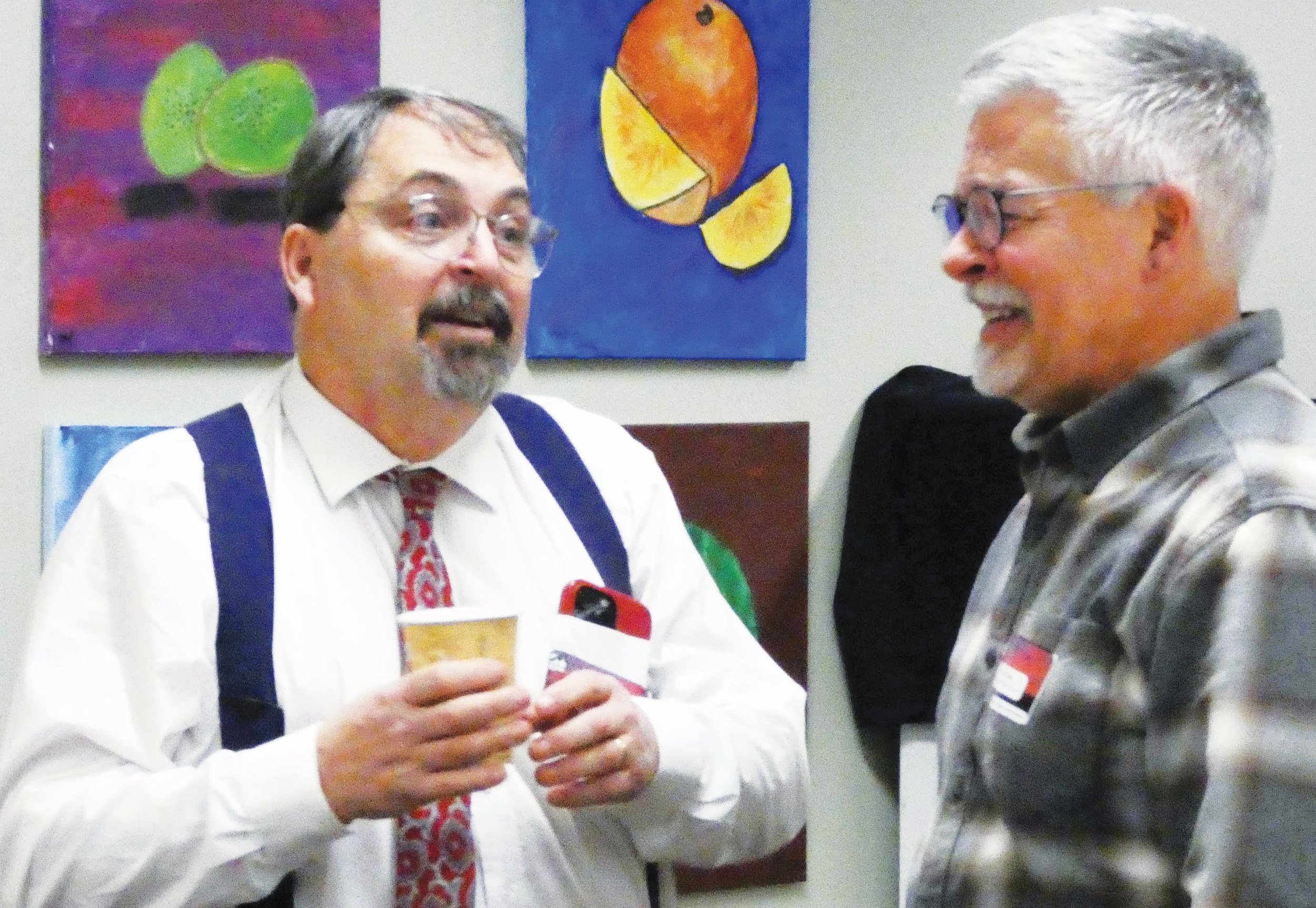
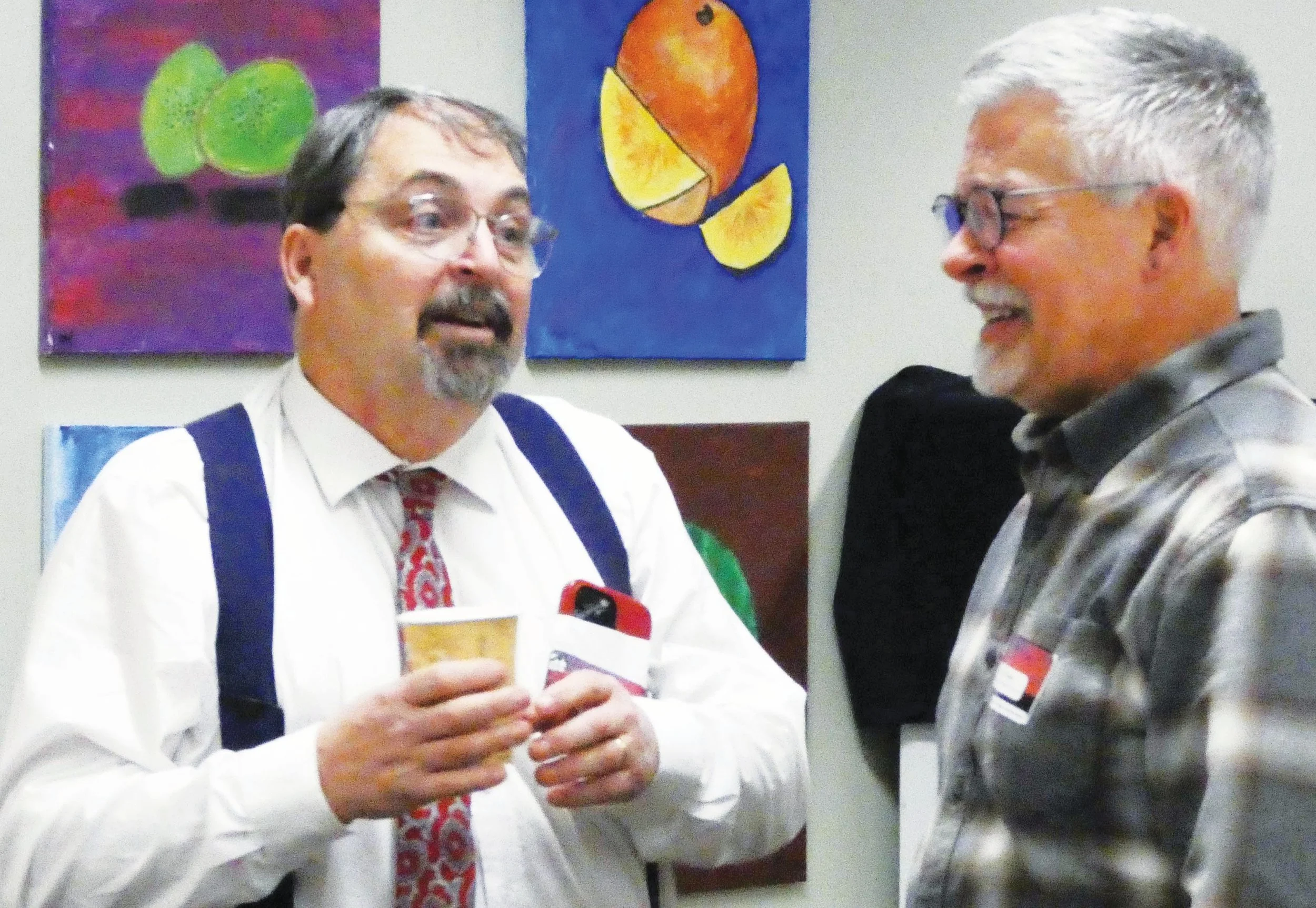
In conversation during the Cohase Chamber of Commerce Economic Summit are, River Bend Technical Center Director Brian Emerson (left) and Two Rivers Ottauquechee Planning Council Executive Director Peter Gregory. The Bridge Weekly/Bernie Marvin
Bradford, VT – Once again, as has happened for many years in the past, the River Bend Career and Technical Center was filled with ideas, programs, municipal government leaders, and enthusiasm, as nearly three dozen business leaders, education officials, and government representatives came together for another Annual Cohase Region Economic Summit.
With the Cohase Chamber of Commerce established for its original four towns 25 years ago and then expanding to six cities, the Chamber serves those six towns through an expanding network of ideas and business promotions.
Those boundaries now include, within the Chamber's areas of influence, the Vermont towns of Newbury, Bradford, and Fairlee, and New Hampshire, with Haverhill, Piermont, and Orford.
The event that got underway Tuesday, December 9, 2025 at 5:30 PM included a welcome and intro of those present, and a full dinner prepared by Chef Heidenreich and his Riverbend culinary arts program.
Then a report session from town representatives was held, plus a short presentation on the technical center by Director Brian Emerson, introduction of the need for a Community Development Concept by Vermont State Representative Monique Priestley, with Michelle Sponheimer and the development team, with a complete discussion of the needs for an Upper Valley Regional Community Development Corporation, and concluding with an ending wrap-up.
Peter Gregory, Executive Director of the Two Rivers Ottauquechee Regional Commission, summed up his comments on the evening's discussion by offering that "I think it was beneficial for the attendees to learn about other ways to enhance capacity to address housing and economic development issues," he provided The Bridge Weekly at the conclusion of the program.
He said, "I was pleased to see that regional organizations like Green Mountain Economic Development Corporation and Grafton Regional Development Corporation will offer guidance on how to complement, rather than duplicate efforts in the area. Two Rivers Ottauquechee Rivers Commission will also participate in discussions and offer assistance to support the needs of its communities," he said.
Haverhill Select Board member Ron Hurlburt attended the session with fellow Select Board member Joe Longacre, as they both did last year. They participated in the evening's discussions and the question-and-answer portion of the three-hour program.
Hurlburt told The Bridge Weekly at the conclusion of the program that it appeared Haverhill was very well received that evening, and there was much interest in them taking part and attending the program.
He said, “Along with the need for multiple unit housing, I like the idea of also partnering with developers to rehab and establish units in existing abandoned buildings.
The idea of a Regional Community Development Corporation seems reasonable and very beneficial. It would just have to be tuned to work for everyone and give people interest."
He added that the main obstacle he saw in Haverhill is all the "NIMBY's" (Not In My Back Yard) being afraid of large amounts of housing coming in. “That is where single large homes could first work. It is difficult to cut out good farmland and convert it to housing. The fellow, Noah Richard, mentioned he gets people from the community to invest in the project. They have guaranteed equity in the property and therefore would have much involvement and interest in the project as it moves along. There might be an avenue under tax takings that would allow developers to then acquire properties for redevelopment.”
Selectman Hurlburt said that everyone at the dinner seemed to be in agreement that there is indeed a housing crisis and something needs to change. “There were a wide range of people attending, being entrepreneurs, builders, selectmen, Chamber Commerce, news/media, finance, conservation to name a few. With that many types of knowledge and occupation, I'd like to think something could move forward.”
He said that “With my table much discussion was made on the new surge of vocational training verses college. People spending the money and time to get a degree are not coming out of college with the pay scale of someone successful in the trades, along with carrying a great deal of debt.”
“Much emphasis is also put on ‘workforce housing’ which is not low income but rather housing trying to meet median income earners to be able to stay in their local town and purchase a home. One builder noted that although he does this for a business, he does not want to just absorb profit off someone's back but also provide affordable type housing for local people.”
One of the major discussions at the meeting was on the subject of “Why the Upper Valley Region Needs a Regional Community Development Corporation.” As pointed out in a White Paper presentation on the subject, the area faces challenges common to many small, rural towns.
Rising housing costs, aging infrastructure, limited economic diversification, and it constrained municipal capacity made large scale community investment quite difficult. These challenges are compounded by small tax basis, limited staff resources and regional housing pressures that can price out residents wanting to come and live and/or work in the community.
A regional community development Corporation (CDC) can fill this gap. By combining local governments with professional management, AC/DC provides continuity, technical expertise, and the ability to coordinate initiatives across multiple sectors and municipal boundaries.
It can help communities throughout the upper Valley plan and implement projects that advance local goals while leveraging federal, state, and by state funding.
It is expected that this discussion of CDC will be ongoing and accompanied by other important topics such as how to better meet childcare needs in the community, a look at zoning and changes that could be made, and looking at a long list of bylaws and ordinances that all of our local communities must now work with.
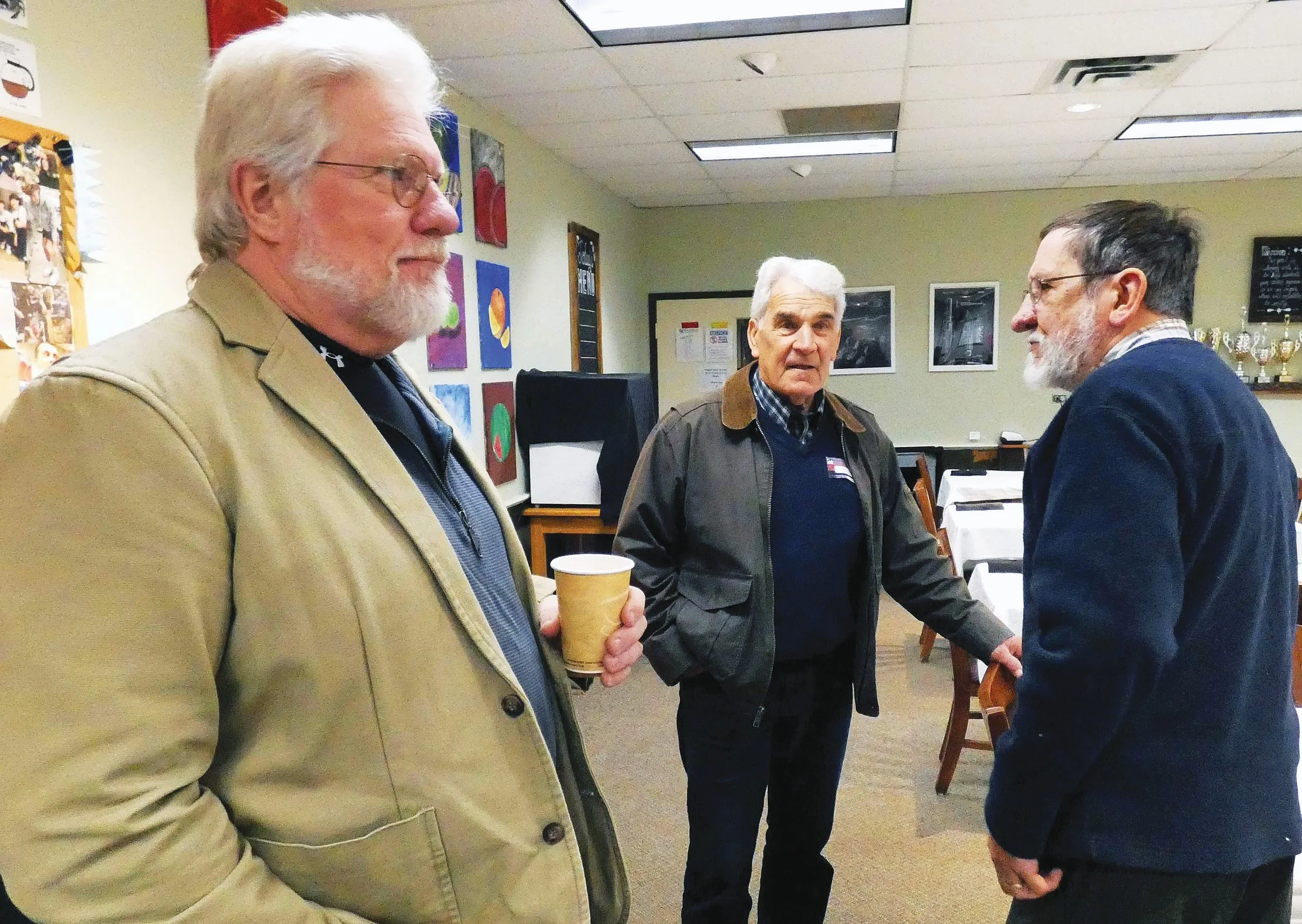
Gathering for the annual Cohase Chamber of Commerce Economic Summit at the River Bend Career and Technical Center recently were, (L-R) Select Board members Ron Hurlburt and Joe Longacre with Chamber Board Member Gary Scruton. The Bridge Weekly/Bernie Marvin
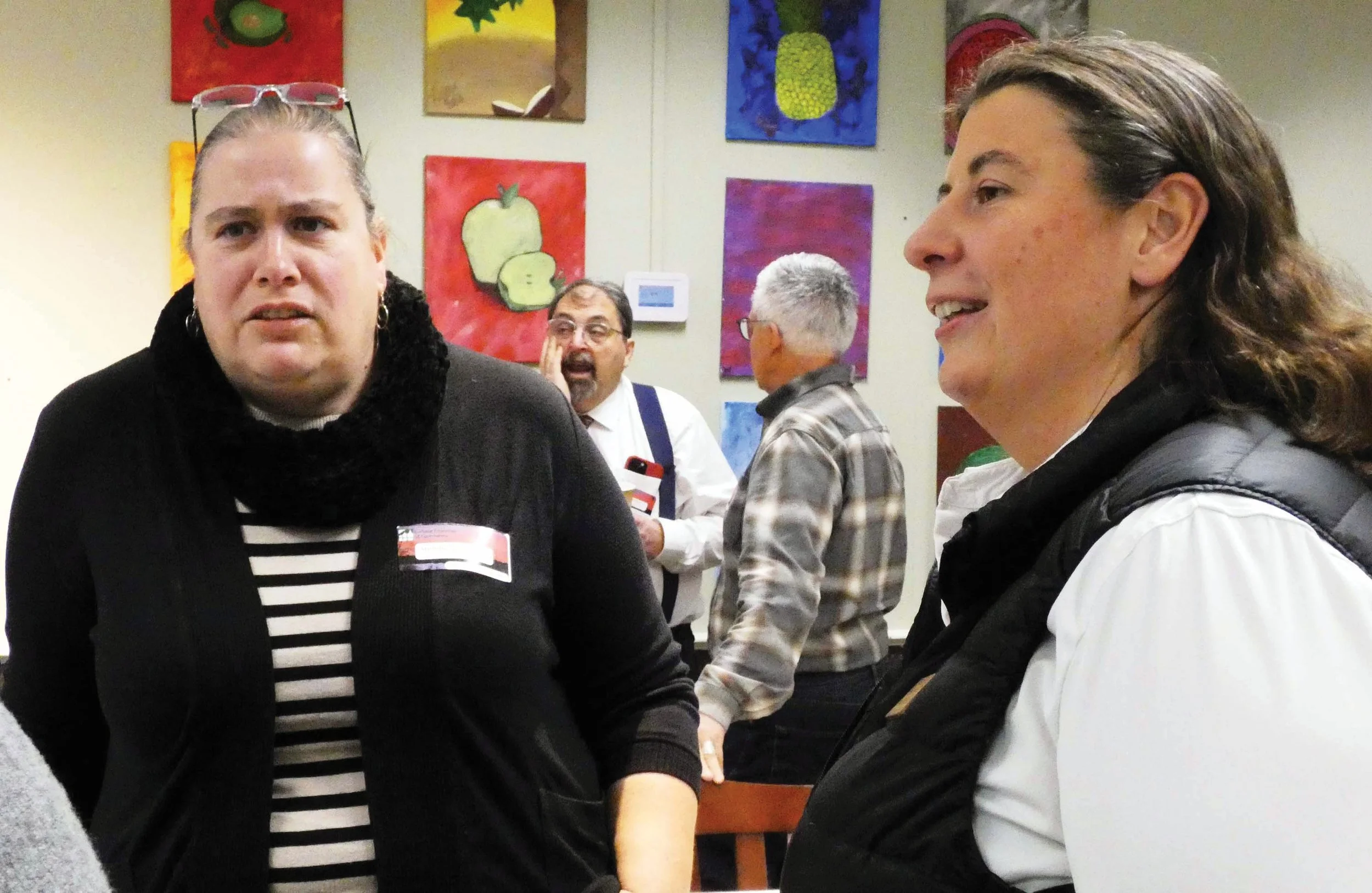
Seen left to right as they talk about a long list of topics presented during the recent Cohase Chamber of Commerce Economic Summit are, Michelle Spohneimer (left) of Vermont ADAADPA and Vermont State Representative Monique Priestley. The Bridge Weekly/Bernie Marvin
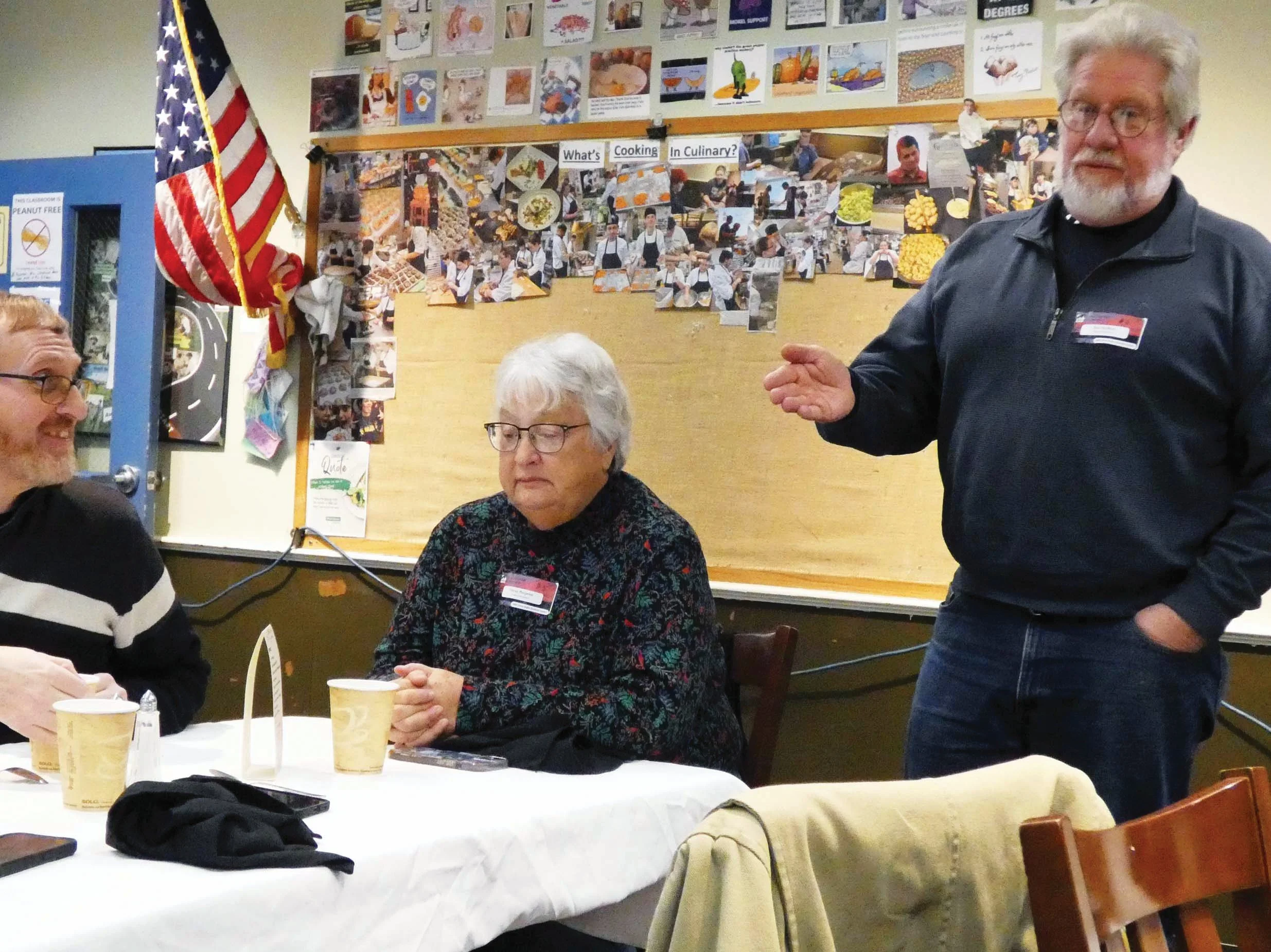
Speaking and listening during the recent Cohase Chamber of Commerce Economic Summit in Bradford were, left to right, Joshua Smith, Owner/Publisher of The Bridge Weekly and Yankee Kingdom Radio, including WYKR Radio, Bradford Select Board Chair Meroa Benjamin, and Haverhill Select Board Member Ron Hurlburt. The Bridge Weekly/Bernie Marvin.
The new Haverhill Town Administrator began duty on December 1
The new Haverhill Town Administrator gained municipal government experience while serving the towns of Peacham and Johnson, Vermont. For those jobs, he was hired in September 2023 as the new Town Administrator for Johnson, Vermont. Before that, he had served as the Peacham Town Clerk and Assistant Town Clerk, all according to press reports from the Vermont News Citizen. Before that, he worked at Habitat for Humanity in southern New York.
By Bernie Marvin
Haverhill, NH – After more than a year's search, the Haverhill Select Board has hired a Peacham, Vermont municipal administrator, Tom Galinat, to fill the job of Haverhill Town Administrator. The job had been filled by the Haverhill Select Board Chair, Rod O'Shana, on an interim basis.
The new Haverhill Town Administrator gained municipal government experience while serving the towns of Peacham and Johnson, Vermont. For those jobs, he was hired in September 2023 as the new Town Administrator for Johnson, Vermont. Before that, he had served as the Peacham Town Clerk and Assistant Town Clerk, all according to press reports from the Vermont News Citizen. Before that, he worked at Habitat for Humanity in southern New York.
The September 8, 2025, select board minutes indicate that select board member Ron Hurlburt reported there were four finalists for the position of Haverhill Town Administrator. Full background checks have been completed on each individual within the indicated minutes, with board interviews scheduled for early October 2025.
At the November 3, 2025, select board meeting, Galinat was introduced as the new Haverhill Town Administrator. Minutes of that meeting indicated he introduced himself and "described his background and expressed his excitement about filling the position." He will be paid an annual salary of $115,000 according to information provided by the Town of Haverhill.
The long, bumpy road to this latest appointment has been a rough one. The position of Haverhill Town Manager had been in place in Haverhill since being approved by annual town meeting voters in 1994, and was first filled by Glenn English, who traveled here from New Jersey to accept the position and then fill it for the next 25 years.
Upon his retirement, the town hired Jo Lacaillade, who served until she retired, and then hired Brigitte Codling from Cabot, Vermont, in 2019. She led an active town management program, expanding town government ranks and working closely with many town departments that would allow it.
This went on until she had a falling-out with some government-active residents who took their gripes to the annual 2024 March town meeting, persuading the town to vote down the town manager form of government by a 361 to 323 vote and replace it with the town administrator form of government.
Essentially this critical town meeting vote, which changed the profile of the job challenges from the town manager, to an administrative role that put the town jobs back under the control of the elected select board.
With that done, all the board needed was a viable candidate to fill the new town administrator position. The board looked no further than the corner office and, in short order, hired Codling, the former town manager, as the new town administrator in April 2024. The position ended for Ms. Codling two months later, when she handed in her resignation on June 14, 2024.
Besides O'Shana, the select board includes Joe Longacre, Theresa Paige, Ron Hurlburt, and Vickie Wyman.
Groton and the Great Depression
Mrs. Blanche Miller, recalled the work of Harold Miller, who came from NY to work with the CCC Boys..
In Groton he became a stone mason and helped build fireplaces at Stillwater Campground, and the stone tower and steps to Owl’s Head, dragging the stones up the path by hand. Harold Miller and Margaret Blanchard married in 1935, they were celebrating their 60th wedding anniversary the year Emily Dyer wrote her essay.
By Deborah Jurist
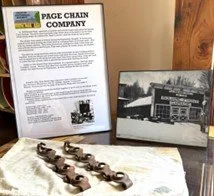
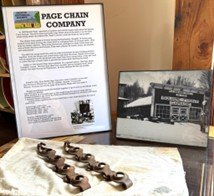
GROTON - While doing research on the Page Chain Company, I found myself intrigued by what life was like in Groton during the Great Depression.
Sewell Page, owner of the Page Chain Company, died suddenly in 1934, leaving his wife Alice with 2 teenaged boys and one 3 year old girl named Marge. The boys, Russell and Ronald, decided to drop out of school and get jobs in order to provide for their Mother and little sister, thus preventing them from having to become dependents of the town. They were successful, Russell joined the Army Air Force at 16, and Ronald, just 14, began a long career as a successful farmer. His farm has become the central part of Newbury’s Four Corners Farm.
Source: Cindy Orr, Ryegate Postmistress and Sewell Page’s granddaughter
I asked myself the question, what did it mean for Alice Page and her baby to become dependents of the town?
Reading Groton town reports for the years 1931, through 1934, a picture began to form of what life during the Great Depression might have looked like.
We had an “Overseer of the Poor” who was elected at Town Meeting. Listed in the Reports, were the costs of services and goods provided to people who needed them. In other words, Groton citizens raised funds through the collection of taxes to provide for the poor, both those who lived in Groton, and for those who were listed as “Tramps”, transients who arrived by train. .
Many people boarded with families or individuals. People who took others into their homes were paid for this service by the taxpayers. Those who needed help were often in need for multiple years. There were sometimes children with no parents needing care, as well as the elderly, oftentimes people died during the time they were being cared for.
Groton paid for hundreds of gallons of milk from Blanchards, JK Whites, and EC Frost. Dozens of cords of wood came from individuals. Taxpayers paid for medical care, trips to the Cottage and Brightlook Hospitals, tobacco, telephone calls, clothes, a stove, moving expenses, legal advice, shoes, grave digging, manure, dental care, and glasses. The Overseer of the Poor was paid for a trip to St. Johnsbury to pick up government issued pork
One family appears over and over again. There seemed to be no father, and at first the mother received financial help for caring for her family. Then the Overseer of the Poor was paid for taking one child to New York, then for taking one to the Barre Sanatorium and eventually for taking the rest of the children “away”..
Tramps were “cared for” by individuals and the taxpayers footed the bill, oftentimes in groups. Once there was a charge for 50, once for 27. It looks like the cost for taking care of one tramp was $.75. The service provided was not defined.
In 1995 a 7th grade student, named Emily Dyer, wrote a paper called “Memories of the Depression”. She interviewed several people who had lived in Groton during the 1930s. Among those people were Norma Hosmer, 89 years old, Evelyn Frost Ricker, 75 years old, Margaret Blanchard Miller, Peggy Smith and Raymond Page, who had been an Overseer of the Poor.
Norma remembered eating lots of parsnips and potatoes, but her Mom also made sour cream cookies and cake with apple frosting. Evelyn Frost’s mother made grape sherbet. Margaret Miller’s Mom made donuts, pies and cakes once a week. Raymond Page, who raised 4 children during the Depression remembered hasty pudding, johnny cake, and milk toast. He mentioned that some people the town had supported, paid the funds back, and some of the transients worked on the roads for $.30 an hour.
In 1932 there were roughly 145 entries for payment to individuals, mostly local men, for work done on the roads.
In 1933 the Civil Works Administration, what we usually refer to as the Civilian Conservation Corps, brought 43 men to Groton who worked on the Westville School, the Hatch Brook Rd. and what they referred to as Ricker Rd.
Mrs. Blanche Miller, recalled the work of Harold Miller, who came from NY to work with the CCC Boys..
In Groton he became a stone mason and helped build fireplaces at Stillwater Campground, and the stone tower and steps to Owl’s Head, dragging the stones up the path by hand. Harold Miller and Margaret Blanchard married in 1935, they were celebrating their 60th wedding anniversary the year Emily Dyer wrote her essay.
Local people were skeptical about how the CCC boys would fare in rural Groton. It turned out they did great. Alice Lord Goodine recalled that her husband Henry, the barber, would go to the CCC Camp once a week to give the boys haircuts and the young men often came into Groton, and spent money after they were paid.
In conclusion, there was a clear commitment to taking care of “our own” as well as those who came to town because they were homeless. Groton, being a farming town, probably fared better than many urban areas during the depression because food production was common.
As we face the new needs of our neighbors and those who land here without means, we have an opportunity to carry on the tradition set by Groton during the last century.
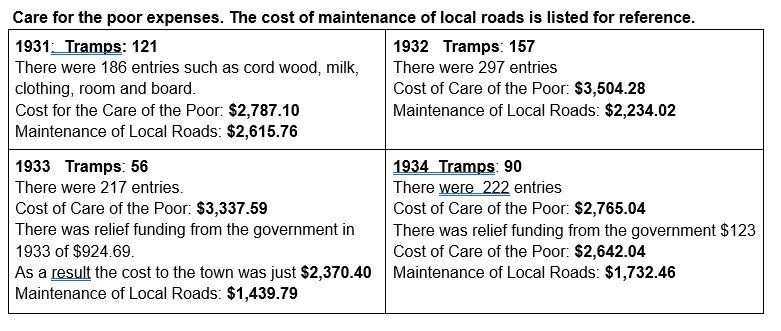
Care for the poor expenses. The cost of maintenance of local roads is listed for reference.
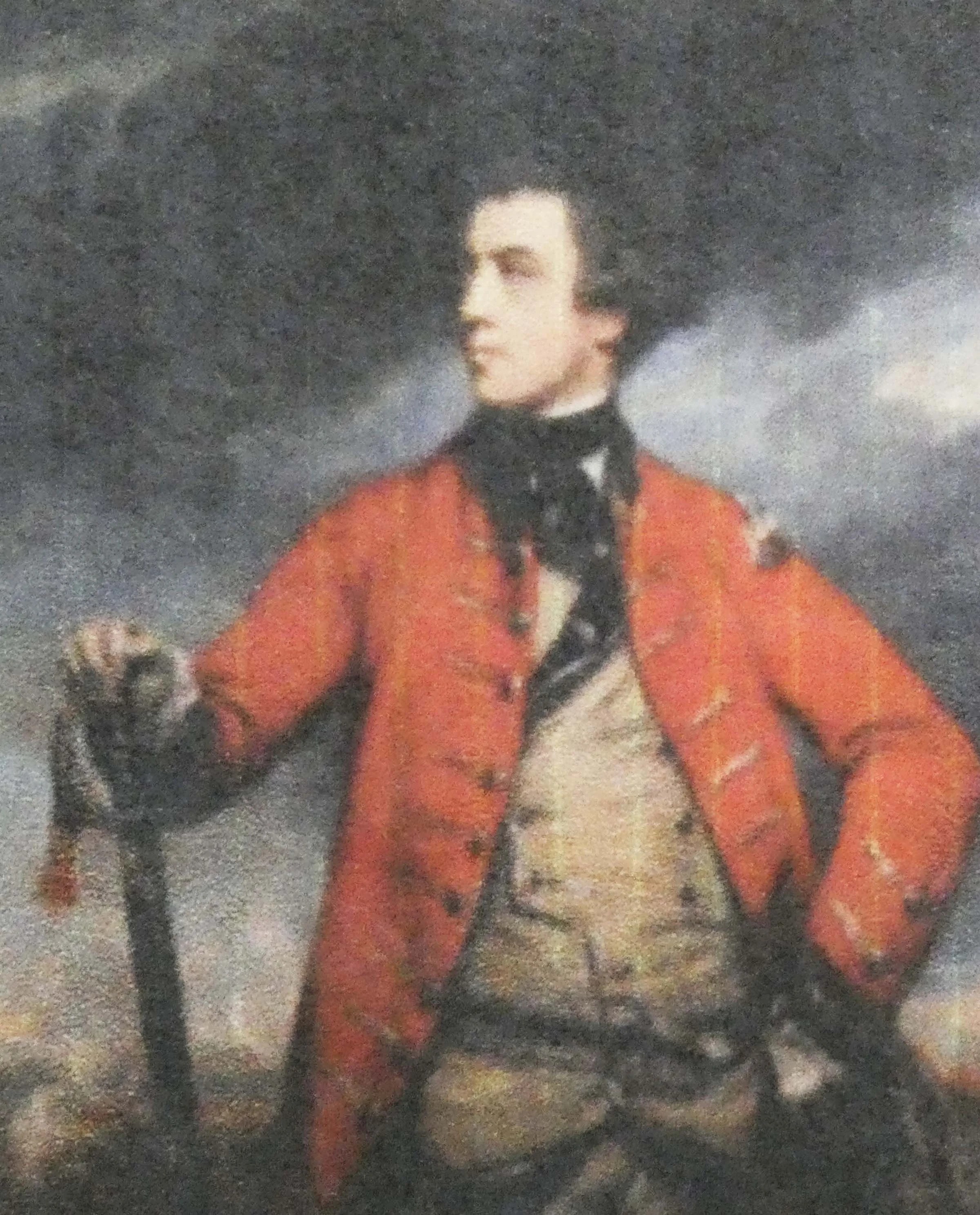
The American Revolution series by Ken Burns featured British Loyalist Col. John Peters of Bradford
Because Colonel Peters was required to travel to the First Continental Congress in Philadelphia in 1774, from time to time, he would be mobbed by the “Liberty Boys” because of his continuing and intense loyalty to the crown prior to the Revolutionary War beginning on April 19, 1775. This, according to Richard M. Ketchum's book “Saratoga, Turning Point of America’s Revolutionary War.”
By Bernie Marvin
Colonel John Peters of the Queens Loyal Rangers was featured on the new Ken Burns series on the American Revolution. It was premiered last week with six, two-hour shows on Public Broadcasting System for New Hampshire and Vermont. Courtesy photo.
Bradford - The newest Ken Burns documentary is a six-part, 12-hour series on the American Revolutionary War. This television documentary was released to the public just last week and featured in the third section a Mooretown (now Bradford, Vermont) military man, British Colonel John Peters, and his family.
Colonel Peters hailed from Connecticut and settled in Piermont for several years, then moved across the Connecticut River to the town of Mooretown (later to become Bradford), Vermont. The town was established in May 1770 in New York before it became the State of Vermont. The town was known as Waitstown and Waits River Town before adopting its original name, Mooretown. That’s when Colonel Peters lived there. The name originated with Sir Henry Moore, the Royal Governor of New York.
According to Wikipedia, after the American Revolution, residents of Mooretown stated they no longer wanted the name to remind them of a royal governor, so they petitioned the Vermont legislature to rename the town Bradford in 1788.
The television story revealed that Peters, born in 1770 in Connecticut, was a Yale graduate and first settled in Piermont, then later moved to Mooretown on the banks of the Connecticut River, where he owned a considerable amount of land, a large home, several saw mills and grist mills, and a large farm.
He actually lived in New York at that time (it was not yet apportioned to Vermont) and was appointed Justice of the Peace, Colonel of the local militia, Judge of Probate, County Registrar, Clerk of Court, and Judge of the Court.
Because Colonel Peters was required to travel to the First Continental Congress in Philadelphia in 1774, from time to time, he would be mobbed by the “Liberty Boys” because of his continuing and intense loyalty to the crown prior to the Revolutionary War beginning on April 19, 1775. This, according to Richard M. Ketchum's book “Saratoga, Turning Point of America’s Revolutionary War.”
Colonel Peters knew after these experiences that the American countryside would not be satisfied with anything short of total independence from England. On his way back from Philadelphia to Mooretown, another gang threatened to kill him as “an enemy.”
Peters back in his hometown was hated and abused by his neighbors and even his own father turned against him. Peters got a mission to go to Canada with American militia members, where he acted as a double agent, spying on both sides.
Peters was branded as an outlaw; his wife and eight children had been turned out of their home and sent off in a sleigh with only one bed to Ticonderoga, 140 miles through the woods, the snow, and bad roads. The group arrived “more dead than alive.”
The family group was then sent on their way to Canada; they became lost, were discovered by a passing British ship, and were transported to St. John’s, Canada. By that time, Colonel Peters was reunited with his family and taken to Montréal. He was ready to seek revenge, and that month, he began to recruit men for a regiment approved by British General John Burgoyne, who named his unit the Queen's Loyal Rangers.
Later in the war, Colonel Peters returned to Vermont, this time to join the fight with his Queen’s Loyal Rangers at the Battle of Bennington, where the British were soundly defeated. He left the Revolution and returned to England with his family.
Community Rallies To Revitalize The Groton Rail Trail
The Gateway Project has been a collaborative effort, states Nahmias, who has spearheaded much of the Project in recent years and shares a common vision for the future of Groton with Gary Lamberton from the Buckaroos of 302 Snowmobile Club, Groton Recreation Commission’s Mike Gaiss, and Greg Western, Executive Director of the Cross Vermont Trail Association (CVTA). “This project was the genesis of several like-minded, hardworking Groton residents who were in the right place at the right time.”
By Trish Griswold
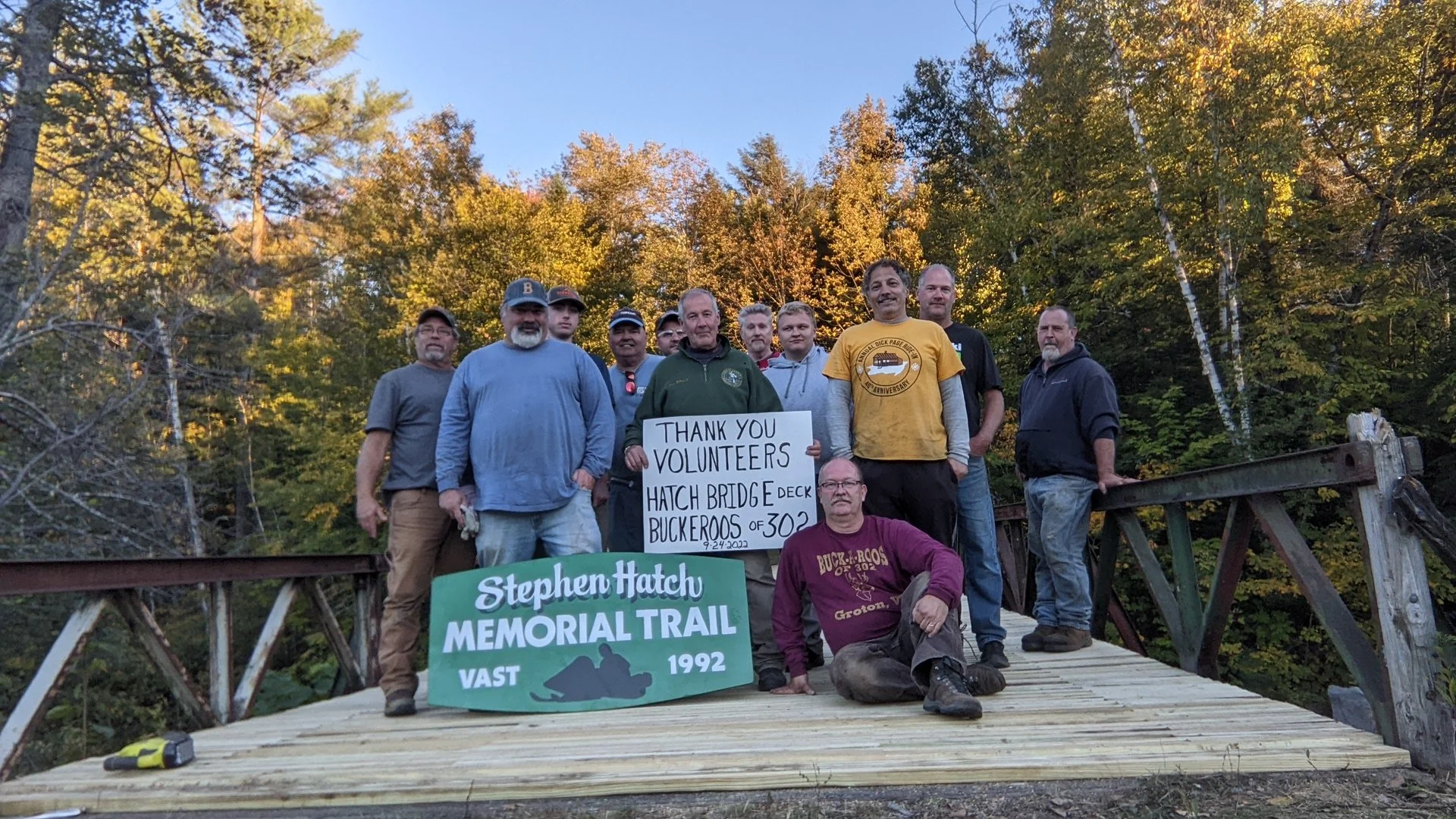
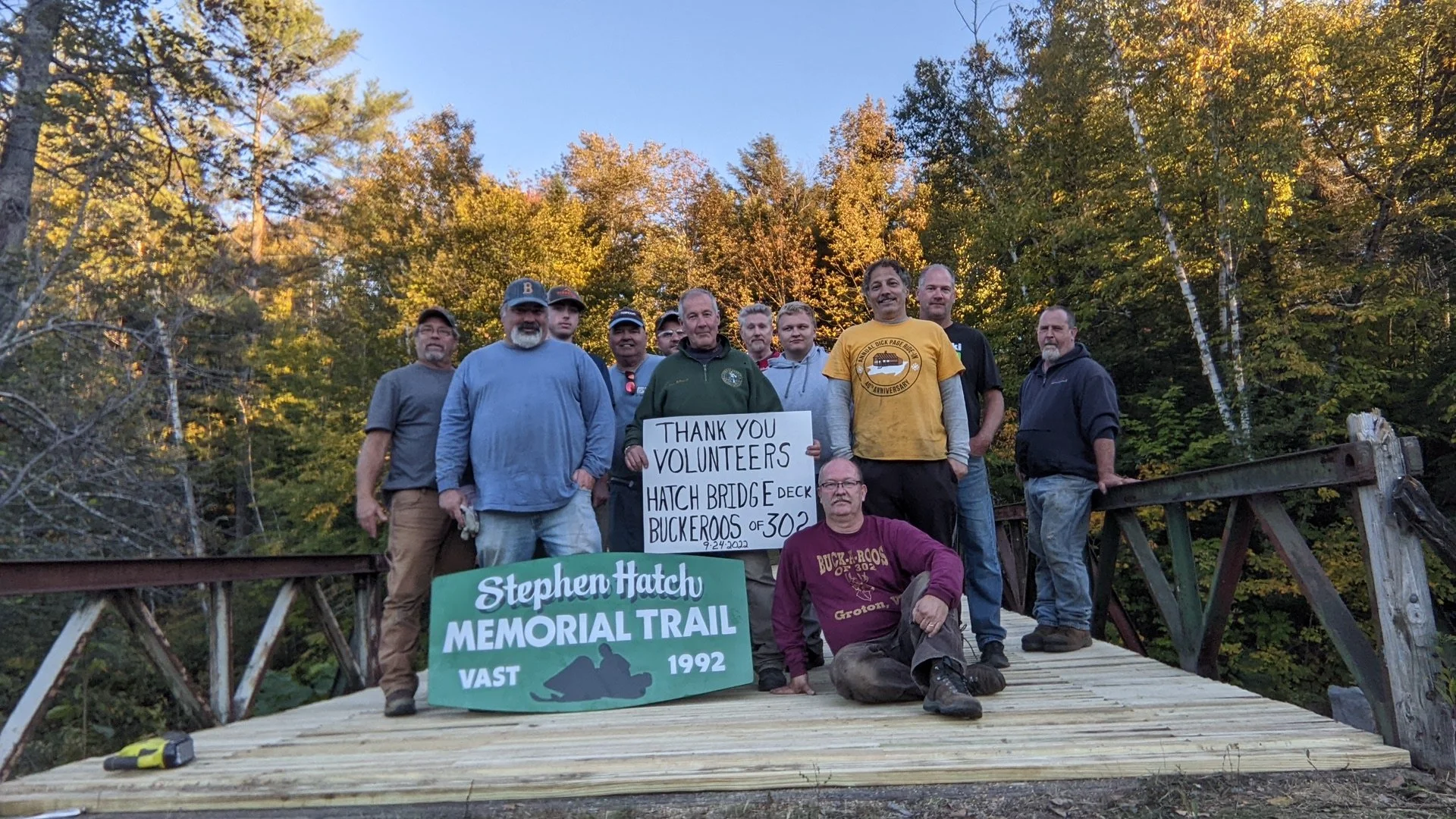
Members of the Buckaroos of 302 Snowmobile Club repaired the Stephen Hatch Memorial Bridge, providing safe, dependable snowmobile access to the Cross Vermont Trail.
GROTON - Neighbors helping neighbors has been a long-standing tradition in the small, rural community of Groton, VT, and newly-elected Selectman Mike Nahmias, who moved to the area in 2017 and has served as Planning Board Chair for several years, has had the privilege of experiencing first-hand the power of many hands making light work for the Town.
“Groton has got a lot of heart,” remarks Nahmias, who estimates that, over the last 50+ years, 250 of the town’s 950 citizens have been directly involved in helping Groton’s Gateway Project, a grass roots economic growth initiative, come to fruition. The intent of the Gateway Project was to upgrade Groton’s portion of the Cross Vermont Trail (CVT), a four-season, multi-use trail network that spans the State of Vermont, east to west from the Connecticut River at the Vermont/New Hampshire border in Wells River to the shores of Lake Champlain in Burlington. The CVT follows the railbed in Groton for 10 miles, the longest segment of the CVT in any town.
“Groton is located at the highest elevation on the trail, the summit, and we are a destination for trail users as we have campgrounds, lakes, ponds, hiking trails, and the forest,” explains Nahmias. “I see us as one of the anchor communities along the trail. Having the new surface in both the town and the forest, we really have the best segment at this time along the trail.”
The Gateway Project has been a collaborative effort, states Nahmias, who has spearheaded much of the Project in recent years and shares a common vision for the future of Groton with Gary Lamberton from the Buckaroos of 302 Snowmobile Club, Groton Recreation Commission’s Mike Gaiss, and Greg Western, Executive Director of the Cross Vermont Trail Association (CVTA). “This project was the genesis of several like-minded, hardworking Groton residents who were in the right place at the right time.”
Nahmias also credits previous Groton Selectboards, Planning Commissions, and other Town Officers for “their forethought in acquiring the railbed from the State of Vermont when it was offered to the Town in the 1980s, for putting an ordinance in place to preserve the railbed as a recreational property with limited access for vehicles, and for drafting a Town Plan with goals and strategies that laid the groundwork for the Town to continue to maintain and improve the trail and embrace its presence as an economic driver for town businesses.”
Funding for the Gateway Project was made possible through a $225,000 grant from the Vermont Outdoor Recreation Economic Collaborative (VOREC), a state-run program managed by the Vermont Department of Forests, Parks and Recreation (FPR) in partnership with the Vermont Agency of Commerce and Community Development (ACCD). One of VOREC’s primary goals is to “strengthen connections between Vermont’s outdoor recreation resources and the benefits that come from participation in outdoor recreation.”
According to Nahmias, the Gateway Project is multi-faceted with many different segments. One portion of the project was to regrade sections of the existing railbed, install and replace eight culverts along the railbed, and install two barrier gates. A landslide in 2023 and a major flood in 2024 caused delays to this portion of the project, but townsfolk and volunteers have persevered despite these challenges.
Another key component of the Gateway Project was to build a 60’ by 100’ all-season parking area near the Village Center (at the old stump dump) and a trailhead with 10 parking spaces, making the CVT fully accessible to snowmobilers, bikers, snowshoers, cross country skiers, horseback riders, walkers, runners, dog sledders, etc. Crucial to the project was acquisition of the lower Groton hydroelectric power station property, a 3-acre parcel of land formerly owned by Green Mountain Power, and the development of a master plan for the proposed 12-acre Groton Gateway Park, which includes the former stump dump and gravel pit as well as retention of its current emergency management use.
Signage and wayfinding for the project were completed in collaboration with the CVTA. This included the design and installation of 50 directional signs on the railbed trail, 6 wayfinding signs, one sign on the road, 2 kiosks, 12 winter trail maps, and a digital map of the railbed trail for the Town’s website. Separate from the grant, Nahmais says, the Buckaroos of 302, whom he refers to as “the unsung heroes of the project,” also repaired the Stephen Hatch Memorial Bridge. These repairs have improved trail accessibility for snowmobilers in the winter months and helped get bikers off Route 302 and onto the trail, increasing safety for everyone.
According to CVTA Board Chair Mike Thomas, the hope is that the newly revitalized rail trail will provide an inviting, safe recreational opportunity for everyone to enjoy the benefits of nature and an active lifestyle. “The Park will be a draw for people to the area, and locals can take advantage of it too with access to the Village of Groton. It ties the community together.”
Former Selectboard Member Deb Jurist is one of many Groton residents who have utilized the CVT for years. “I have been riding my bike on the railroad bed since 1984 when I bought the Stoneshed in Ryegate and built my business, Mountain Meadows Pottery. I have seen a lot of changes over the years for sure. But it still holds true that there is always something to discover on the railroad bed. It might be a green heron, the sound of croakers in the spring, or sumac with leaves in green, yellow and red. The railroad bed never disappoints.”
The revitalized trail, Jurists says, makes for a smoother ride. She recently shared that, decades ago, she and her then 3-year-old daughter nicknamed one of the biggest puddles on the old trail “Sinker.” Thankfully, “Sinker” and the other puddles are gone. “[The railroad bed] is vastly easier to ride on now that it has been upgraded, which makes it much more accessible to me at 75 years old.”
Many local businesses, Vermont-based companies, and community volunteers, including: Berry’s Forest Products, Blue Mountain Excavation, Oliver Landworks, Rise and Run Timber Frames, Robco, SE Group and the Buckaroos of 302, have been instrumental in bringing the Gateway Project to life. “Over 1000 volunteer hours were put into this project,” Nahmias says, “and we couldn’t have done this work without them.”
More information about the CVT, including up-to-date trail maps, are available online at https://crossvermont.org/. Additional information is available on the Groton, VT, website at https://grotonvt.com/.
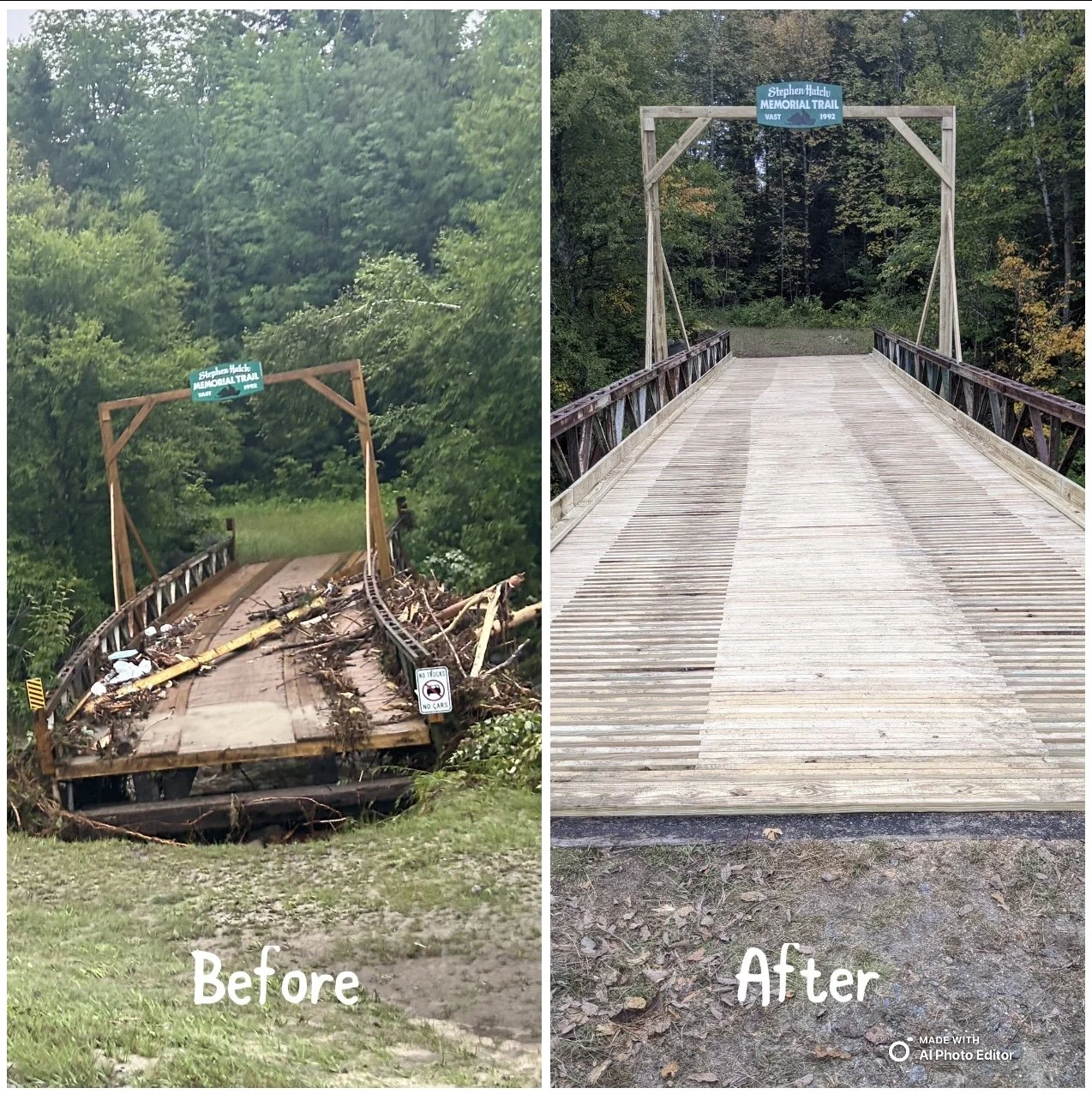
Repairs to the Stephen Hatch Memorial Bridge have increased safety for nature goers by getting bicycle traffic off the roadway and onto the Cross Vermont Trail.
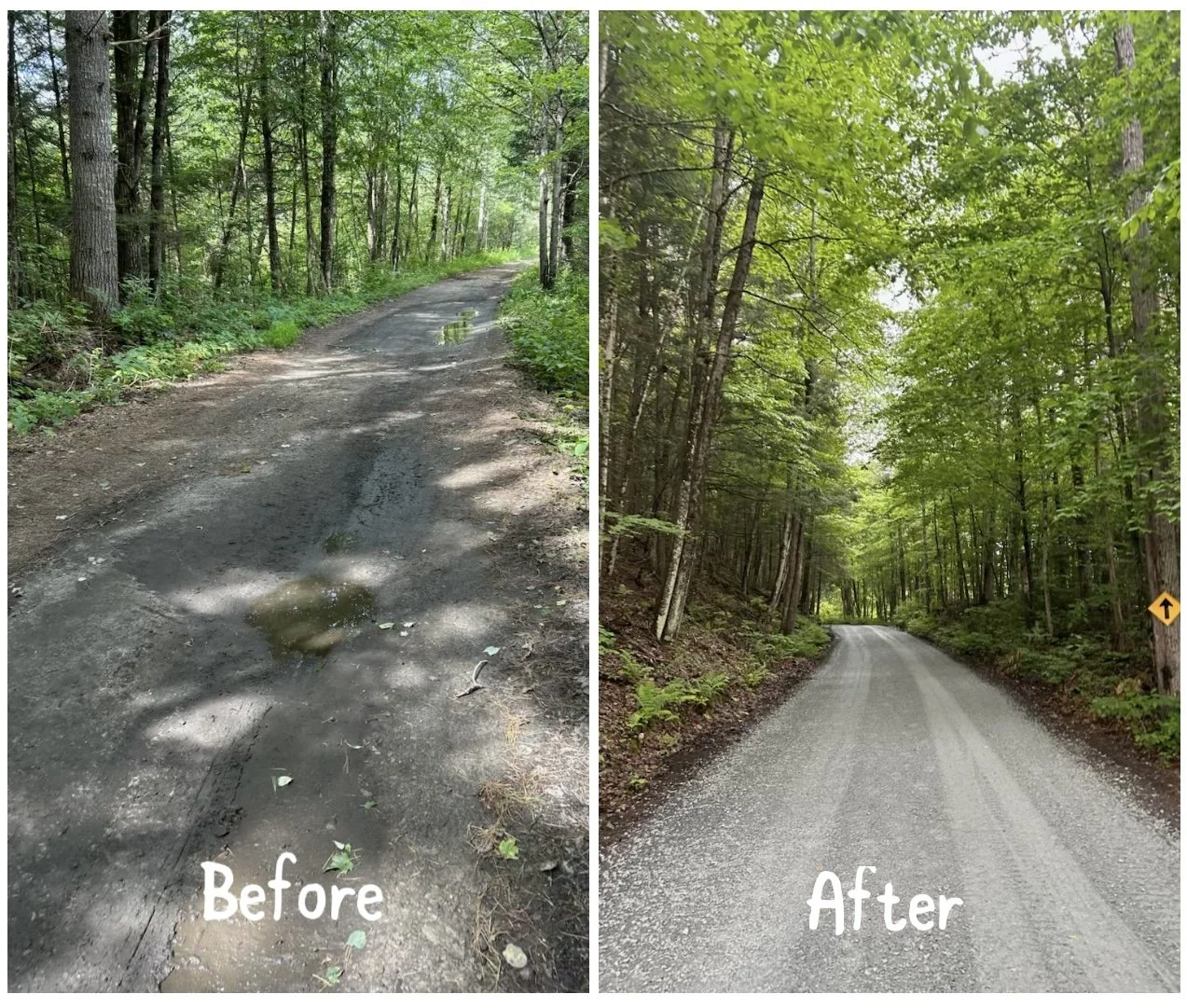
The “before” picture on the left shows the surface of Groton’s rail trail (between the Village and Pine Mountain) prior to recent changes. The “after” picture on the right shows the revitalized trail roughly one mile east, closer to Pine Mountain.
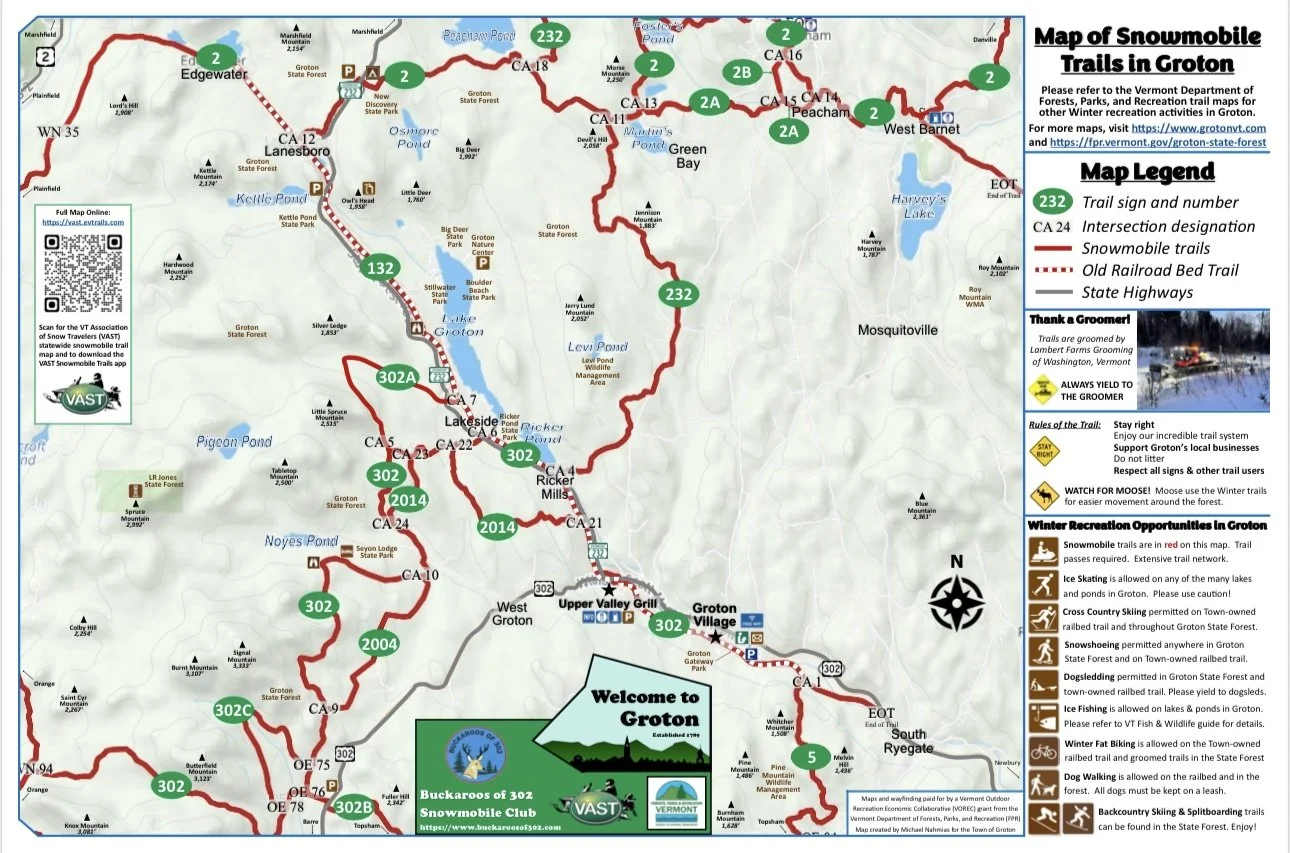
The newly designed Buckaroos of 302 Snowmobile Club trail map showcases snowmobile trails in Groton as well as other noteworthy landmarks and reference points.
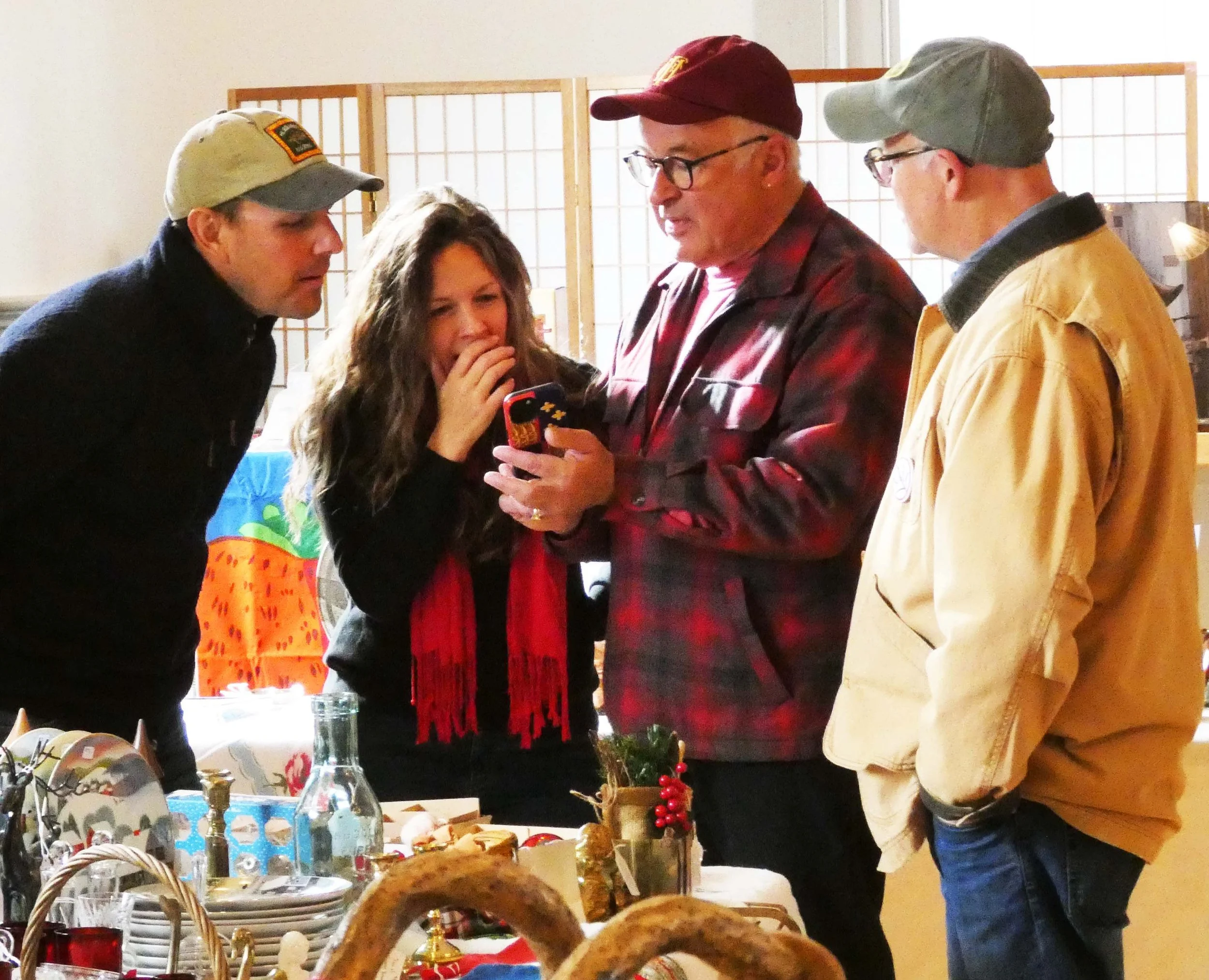
Alumni Hall Antique Show For Benefit Of Wentworth-Brown House
For the Antiques Show event, tables and display areas were set up throughout Alumni Hall's floor space, and business was brisk because of the variety of small items that were brought in and displayed for sale. Proceeds from the sale of foods and refreshments, plus vendor display fees, were all given over to the benefit of the nearby Wentworth-Brown House, which is a mammoth Court Street Arts historic renovation project located on the south lawn of the Haverhill Common.
By Bernie Marvin
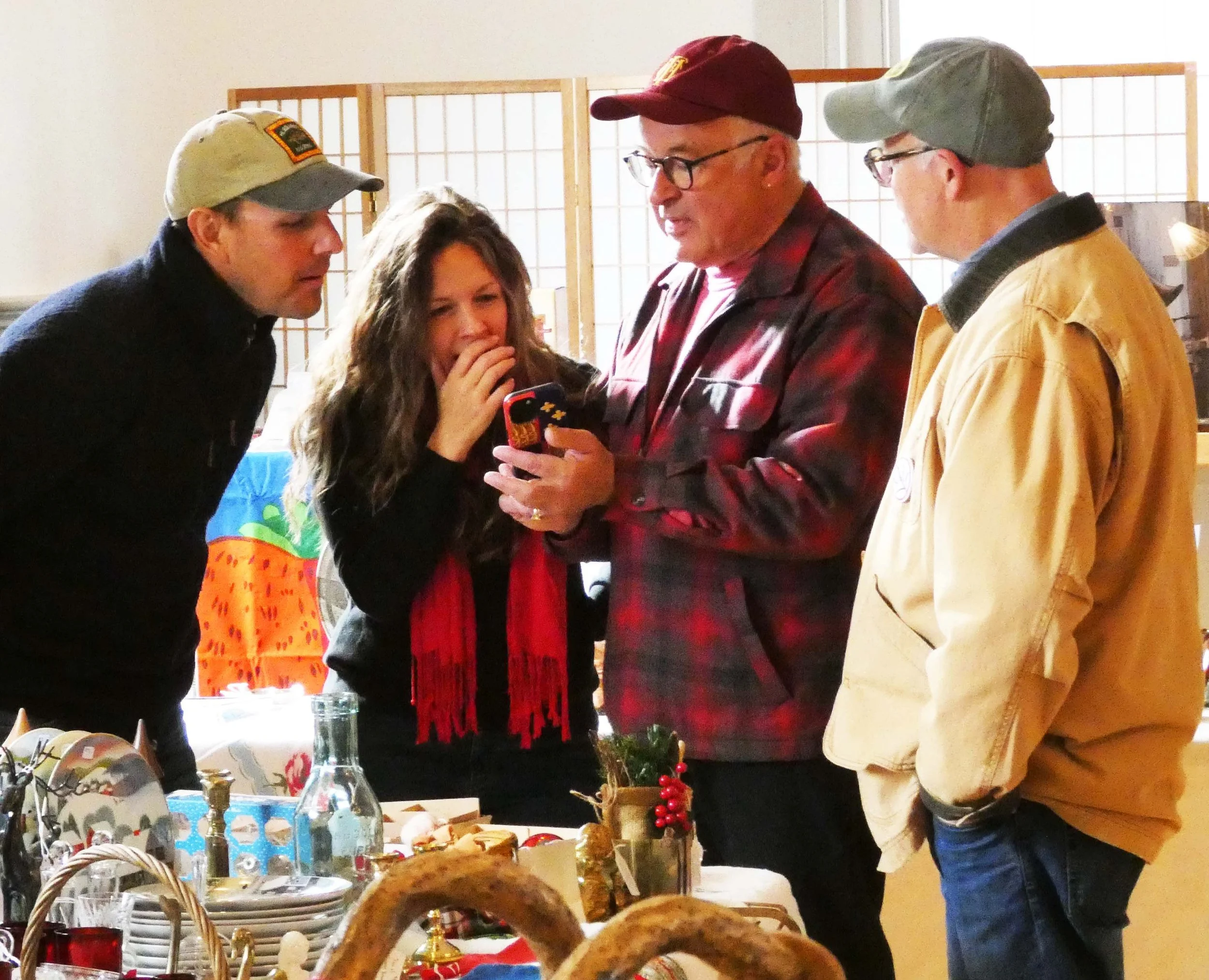
Retired Reverend Canon David Carlson, at right center, shows friends an interesting item he found while browsing the recent Antiques Show at Alumni Hall in Haverhill Corner. The Bridge Weekly/Bernie Marvin.
Haverhill Corner, NH The second Annual Antique Show held at the Alumni Hall in Haverhill Corner came together as a benefit for the nearby Wentworth-Brown House restoration project.
The 15 dealers from New Hampshire and Vermont, who gathered inside the spacious hall located on Court Street, brought a wide variety of antiques and collectibles, including baskets, books, ceramics, coins, crystal, glass, metal, and tinware, signs, small furniture, vintage linens, and considerably more.
The show, which was open to the public from 10:00 AM to 4:00 PM, was well attended. There were many new faces and dealers involved, as the event had a large crowd last year, according to Court Street Board Vice President Jeff Mazullo. He said that he had to turn away some vendors due to a lack of floor space to accommodate all who wanted to be part of the Court Street Arts show.
He said events such as the antiques show are helping Court Street Arts "get back into the swing of things," after the Covid time and the board is planning some exciting programs for the future. He said the "great cooperation" shown by other organizations in Haverhill Corner, such as the Haverhill Library Association, the Historical Society, and the participation in the Haverhill History Day, was superb.
For the Antiques Show event, tables and display areas were set up throughout Alumni Hall's floor space, and business was brisk because of the variety of small items that were brought in and displayed for sale. Proceeds from the sale of foods and refreshments, plus vendor display fees, were all given over to the benefit of the nearby Wentworth-Brown House, which is a mammoth Court Street Arts historic renovation project located on the south lawn of the Haverhill Common.
Court Street Arts Board President Pat Buchanan told The Bridge Weekly that the progress on the renovations at Wentworth-Brown included the installation of heat and water, and they hope to begin using the building for other programs soon.
She said the painters are ready to do their work on various rooms, proceeding one step at a time, while, Buchanan said, they decide how each area will be utilized for public programming. She said arrangements are being worked on with a well-known local musical group to feature them at the Wentworth-Brown House, which will be something different for the type of programs to be held at the Wentworth-Brown House.
She said that music practice rooms may be set up, as a generous donor has provided full-size electric keyboards. Buchanan said they are also exploring ways to utilize the beautiful grounds surrounding the Wentworth-Brown House. She said the board has received many wonderful ideas on ways to feature the facility,) including using the yard for concerts.
She said that now that the grant monies available for projects like what they are doing with the Wentworth-Brown House have pretty much dried up, they are looking forward to the annual appeal as an important fund-raising program.
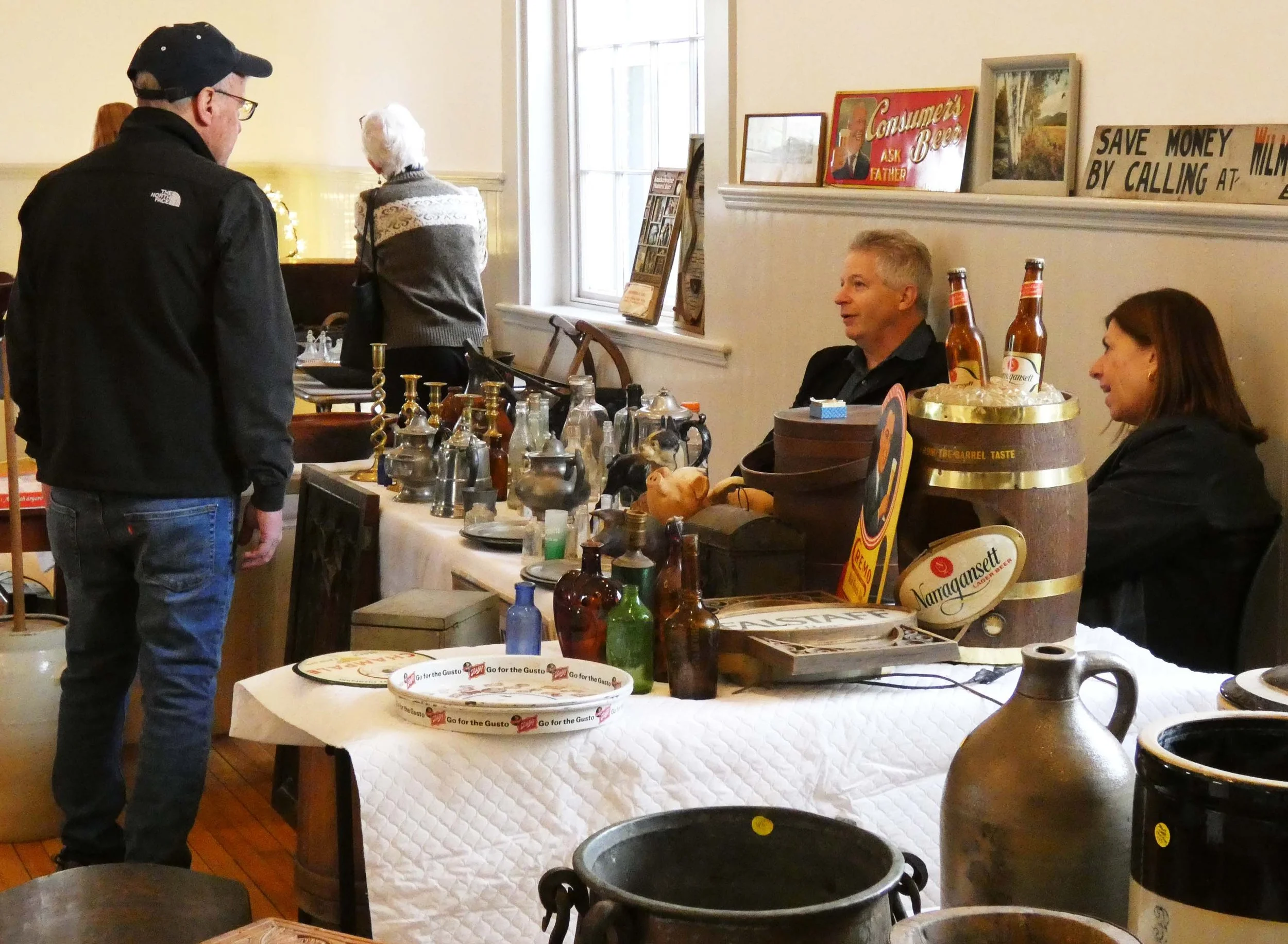
Frank Stiegler, at left, speaks with antique dealers who were displaying at the recent Antiques Show at Alumni Hall in Haverhill Corner. The Bridge Weekly/Bernie Marvin.
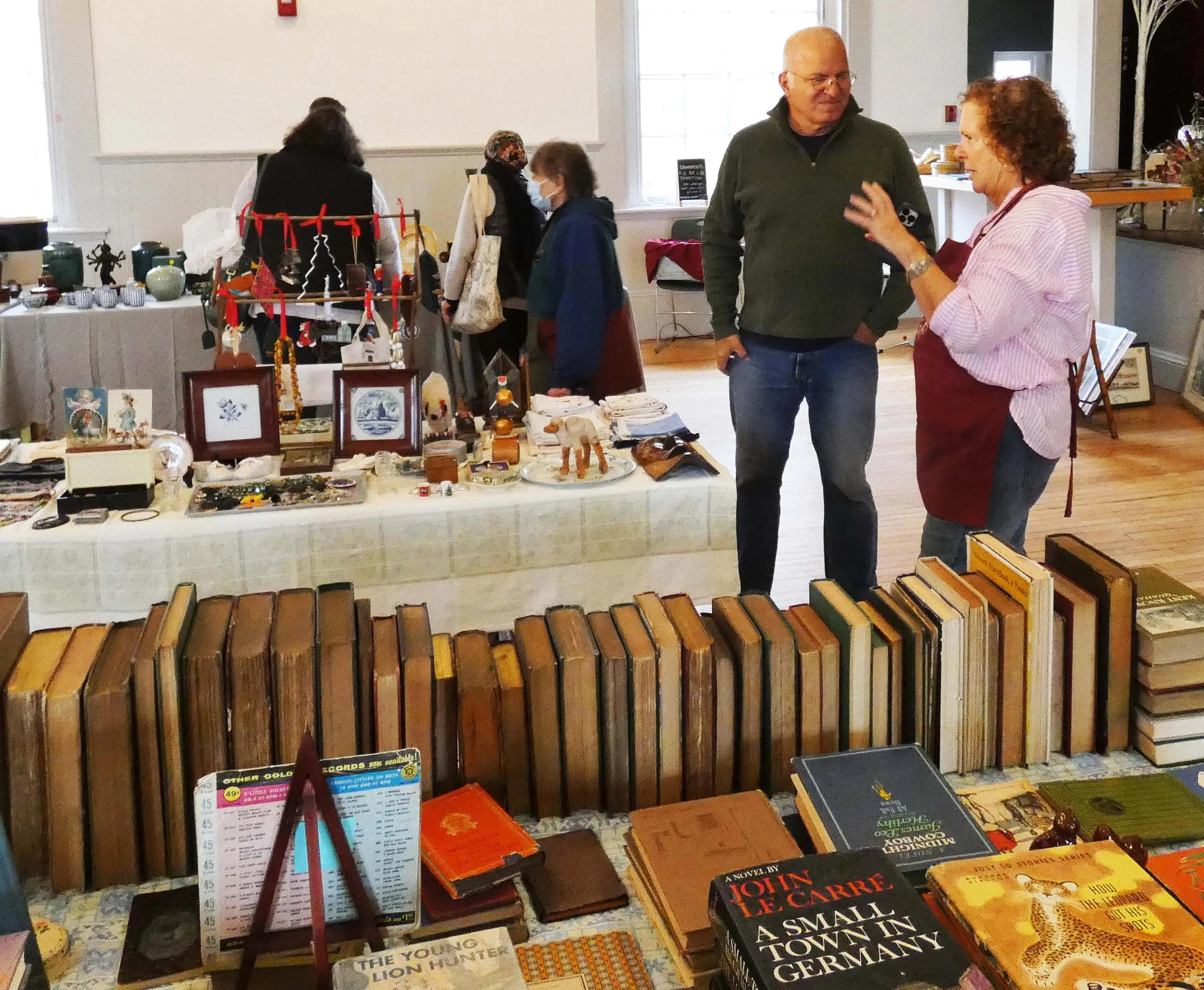
Court Street Arts President Pat Buchanan at right and Vice President Jeff Mazullo discuss the recent Antiques Show held at Alumni Hall in Haverhill Corner. The Bridge Weekly/Bernie Marvin
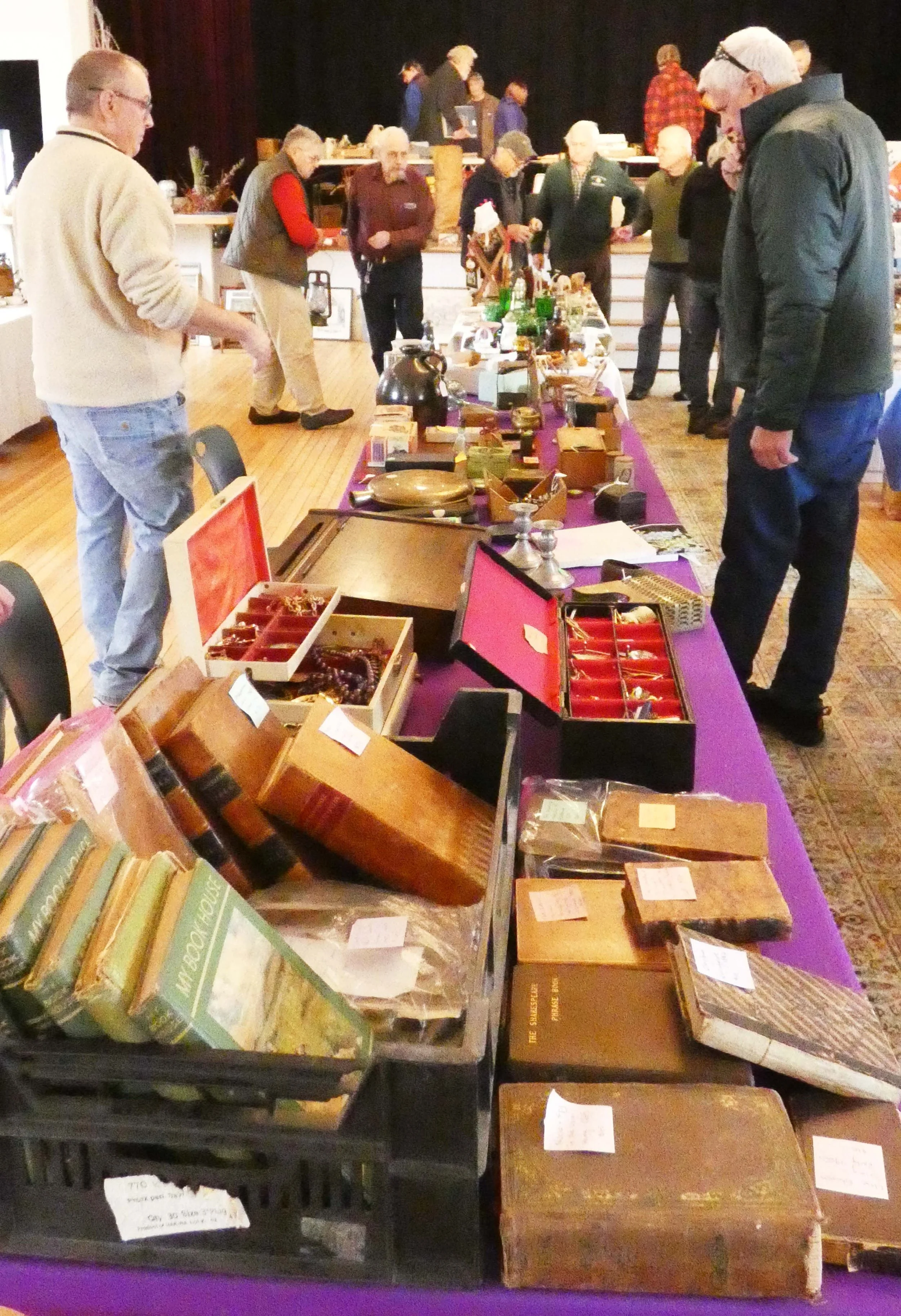
Antiques-laden tables and booths were popular gathering places during the recent Antiques Show at Alumni Hall. The Bridge Weekly/Bernie Marvin.
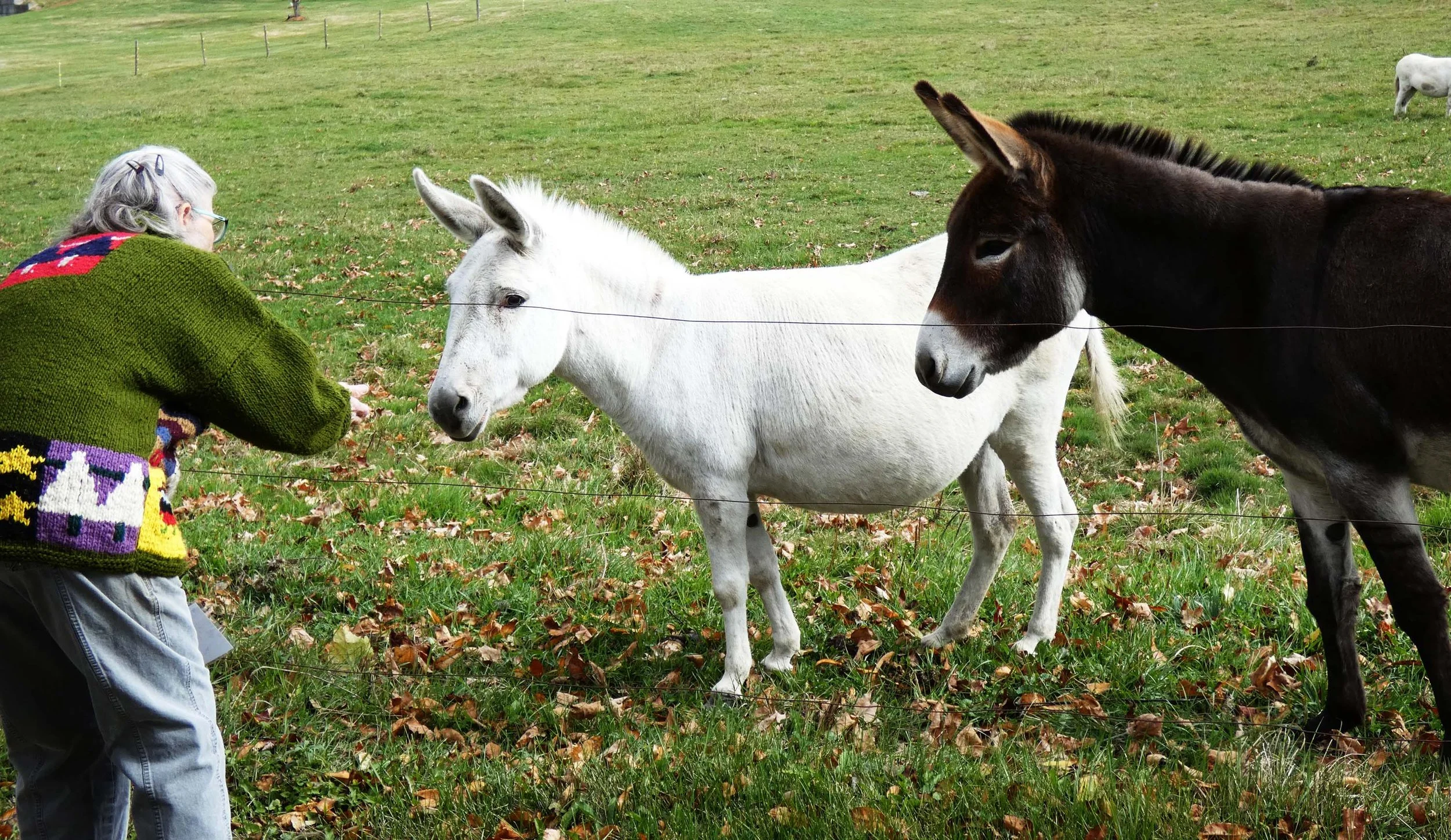
Historical Society looking at the rehab and future use of Pierson Hall
The report also indicated that electrical work, painting, and repairs to plaster and the schoolroom's tin ceiling were made possible in large part through The Mildred Page Fund for Public Buildings at Haverhill Corner, administered by the Haverhill Select Board. The Haverhill Historical Society is grateful to the Board--and especially to Mildred Page--for their vision and generosity in helping to restore this precious link with Haverhill's earliest years to much of its former glory.
By Bernie Marvin
Chatting with two handsome donkeys, in a field adjacent to the Ladd Street School Museum recently, is Elaine Elliott from Haverhill. The donkeys, left to right. are Daisy and Ed. The Bridge Weekly/Bernie Marvin
Haverhill Corner, NH On Saturday, October 18, 2025, as a morning sun began to brighten through the cloud bank that hung over the nearby Connecticut River, donkeys Ed, Daisy, and Flower grazed in a lush field just outside the back door of the historic Ladd Street School.
It was a pretty setting as visitors began to head to the Haverhill Historical Society's 2025 Fall Open House, where, inside the white school building, the society had invited the public to come and enjoy the open house.
Once again, as they had many times in the past, society board members and others welcomed visitors to enjoy refreshments and friendly conversations as they learned about the museum's collection of military, railroad, and town history items.
In a previous report on the Town of Haverhill website, a bit of the Ladd Street School's history is mentioned, along with past work. The report indicates that the Ladd Street School, now standing at the corner of County Road and Dartmouth College Highway, was built in 1849 for School District No. 2 and was one of many Haverhill School Districts located in various sections of the town during the nineteenth century. "Its construction coincided with the demolition of the 1790 meetinghouse of the First Congregational Church, which stood nearby. When the parish purchased the brick meetinghouse on the common in 1829, the church at Ladd Street was gradually abandoned."
During the past 20 years, the Society has made extensive repairs to the foundation, windows, roof, and belfry. With major exterior repairs completed, attention has turned to refurbishing the interior, in the hope that the building -long a vital community symbol - can now also be used for Society and community functions.
The report also indicated that electrical work, painting, and repairs to plaster and the schoolroom's tin ceiling were made possible in large part through The Mildred Page Fund for Public Buildings at Haverhill Corner, administered by the Haverhill Select Board. The Haverhill Historical Society is grateful to the Board--and especially to Mildred Page--for their vision and generosity in helping to restore this precious link with Haverhill's earliest years to much of its former glory.
Haverhill Historical Society President Peter Tice told The Bridge Weekly that the Saturday event was well-attended, and he saw some new names and faces of people who are interested in the Historical Society. "We were also most fortunate to have in attendance lifelong Haverhill resident Gary Elliott, who shared precious information about a military long coat that we have on display that was worn in World War I by Harold Swan of Haverhill."
In a sidebar description of the Swan brothers, Haverhill Historical Society
Board member Russ Brady reported that the Twins, Harold and Herbert Swan, were born in Haverhill. Their family home was the property currently known as 1096 Dartmouth College Highway (the next house North of the Judge McKenna home) on Route 10 in Haverhill.
Brady continued, "Both Harold and Herbert served in World War 1. Harold's uniform is currently on display at Haverhill Historical Society's Ladd Street School Museum. Upon returning from service, Harold resided in Orford, NH. He is buried in the Orford cemetery."
"Herbert returned to Haverhill. He operated a funeral home in Woodsville and also made coffins and furniture. See the link: https://www.rickerfuneral.com/our-history. He owned several properties in town, including the home at the corner of School Street and Route 10 (140 School Street), Haverhill Corner, the former home of Dr. James Brown and his wife, Beverly. Herbert is buried in the Ladd Street Cemetery," Brady wrote.
Tice told The Bridge Weekly, "I think that attracting new people to the Society--whether they want to serve on the Board, volunteer to help with events or routine activities, or simply enjoy the collection and fellowship--should be a high priority."
"I believe that the Society is the people," he continued. "It goes without saying that we are stewards of the collection, the artifacts, and the buildings, but without the people, they're just things; their relationship to the people, to our heritage, to our culture is what gives them life and meaning."
Tice said the Society has two new "almost-official Board members who have been diving into the collection to move forward with the immense job of cataloguing artifacts that was started years ago by the Society and most recently addressed by long-time Board member Maryellen Kirkpatrick. The members are Catherine Bullock and Audra Weber."
He noted they will not only be cataloguing but also coordinating their efforts with other members of the Society to physically reorganize and improve the archiving of the collection that is presently out of routine public view.
"We also were proud to participate in Haverhill History Day, with two large illustrated interpretive posters regarding 19th- and 20th-century fires in Haverhill Corner. We had several Board members present at Pearson Hall to answer (and ask!) questions about Town and Village history, and we were glad to help round out the experiences enjoyed by visitors, Tice said.
He also noted the upcoming work on Pearson Hall. "We have spent much of the Summer engrossed in Pearson Hall, and we are in the process of developing plans for future rehabilitation and usage of the building."
Tice said, "Our immediate and dominant focus has been addressing the roof, which is coming due for replacement, but various members of the Board have put forth several interesting ideas for how the building is to be used and how renovation, maintenance, and operations can be funded," he concluded.
Current Board Members include President Peter Tice; Vice President Russ Brady; Treasurer Micah Weiss, and Secretary Esther Hodges-LeClaire. Other board members include Evelyn Adams, Adam Hodges-LeClaire, Greg Mathieson, and Truman Sloan.
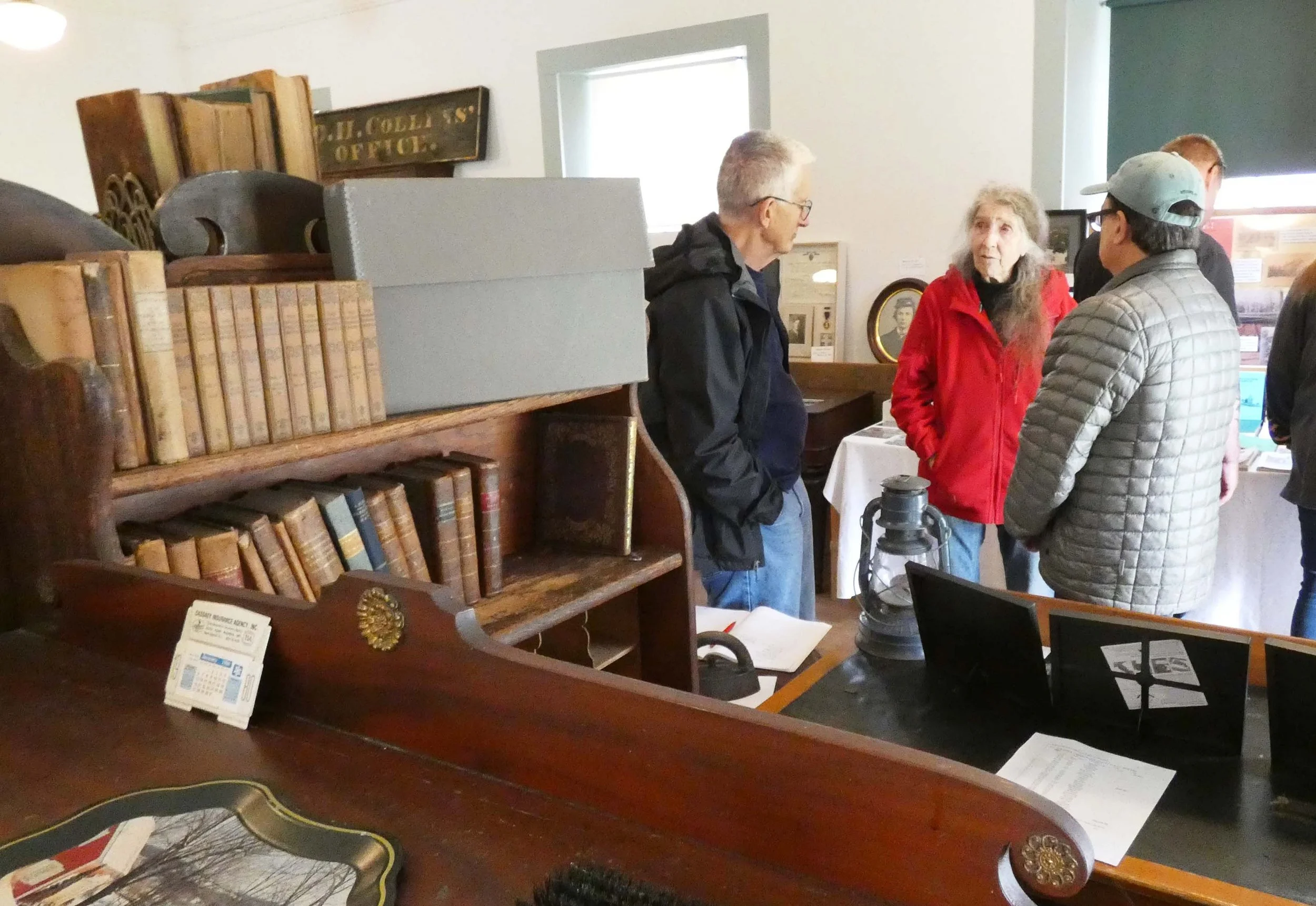
Enjoying an afternoon at the recent Haverhill Historical Society's Open House at the Ladd Street School Museum are, left to right, Phil Szilva, Lady Borton and Truman Sloan, all of Haverhill. The Bridge Weekly/Bernie Marvin
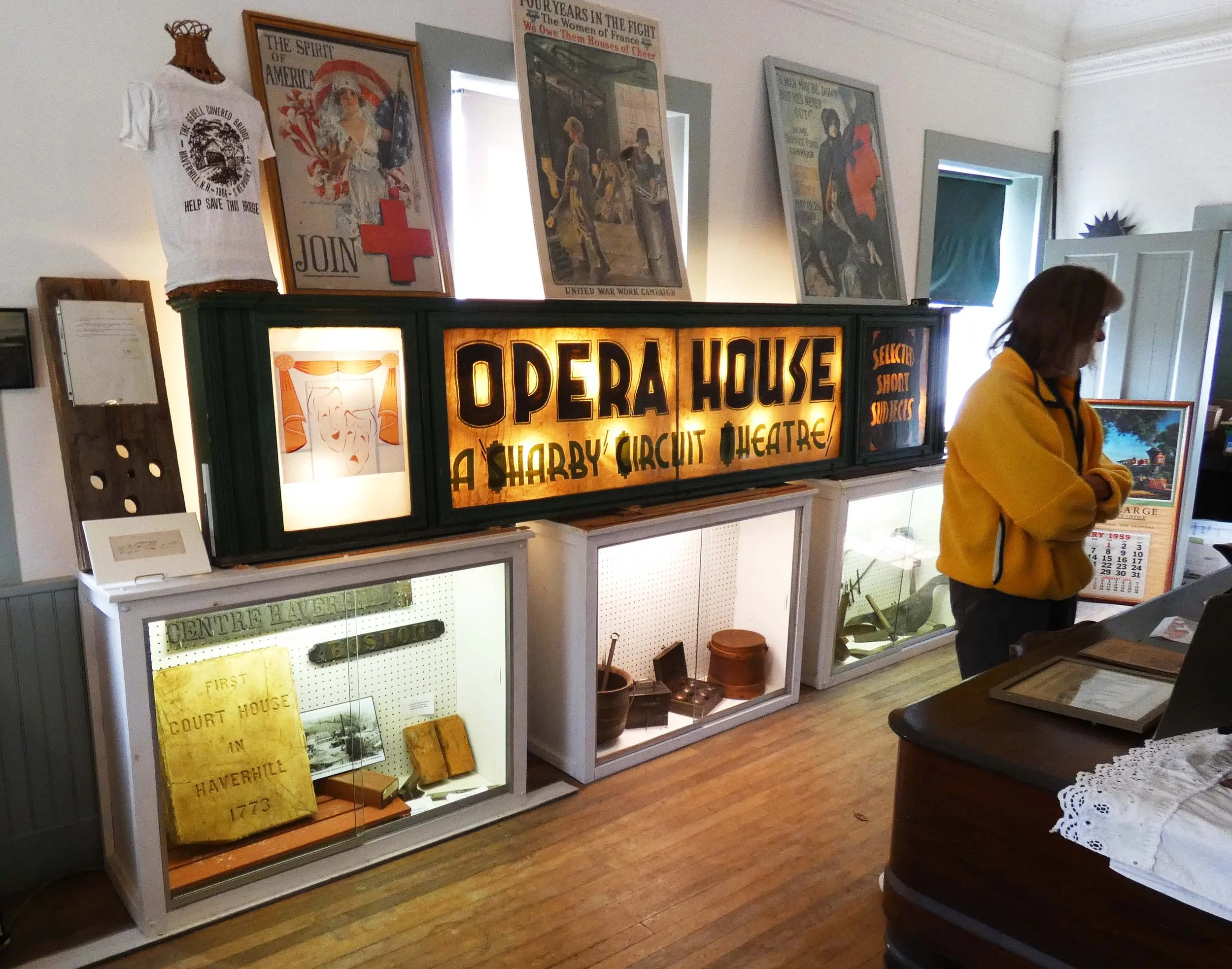
A visitor to the recent Haverhill Historical Society's Ladd Street School Museum Open House looks over historic artifacts on display, including an old Woodsville Opera House lighted sign. The Bridge Weekly/Bernie Marvin
Haverhill Historical Society Board members, left to right, Russ Brady and Greg Mathieson prepare refreshments prior to holding their Open House last weekend at the Ladd Street School Museum. The Bridge Weekly/Bernie Marvin.
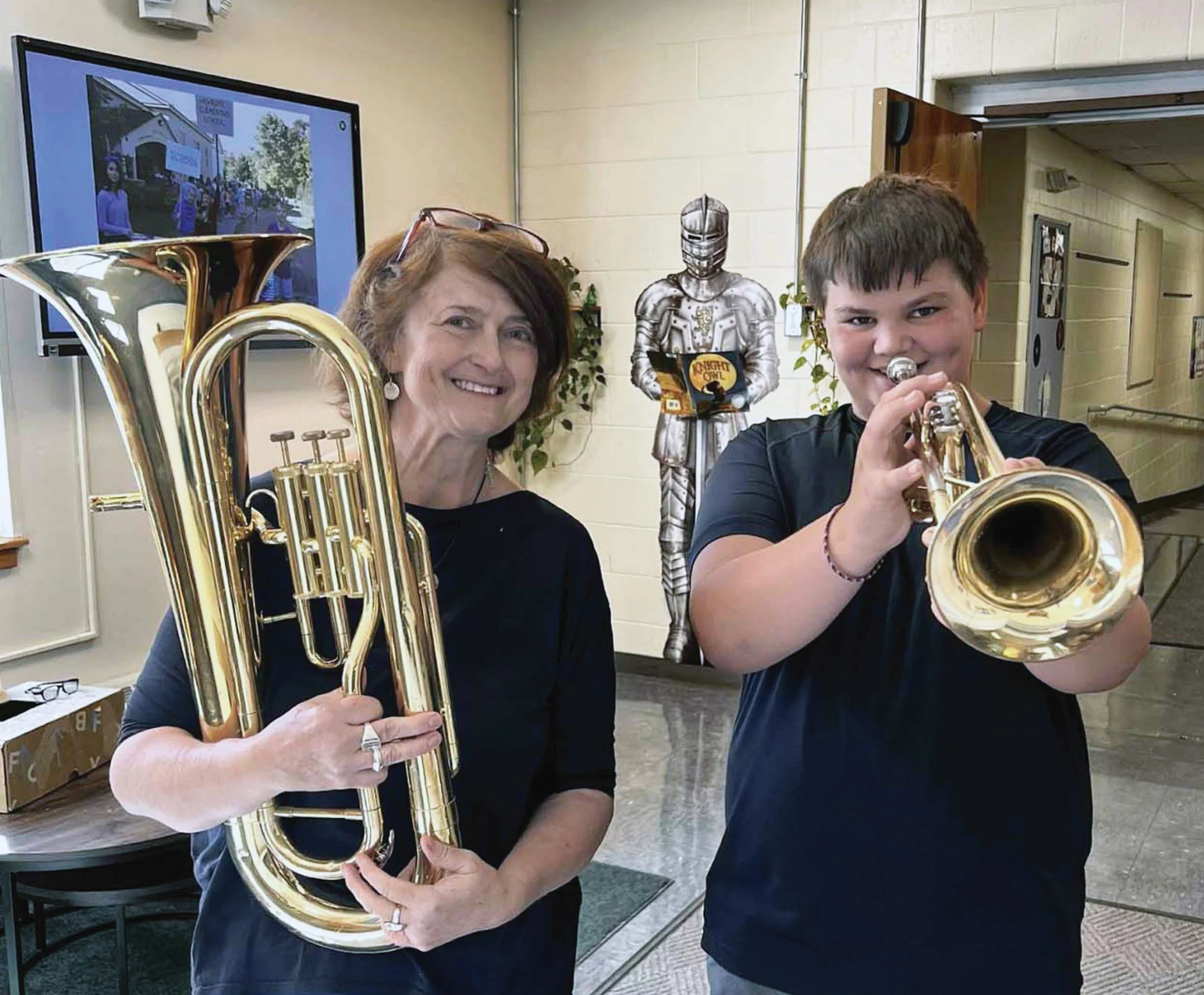
Music Helps
For the students of NES, Music Helps is enabling access to music education and exploration that otherwise would not have been possible. According to Music Helps Board member Rowe Williams, all other Orange East Superintendency Unit (OESU) schools have music programs, and this boost gives Newbury Elementary School students the same opportunities as other students in the district to play music on an instrument of their choice.
By Bernie Marvin
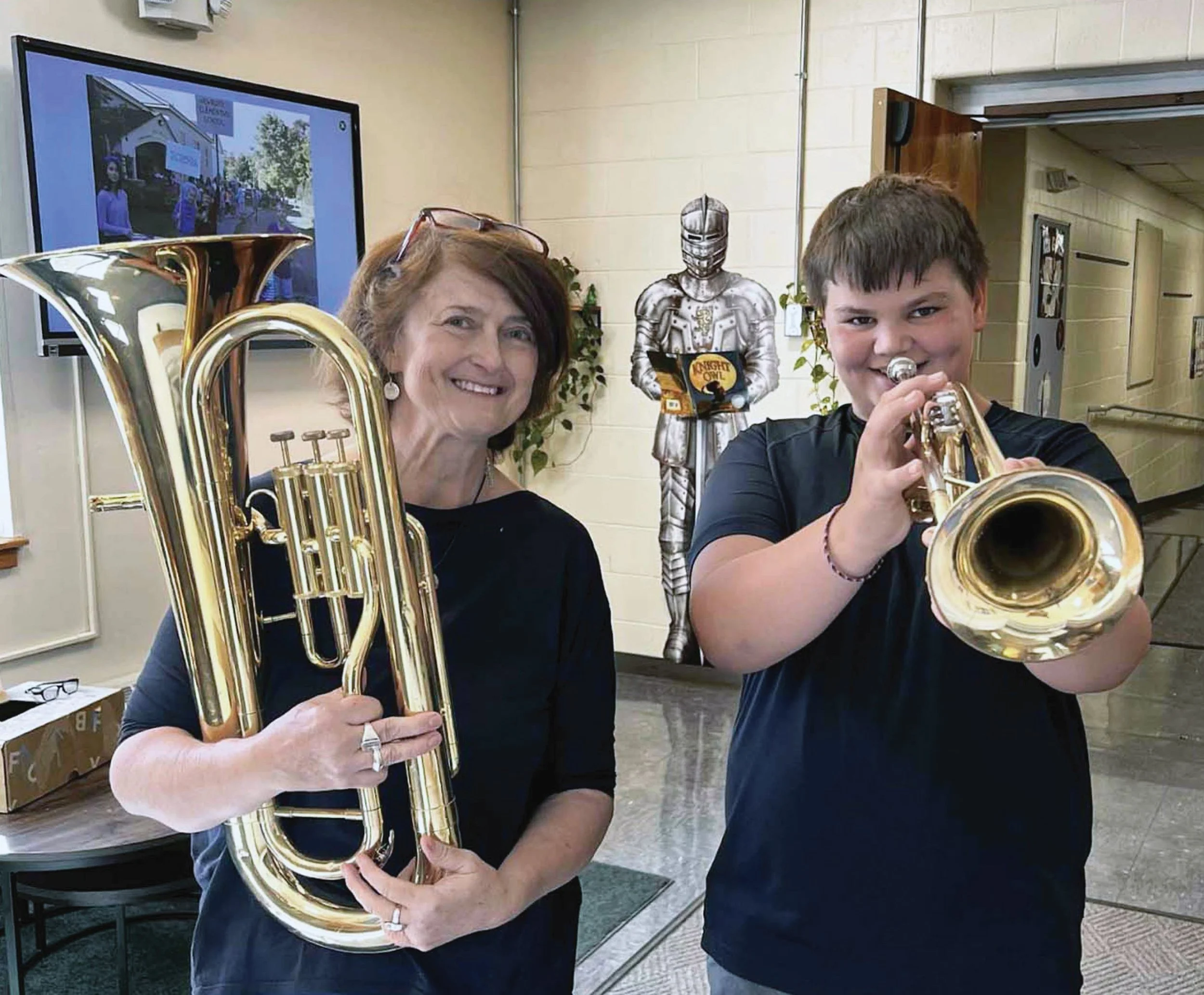
Music teacher Roxanna Zampieri with student Timmy Longmoore and their band instruments, acquired as part of a band initiative co-sponsored by Music Helps. Courtesy photo. Courtesy photo.
Newbury, VT - Newbury Elementary School music teacher has recently received a $1,500 grant that will enable her to establish a student band at Newbury Elementary School (NES).
Music Teacher Roxanna Zampieri had earlier applied for and received the grant from a local music education organization, Music Helps. In an interview with The Bridge Weekly, Music Helps board President Eliza Goodell noted that the overall aim of Music Helps is to facilitate the organization and distribution of private lesson scholarships, instrument rentals and loans, and school workshops, masterclasses, and performances, in an effort to increase access to musical education for all.
She said the group also aims to bring affordable, engaging musical performances to rural communities and provide spaces for music students to gain experience performing. The group is involved in everything from fundraising to organizing concerts and coordinating with schoolteachers and administrators.
For the students of NES, Music Helps is enabling access to music education and exploration that otherwise would not have been possible. According to Music Helps Board member Rowe Williams, all other Orange East Superintendency Unit (OESU) schools have music programs, and this boost gives Newbury Elementary School students the same opportunities as other students in the district to play music on an instrument of their choice.
Williams noted that Zampieri, who also teaches band music at Blue Mountain School (BMU), has already ordered instrument rentals for the program and presently has 40 students signed up. They had hoped to march in the early October Groton Fall Foliage Parade but had managed to squeeze in only one practice lesson prior to the parade stepping off.
Zampieri recently reported to The Bridge Weekly for this story that the Music Helps Scholarship program enables Newbury Elementary School students to receive an equitable music education in the OESU.
She said that students are now eligible to begin guitar/strings at Grade 2 at NES, and all other band students start in Grade 3. There are 49 students registered in Grades 2-6. Students receive a free instrument rental, along with a free weekly lesson and a monthly band class.
With this being offered to them when they leave NES for a middle school program within the OESU or in any other school, they will have the option of joining the band. If they did not have the prior education and offerings at NES, they would not have the chance, she said.
She said that music "is something that is a skill for life." Music supports reading through phrasing, note recognition/reading, and vocabulary. t supports math through counting, beat keeping, rhythmic reading, fractions, and more. Studying an instrument also supports proper health through correct posture, breathing, and cleaning, as well as learning how the instrument produces sound, understanding sound vibrations, and recognizing sound levels. This connection to science is a valuable aspect of the experience. If you add marching, it can be cardio and build stamina, she said, adding that `am also excited about what this will bring to the community.
Music Helps has indeed helped to give the gift of music to all NES students enrolled in the program.
She said she has worked with Music Helps in scheduling master classes with musician and teacher Patrick Ross when she was at SAU 23 for Grades 4-12. Patrick also team-taught his piece, "Raise Your Flag," with the students and performed with them in their spring concert.
One of the students, whom she referred to for private lessons and studies with Patrick Ross from Woodsville High School, received a lesson scholarship from Music Helps and is now majoring in music at Plymouth State University. The organization is wonderful, Zampieri said.
"Music Helps," Goodell described "began in 2022 and was brought together over a shared appreciation for music and music education. Everyone who continues to be on the board and who has joined the board has been positively impacted by access to music education and is passionate about increasing accessibility to the arts in our rural communities."
In addition to Goodell and Williams, the Music Helps board is comprised of Susan Goodell, Paul Sachs, David Carlson, and Don Sinclair. All Upper Valley locals, the board knows firsthand the critical support that was needed to foster their own musical education. Now they aim to ensure everyone has that same support.
Goodell also stated that while most of the operating costs are funded through individual donations, the group raises funds through benefit concerts, often in collaboration with local businesses. å are super grateful to have businesses in our area who support our mission, he ” he said.
Music Helps is always seeking interested schools to bring in musicians for performances, masterclasses, and workshops. Eliza added that they are working on a collaboration with both Bradford Elementary and Newbury Elementary now and have worked with Haverhill Middle and Woodsville High School, Oxbow High School, and Newbury Elementary School before.
According to the Music Helps website, private lesson scholarship applications are open for music teachers to apply on behalf of students with financial needs. Other educators may also reach out or submit applications for school collaborations of community programming. Music Helps support is available for any genre of music and any instrument.
For more information and to support their mission, please visit www.musichelps.us.
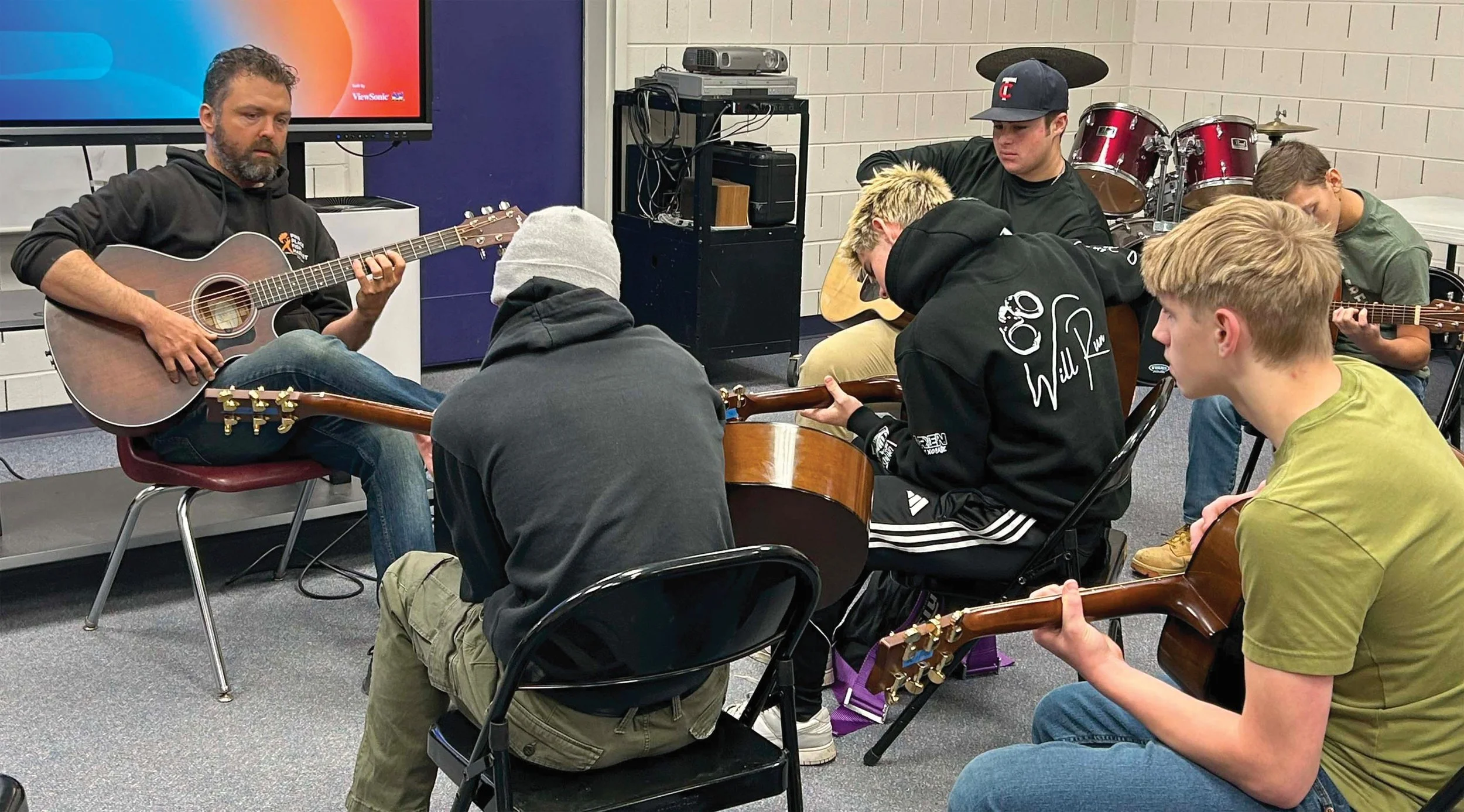
Multi-instrumentalist Patrick Ross gives a master class to an Oxbow High School guitar class in Bradford, Vermont. This multi-day intensive was supported in part by Music Helps3chool programming initiative. Courtesy photo.
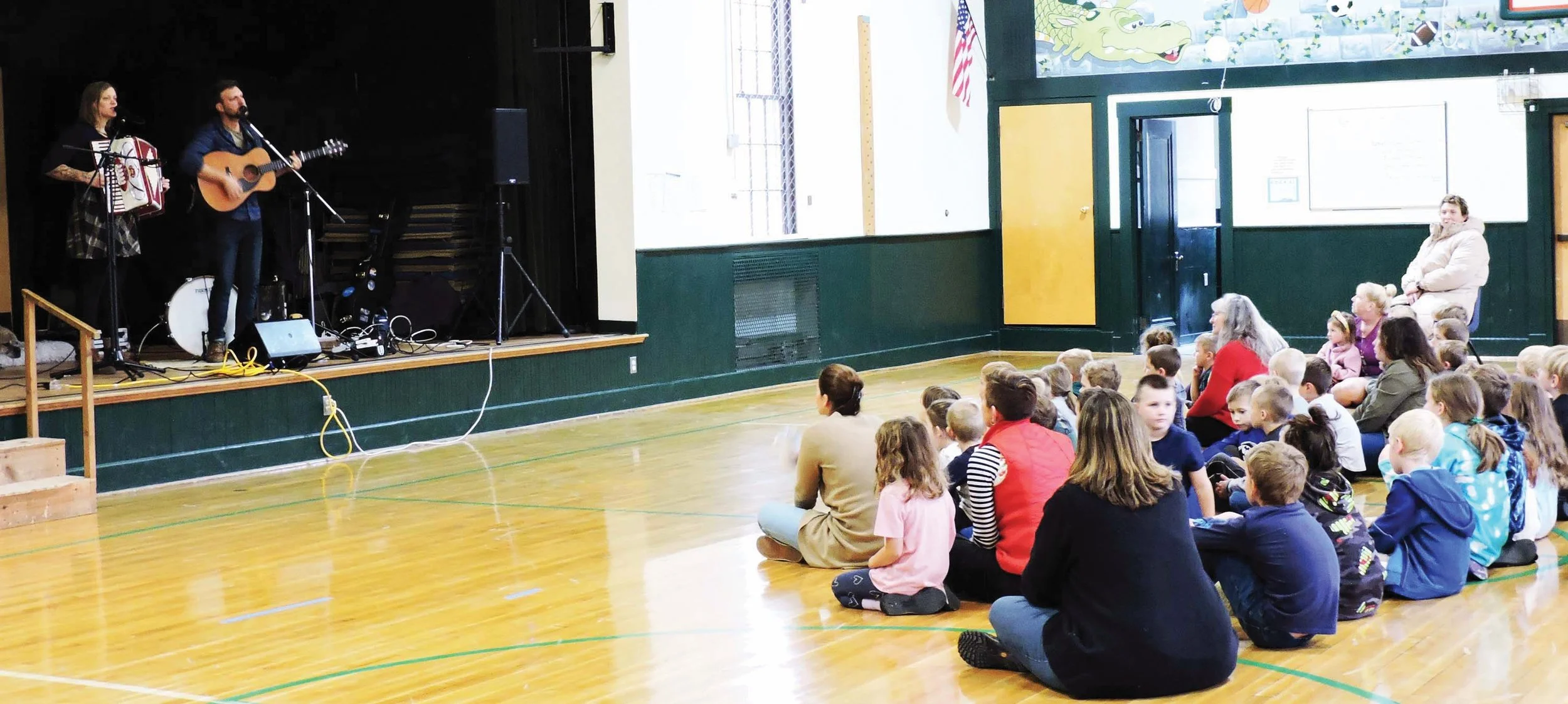
The Rough and Tumble, a folk/Americana duo, performs at a Music Helps sponsored school- wide assembly at the Newbury Elementary School. Courtesy photo.
On the Newbury Common Newbury Elementary School students experiment with their new band instruments as part of the Music Helps band program collaboration. Students are, left to right, Harrison Woodward, Mckenzie Torrey, Charlotte Spooner, Stephen Oliver and Kaydence Boyce. Courtesy photo.
Who Ya Gonna Call? Vermont’s 802 Ghostbusters Bring Heart, Humor, and Help to Communities
October is their biggest month. “Almost every weekend, we’ve got something,” Stasia said. “Parades, trunk-or-treats, conventions — we call it Hauntober.”
The Ecto JK-1 is fully decked out all season long as they string together events across the state. Later in the season, the group will appear in Casella’s Lights Parade, followed by a special basket raffle fundraiser at Old Town Café and Comics on November 14th, from 3:00 p.m. to early evening.
By Joshua Smith
The Team at Rail City Fan Fest 2024 posing with their ECTO JK1 (Courtesy Photo)
“I’d seen fan groups all across the country doing parades, Make-A-Wish events, and fundraisers. It looked like so much fun — and I thought, we could do that too.”
— Stasia D., Co-founder, 802 Ghostbusters
A Nostalgic Spark That Became a Movement
If you were walking through a fall festival, trunk-or-treat, or a downtown parade in Vermont and suddenly heard the unmistakable wail of a Ghostbusters siren, chances are you’ve encountered the 802 Ghostbusters.
They’re not actors or a traveling show. They’re Vermonters — parents, makers, neighbors — who’ve turned their love of Ghostbusters into a powerful community-building force.
The group began in 2016, when Stasia and Stef D., along with their family, decided to join the growing ranks of Ghostbusters fan “franchises” springing up across the country. What started as a fun family project soon grew into a statewide group with members stretching throughout almost all 14 counties, each bringing their own talents — from prop building to event planning to interacting with kids and families.
Community First, Cosplay Second
When the 802 Ghostbusters show up, they bring more than just proton packs. Their appearances at touch-a-truck events, trunk-or-treats, and local parades are free for communities — powered by their volunteer energy and the magic of their Ecto JK-1, a Jeep Wrangler transformed into a rolling nostalgia machine.
The Ecto JK-1 was built by member Mathew Haley, lovingly nicknamed “our Egon” for his technical know-how.
“It’s an easy, free way to connect,” Stasia said. “Kids climb in, push the buttons, sound the siren — and adults light up too. You can always tell when a parent has that moment of recognition, like, ‘Okay, it’s time for you to watch Ghostbusters.’ It becomes this pop culture capstone between generations.”
Ghostbusters Give Back
This year, the 802 Ghostbusters joined the Ghostbusters Gives Back Initiative, a national partnership between fan groups, Sony, and the Starlight Children’s Foundation.
The initiative runs June 8, 2025 through June 7, 2026, and every dollar raised by registered franchises is matched by Sony — up to $150,000 nationwide — doubling the impact for hospitalized children and their families.
Funds support entertainment, events, and hospital programs that bring comfort during difficult times.
“We set a fundraising goal along with other franchises across the country,” Stasia said. “On June 8th — Ghostbusters Day — we’ll check in to see how we did.”
June 8th, of course, marks the original release date of the 1984 film. Some dates are sacred.
The Busy Season: “Hauntober”
October is their biggest month. “Almost every weekend, we’ve got something,” Stasia said. “Parades, trunk-or-treats, conventions — we call it Hauntober.”
The Ecto JK-1 is fully decked out all season long as they string together events across the state. Later in the season, the group will appear in Casella’s Lights Parade, followed by a special basket raffle fundraiser at Old Town Café and Comics on November 14th, from 3:00 p.m. to early evening.
The Ecto JK-1 and a giant Stay Puft Marshmallow Man will be on-site, and all proceeds will benefit the Starlight Children’s Foundation.
After November, things quiet down — but their sense of purpose never does.
Vermont Heart in a Proton Pack
In a world where cosplay can sometimes be competitive or celebrity-driven, the 802 Ghostbusters stand out. They’re Vermonters bringing nostalgia, joy, and service to their neighbors.
They show up at the same parades your kids march in, park next to you at the grocery store, and hand out smiles at no cost. Their focus isn’t on fame — it’s on connection.
“Little kids don’t always get the reference, but they know we’ve got cool things to look at,” Stasia said. “Adults love it. It’s a conversation starter — and that’s what makes it special.”
Join the 802 Ghostbusters This Halloween Season!
Follow the siren to an event near you. The 802 Ghostbusters will be appearing at parades, trunk-or-treats, and fundraisers every weekend in October, bringing spooky fun and raising money for the Starlight Children’s Foundation.
Want to help or get involved?
Love Ghostbusters?
Enjoy community events and volunteering?
Want to make kids (and grown-ups) smile?
The 802 Ghostbusters welcome new members from all across Vermont. Whether you’re a prop builder, a people person, or just someone who loves spooky season, there’s a place for you.
Follow them on Facebook at facebook.com/802Ghostbusters for upcoming appearances and info on how to join the team.
This Halloween season, let a little movie magic — and a lot of Vermont heart — remind you that our communities shine brightest when we come together.
The Last Word
Seeing Ghostbusters gear against a Vermont backdrop shouldn’t work — and yet, it absolutely does. Vermonters have always known how to blend work ethic with whimsy, and the 802 Ghostbusters prove that community service can wear a proton pack.
This Hauntober, if you hear that siren echoing through town, don’t just smile — follow it. You might find yourself in the middle of something special… and maybe even holding a proton pack of your own.
Richmond Independence Day Parade 2025 (we placed 3rd. The prize was $75, donated to the Starlight Children’s Foundation)
The franchises are “International”. Here’s a nice map of the North America teams (Courtesy Photo)
A young fan in awe of the larger props from the group (Courtesy Photo)
A Sisterhood of Hope
When asked if she had any advice for others, Erin replies, “Don’t jump right into thinking the worst. I have to have chemo. I’m going to lose my hair. Every single person’s cancer story is different, and your diagnosis is what drives your treatment so never, ever put off having a check-up because you’re afraid. As the saying goes, ‘Better the devil you know than the devil you don’t.’”
By Trish Griswold
According to the National Breast Cancer Foundation, Inc., there are “more than 4 million current breast cancer survivors in the United States.” Erin Atkinson (L), owner of Gather Together Cafe, and her sister, Liz Gilbert Shelton, owner of An Affair to Remember: The Party Store and Everything But the Cook, are among them. TBWS Photo/Trish Griswold
WOODSVILLE - “The last words I ever wanted to hear from my daughters was, ‘I have cancer,’” remarks Marilyn Gilbert, mother of Elizabeth “Liz” Gilbert Shelton, owner of An Affair to Remember: The Party Store and Everything But the Cook, and Erin Atkinson, owner of Gather Together Cafe. “I was totally devastated, but once I got over the initial shock, my main concern was that they get the best treatment plan available.”
Through a routine mammogram conducted in 2008, Liz was diagnosed with hormone receptor-positive (HR+) breast cancer, a form of breast cancer linked to hormone levels, such as estrogen, rather than inherited mutations and genetic predisposition. The then 45-year-old wife and working mother of three young adult children underwent surgery and an extensive treatment plan that included radiation twice a day for ten days followed by balloon breast brachytherapy and four rounds of chemotherapy.
“For me, my whole thing was, we need to take care of this. I wasn’t really emotional,” Liz recalls, but her husband, Kevin Shelton, was. “For the people not going through it, it’s the hardest. They’re treading water, not knowing what to do with themselves, and thinking, ‘What do I say? What do I do?’”
Looking back, Liz says that she can only remember crying once, and that was when a representative from Dartmouth Hitchcock’s Cancer Center called to schedule her first appointment. “The first time they said the word ‘cancer.’ That’s when it became real. The biggest thing was that I wanted to know what I did wrong. That was the only question I asked. Did I do something wrong? Did I not take care of myself? When, in fact, it had nothing to do with my lifestyle and my life choices. It was the luck of the draw.”
New research from the National Breast Cancer Foundation, Inc. (NBCF), among others, indicates that “1 in 8 women in the United States will be diagnosed with breast cancer in her lifetime.” Given this startling statistic and her increased risk of breast cancer because a first-degree relative (mother, sister, or daughter) had been diagnosed, Liz’s younger sister, Erin, was vigilant about preventative care. A routine mammogram done a few years ago had detected calcification(s) in her left breast. This turned out to be a benign cyst; however, since certain patterns of calcification can sometimes be an early indicator of breast cancer, Erin paid special attention to the changes in her body.
During a routine self-exam in October of last year, Erin felt a 1.2-centimeter lump in her breast that turned out to be hormone-based breast cancer (different from but similar to Liz’s). Erin had a regularly scheduled physical a few days later so she purposely did not mention the lump to her primary care doctor. “I didn’t say anything to her to see if she felt it, and she did not. I said, ‘Did you, by any chance, feel that right there?’ She said, ‘I did not. I missed it.’”
Erin’s doctor scheduled a mammogram for later that week. “If she had not asked for the right side to have a special plate,” Erin says, “they would not have found [the lump] on a regular mammogram either. So, my cautionary tale is to be proactive. You know your body. Make sure you’re doing your self-checks. Thankfully, I caught it so quickly that it was very small.”
Erin underwent surgery, reconstructive surgery, and five weeks of radiation therapy. She is also on an estrogen suppressant that she will likely take for the next five years. “Because I already had time to process before I went to my primary care doctor and had the mammogram and the biopsy, I wasn’t upset. I wasn’t scared. I tend to have a pretty positive attitude toward health care. I felt like, ‘Okay, what is the next step? Let’s get this taken care of.’”
The physicians and other care providers at Cottage Hospital and Dartmouth Hitchcock’s Cancer Center, both Hanover, NH, and St. Johnsbury, VT, “jumped right in,” Erin says. They scheduled her appointments, presented her with comprehensive treatment plan options, and a smorgasbord of reading materials. Erin also sought genetic testing. “Unlike Liz, I wanted to check for my own son's sake because it could be a precursor to him, looking down the line at something like prostate cancer or if I had a granddaughter some day, but it was not genetically driven.”
Due in part to the 16-year gap between their diagnoses, Erin and Liz agree that, while their outcomes have been positive and nothing short of a blessing, they had drastically different experiences, from detection to coping strategies and treatment plans to side effects. Erin’s breast cancer was initially detected through a self-exam, while Liz’s was detected with a routine mammogram. The treatment options and side effects were also different. Liz suffered more intense symptoms, such as vomiting, while Erin’s side effects were minimal. Erin took a literary, methodical approach to processing her diagnosis, finding a sense of peace and camaraderie in talking with others, while Liz preferred a more private approach, relying on her sense of humor, friends, and immediate family.
Despite the disparities in their cancer stories, there is one common thread. The Gilbert sisters’ breast cancer journeys introduced them to a sisterhood founded on hope for survival and an unbreakable bond shared among countless women nationwide. “When you fall down, [our community] will pick you up,” Liz says, retelling the story of one customer who “popped her head in the door” at The Party Store after learning about Liz’s diagnosis and said, “‘I’m 10 years out.’ It’s them letting you know that you’ll be okay.”
Admittedly, the journey can be scary and overwhelming, Liz and Erin explain, but there is hope for survival. According to NBCF, when breast cancer is detected and treated at “its earliest, localized stages, the 5-year relative survival rate is 99%.”
When asked if she had any advice for others, Erin replies, “Don’t jump right into thinking the worst. I have to have chemo. I’m going to lose my hair. Every single person’s cancer story is different, and your diagnosis is what drives your treatment so never, ever put off having a check-up because you’re afraid. As the saying goes, ‘Better the devil you know than the devil you don’t.’”
Author’s Note: October is Breast Cancer Awareness Month, a time dedicated to empowering women by raising awareness and promoting early detection. This article honors all women - past, present, and future - who have battled or will battle breast cancer in their lifetime. For more information about breast cancer research, contact your primary care provider, or go to nationalbreastcancer.org or komen.org.
“I am not defined by my cancer. I am stronger than it.” -Author Unknown
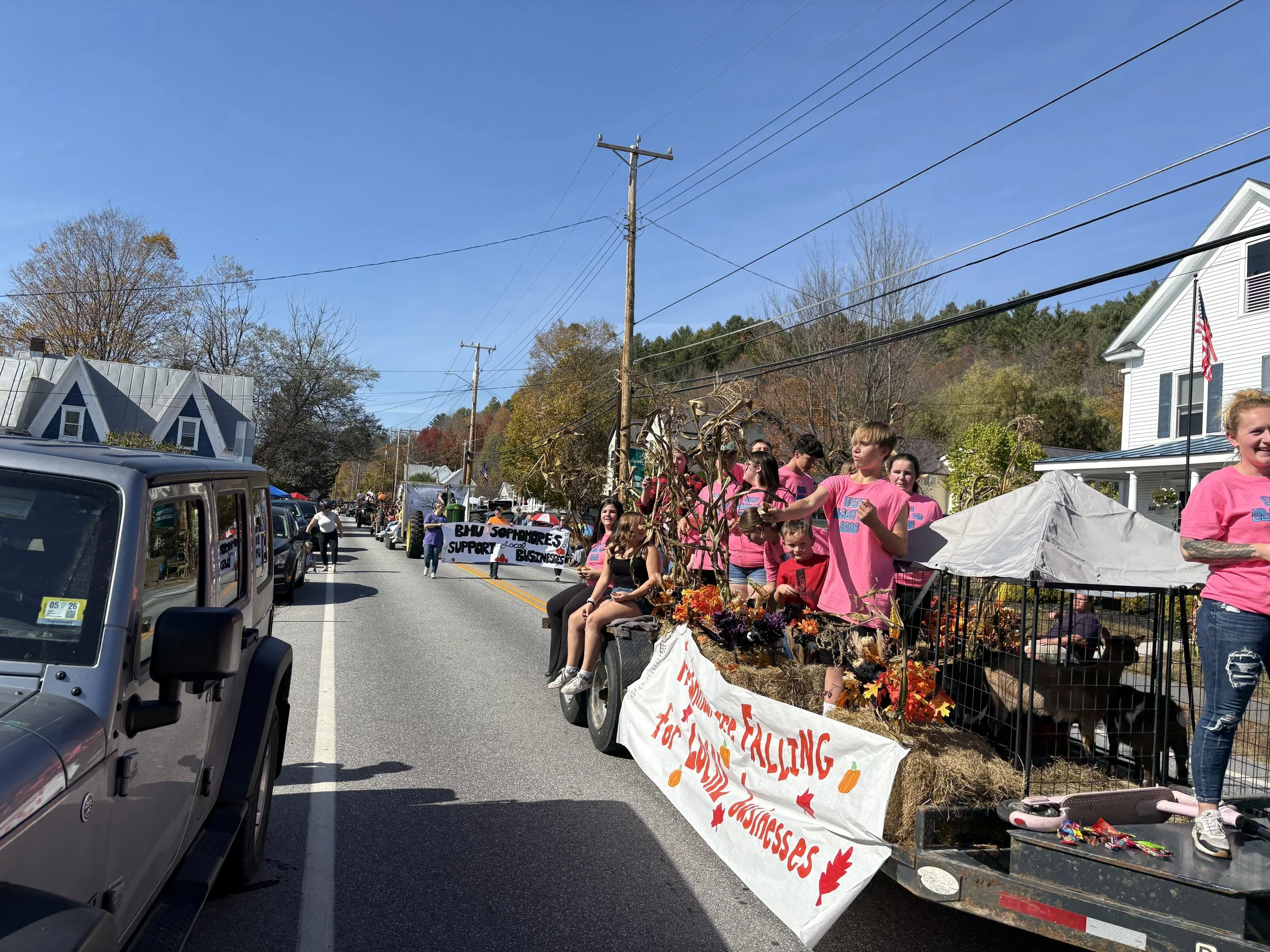
Groton’s 69th Annual Fall Foliage Festival: When the Town Dresses Up for Everyone
“It’s like coming home,” said Michelle Emerson Kalnins, BMU class advisor. “You get to see all the people you grew up with, you get to see all the buildings you grew up with. All the families come back. It’s a great time here in Groton.”
The Chicken Pie Supper isn’t just a meal. It’s an anchor. People plan their weekends, even their travel, around it. Proceeds from ticket sales support scholarships for local high school seniors, the library, and other community projects. It’s generosity served alongside supper.
By Joshua Smith
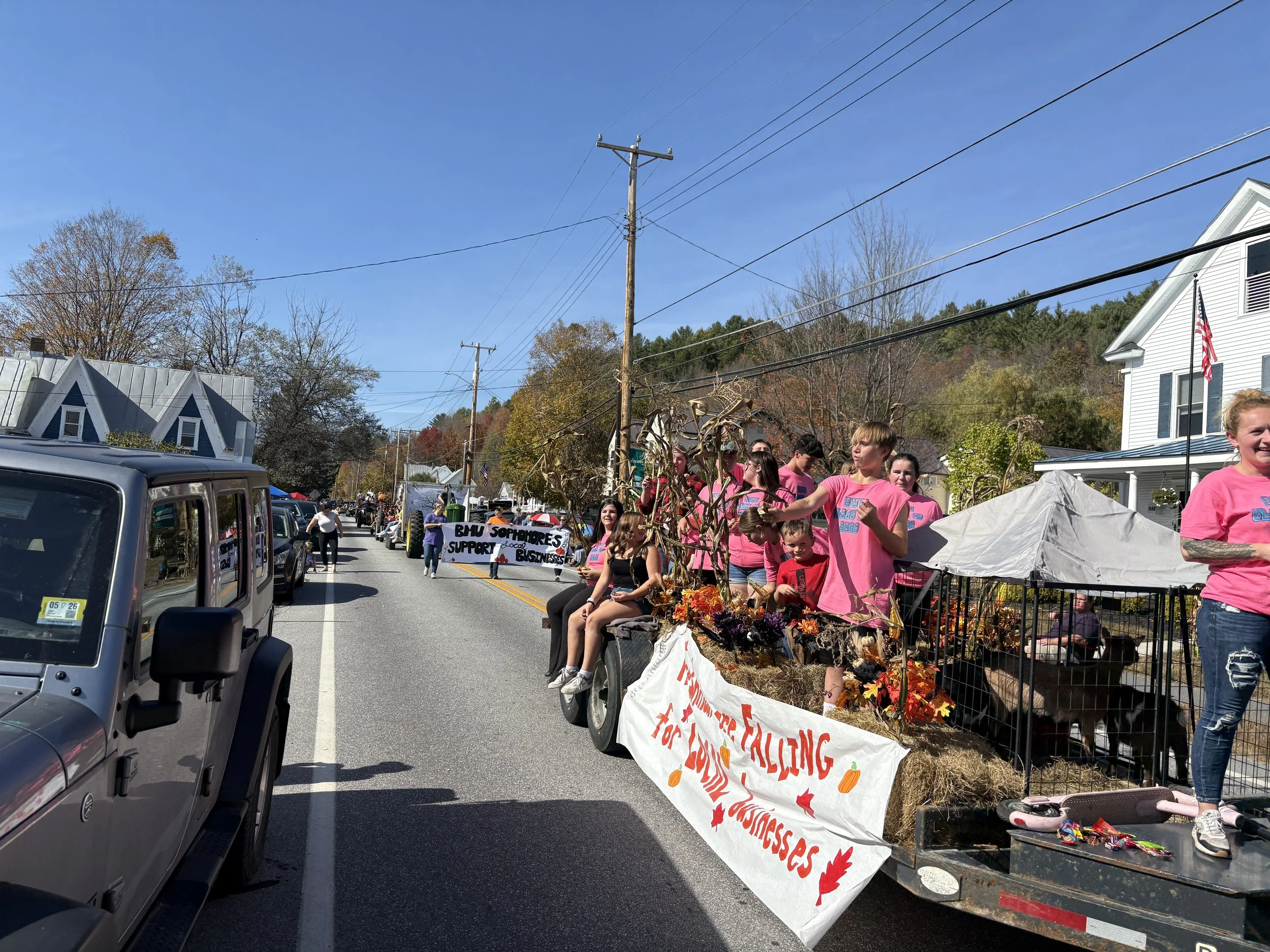
GROTON VT - “It’s important to continue to foster a sense of community and togetherness. It’s a New England tradition of everyone getting together.”
— Aaron Smith, Groton Fire Chief
Every October, just as the maples burst into fiery reds and the hillsides settle into their golden glow, Groton does what it’s done for generations: it dresses up for everyone.
For one day each year, this small town in the southwestern corner of Vermont’s Northeast Kingdom transforms into something both deeply familiar and quietly magical. Streets fill with neighbors, visitors, and returning families. The air carries the mingled scents of baked goods, autumn leaves, and wood smoke. It’s part reunion, part fair, part homecoming.
The 69th Annual Fall Foliage Festival wasn’t just another event on the calendar. It was living proof that some traditions aren’t merely remembered — they’re relived.
A Morning That Tastes Like Home
Long before the parade or the vendors set up, folks were already filing into the basement of the Methodist Church for the annual lumberjack breakfast, a fixture of festival morning for as long as anyone can remember.
The menu is unapologetically hearty: pancakes, sausage, biscuits and gravy, doughnuts, and pie. It’s the kind of breakfast that doesn’t just fill you up — it anchors you. Generations have started their festival day at those tables, catching up over steaming cups of coffee while kids sneak extra doughnuts when they think no one’s watching.
Main Street Comes Alive
By mid-morning, downtown Groton was buzzing. Over 40 vendors filled Main Street, a colorful mix of local craftspeople, bakers, and community groups. Handmade goods sat beside jars of homemade jam. Students from local schools sold baked treats and raffle tickets to raise funds for their class projects.
The Baptist Church bake sale was, as always, a destination of its own. Pies, cookies, and breads lined long tables like trophies of neighborly pride. Many of those recipes haven’t changed in decades — and that’s exactly how folks like them.
It’s the kind of Main Street scene that could’ve taken place fifty years ago or last weekend. Old friends stop mid-street to talk, shop owners lean in their doorways, and the rhythm of conversation rolls like the nearby hills.
Parade Magic on Route 302
At 1:30 p.m., Route 302 shut down for thirty minutes as the parade took over. There’s nothing flashy about Groton’s parade — and that’s precisely why it’s so beloved.
The school band led the way, followed by fire trucks, tractors pulling themed floats, and plenty of kids waving proudly from hay bales. Families lined the sidewalks bundled in sweaters, cider in hand, cheering as neighbors rolled by.
For Groton Fire Chief Aaron Smith, moments like this define the festival.
“It’s important to continue to foster a sense of community and togetherness,” he said. “It’s a New England tradition of everyone getting together.”
Up the Road a Bit
Just up the road a bit, the Upper Valley Grill hosted the annual pumpkin weigh-in. It’s a friendly kind of competition — the kind that makes everyone grin. This year’s bragging rights went to Calvin Lang, who tipped the scales with a 184-pound pumpkin. It wasn’t just a pumpkin; it was a testament to patience, care, and a bit of local pride.
A Supper That Defines a Town
As the sun dipped behind the hills, all roads led to the Groton Community Building, where the world-famous Chicken Pie Supper capped the day.
Three seatings — 4:30, 5:30, and 6:30 — along with take-out at 5, 6, and 7 — meant a steady stream of hungry festival-goers filed through the doors. The smell of chicken, biscuits, and gravy filled the building, wrapping everyone in something both familiar and comforting.
“It’s like coming home,” said Michelle Emerson Kalnins, BMU class advisor. “You get to see all the people you grew up with, you get to see all the buildings you grew up with. All the families come back. It’s a great time here in Groton.”
The Chicken Pie Supper isn’t just a meal. It’s an anchor. People plan their weekends, even their travel, around it. Proceeds from ticket sales support scholarships for local high school seniors, the library, and other community projects. It’s generosity served alongside supper.
Neighbors Supporting Neighbors
Over at the library, programs ran throughout the day, reminding everyone that this festival isn’t only about tradition — it’s about community action.
“It is a wonderful opportunity to support our neighbors,” said Sarah Spira, town librarian. “And gather with our neighbors and support local businesses and organizations and celebrate the passing of the season.”
Her words ring true. Groton’s festival is more than food, music, and parades. It’s a seasonal ritual — a way for the town to check in with itself, to reconnect, to show visitors and former residents what “home” still means.
A Town, Unchanged at Its Core
I grew up here. Walking down Main Street during the Fall Foliage Festival, I see new faces, new storefronts, a few changes here and there. But at its core, Groton hasn’t changed. The same hills rise behind the town. The same church basements hum with chatter. The same floats roll past under autumn skies.
For 69 years, this festival has marked not just the turning of the leaves, but the steady rhythm of a community that shows up for one another. It’s where memory and the present meet.
And long after the last chicken pie is served and the vendors pack up their tables, the feeling of the day lingers — like the warm, golden light on the hillsides that surround this little Vermont town.
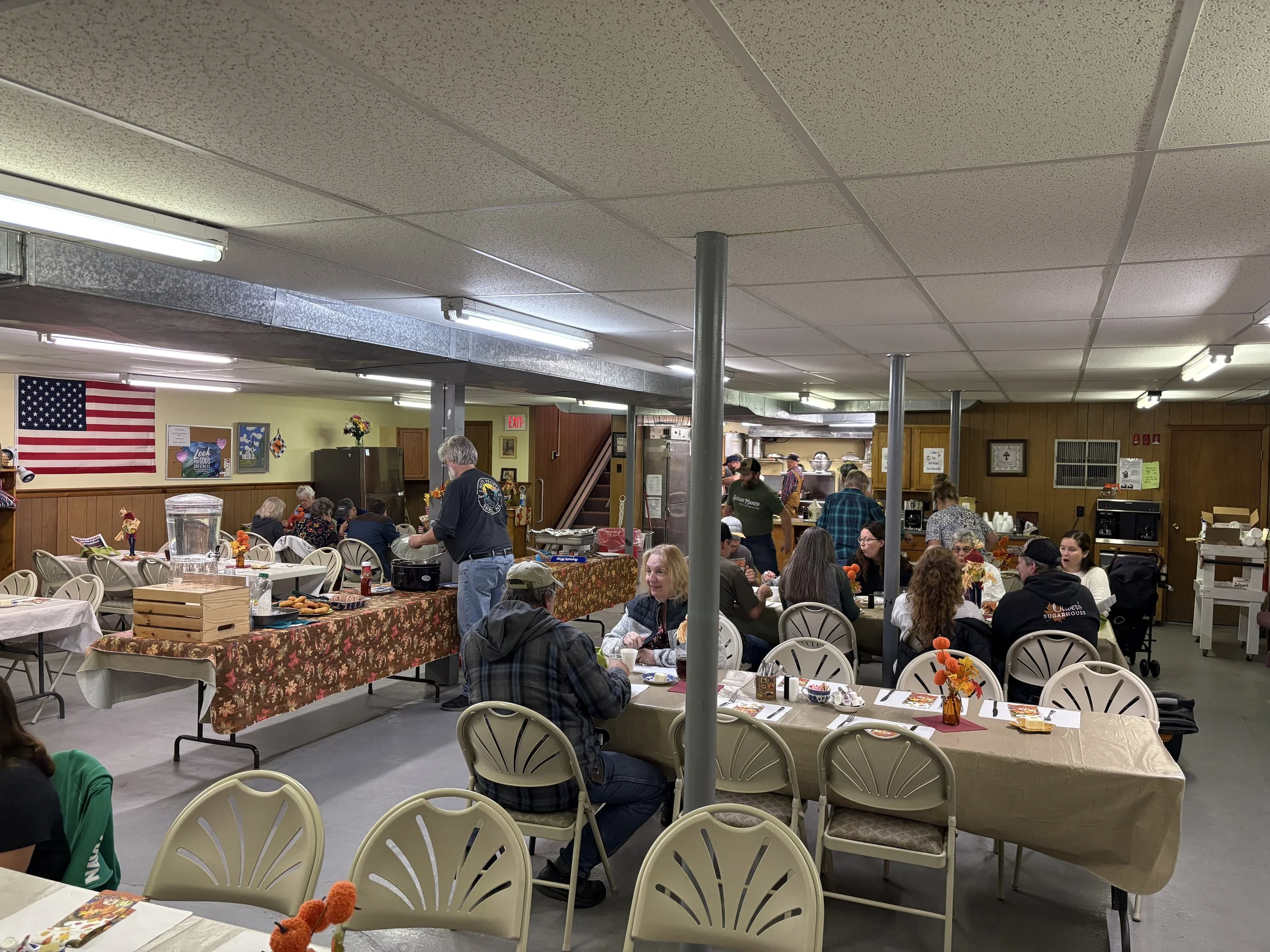
The Morning always starts with the Lumberjack Breakfast in the basement of the Groton United Methodist Church.
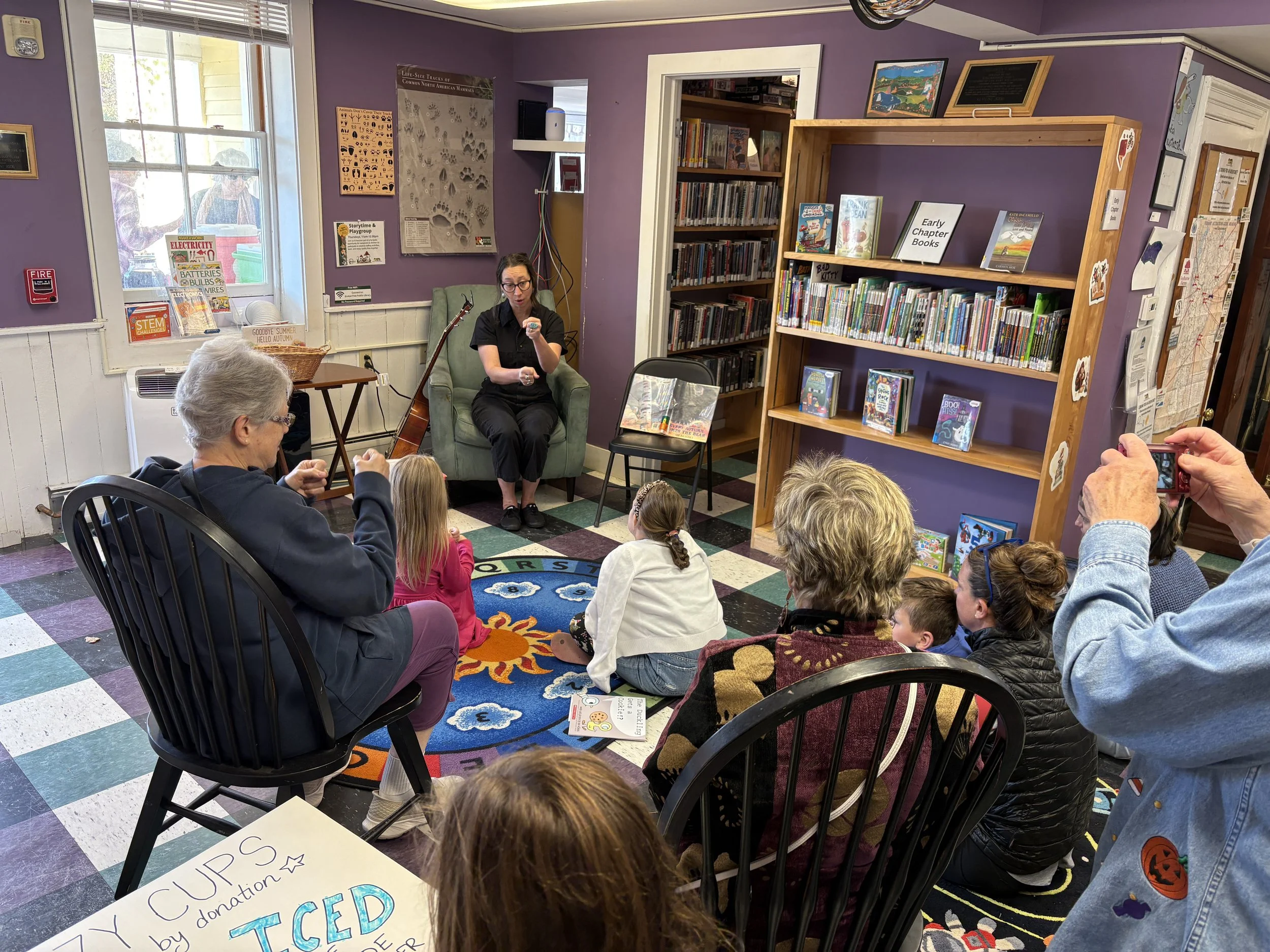
Amid the bustle outside, Librarian Sarah Spira leads a cozy reading hour for children, sharing stories by local authors and offering a welcome break from the festival excitement.
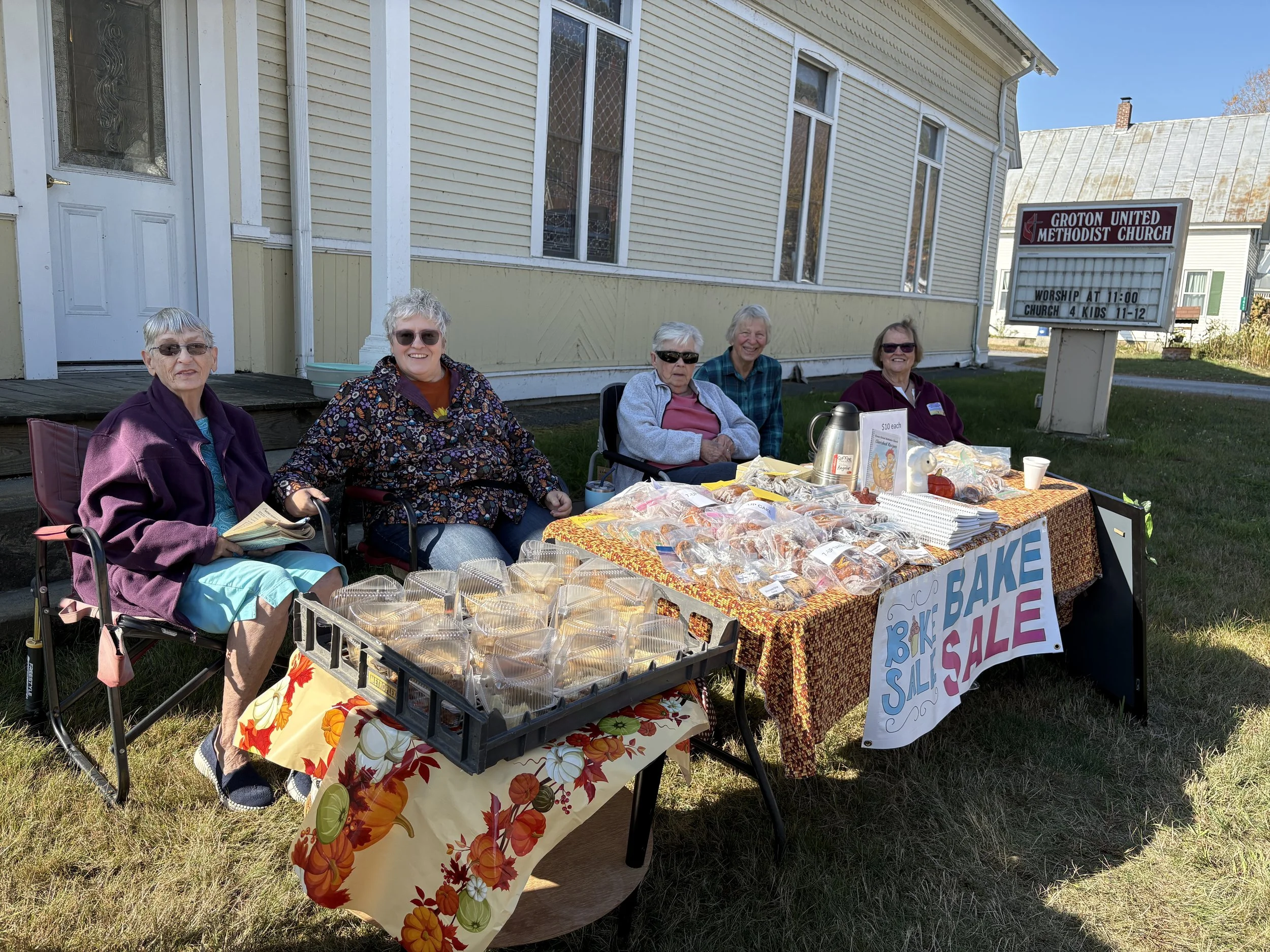
Bake Sale goodies: United Methodist women L-r) Betty Rainford Brenda Powers Babs Smith Kathy Crum Pastor Pam Smith
After serving the town of Groton in the Highway Department for over thirty -two years, Phillip Palmer recently retired and was participating in the festivities of the annual Fall Foliage Parade from the wheel of Groton’s antique fire department truck. The Bridge Weekly/Shauna Kimball
The unsung heroes of Groton’s Chicken Pie Supper — the “runners” — keep the food moving from the kitchen downstairs to the bustling dining hall upstairs. (L–R) Poppy Shattuck, Madison Frigon, Zhijie Zhong, Bella Cole, Raiden Moulton, and Lucas Welch
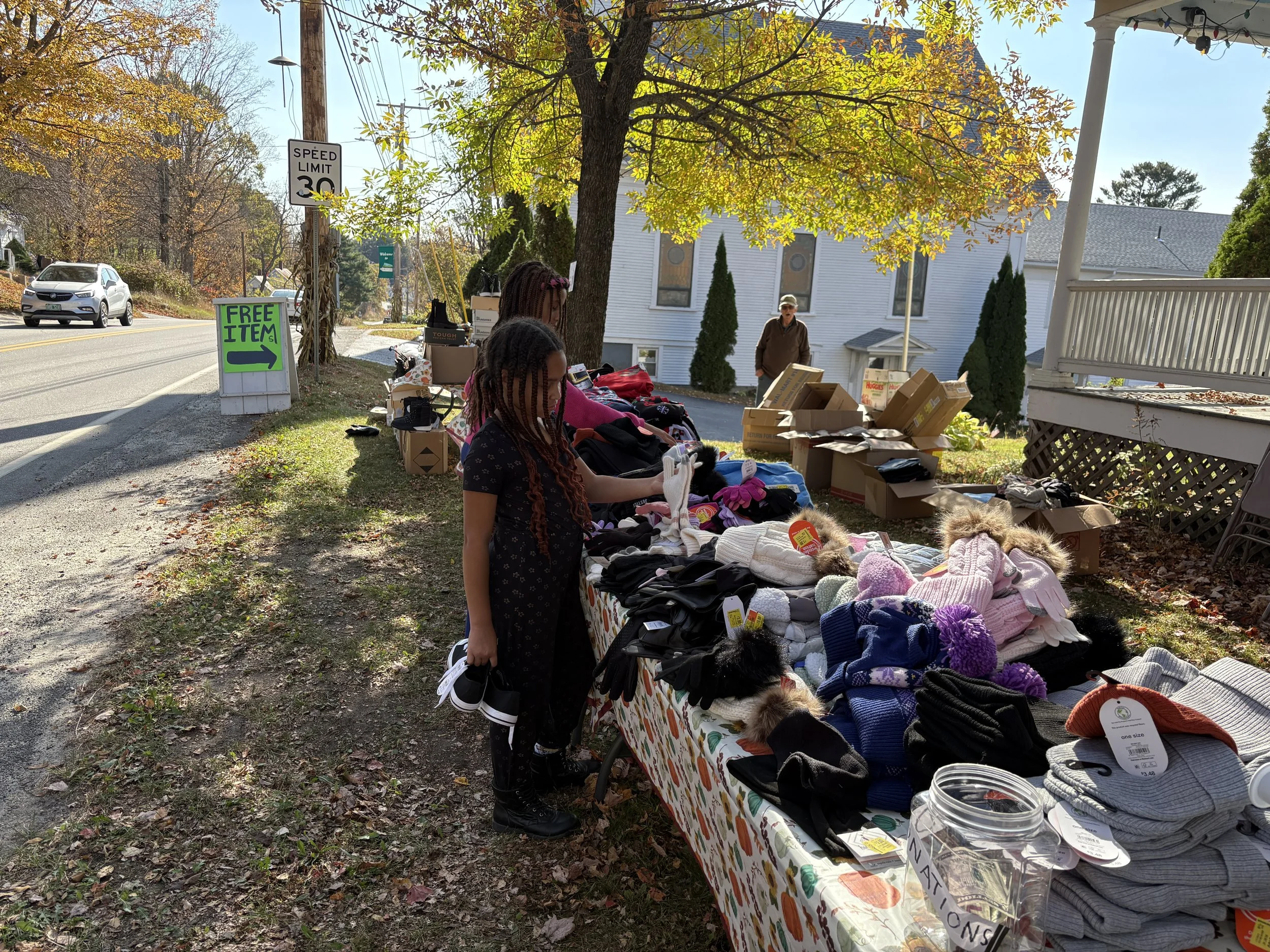
Children explore a sea of donated new clothing laid out by the Groton Baptist Church, offered freely to families or by donation.
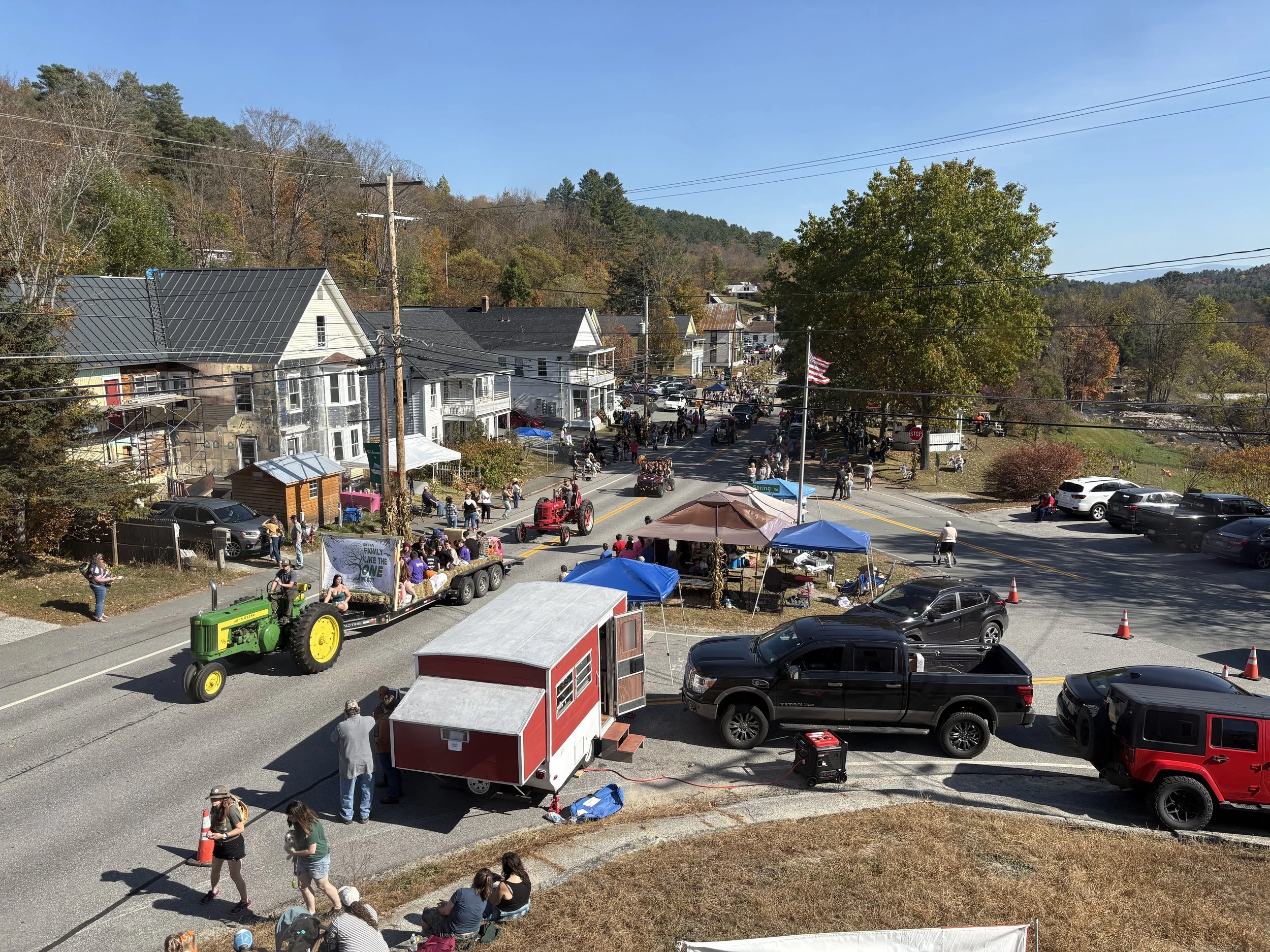
The parade, lasting about 30 minutes, is one of the highlights of the Groton Fall Foliage Festival, seen here from a second-story church window.
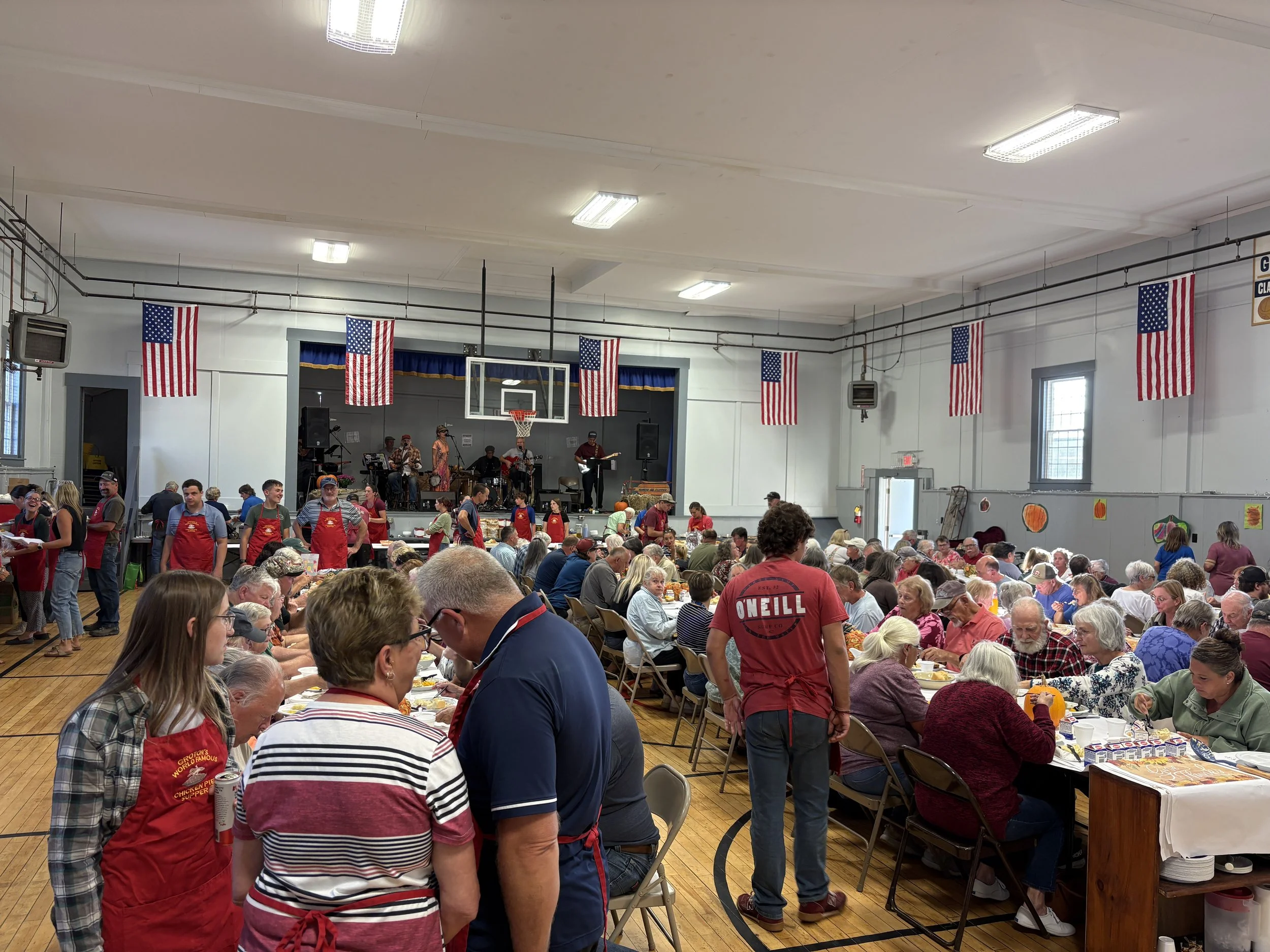
The Groton Community Building is transformed into a bustling dining hall as hundreds gather for the world-famous Chicken Pie Supper, the crown jewel of the Fall Foliage