

Don’t Let Your Friends Go Without You: Vermont’s Sci-Fi, Fantasy & Horror Expo Returns
The 7th annual Vermont Sci-Fi, Fantasy & Horror Expo returns to the Champlain Valley Exposition in Essex Junction on Saturday–Sunday, April 25–26, 2026, and it’s shaping up to be the kind of event you don’t just “drop by.” You plan around it. Because once you’re inside, you start realizing how big it is, how much there is to do, and how quickly the weekend fills up.
If you’ve ever seen someone’s convention photos afterward—kids grinning in Jedi robes, a parent holding a freshly signed poster, a group of friends who clearly had the best weekend—and thought, Wait… that was in Vermont?—this is your heads-up.
By Joshua Smith
Green Mountain Turtles will be there
The 7th annual Vermont Sci-Fi, Fantasy & Horror Expo returns to the Champlain Valley Exposition in Essex Junction on Saturday–Sunday, April 25–26, 2026, and it’s shaping up to be the kind of event you don’t just “drop by.” You plan around it. Because once you’re inside, you start realizing how big it is, how much there is to do, and how quickly the weekend fills up.
Jeff Folb—owner and general manager of Vermont Gatherings, the team behind the Expo—calls it Vermont’s own version of a Comic-Con experience, “our local Comic-Con, without calling it a Comic-Con.” And that’s not just a fun line—it’s a pretty accurate description of what the Expo has become. It began as a Vermont Sci-Fi & Fantasy event, and Folb says “a couple years ago we added horror,” then “officially unofficially added paranormal and pop culture.” In other words: it’s not one niche. It’s a whole universe of niches—under one roof, for one weekend.
Three buildings. One problem: you can’t do it all.
The most important thing first-timers don’t understand is scale. This Expo isn’t a single hall with a handful of tables. Folb says the event runs across “three attached buildings,” covering “about 80,000 square feet.” That layout is part of the fun: you can bounce from sci-fi to fantasy to paranormal to hands-on workshops to gaming—without ever feeling like you’ve “seen it all.”
And yes, you can do it in one day—technically. But Folb puts it plainly: “You could certainly get through the show in a day, but if you really want to… experience it—meet guests, get autographs, go to panels, do gaming—“you could certainly very easily stretch that out into two days.” Translation: if you only come for one day, you’ll probably spend the next week saying, Next year we’re doing both.
What’s on the floor? Pretty much everything.
So what is it, exactly? Folb describes it as an expo “featuring all kinds of guests” and “almost any medium you can think of” within sci-fi, fantasy, horror, paranormal, and pop culture.
This year’s guest lineup includes Bruce Boxleitner and Claudia Christian from Babylon 5 (Folb notes Boxleitner was also in Tron), plus Adam Berry from Ghost Hunters and Kindred Spirits, and Brett Wagner, known for portraying Leatherface.
But guests are only one piece of the weekend. Folb says there are “over 150 authors and artists, comic creators, game designers… cosplayers… crafters… vendors, gaming panels.” If you like browsing, you’ll be in heaven: art for your walls, handmade fandom merch, costume pieces, props, jewelry, books, comics, and the kind of “I didn’t know this existed” stuff you only find at conventions.
He also breaks down how the buildings feel different. One area is “a little more horror focused and paranormal focus,” while another includes what he calls the “old Star Wars section,” with costuming groups and Star Wars-themed vendors. It’s the kind of variety that lets different members of a family or friend group split up—and still all come back excited.

Bruce Boxleitner will be there
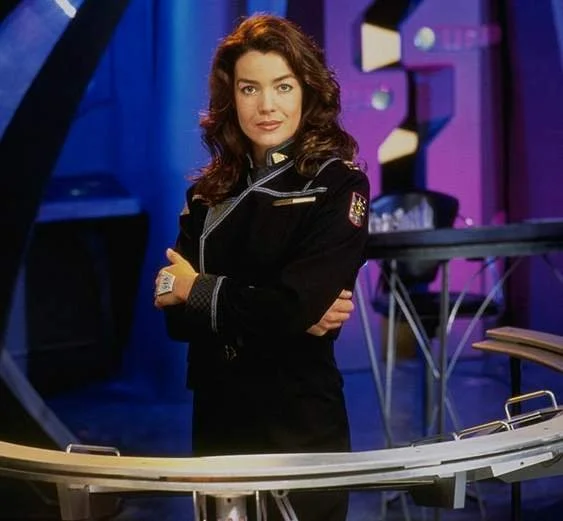
Claudia Christian will be there
The experiences people remember
Beyond shopping and autographs, this Expo leans hard into things you can do.
There’s a dedicated building for “panel rooms, food and beverage and gaming,” with scheduled and pickup games “all day, both days,” including role-playing, board games, and more. Folb says you can expect “10 or 12 panels and workshops a day,” ranging from paranormal topics to creative sessions like “how to create a comic book… how to create a character… how to get published.”
There’s also a professional photo setup with scheduled sessions for guests—and Folb notes attendees can book photos in costume, too.
“Horror” doesn’t mean “not for kids”
If you’re a parent reading the event name and hesitating at the word horror, Folb is clear about the tone: “All of our shows… are family friendly and family focused,” and even when a guest is known for scarier roles, the Expo doesn’t cross the line into adult-only content.
Costumes are encouraged, but not required—Folb estimates “probably 40 or so percent” of attendees show up in some form of costume. And there’s a built-in incentive: the Expo gives out “awards and prizes for costumes” throughout both days. So whether your kid has a full superhero outfit or you’re rocking a last-minute wizard cape, you’re part of the fun.
The “FOMO” truth: this is the weekend people talk about afterward
Folb says the bigger mission is creating events where “you can bring the grandparents and the grandkids and everyone in between, and everyone’s gonna have a great time.” That’s what makes this Expo different: it’s not designed for just one age group. It’s built so nobody’s bored—because there’s always another building, another panel, another game, another photo op, another aisle you haven’t explored yet.
Or, as Folb sums it up: “It’s an event… an experience for everyone.”
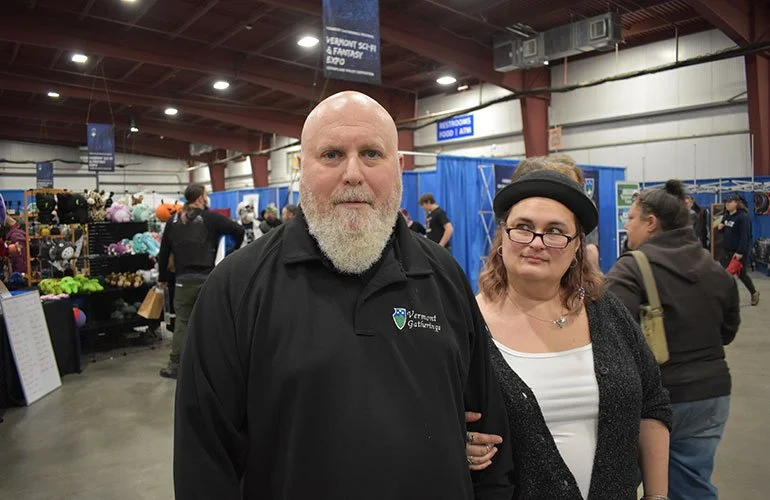
Jeff Folb is the Owner and General Manager of Vermont Gatherings - Courtesy Photo
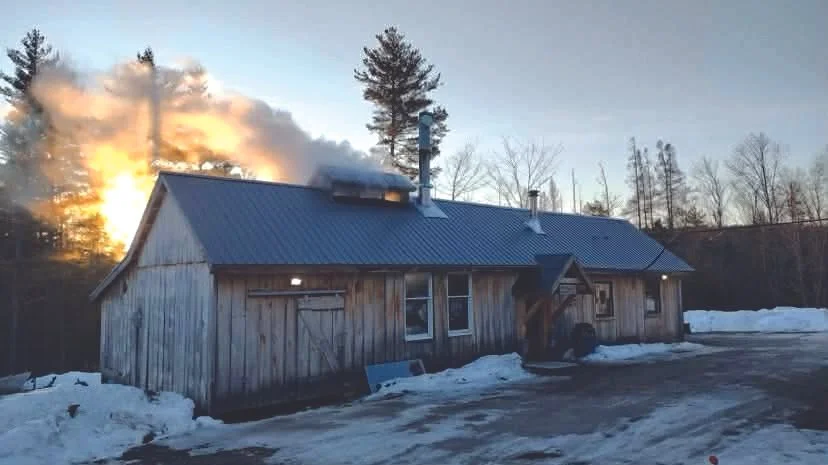
Sugaring Season: Patience, Weather, and a Little Bit of Luck
For those who don’t sugar, here’s the quick version of how it works. When temperatures drop below freezing, the tree essentially pulls moisture up from the ground. When it warms up, that pressure reverses, and the sap flows out—right into buckets or tubing systems if you’ve tapped the tree. It’s like the tree is breathing in and out.
No freeze? No recharge.
Too warm for too long? The season can start slipping away.
What this year is teaching us about maple season in our neck of the woods
By Joshua Smith
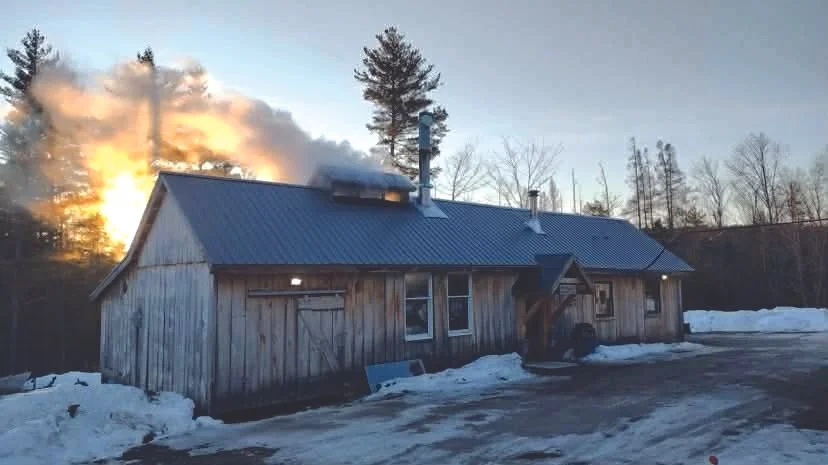
Boiling sap at sunrise at Oliver’s Sugarhouse in Groton, VT.
There are a few things you can count on this time of year. Mud season is coming whether we like it or not. Someone’s already put the snow tires on the “maybe next weekend” list. And across towns like Groton, Bath, Corinth and Peacham, there are folks watching the weather with the same level of trust they give a used snowblower.
Because it’s sugaring season.
Now, if you’ve ever made maple syrup—or even just helped out for a day—you know this isn’t a hobby for the impatient. It’s part science, part tradition, and a whole lot of hoping the weather cooperates.
I recently had the chance to talk with Mark Isselhardt from the Proctor Maple Research Center, and if there’s one takeaway from this year so far, it’s this: no two sugaring seasons are ever the same.
A Season That Keeps You Guessing
If you’ve been out in the sugar woods this year, you’ve probably already felt it. This season got off to a slower start than what we’ve seen the past few years. Colder temperatures early on meant things didn’t get moving right away.
Then came the snow—which looked promising—but it didn’t stick around long. A stretch of warm weather, some rain, and a little wind took care of that pretty quickly.
And here’s the thing a lot of folks don’t realize: too much warmth can be just as much of a problem as too much cold.
Sugaring depends on that classic New England rhythm—freezing nights and warmer days. That’s what gets the trees to move sap. Without that back-and-forth, things slow down.
As Mark explained, sap flow doesn’t just happen steadily over time. It comes in bursts. You might have a few days where everything lines up perfectly and you make a big chunk of your syrup all at once. Then you might go several days with almost nothing.
It keeps you humble.
Why the Weather Matters So Much
For those who don’t sugar, here’s the quick version of how it works. When temperatures drop below freezing, the tree essentially pulls moisture up from the ground. When it warms up, that pressure reverses, and the sap flows out—right into buckets or tubing systems if you’ve tapped the tree. It’s like the tree is breathing in and out.
No freeze? No recharge.
Too warm for too long? The season can start slipping away.
And that’s where things get tricky this year.
We’ve already had a stretch of warmer-than-average temperatures. For some producers, especially those in warmer areas or with trees facing the sun, that can impact how productive their taps are. The tap holes can start to seal up earlier than expected, meaning less sap when conditions improve.
So far, reports across the region—and the state—are all over the map. Some producers are just getting started, while others are already a good way into their season. That’s sugaring. It’s never one-size-fits-all.
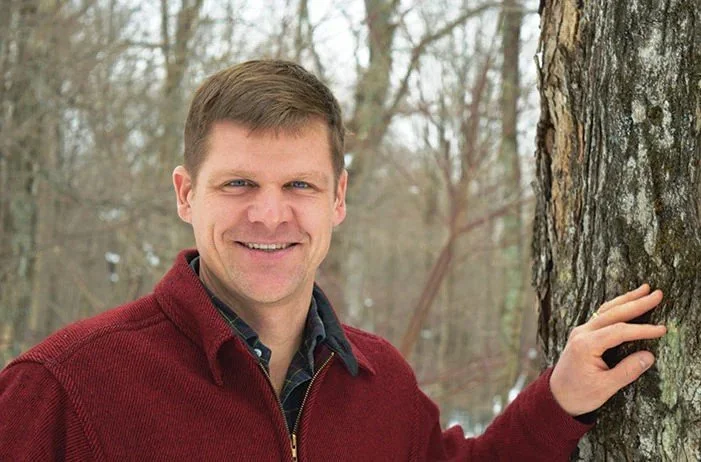
Mark Isselhardt is the UVM Extension maple specialist. He has been based at University of Vermont Proctor Maple Research Center since 2016. Photo courtesy of UVM Extension
The Good News
It’s not all uncertainty. One thing Mark pointed out is that the quality of syrup this year has been strong. Producers are reporting good flavor and color, and sap sweetness seems to be right where it should be.
That’s a big deal. There was some concern going into the season that last summer’s dry conditions might affect sugar content in the sap. So far, that doesn’t seem to be the case.
And while it’s still too early to call the season one way or the other, there’s a sense of cautious optimism out there. As long as we don’t get a long stretch of unseasonably warm weather, there’s still plenty of opportunity for good runs.
Buckets, Tubing, and Tradition
If you grew up around sugaring, you probably have your own version of how it was done.
For me, it was buckets, a tractor, and a whole lot of lifting. You’d go tree to tree, dump the sap, haul it back, and repeat until your arms reminded you exactly how much sap weighs. And for the record—it’s heavy.
These days, a lot of larger operations use tubing and vacuum systems, which allow them to collect sap more efficiently and at a larger scale. In fact, Vermont now produces over half of all the maple syrup in the United States, and production has grown dramatically over the past few decades.
But whether you’re running thousands of taps or just a handful in your backyard, the heart of sugaring hasn’t changed. It’s still about paying attention. Showing up. And working with what nature gives you.
For Those Who Don’t Sugar
Even if you’ve never tapped a tree, sugaring season is still part of life around here.
It’s the steam rising from sugarhouses on a cold morning. It’s the smell of boiling sap drifting through the woods. It’s the quiet understanding that spring is getting closer—even if it doesn’t quite feel like it yet.
And if you’ve never tried it, even tapping a couple trees with your family can give you a whole new appreciation for what goes into that bottle on your table.
Because it’s not quick. It’s not easy. And it’s definitely not predictable.
A Season Built on Optimism
Talking with Mark, one thing stood out more than anything else. You have to be an optimist to be a sugarmaker.
Every season brings its own challenges. Every year is a little different. And no matter how much experience you have, you’re still at the mercy of the weather. But that’s part of what makes it special.
So whether you’re out there collecting sap, boiling late into the night, or just enjoying a stack of pancakes with the finished product, this season is a reminder of something simple. Around here, we don’t just wait for spring.
We tap into it.
And if you’re not out there in the woods yourself, this is the perfect time to go find the folks who are. Take a drive. Follow the steam. Stop in at a sugarhouse if you see one open, or plan a visit during Vermont Maple Open House Weekend. You can also find local producers through the Vermont Maple Sugar Makers' Association at vermontmaple.org or the New Hampshire Maple Producers Association at nhmapleproducers.com.
And when you do—buy a bottle. Maybe two. Because behind every jug of syrup is a season like this one: unpredictable, a little stubborn, and made better by the people willing to stick with it.
That’s what you’re really bringing home.
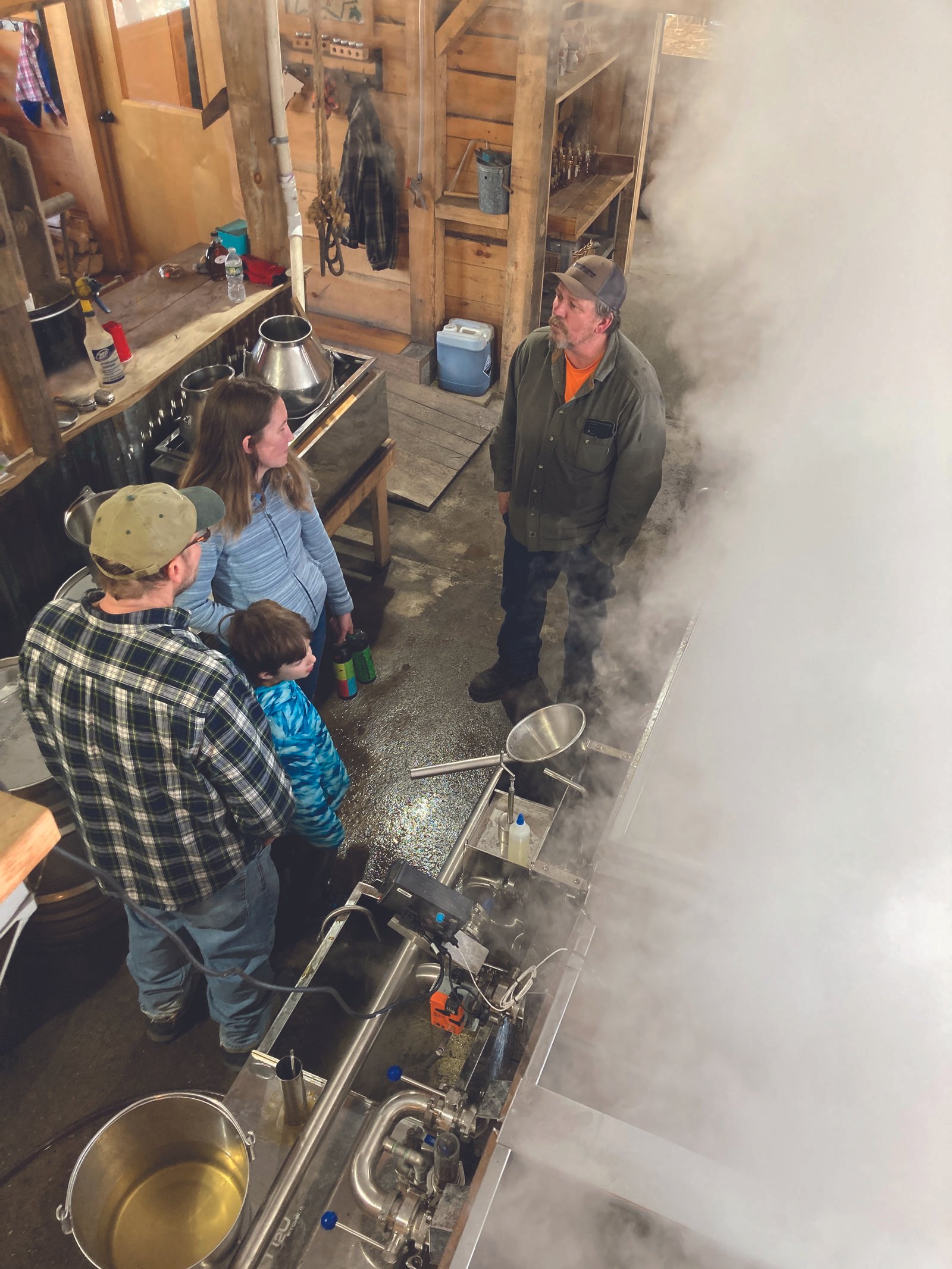
Troy Oliver (top right) explains the boiling process to visitors (bottom left) Kirk Morrison, Connor McCord and Kori McCord at Oliver’s Sugarhouse.
Groton and the Great Depression
Mrs. Blanche Miller, recalled the work of Harold Miller, who came from NY to work with the CCC Boys..
In Groton he became a stone mason and helped build fireplaces at Stillwater Campground, and the stone tower and steps to Owl’s Head, dragging the stones up the path by hand. Harold Miller and Margaret Blanchard married in 1935, they were celebrating their 60th wedding anniversary the year Emily Dyer wrote her essay.
By Deborah Jurist
GROTON - While doing research on the Page Chain Company, I found myself intrigued by what life was like in Groton during the Great Depression.
Sewell Page, owner of the Page Chain Company, died suddenly in 1934, leaving his wife Alice with 2 teenaged boys and one 3 year old girl named Marge. The boys, Russell and Ronald, decided to drop out of school and get jobs in order to provide for their Mother and little sister, thus preventing them from having to become dependents of the town. They were successful, Russell joined the Army Air Force at 16, and Ronald, just 14, began a long career as a successful farmer. His farm has become the central part of Newbury’s Four Corners Farm.
Source: Cindy Orr, Ryegate Postmistress and Sewell Page’s granddaughter
I asked myself the question, what did it mean for Alice Page and her baby to become dependents of the town?
Reading Groton town reports for the years 1931, through 1934, a picture began to form of what life during the Great Depression might have looked like.
We had an “Overseer of the Poor” who was elected at Town Meeting. Listed in the Reports, were the costs of services and goods provided to people who needed them. In other words, Groton citizens raised funds through the collection of taxes to provide for the poor, both those who lived in Groton, and for those who were listed as “Tramps”, transients who arrived by train. .
Many people boarded with families or individuals. People who took others into their homes were paid for this service by the taxpayers. Those who needed help were often in need for multiple years. There were sometimes children with no parents needing care, as well as the elderly, oftentimes people died during the time they were being cared for.
Groton paid for hundreds of gallons of milk from Blanchards, JK Whites, and EC Frost. Dozens of cords of wood came from individuals. Taxpayers paid for medical care, trips to the Cottage and Brightlook Hospitals, tobacco, telephone calls, clothes, a stove, moving expenses, legal advice, shoes, grave digging, manure, dental care, and glasses. The Overseer of the Poor was paid for a trip to St. Johnsbury to pick up government issued pork
One family appears over and over again. There seemed to be no father, and at first the mother received financial help for caring for her family. Then the Overseer of the Poor was paid for taking one child to New York, then for taking one to the Barre Sanatorium and eventually for taking the rest of the children “away”..
Tramps were “cared for” by individuals and the taxpayers footed the bill, oftentimes in groups. Once there was a charge for 50, once for 27. It looks like the cost for taking care of one tramp was $.75. The service provided was not defined.
In 1995 a 7th grade student, named Emily Dyer, wrote a paper called “Memories of the Depression”. She interviewed several people who had lived in Groton during the 1930s. Among those people were Norma Hosmer, 89 years old, Evelyn Frost Ricker, 75 years old, Margaret Blanchard Miller, Peggy Smith and Raymond Page, who had been an Overseer of the Poor.
Norma remembered eating lots of parsnips and potatoes, but her Mom also made sour cream cookies and cake with apple frosting. Evelyn Frost’s mother made grape sherbet. Margaret Miller’s Mom made donuts, pies and cakes once a week. Raymond Page, who raised 4 children during the Depression remembered hasty pudding, johnny cake, and milk toast. He mentioned that some people the town had supported, paid the funds back, and some of the transients worked on the roads for $.30 an hour.
In 1932 there were roughly 145 entries for payment to individuals, mostly local men, for work done on the roads.
In 1933 the Civil Works Administration, what we usually refer to as the Civilian Conservation Corps, brought 43 men to Groton who worked on the Westville School, the Hatch Brook Rd. and what they referred to as Ricker Rd.
Mrs. Blanche Miller, recalled the work of Harold Miller, who came from NY to work with the CCC Boys..
In Groton he became a stone mason and helped build fireplaces at Stillwater Campground, and the stone tower and steps to Owl’s Head, dragging the stones up the path by hand. Harold Miller and Margaret Blanchard married in 1935, they were celebrating their 60th wedding anniversary the year Emily Dyer wrote her essay.
Local people were skeptical about how the CCC boys would fare in rural Groton. It turned out they did great. Alice Lord Goodine recalled that her husband Henry, the barber, would go to the CCC Camp once a week to give the boys haircuts and the young men often came into Groton, and spent money after they were paid.
In conclusion, there was a clear commitment to taking care of “our own” as well as those who came to town because they were homeless. Groton, being a farming town, probably fared better than many urban areas during the depression because food production was common.
As we face the new needs of our neighbors and those who land here without means, we have an opportunity to carry on the tradition set by Groton during the last century.
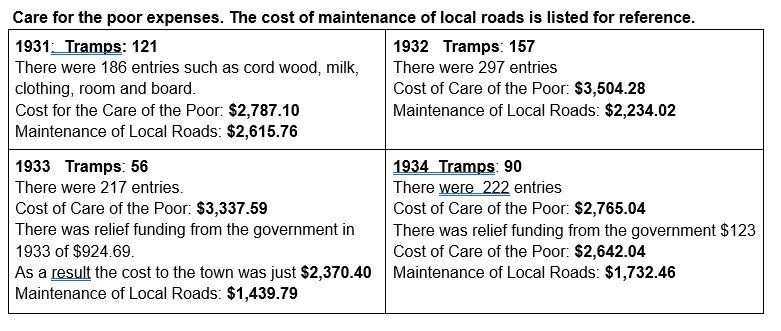
Care for the poor expenses. The cost of maintenance of local roads is listed for reference.
Community Rallies To Revitalize The Groton Rail Trail
The Gateway Project has been a collaborative effort, states Nahmias, who has spearheaded much of the Project in recent years and shares a common vision for the future of Groton with Gary Lamberton from the Buckaroos of 302 Snowmobile Club, Groton Recreation Commission’s Mike Gaiss, and Greg Western, Executive Director of the Cross Vermont Trail Association (CVTA). “This project was the genesis of several like-minded, hardworking Groton residents who were in the right place at the right time.”
By Trish Griswold
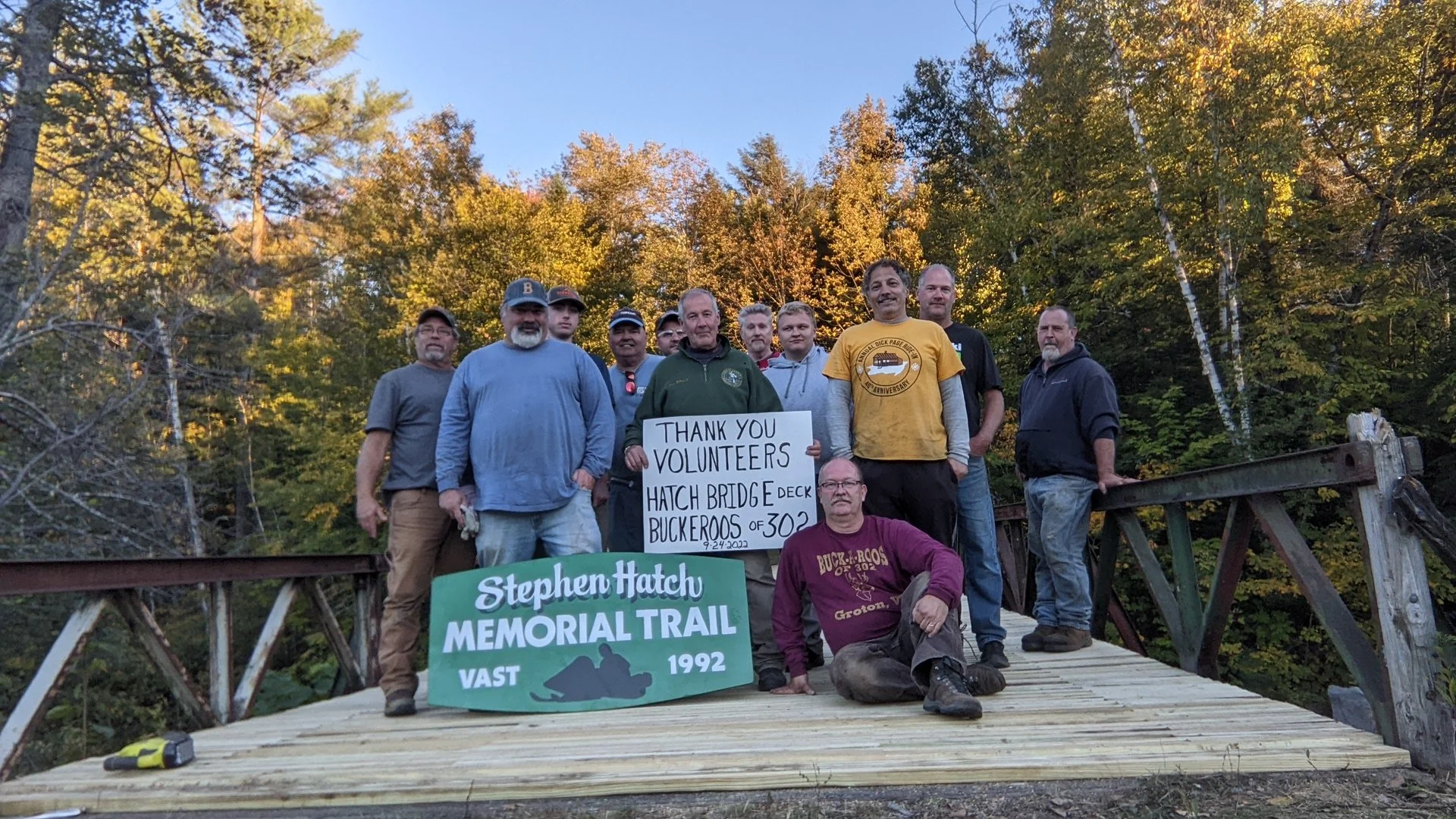
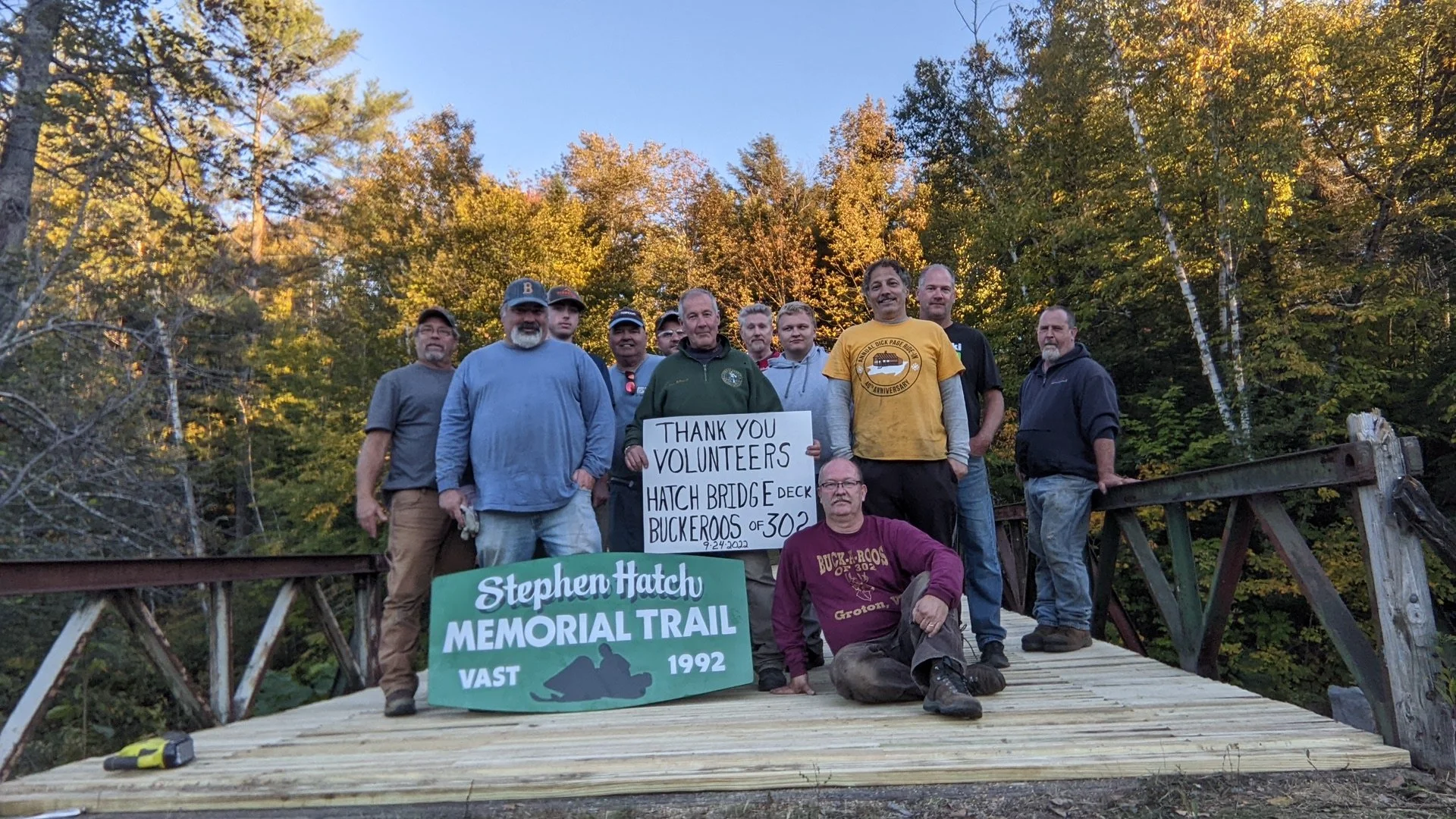
Members of the Buckaroos of 302 Snowmobile Club repaired the Stephen Hatch Memorial Bridge, providing safe, dependable snowmobile access to the Cross Vermont Trail.
GROTON - Neighbors helping neighbors has been a long-standing tradition in the small, rural community of Groton, VT, and newly-elected Selectman Mike Nahmias, who moved to the area in 2017 and has served as Planning Board Chair for several years, has had the privilege of experiencing first-hand the power of many hands making light work for the Town.
“Groton has got a lot of heart,” remarks Nahmias, who estimates that, over the last 50+ years, 250 of the town’s 950 citizens have been directly involved in helping Groton’s Gateway Project, a grass roots economic growth initiative, come to fruition. The intent of the Gateway Project was to upgrade Groton’s portion of the Cross Vermont Trail (CVT), a four-season, multi-use trail network that spans the State of Vermont, east to west from the Connecticut River at the Vermont/New Hampshire border in Wells River to the shores of Lake Champlain in Burlington. The CVT follows the railbed in Groton for 10 miles, the longest segment of the CVT in any town.
“Groton is located at the highest elevation on the trail, the summit, and we are a destination for trail users as we have campgrounds, lakes, ponds, hiking trails, and the forest,” explains Nahmias. “I see us as one of the anchor communities along the trail. Having the new surface in both the town and the forest, we really have the best segment at this time along the trail.”
The Gateway Project has been a collaborative effort, states Nahmias, who has spearheaded much of the Project in recent years and shares a common vision for the future of Groton with Gary Lamberton from the Buckaroos of 302 Snowmobile Club, Groton Recreation Commission’s Mike Gaiss, and Greg Western, Executive Director of the Cross Vermont Trail Association (CVTA). “This project was the genesis of several like-minded, hardworking Groton residents who were in the right place at the right time.”
Nahmias also credits previous Groton Selectboards, Planning Commissions, and other Town Officers for “their forethought in acquiring the railbed from the State of Vermont when it was offered to the Town in the 1980s, for putting an ordinance in place to preserve the railbed as a recreational property with limited access for vehicles, and for drafting a Town Plan with goals and strategies that laid the groundwork for the Town to continue to maintain and improve the trail and embrace its presence as an economic driver for town businesses.”
Funding for the Gateway Project was made possible through a $225,000 grant from the Vermont Outdoor Recreation Economic Collaborative (VOREC), a state-run program managed by the Vermont Department of Forests, Parks and Recreation (FPR) in partnership with the Vermont Agency of Commerce and Community Development (ACCD). One of VOREC’s primary goals is to “strengthen connections between Vermont’s outdoor recreation resources and the benefits that come from participation in outdoor recreation.”
According to Nahmias, the Gateway Project is multi-faceted with many different segments. One portion of the project was to regrade sections of the existing railbed, install and replace eight culverts along the railbed, and install two barrier gates. A landslide in 2023 and a major flood in 2024 caused delays to this portion of the project, but townsfolk and volunteers have persevered despite these challenges.
Another key component of the Gateway Project was to build a 60’ by 100’ all-season parking area near the Village Center (at the old stump dump) and a trailhead with 10 parking spaces, making the CVT fully accessible to snowmobilers, bikers, snowshoers, cross country skiers, horseback riders, walkers, runners, dog sledders, etc. Crucial to the project was acquisition of the lower Groton hydroelectric power station property, a 3-acre parcel of land formerly owned by Green Mountain Power, and the development of a master plan for the proposed 12-acre Groton Gateway Park, which includes the former stump dump and gravel pit as well as retention of its current emergency management use.
Signage and wayfinding for the project were completed in collaboration with the CVTA. This included the design and installation of 50 directional signs on the railbed trail, 6 wayfinding signs, one sign on the road, 2 kiosks, 12 winter trail maps, and a digital map of the railbed trail for the Town’s website. Separate from the grant, Nahmais says, the Buckaroos of 302, whom he refers to as “the unsung heroes of the project,” also repaired the Stephen Hatch Memorial Bridge. These repairs have improved trail accessibility for snowmobilers in the winter months and helped get bikers off Route 302 and onto the trail, increasing safety for everyone.
According to CVTA Board Chair Mike Thomas, the hope is that the newly revitalized rail trail will provide an inviting, safe recreational opportunity for everyone to enjoy the benefits of nature and an active lifestyle. “The Park will be a draw for people to the area, and locals can take advantage of it too with access to the Village of Groton. It ties the community together.”
Former Selectboard Member Deb Jurist is one of many Groton residents who have utilized the CVT for years. “I have been riding my bike on the railroad bed since 1984 when I bought the Stoneshed in Ryegate and built my business, Mountain Meadows Pottery. I have seen a lot of changes over the years for sure. But it still holds true that there is always something to discover on the railroad bed. It might be a green heron, the sound of croakers in the spring, or sumac with leaves in green, yellow and red. The railroad bed never disappoints.”
The revitalized trail, Jurists says, makes for a smoother ride. She recently shared that, decades ago, she and her then 3-year-old daughter nicknamed one of the biggest puddles on the old trail “Sinker.” Thankfully, “Sinker” and the other puddles are gone. “[The railroad bed] is vastly easier to ride on now that it has been upgraded, which makes it much more accessible to me at 75 years old.”
Many local businesses, Vermont-based companies, and community volunteers, including: Berry’s Forest Products, Blue Mountain Excavation, Oliver Landworks, Rise and Run Timber Frames, Robco, SE Group and the Buckaroos of 302, have been instrumental in bringing the Gateway Project to life. “Over 1000 volunteer hours were put into this project,” Nahmias says, “and we couldn’t have done this work without them.”
More information about the CVT, including up-to-date trail maps, are available online at https://crossvermont.org/. Additional information is available on the Groton, VT, website at https://grotonvt.com/.
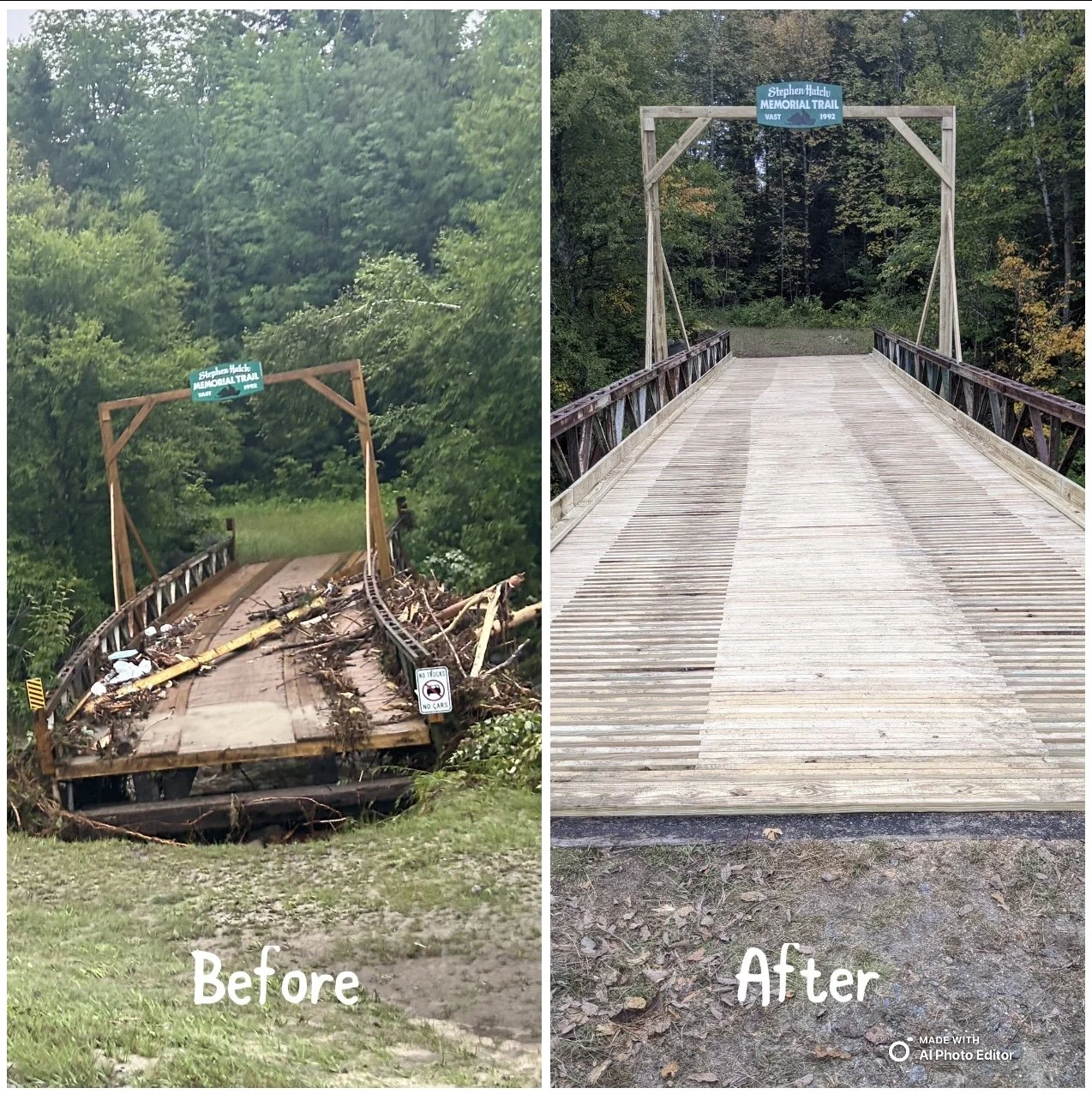
Repairs to the Stephen Hatch Memorial Bridge have increased safety for nature goers by getting bicycle traffic off the roadway and onto the Cross Vermont Trail.
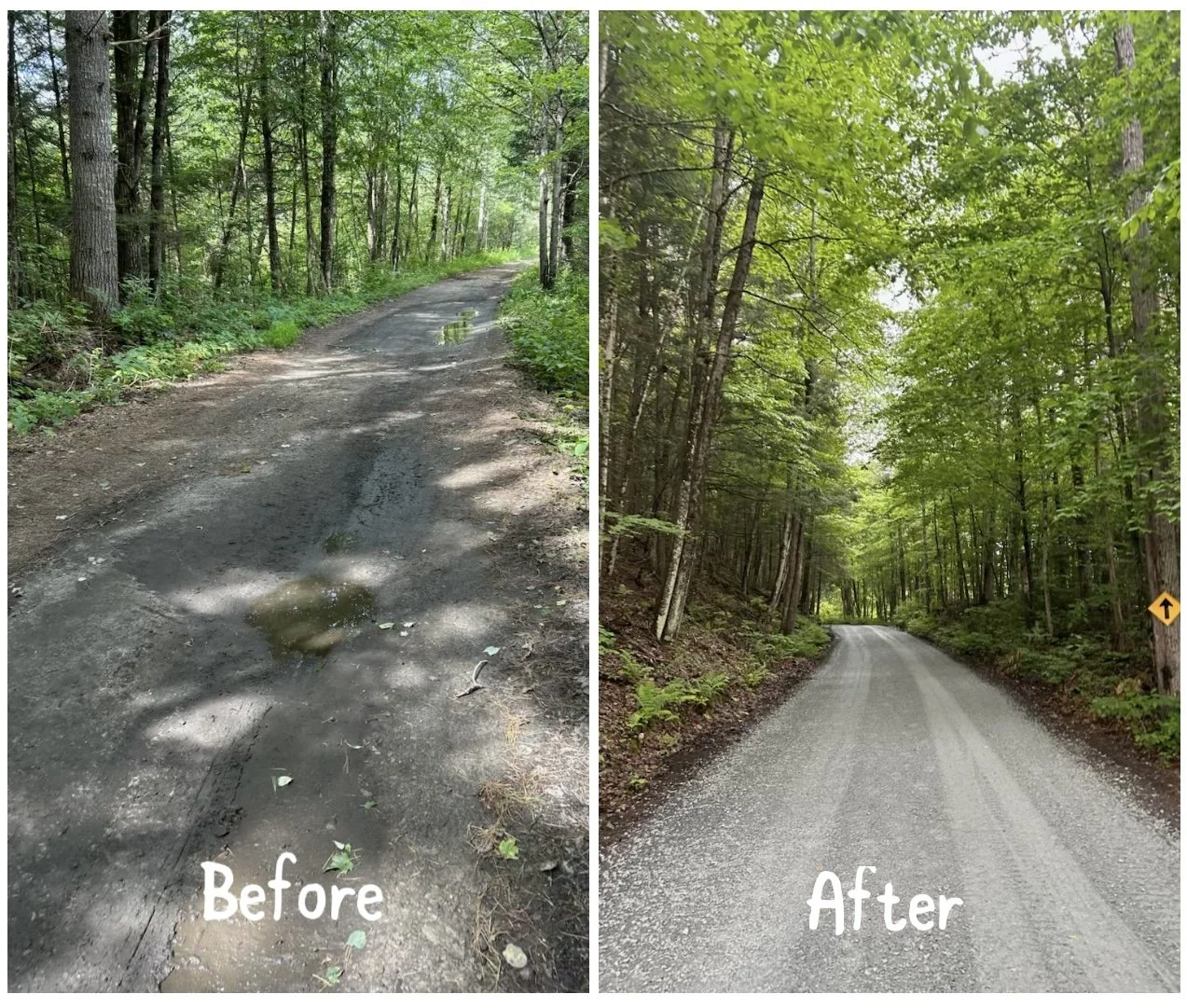
The “before” picture on the left shows the surface of Groton’s rail trail (between the Village and Pine Mountain) prior to recent changes. The “after” picture on the right shows the revitalized trail roughly one mile east, closer to Pine Mountain.
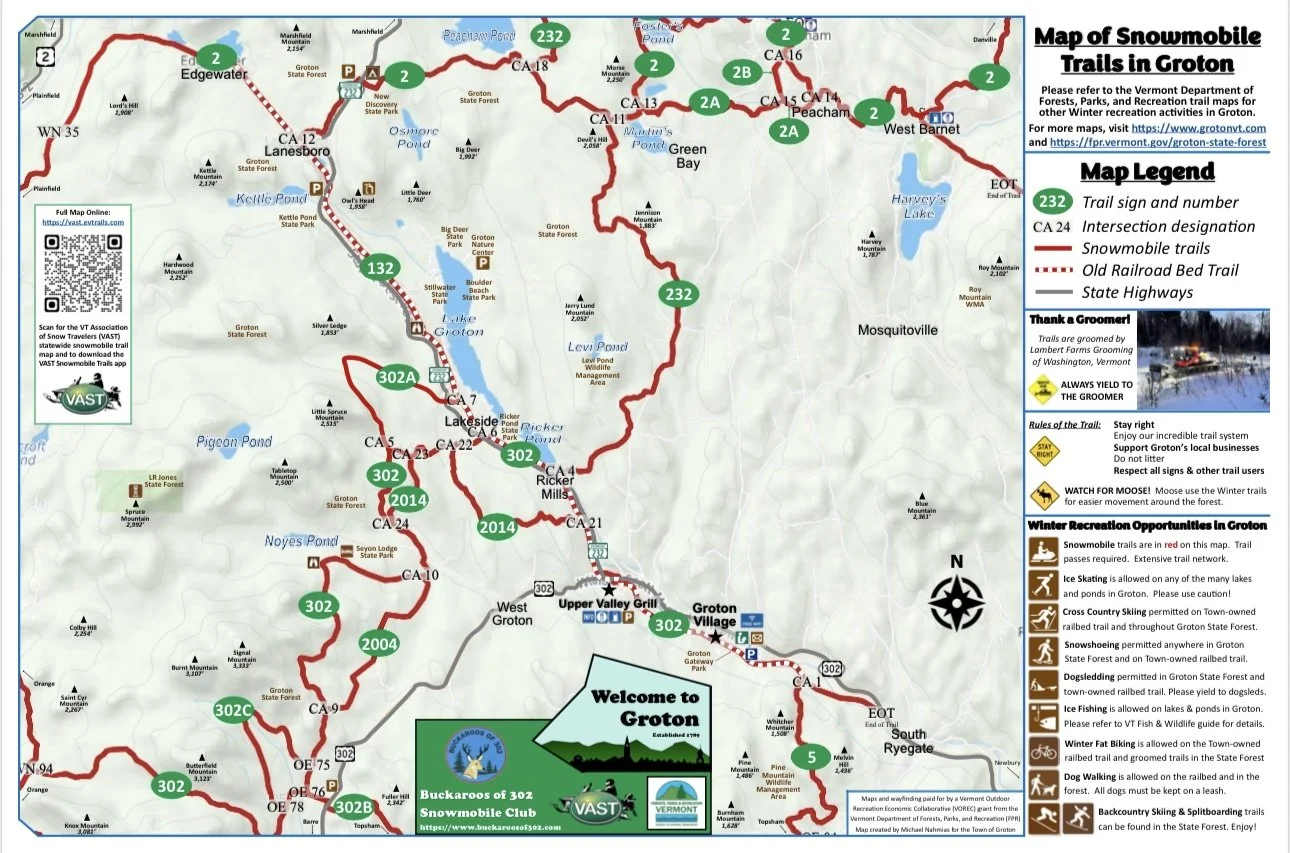
The newly designed Buckaroos of 302 Snowmobile Club trail map showcases snowmobile trails in Groton as well as other noteworthy landmarks and reference points.
Groton’s 69th Annual Fall Foliage Festival: When the Town Dresses Up for Everyone
“It’s like coming home,” said Michelle Emerson Kalnins, BMU class advisor. “You get to see all the people you grew up with, you get to see all the buildings you grew up with. All the families come back. It’s a great time here in Groton.”
The Chicken Pie Supper isn’t just a meal. It’s an anchor. People plan their weekends, even their travel, around it. Proceeds from ticket sales support scholarships for local high school seniors, the library, and other community projects. It’s generosity served alongside supper.
By Joshua Smith
GROTON VT - “It’s important to continue to foster a sense of community and togetherness. It’s a New England tradition of everyone getting together.”
— Aaron Smith, Groton Fire Chief
Every October, just as the maples burst into fiery reds and the hillsides settle into their golden glow, Groton does what it’s done for generations: it dresses up for everyone.
For one day each year, this small town in the southwestern corner of Vermont’s Northeast Kingdom transforms into something both deeply familiar and quietly magical. Streets fill with neighbors, visitors, and returning families. The air carries the mingled scents of baked goods, autumn leaves, and wood smoke. It’s part reunion, part fair, part homecoming.
The 69th Annual Fall Foliage Festival wasn’t just another event on the calendar. It was living proof that some traditions aren’t merely remembered — they’re relived.
A Morning That Tastes Like Home
Long before the parade or the vendors set up, folks were already filing into the basement of the Methodist Church for the annual lumberjack breakfast, a fixture of festival morning for as long as anyone can remember.
The menu is unapologetically hearty: pancakes, sausage, biscuits and gravy, doughnuts, and pie. It’s the kind of breakfast that doesn’t just fill you up — it anchors you. Generations have started their festival day at those tables, catching up over steaming cups of coffee while kids sneak extra doughnuts when they think no one’s watching.
Main Street Comes Alive
By mid-morning, downtown Groton was buzzing. Over 40 vendors filled Main Street, a colorful mix of local craftspeople, bakers, and community groups. Handmade goods sat beside jars of homemade jam. Students from local schools sold baked treats and raffle tickets to raise funds for their class projects.
The Baptist Church bake sale was, as always, a destination of its own. Pies, cookies, and breads lined long tables like trophies of neighborly pride. Many of those recipes haven’t changed in decades — and that’s exactly how folks like them.
It’s the kind of Main Street scene that could’ve taken place fifty years ago or last weekend. Old friends stop mid-street to talk, shop owners lean in their doorways, and the rhythm of conversation rolls like the nearby hills.
Parade Magic on Route 302
At 1:30 p.m., Route 302 shut down for thirty minutes as the parade took over. There’s nothing flashy about Groton’s parade — and that’s precisely why it’s so beloved.
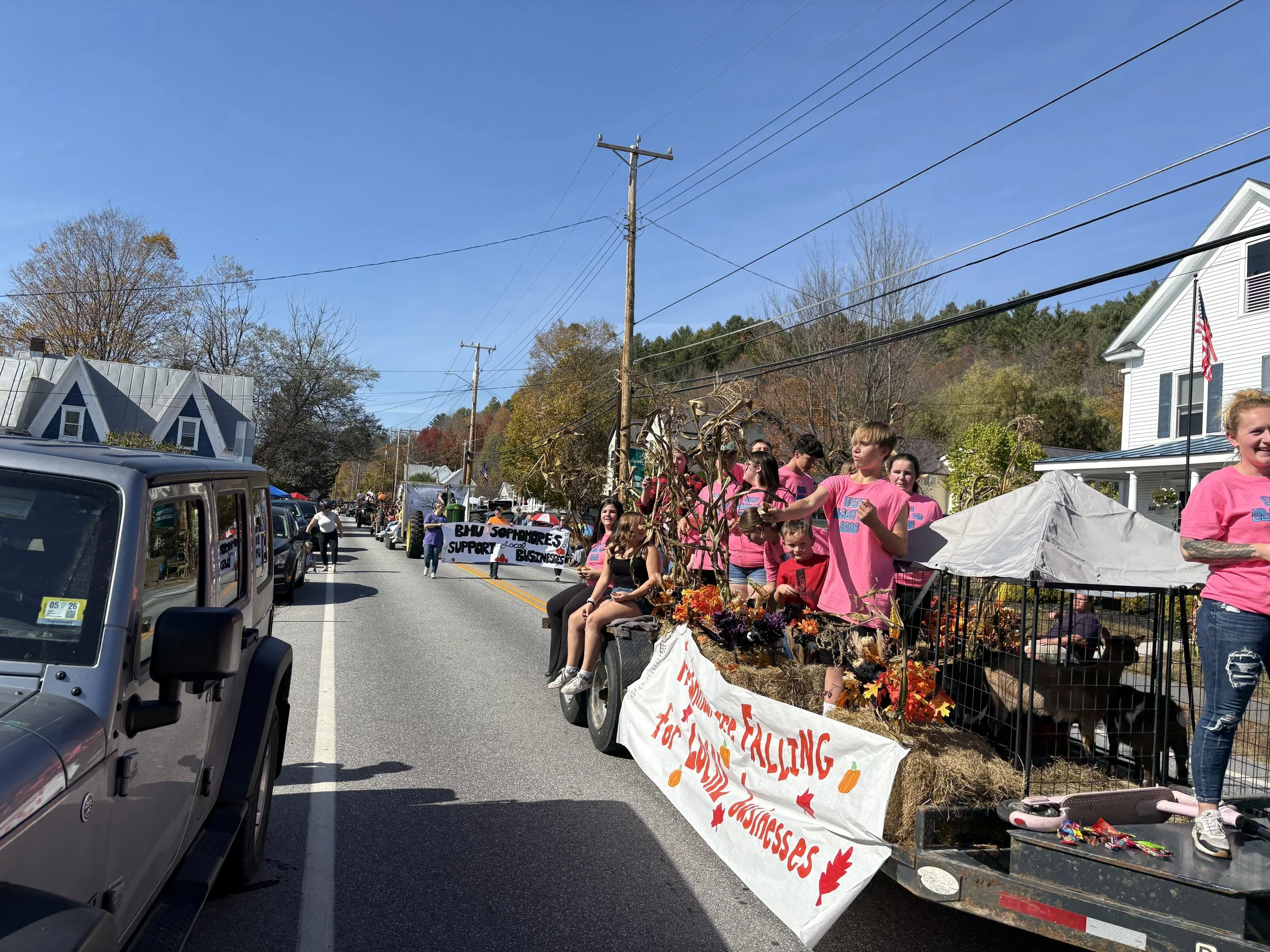
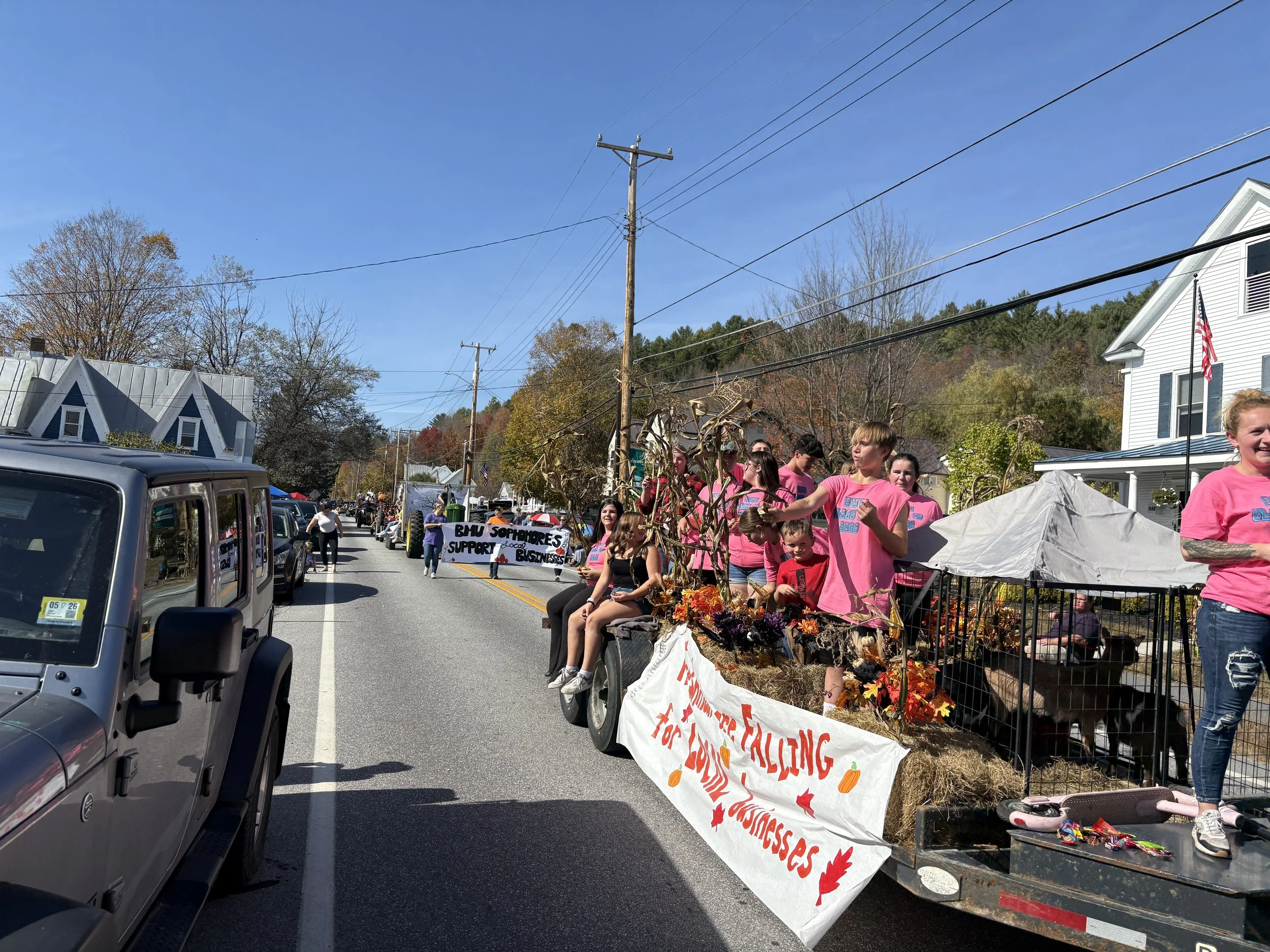
The school band led the way, followed by fire trucks, tractors pulling themed floats, and plenty of kids waving proudly from hay bales. Families lined the sidewalks bundled in sweaters, cider in hand, cheering as neighbors rolled by.
For Groton Fire Chief Aaron Smith, moments like this define the festival.
“It’s important to continue to foster a sense of community and togetherness,” he said. “It’s a New England tradition of everyone getting together.”
Up the Road a Bit
Just up the road a bit, the Upper Valley Grill hosted the annual pumpkin weigh-in. It’s a friendly kind of competition — the kind that makes everyone grin. This year’s bragging rights went to Calvin Lang, who tipped the scales with a 184-pound pumpkin. It wasn’t just a pumpkin; it was a testament to patience, care, and a bit of local pride.
A Supper That Defines a Town
As the sun dipped behind the hills, all roads led to the Groton Community Building, where the world-famous Chicken Pie Supper capped the day.
Three seatings — 4:30, 5:30, and 6:30 — along with take-out at 5, 6, and 7 — meant a steady stream of hungry festival-goers filed through the doors. The smell of chicken, biscuits, and gravy filled the building, wrapping everyone in something both familiar and comforting.
“It’s like coming home,” said Michelle Emerson Kalnins, BMU class advisor. “You get to see all the people you grew up with, you get to see all the buildings you grew up with. All the families come back. It’s a great time here in Groton.”
The Chicken Pie Supper isn’t just a meal. It’s an anchor. People plan their weekends, even their travel, around it. Proceeds from ticket sales support scholarships for local high school seniors, the library, and other community projects. It’s generosity served alongside supper.
Neighbors Supporting Neighbors
Over at the library, programs ran throughout the day, reminding everyone that this festival isn’t only about tradition — it’s about community action.
“It is a wonderful opportunity to support our neighbors,” said Sarah Spira, town librarian. “And gather with our neighbors and support local businesses and organizations and celebrate the passing of the season.”
Her words ring true. Groton’s festival is more than food, music, and parades. It’s a seasonal ritual — a way for the town to check in with itself, to reconnect, to show visitors and former residents what “home” still means.
A Town, Unchanged at Its Core
I grew up here. Walking down Main Street during the Fall Foliage Festival, I see new faces, new storefronts, a few changes here and there. But at its core, Groton hasn’t changed. The same hills rise behind the town. The same church basements hum with chatter. The same floats roll past under autumn skies.
For 69 years, this festival has marked not just the turning of the leaves, but the steady rhythm of a community that shows up for one another. It’s where memory and the present meet.
And long after the last chicken pie is served and the vendors pack up their tables, the feeling of the day lingers — like the warm, golden light on the hillsides that surround this little Vermont town.
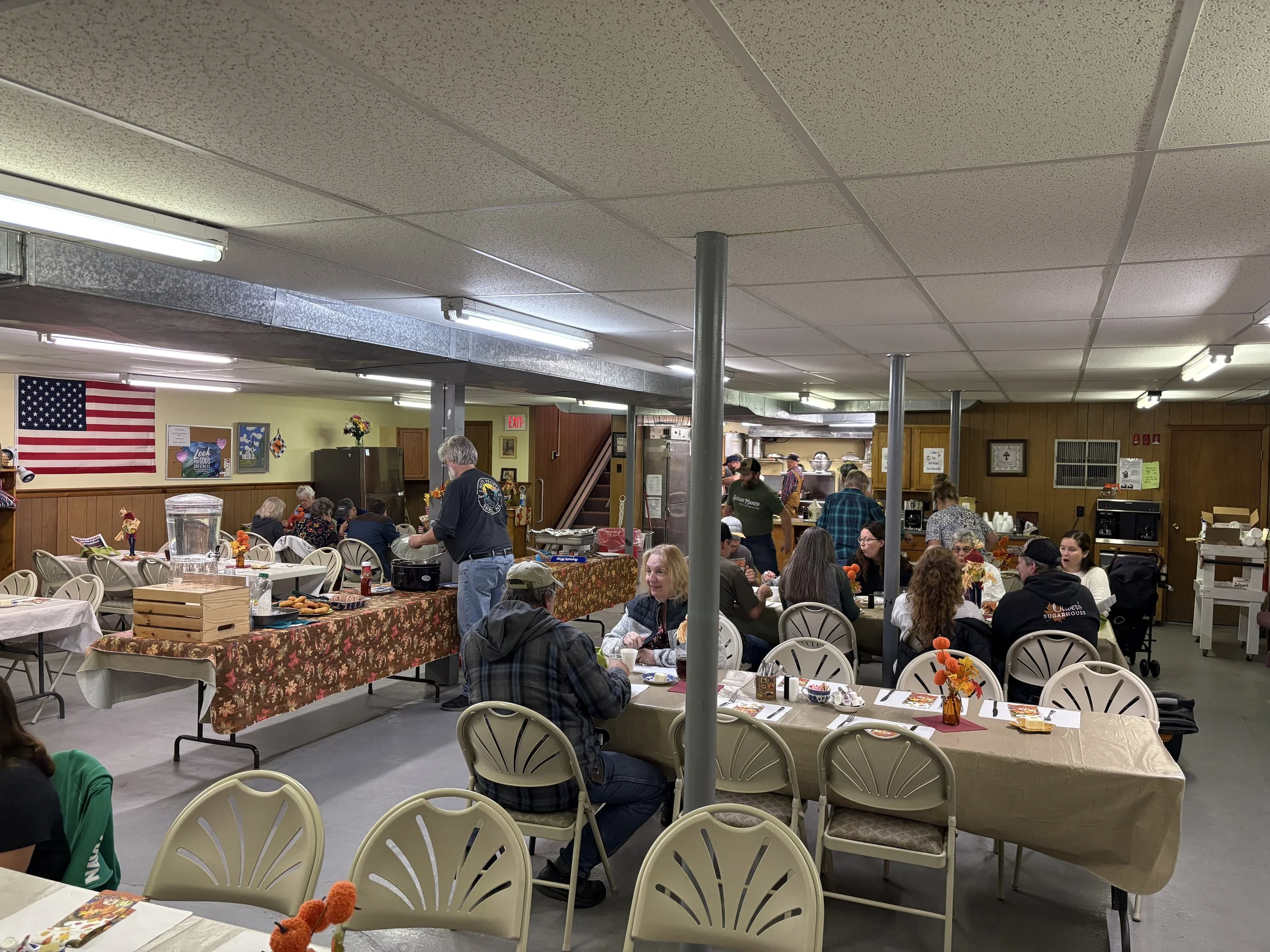
The Morning always starts with the Lumberjack Breakfast in the basement of the Groton United Methodist Church.
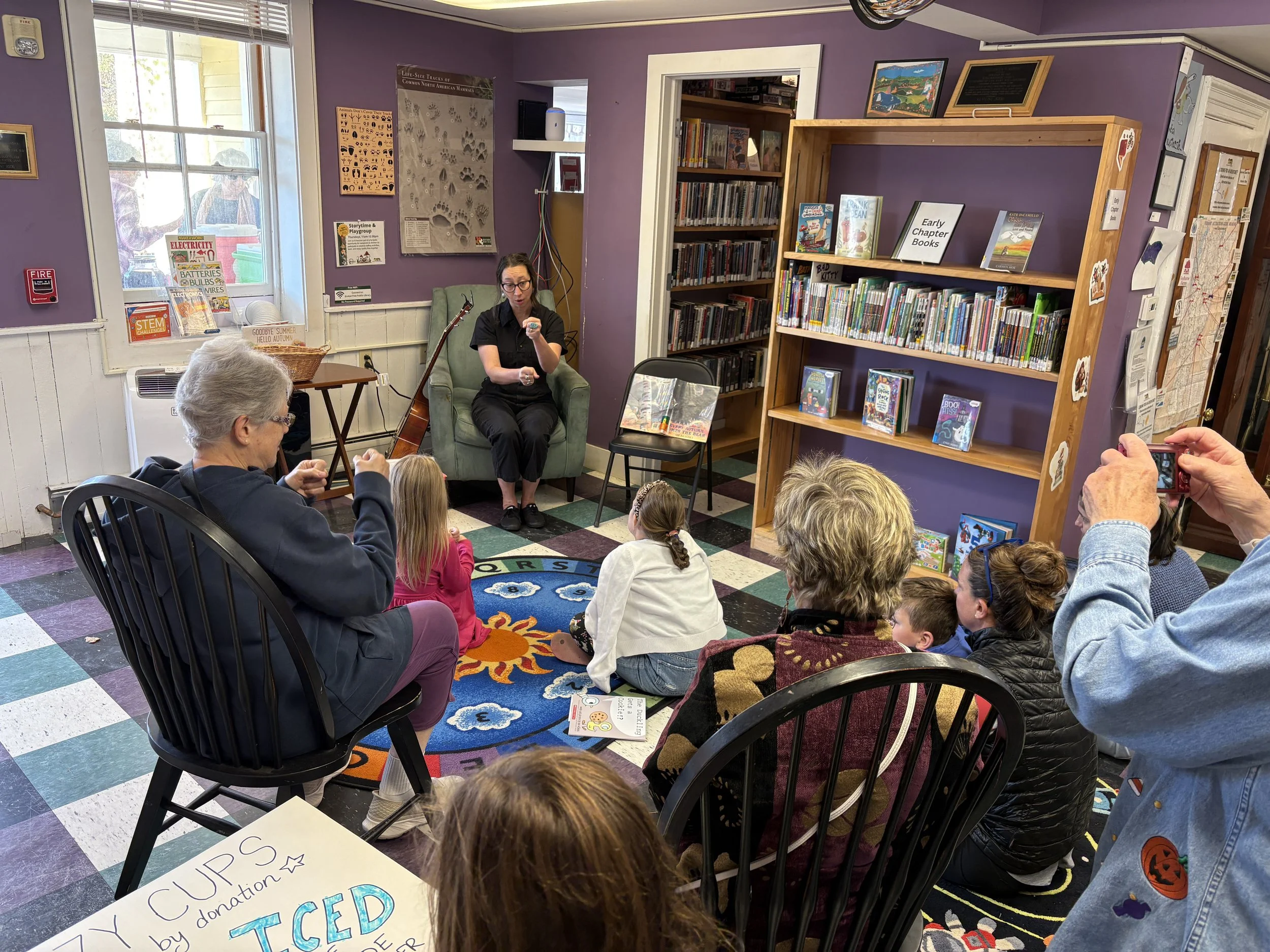
Amid the bustle outside, Librarian Sarah Spira leads a cozy reading hour for children, sharing stories by local authors and offering a welcome break from the festival excitement.
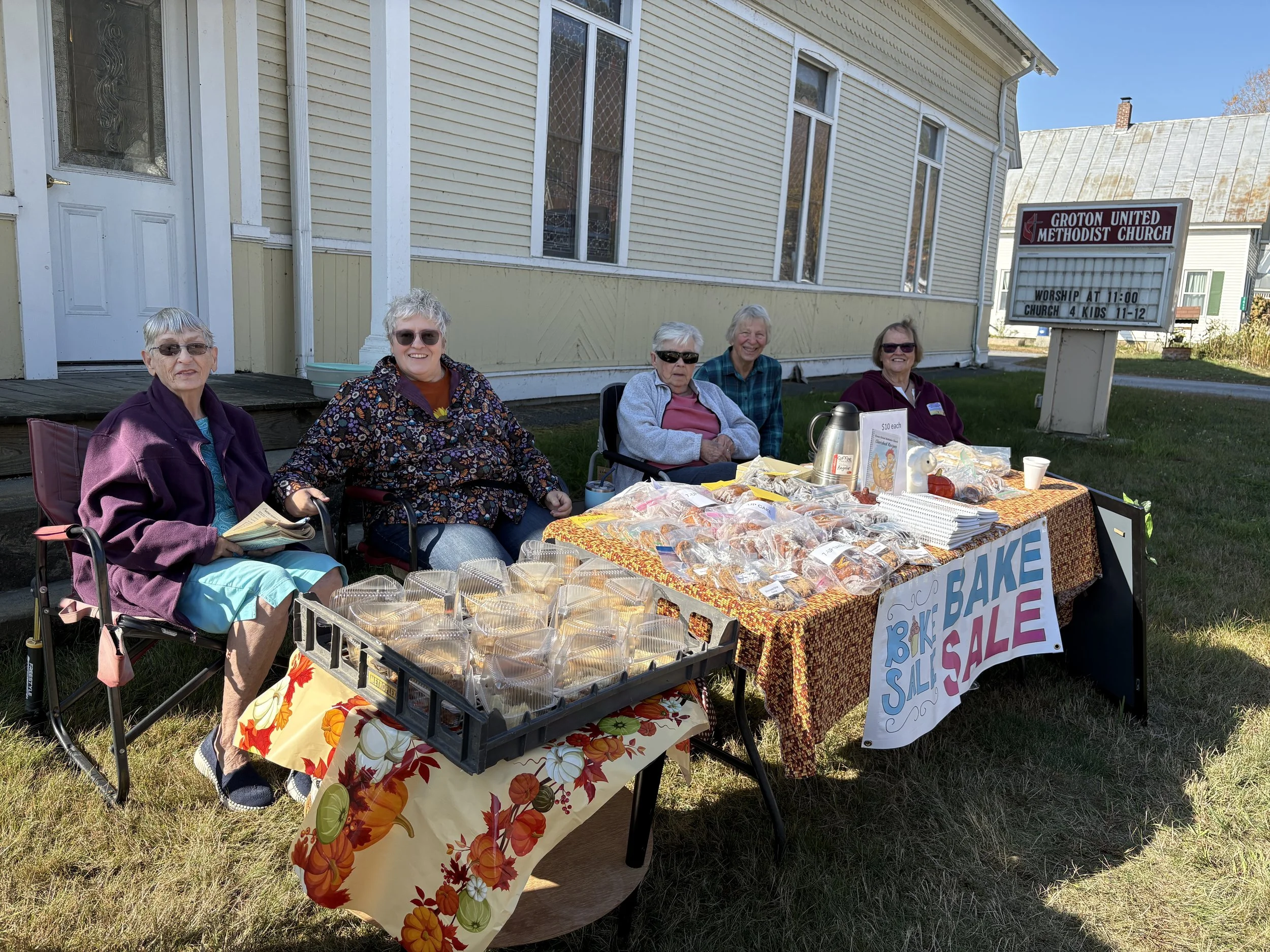
Bake Sale goodies: United Methodist women L-r) Betty Rainford Brenda Powers Babs Smith Kathy Crum Pastor Pam Smith
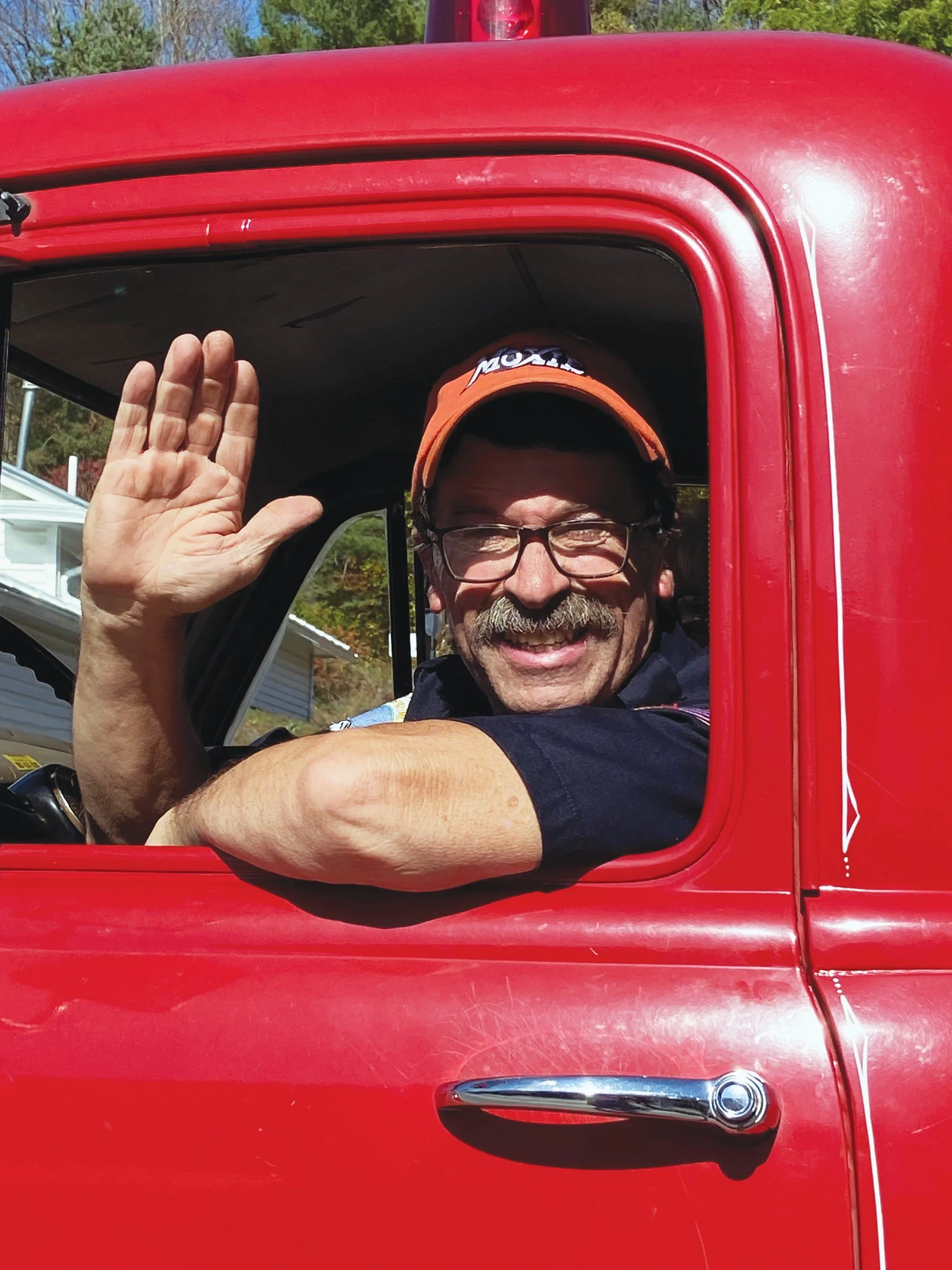
After serving the town of Groton in the Highway Department for over thirty -two years, Phillip Palmer recently retired and was participating in the festivities of the annual Fall Foliage Parade from the wheel of Groton’s antique fire department truck. The Bridge Weekly/Shauna Kimball
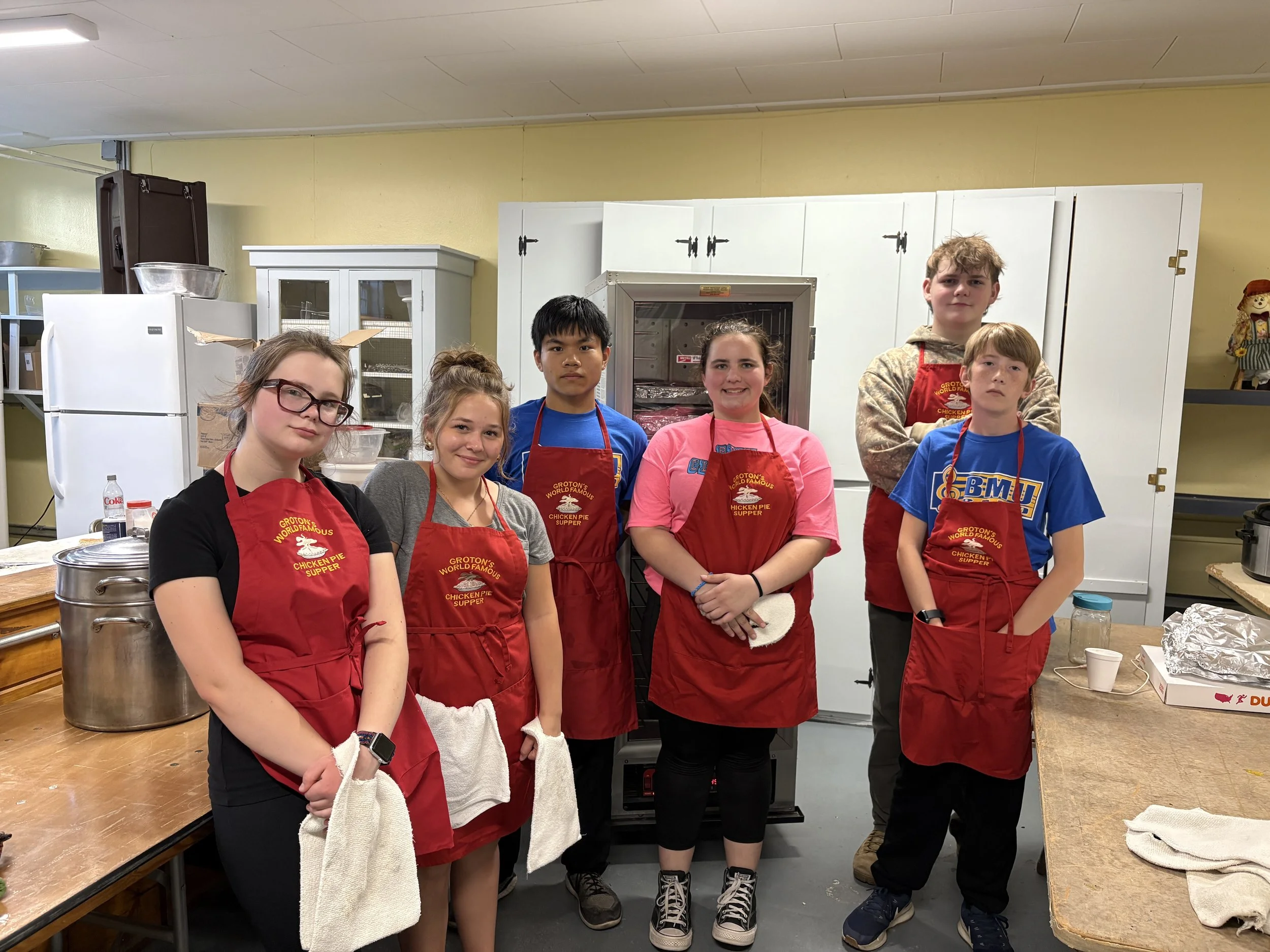
The unsung heroes of Groton’s Chicken Pie Supper — the “runners” — keep the food moving from the kitchen downstairs to the bustling dining hall upstairs. (L–R) Poppy Shattuck, Madison Frigon, Zhijie Zhong, Bella Cole, Raiden Moulton, and Lucas Welch
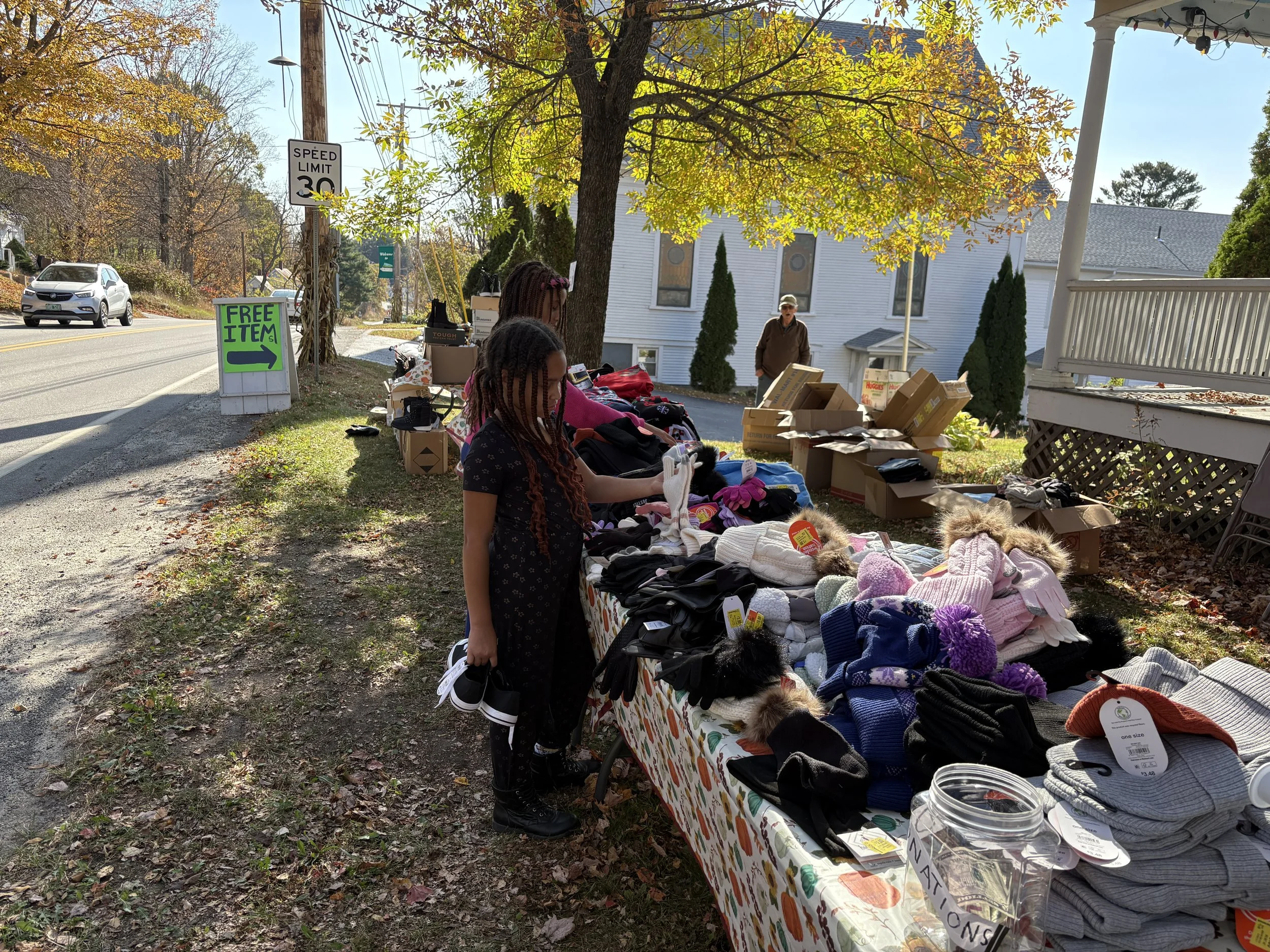
Children explore a sea of donated new clothing laid out by the Groton Baptist Church, offered freely to families or by donation.
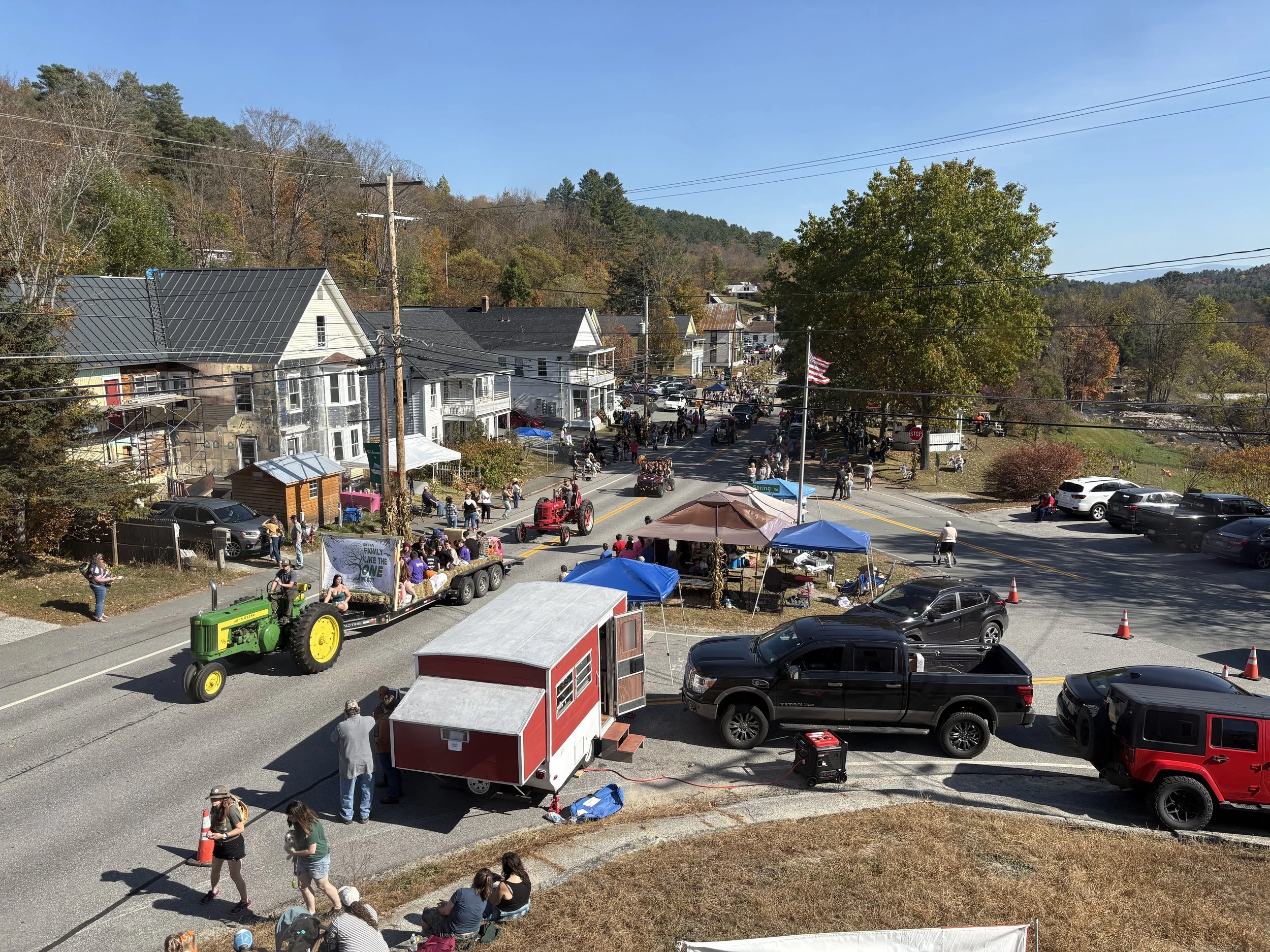
The parade, lasting about 30 minutes, is one of the highlights of the Groton Fall Foliage Festival, seen here from a second-story church window.
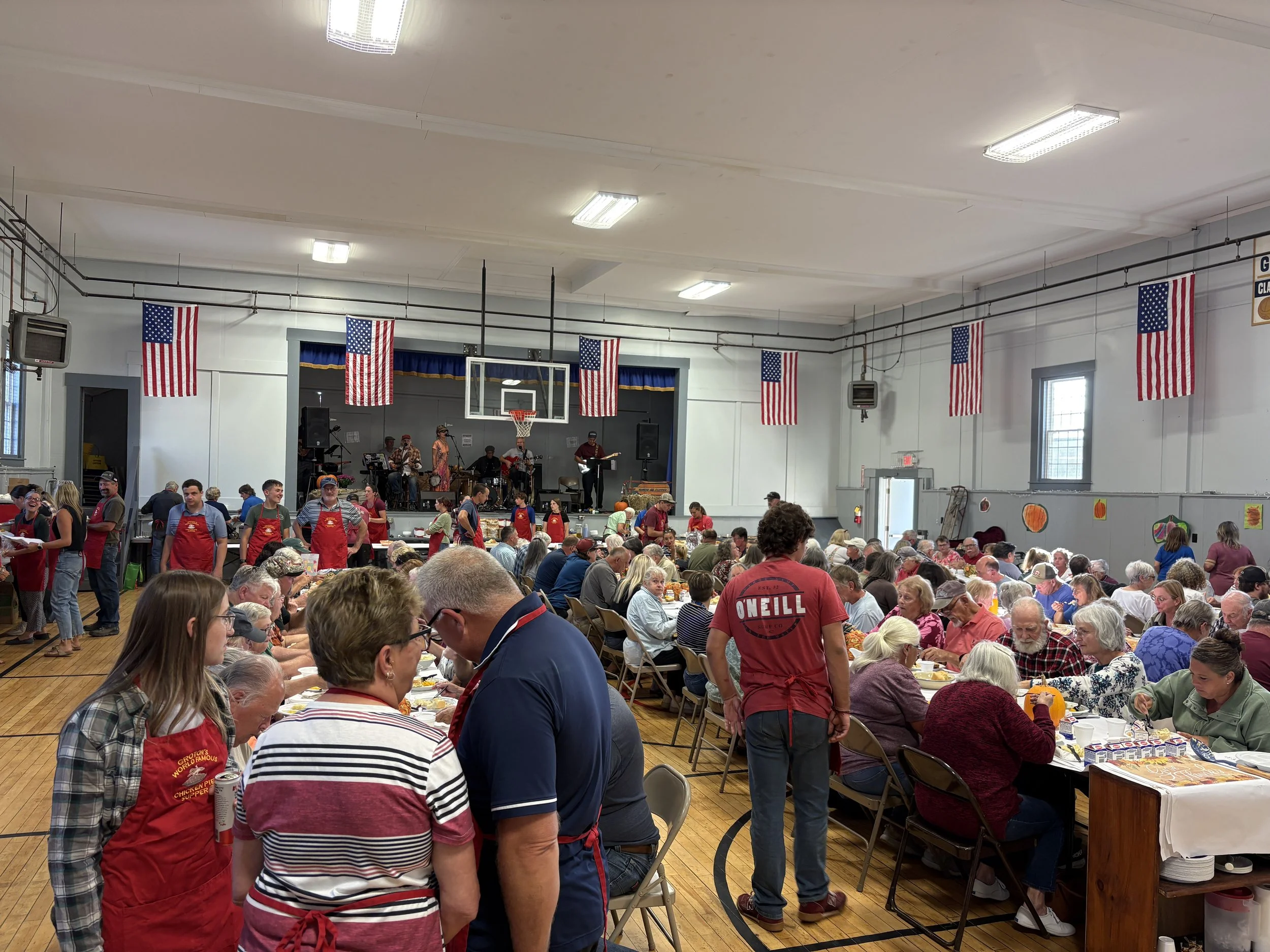
The Groton Community Building is transformed into a bustling dining hall as hundreds gather for the world-famous Chicken Pie Supper, the crown jewel of the Fall Foliage
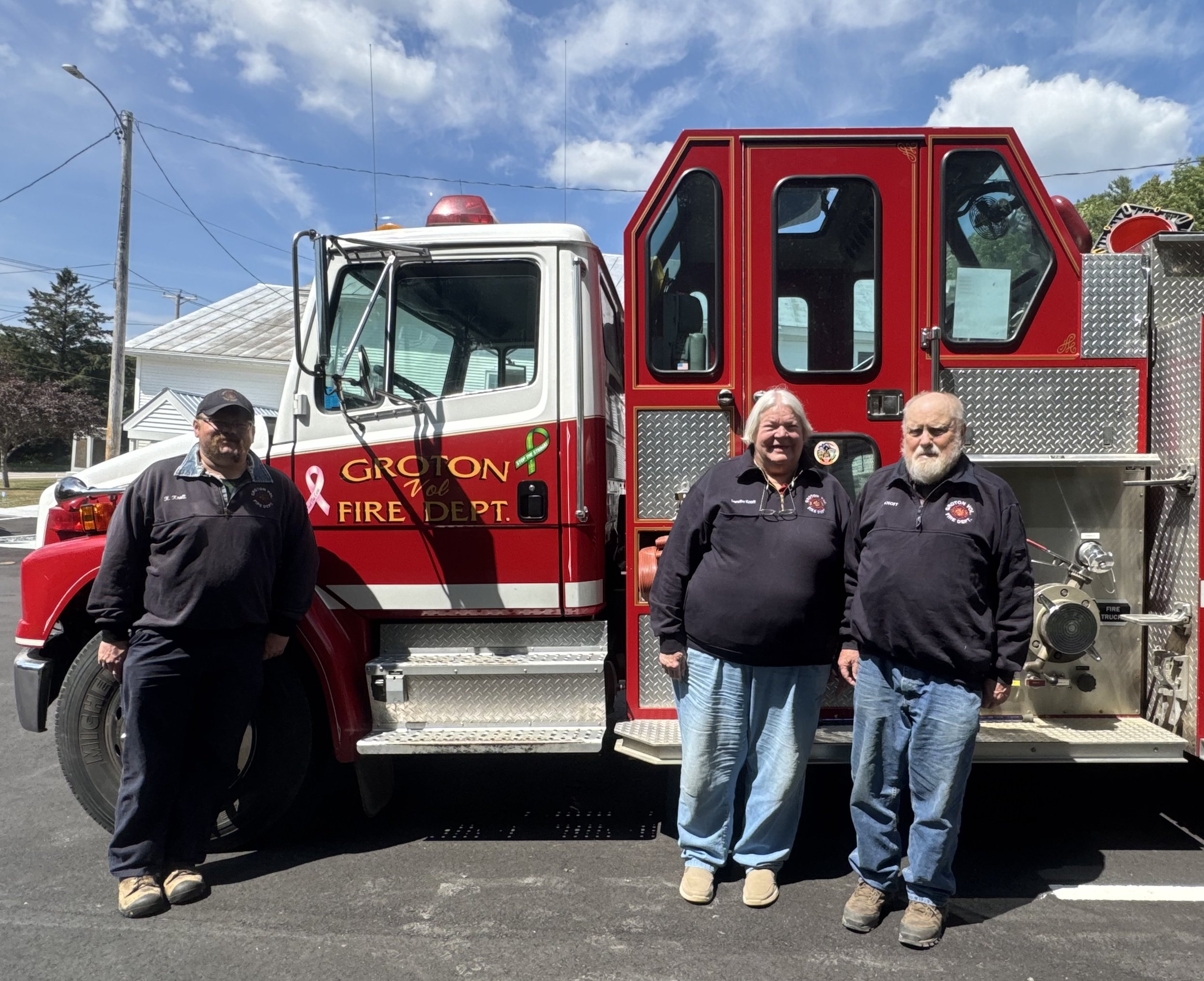
Retired Groton Fire Chief Wayne Knott Leaves a Legacy of Teaching and Learning
Ret. Chief Knott is humble and well aware that he could not have been “truly extraordinary” throughout his career without the unconditional love and support of his wife, Dorothy, whose guidance has been instrumental to his success.
By Trish Griswold
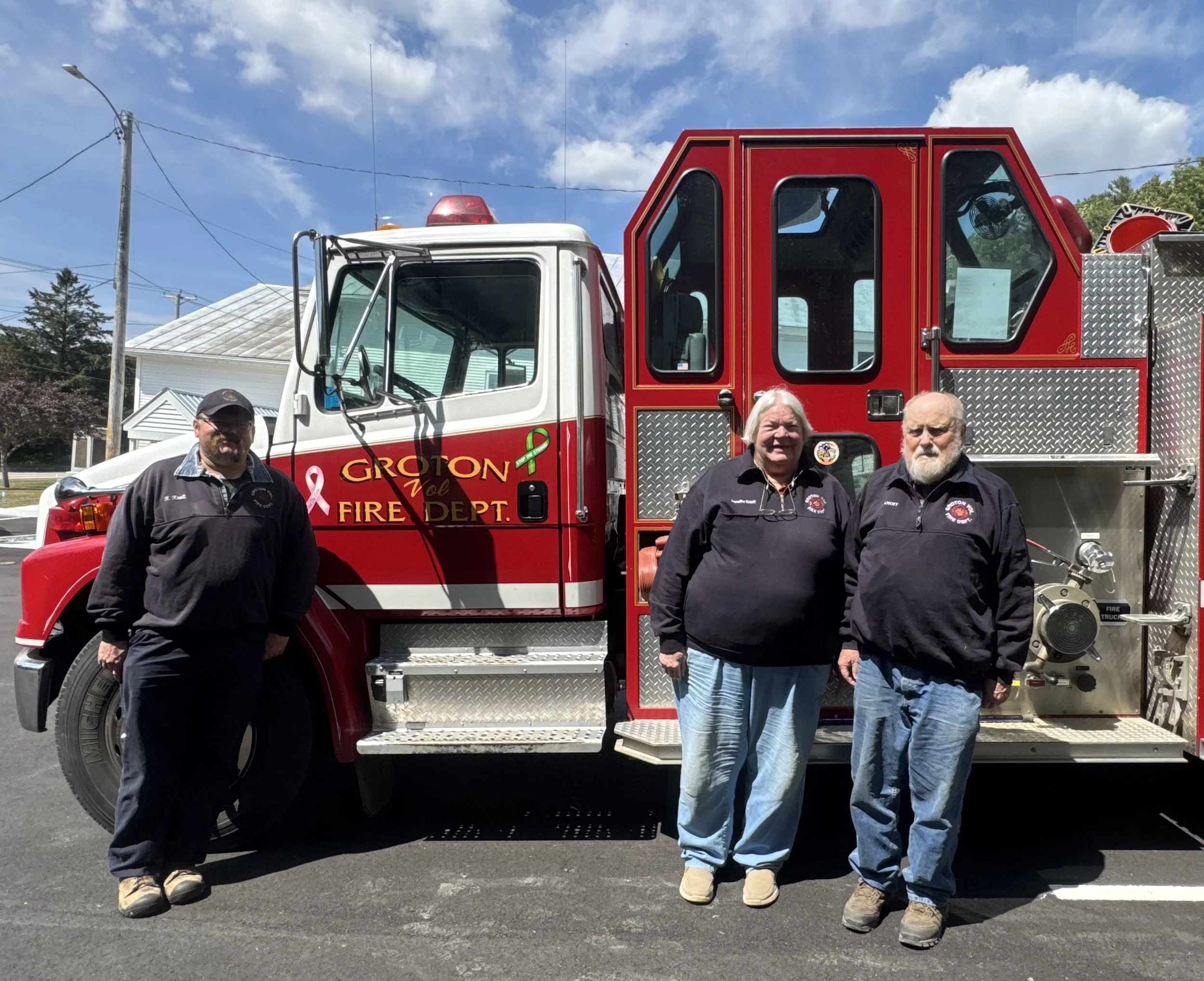
Longtime Groton Fire Chief Wayne Knott (R) recently retired after a 57-year career in fire service. He has enjoyed sharing his passion for firefighting and emergency services with his son, Henry (L), who currently serves as Captain and Training Officer, and his wife, Dorothy (center), who is a Level 1 firefighter and dispatcher for the department. The Bridge Weekly/Trish Griswold
Groton, VT - Former Groton Volunteer Fire Chief Wayne Knott retired from his post in January, following a distinguished 57-year career in fire service, but his legacy of teaching and learning will burn brightly for many generations to come.
“Chief Knott has been a pillar in the Vermont fire service for many years,” remarks Jamie Eastman, a Flight Nurse-Paramedic at Boston MedFlight who got his start in emergency services as a cadet working under the tutelage of Ret. Chief Knott. “He welcomed me into my first EMS role and opened the door to where I am today. He gave me the opportunity to continue my EMS education.”
Ret. Chief Knott’s influence is far-reaching, and his resume is both extensive and diverse. His career began at age 16 when he joined the cadet auxiliary program at the local fire department in his hometown of Barnstable, MA. As a child, he was “scared” of the 1938 Mack fire truck that bellowed down the roads of Barnstable to fires in his area, but he laid those fears to rest when a group of friends convinced him to become a fire cadet. “We were fortunate that we had some excellent people who took this ragtag bunch of teenagers and showed them the pump, the nozzle, and so forth. We were spoiled,” says Ret. Chief Knott, who admits to enjoying the adrenaline rush. “We had a county drill yard, like from [Groton] to Haverhill, so we’d go over to the drill yard, and we would do things we can’t do now because of EPA guidelines.”
Ret. Chief Knott served with the Barnstable Fire Department until 1974 when he married his wife, Dorothy, and they moved to Woodbury Lake in Calais, VT. He worked as a horse logger but decided to return to college and pursue a career as an arborist. Ret. Chief Knott earned an Associate in Arts Degree in Education from Cape Cod Community College, an Associate of Applied Science Degree in Forestry from Paul Smith’s College, and a Bachelor of Science Degree in Natural Resources from UMass-Amherst. In 1977, the Knott Family moved to Groton, VT, where Ret. Chief Knott became employed at Northeastern Log Homes before eventually starting his own boat and canoe repair business.
In addition to maintaining his full-time job, Ret. Chief Knott devoted himself to building a network of emergency services both locally and throughout the region. He served as a Vermont State Fire Instructor for more than 20 years. He also served on the Board of Directors and the Training Committee for Twin State Mutual Aid and held the post of Vice President and Inspector for Capital Fire Mutual Aid. Ret. Chief Knott was a founding member of the Groton-Ryegate FAST Squad, serving as Head of Services for three years, and a Rural Water Instructor for a private company called Catamount Fire Training for more than 15 years. During his 18 year-career with the Groton Volunteer Fire Department (GVFD), Ret. Chief Knott organized and facilitated a multitude of drills and trainings for the department, including but not limited to: Ice Rescue Team training, Dry Hydrant Program training, DHART Landing Zone training, Flashover training, Firefighter Rehab training, Logger Rescue training, and an Emergency Vehicle Operating Class.
When asked about the accomplishment(s) he is most proud of, Ret. Chief Knott references a bookshelf at the Groton Free Public Library that contains a vast collection of texts and other resources for fire and emergency medical services. The library’s computer system also has a direct link to the National Fire Academy so that “an individual can sit here in Groton and get material from the National Library to help them advance their career…these are resources for the next generation.”
Ret. Chief Knott cites recruitment, retention, and training as the biggest challenges he faced during his tenure. “We’re here to help when people are having a real hard day,” he explains. “We've had some tragedies over the years, but we’ve had some saves too.” In addition to the level of commitment necessary and the emotional toll on first responders, Ret. Chief Knott says the training required for each certification “takes hundreds and hundreds of hours.” He hopes that making education more accessible through the materials offered at the local library will help inspire the next generation to become more involved with emergency services.
According to Ret. Chief Knott’s successor, Chief Aaron Smith, “Wayne's decades of service to the Groton Fire Department has unquestionably been the reason for its continued operational success. For years, Wayne has emphasized outside of the textbook teaching or ‘local training to local realities’ which, beyond a doubt, has saved more than one area family's home. I check with Wayne before clearing off an emergency scene, making sure I have not overlooked something.”
Ret. Chief Knott is undoubtedly a wealth of knowledge and well-respected for his expertise. He has helped train hundreds of up-and-coming young firefighters in the area, and his motto has always been, “When you teach, you learn twice.” If there was a job to be done, he worked alongside his squad members, showing them what to do every step of the way. “Chief Knott is the kind of leader who never asks others to give what he hasn’t already given himself,” Eastman states. “His dedication, his stamina, and his refusal to let his community down are what make him truly extraordinary.”
Ret. Chief Knott is humble and well aware that he could not have been “truly extraordinary” throughout his career without the unconditional love and support of his wife, Dorothy, whose guidance has been instrumental to his success. Dorothy, a Level 1 firefighter and dispatcher, helped Ret. Chief Knott build GVFD “from the ground up.” She has worked quietly behind the scenes, filing paperwork, organizing events, preparing food, etc. “The only way I made it through the universe,” Ret. Chief Knott says, “is that woman right there.”
Together, the Knotts have passed their legacy in emergency services on to countless youngsters, including their son, Henry, a mate with Hornbeck Offshore Services who also serves as Captain and Training Officer for GVFD. “Dad’s time in fire service influenced me in many ways. It taught me that, even on the hottest days, you’re still going to pack up and attack the fire because that’s what needs to be done,” Captain Knott says. “It taught me hard work and preparedness so we are ready to respond when called upon to help people on their hardest days. His time as a first responder above all has introduced me to a group of people who are always ready and willing to drop what they are doing to help their neighbors. I’m grateful to be a part of this community.”
GVFD meetings are held at 7:00 pm every Tuesday at the Groton Fire Station. Anyone interested in learning more about fire service is invited to attend a meeting and/or talk with a member of the department.