
By Bernie Marvin

AMERICAN OVERSEAS CEMETERIES ARE TENDED BY NEIGHBORS AND FRIENDS WHO ADMIRE THE SPIRIT OF OUR ARMED FORCES YOUTH DISPLAYED DURING WORLD WAR 2. THOSE SPIRITED YOUTH ARE NOW KNOWN AS “AMERICA'S GREATEST GENERATION”
As Memorial Day, Monday, May 28, 2018 approaches, Bernie's Beat column continues with stories on area veterans who fought and died during World War II. They will be remembered by many during the upcoming Memorial Day services occurring throughout our region.
According to notes sent me by the American Battle Monuments Commission, by the end of World War II several hundred temporary burial grounds had been established on battlefields around the world. In 1947, 14 sites in foreign countries were selected to become permanent burial grounds by the American Battle Monuments Commission. The locations of the sites corresponded closely with the course of military operations during the war.
After the war, all temporary cemeteries were discontinued by the War Department and the remains in them were handled and distributed under the direction of the next of kin. Like the World War I cemeteries established throughout Europe, World War II sites were established as permanent military burial grounds and granted by the host country in perpetuity.
Each grave site is within a permanent American World War I and 2 Cemetery on foreign soil and is marked by headstones of white marble. In addition to their landscaped grave areas and nonsectarian chapels, the World War II cemeteries contains sculpture, a museum area with battle maps and narratives depicting the course of the war in the region and a visitor reception facility.
The final resting place for one area American G.I. who participated in the June 6, 1944 D-Day landings is the Normandy Cemetery located on a cliff overlooking Omaha Beach and the English Channel near St. Laurent Sur Mer about 170 miles west of Paris, France.
It was here in the morning of that historic invasion day that Private First Class Raymond A. Cole, born and raised in nearby Landaff, landed on the beach as a member of the US Army Second Ranger Battalion. His mission was to scale the hundred foot vertical cliffs at Pointe Du Hoc that rose near the landing beaches of Normandy.
Sometime during the day of June 6, it was reported that "Cole's down!” and as the furious action continued for the men of the Second Ranger Battalion, casualty rates grew and in the end less than 90 men of the original 250 that began the assault survived the attack on Pointe Du Hoc.
Private First Class Cole sleeps forever in the Normandy American Cemetery and Memorial in Normandy, France. At his head stands a white marble cross listing only his name; Raymond A. Cole, rank; PFC, unit; 2d Ranger Bn, state of former residence; New Hampshire and his date of death; June 6, 1944. That is the story of this Landaff boys' life and death history on D-Day. He landed, he assaulted and he died, all within that single day.
Private First Class Cole's Nephew, Tim Cole, of Orford and formerly of Piermont, speaks fondly of his Uncle Raymond, although he was very young when Raymond was around the area. Tim Cole's father, Archie, was one of Raymond's 10 brothers and sisters who were raised in Landaff, but who moved around to where the work was located.
Tim Cole's father, Archie, eventually settled in Piermont on the old Brook Road, now Route 25C, where he and the family tended their farm. Archie, like most young men of that era, either signed up or was drafted into the Army and went off to war. Archie ended up fighting in the Italian front and survived the war.
Archie's spirit of America was passed to son, Tim. He was scooped up in the Viet Nam war draft and shipped of to Viet Nam for his year of duty there, leaving the Army after the completion of his three year hitch and returning to Piermont, where he went on to serve the town as its fire chief for 18 years, among many other jobs held as a volunteer.
Raymond Cole was 22 years old when he was killed, probably scaling the steep canyon wall of Pointe Du Hoc. He had dutifully reported to the Army just prior to Christmas on December 15, 1942 at Manchester, where, as a civilian, he was a machine shop operator .
Fortunately for the Cole family back in New Hampshire, he was not married and left no dependents according to his documents on file with the Battlefield Commission. Just where Raymond lies within the cemetery I am not sure, but it is wherever H Row 24, Grave 35 is located.
The cemetery covers covers 172 acres and contains the graves of 9386 military dead, most of whom lost their lives in the landings and ensuing operations after they get off the beachhead at Normandy and proceeded through France.
On the walls of a semicircular garden on the east side of the memorial are inscribed the names of 1557 missing soldiers who sleep elsewhere in unknown graves. The memorial consists of a semicircular structure containing large maps and narratives of military operations and at the center is the bronze statue showing the "Spirit of American Youth."
Concerning Private First Class Cole's assault area, the Pointe Du Hoc Ranger Monument is located on a cliff eight miles west of the Normandy American Cemetery and overlooks Omaha Beach. It was erected by the French to honor elements of the Second Ranger Battalion which scaled the 100-foot cliff, seized the objective and defended it successfully against determined German counterattacks at a very high cost. A battle scarred area on the right flank of Omaha Beach remains much as the Rangers left it on June 6, 1944.
Tim Cole told me that his uncle Raymond's grave is always decorated with a homegrown flowers from nearby gardens Normandy. The flowers are grown by neighbors and placed on graves in the American Cemetery nearby.
One family that places flowers on American soldiers graves includes Marie Legrand who has been doing the honor since 1984 after the mayor of her village asked if she could house a few American soldiers for the 40th anniversary celebration of D-Day.
Legrand, on a recent visit to New Hampshire and to members of the Cole family, said "We were liberated by the Allied forces and I will never forget that. We are free now. It is our duty to honor those who served."
Cole said that the Legrand's came to New Hampshire to meet with he and his sister Joyce and another family who has a relative buried in the American Cemetery at Normandy. He said the French neighbors in Normandy will continue the tradition of decorating Americans graves forever, as other family members learn about performing these honors to pay tribute and appreciation to the soldiers who saved their country.
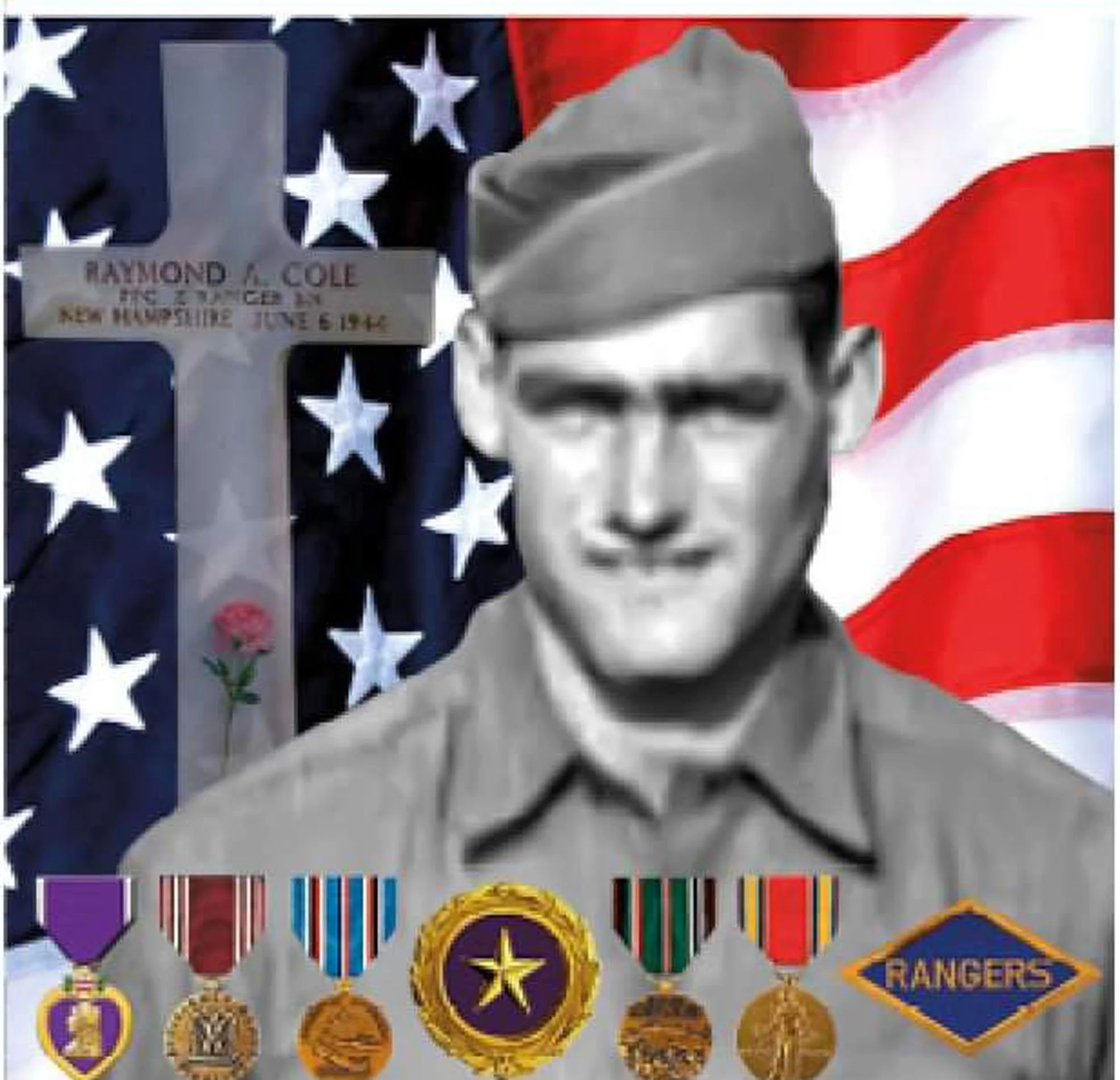
Private First Class Raymond Cole, of Landaff, was killed as he scaled the cliffs at Pointe Du Hoc in France on D-Day morning, June 6, 1944. He is the uncle of Orford resident, Tim Cole, a Viet Nam veteran who once lived on Route 25C on a small farm there. His father was Archie Cole, a World War 2 veteran. Courtesy photo.