
Unsung Heroes
By Tanya Sousa

There are few places in Vermont where you don’t hear the yips of coyotes. The best time to hear these sounds is when the sun and moon do their changing-of-the-guard -- or not long afterwards. They sometimes hunt during the day but seem to love those ‘between’ times as much as they love the spaces between farm fields and forested stretches.
When I was a girl, I rarely saw a coyote. A fox would run without looking back. A coyote would run, then stop to look at me with curiosity. It was a thrill for me to catch a glimpse. They were so beautiful, so dog-like.
When I was in college, I arranged a moonlight picnic with a beau in a newly mown hayfield. I brought cheese, bread, grapes, a bottle of wine and lovely glasses, spread out the quilt on the grass, and lit an oil lamp when the perfect thing happened – coyotes began to yip and howl in nearby hills. My heart soared, but the young man, over six feet tall, muscled and strong, was shaken. “We’re packing up and leaving,” he said. “Listen to them! Listen to how many of them are out there,” my beau at the time shuddered as the coyotes continued their calls.
I attended a workshop where a researcher presented the findings of his studies on coyote vocalizations. They are known to “sing” together. The researcher played a recording of coyotes in full chorus and asked us to identify how many we heard. Common answers were six to twelve. What was the truth of it? He grinned before sharing the surprise. There were only two. The rapid ‘fire’ and range of sounds they make give the illusion of many animals.
Eastern Coyotes do form packs, but they’re usually smaller than the listener believes. There are often only two – a mated pair – and perhaps their young. Sometimes there are a couple of older pups that choose to stay on a while before finding their own territory, and those few will travel together in a family group. They usually mate for life and have very strong family bonds, traits we strive to attain ourselves and usually value. They are adaptable and intelligent.
DNA samples of Eastern coyotes show they are a hybrid of coyote, a bit of wolf, and in some cases a percentage of domestic dog. The species moved to our area sixty or seventy years ago to fill the gaping hole left when we eradicated wolves. Nature abhors a vacuum, and when there was the call to fill the position, a more wolf-like coyote developed, applied for the job, was hired, and has been a dream employee for nature’s purposes. Human efforts to stamp down coyotes, as we did the wolves, have failed.
People are more apt to shoot a red or gray fox if they actually see it after pets or poultry rather than because they feel its very presence is a threat, but the coyote still maintains its “bad predator” status in our minds. That feeling is so still so powerful that it dictates policy around hunting seasons. According to Vermont Fish and Wildlife biologist Chris Bernier, the red fox is protected from overhunting with the season only lasting two months, and at a time when mothers with kits will not be killed. Coyotes, on the other hand, may be shot at any time, for any reason, or no reason. There is also no limit to how many someone may shoot. The strategy doesn’t work because coyotes breed less when the population is healthy, and more when numbers are threatened by hunting like this.
Science shows a healthy landscape includes predators like them to keep other species in balance.
When I worked in a public school, I often had students tell me about hunting with family. One girl shared what she considered the spine-chilling tale of her father having to shoot a coyote that showed up as they were after turkeys. “He had to shoot it,” she said, her eyes wide, “It was right there and it was looking at us.” Other stories were similar and can be found in many hunter tales online – stories of coyotes following hunters through the woods. However, according to a number of naturalists, wildlife biologists, and researches there is a perfectly good reason for the coyotes’ behavior.
Coyotes are opportunists and have found that following human activity can be beneficial since there is often food involved. They’ll come out sometimes to follow a tractor cutting hay – to find the rodents killed or exposed. Turkey calls don’t only call turkeys – they call the animals that eat turkeys. Walter Medwid, biologist and former Executive Director of the International Wolf Center in Ely, MN (now a resident of Derby, Vermont) pointed out that deer hunters are clear signs to keenly intelligent coyotes that scraps may be not far behind. They follow humans, the apex predator of the area, not unlike wolves did long ago. It must have been a good arrangement, as it led to the creation of our domestic dogs and food for both species. As far as hunters’ worries that coyote predation on deer and deer fawns are decimating the herd, the Journal of Wildlife Management reports there is little evidence of a decline in deer populations concurrent with coyote population numbers and expansion. Fish and Wildlife reports reveal that harsh winters are worse for deer population than any of the predators. What coyotes’ stomach contents do show for certain is that they eat a wide variety of animals, fruits and vegetation – they rely heavily on rodents and rabbits.
Wild canids don’t get enough credit for the number of rodents they clear from farmlands. New Hampshire’s Fish and Game’s web page encourages farmers to welcome coyotes, pointing out they feed on rats, mice, rabbits, and other farm “pests”. Coyotes who don’t prey on a farmer’s sheep, calves, chickens or other livestock can be not only rodent control, but will dissuade a potentially more predatory coyote from moving in.
I walked with my old dog one night just after the moon took its post and the fireflies began to dance. When I reached the base of low Vermont mountains, the coyotes began their part of night’s symphony. I stood and listened. My old dog listened too and then raised his muzzle and howled in return. I laughed out loud at the surprising reminder of where he came from; he saluted the unsung heroes.
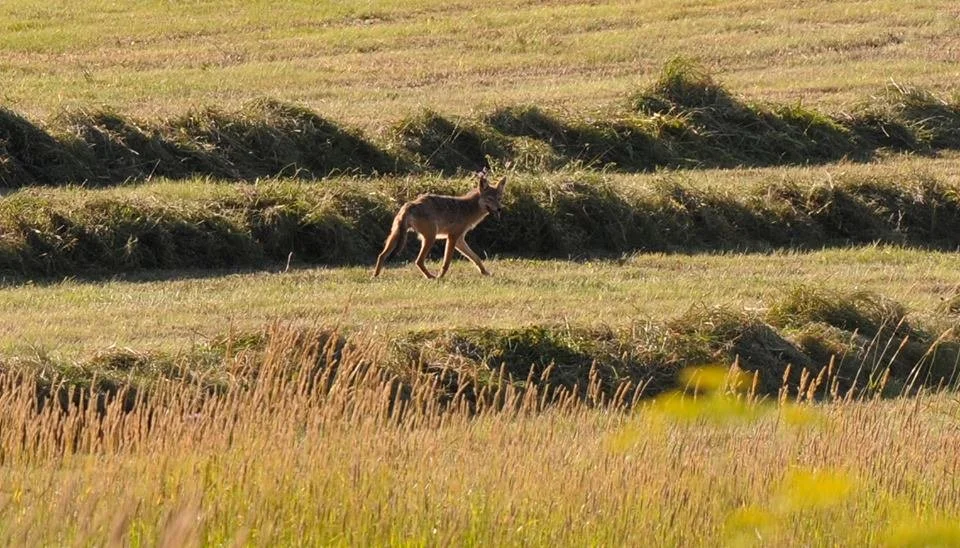
Coyote in a hayfield (The photo is courtesy of Craig Newman of Shelburne)