
The School of Hard Rocks
By Tanya Sousa

I have wonderful memories of walking down gravel roads in East Albany, Vermont with my father when I was a child. That was when I learned that the hackneyed saying, “It’s the journey, not the destination, that matters” is absolutely true. We weren’t on the way to anywhere. We were scanning the roadsides for stones – stones with pattern, or interesting colors, or interesting shapes. My dad found a beautiful purplish one and used a grinder to make it into a heart. Another, oblong blond one was turned into an oval, polished as well as he could with what he had. There were a couple of others I can’t remember now, but I do recall him making a beautiful charm bracelet for me out of those shaped and slightly polished stones. He wrapped them using some thin copper wire before “wire wrapping” of stones for pendants became a thing.
I was always on the hunt for green stones because they were so hard to locate where we lived, and I loved something in the leaf-like hues. My jackpot finds included a very deep green one, smooth to the touch and large enough to fill my palm, and a lighter green one with black specks throughout. I remember exactly what they looked like and how they felt. I gave my collection of special rocks to my nephew when I “grew up” and kept my adult rock collecting morphed into gathering larger ones that would look good in my gardens. I even built stone retaining walls with rocks gathered from farmer’s fields... until I injured my back doing it and had to, pardon the pun, “back off” from many of the physical things I loved including lifting and placing larger finds.
The back pain meant that many things that brought me the most joy and relaxation were removed from my life; Over the years, child-like joy was disappearing and angst and wondering who I even am anymore was taking its place.
The time came not long ago that I needed to drive by a riverbend in each week to get to and from a work site. The summer had been dry, and the water receded so much it exposed a huge swath of river-rounded rocks of all sizes. I only looked from the road as I passed for weeks, then one day I parked and walked down to the rocky expanse, feeling the call of the stones. I spied some with amazing lines, others with mixed colors, and even one bright red one with thick black shapes within, not at all like a granite, and surprisingly like a jasper. Then I saw it – a green stone with black flecks. I ran back to the car to grab a shopping bag with something light in my step that I hadn’t had in too long. I went home that day with three shopping bags of rocks filled just enough that I could carry them safely. I also carried a happy heart-and began researching.
I discovered my green childhood rocks and the greenies I found that day by the river are all Serpentine, and since then, I’ve found them in a wide range of greens from the hues of mint chocolate chip ice cream to the dark green of lush moss and every green in between. I posted pictures of some of my finds on social media and had many friends I’ve known for years share that they love rocks too. It was as if I shone light on the child-like happiness they could feel as well. I researched how to cut, shape and polish the rocks I found. I already had diamond blades and a wet saw for tiles. Another rock lover loaned me a “cabbing machine” to do the shaping and polishing. I couldn’t wait to see what beautiful creations I could come up with – especially with my serpentines.
Internet research uncovered things to be wary of, though. I read, “Serpentine stones are a group of green minerals formed through the alteration of magnesium-rich rocks, often associated with the process of serpentinization. They are valued for their beauty and are believed to have various healing properties, including promoting emotional balance and spiritual growth.” I also read that some have asbestos fibers in them too, so when I work with these and other stones by cutting them into slabs and shaping and polishing them, I follow safety guidelines – using water as part of those processes and wearing a respirator while I work. The water with a wet saw and the water that is used with the “cabbing machine” makes sure there isn’t any dangerous dust to inhale. Touching rocks or their dust will not cause a health issue, but breathing in dust from them can.
With precautions in place, I now regularly search for, collect, slab and shape/polish stones, finding a way to adjust my love of stone into art forms I can manage. My husband came home the other day from a laundry list of appointments and found me polishing my latest finds, looking rather like an alien in my respirator, hair tied back tightly and wearing an old canvas work apron. “Look at you!” He hollered over the roar of the cabber – and truly I must have been a frightening sight, but he beamed at me when he said it; the playful woman he’d fallen in love with is back. I don’t know if serpentine stones really hold healing properties as some claim, but I can say that they’ve done much to heal me.
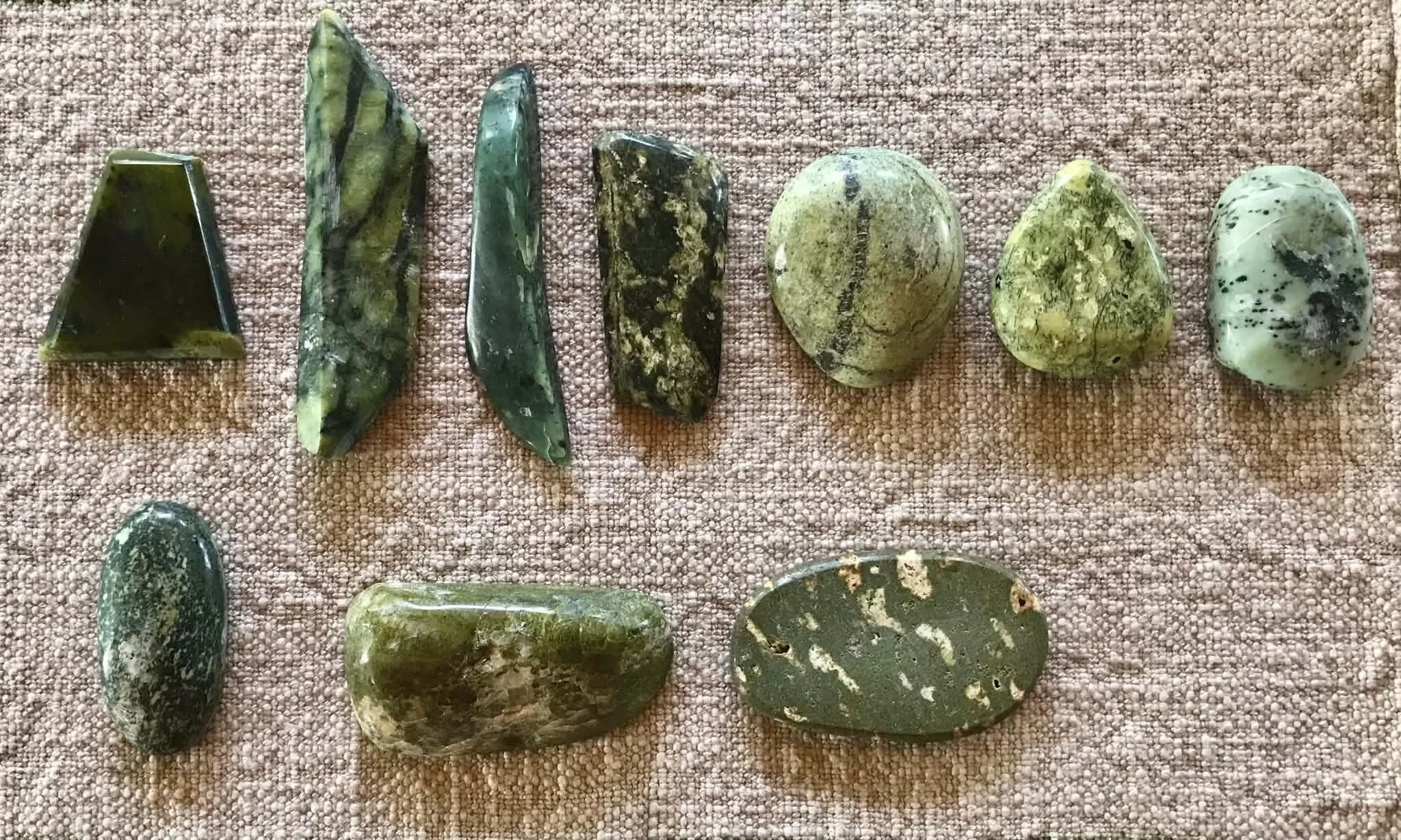
Kinds of Serpentine (photo by Tanya Sousa)