
The Pond
By Tanya Sousa

My first memory of “The Farm” was looking into a spring at the corner of the gravel road and driveway. I was four years old and new to the countryside, coming recently from a suburban area of concrete, traffic, manicured yards, and tied up, barking dogs. On that first day, when I gazed into the spring, I saw that it bubbled from a sandy-bottomed spot—from a dark, mysterious hole in the center—and the water I stared into was clearer than window glass. It was as if I was seeing for the first time, and in a way, I really was.
The spring fed a thin but persistent stream, which in turn fed a small pond by the old farmhouse. I loved the pond instantly. It was surrounded by marshy ground on one side that was punctuated with cattails, their brown, velvet-soft spears and even their names delighting me. There were some rocks and a gently sloping grass bank on the other side where frogs and turtles and dragonflies would sun themselves. The shallow water at the edge was rich with life, too: dragonfly nymphs, tadpoles in various stages of development, minnows, and water bugs that skated flirtatiously on the surface. The water warmed where it pooled, far from the cold spring that fed it. Although I never saw any creatures in the spring itself, I knew even at that young age it was the spring that allowed the pond to “be.”
Once we settled in on the defunct farm, I never wanted to be any other place but outside, and then often by the pond with a jar or a sieve or sometimes a little plastic bucket meant for more civilized places, like a public beach. I emptied my bin of doll clothes, then filled it instead with water and temporarily with the creatures I’d catch at the pond’s watery edge. After watching them swim around awhile, I’d let them go. I never wanted to hurt the beings I caught. Over the course of a couple of years, they became like sisters and brothers, no different from me except in their outer shell. I saw that they ate, that they rested and moved, that they could seem afraid or angry, and could even enjoy a gentle touch—mine.
My dolls languished in the closet, but the doll carriage came outside so I could push it gleefully around the yard, offering free thrill rides to frogs, turtles, or sometimes even snakes I found from lifting sun-baked rocks. The frogs were my biggest challenge. I kept tabs on how many I would catch on a given day, constantly trying to best my own record.
Then a day came that nearly made me feverish with joy.
The frogs were out as usual, but now each had another frog clinging tightly to its back. “Mom! Look! A two-for-one-sale!” I hollered, but sadly my mother was in the house doing dishes from lunch. I stalked through the grasses and reeds, and was surprised by how easy it was to catch them this way. Before long, I had an impressive number of two-for-ones loaded into the baby carriage, and began the free carriage tour of the front yard. The seemingly happy passengers didn’t even try to hop out.
Before long, my mother came out from the dark of the house and into the brilliant sunshine. I was in the shade of a cedar hedge and the maples growing around the yard, so the frogs wouldn’t get too hot or dry, and not far from the spring and its persistent stream. Mom squinted her eyes and, seeing her little girl’s beaming face, she couldn’t help but walk over. “What do you have in there today?” she asked.
Finally! I was able to deliver my line. “Look Mom! A two-for-one sale!”
My mother scrunched her face with confusion, leaned over the carriage, and gasped. “You need to let them go right away!”
Now it was my turn to be confused. “Why?”
“They…They’re… They’re BUSY,” she stammered. “Put them back right now!”
Not to worry: my mother explained the biology of it later, when she wasn’t so shocked, and from then on I knew better than to bother the frogs when they were joining together to create future tadpoles. It was a little disappointing to not commune with them during their mating season, and I did secretly think that honeymooning frog couples would enjoy the carriage tours I offered, but I respected my mother’s wishes.
It has been more than 40 years since I was a child living on that farm with my pond. I heard the homeowners filled the pond in. I was beyond sad the day the news reached my ears: they didn’t want the stream cutting through the neat yard they’d created, so it was redirected to drain into a culvert. Now, instead of supporting habitat, the clear spring water runs and mixes with mud and grime from passing cars. It’s what we do far too often: for matters of convenience or vanity, we take actions, but don’t think of their ripple effects.
The spring keeps bubbling. I imagine that, when the house changes hands again someday, as it surely will, someone will look into the glass-clear water, consider the pond site, and undo the damage. Life will spring back again, please pardon the pun, because there is nothing more persistent than nature itself. The thought gives me hope.
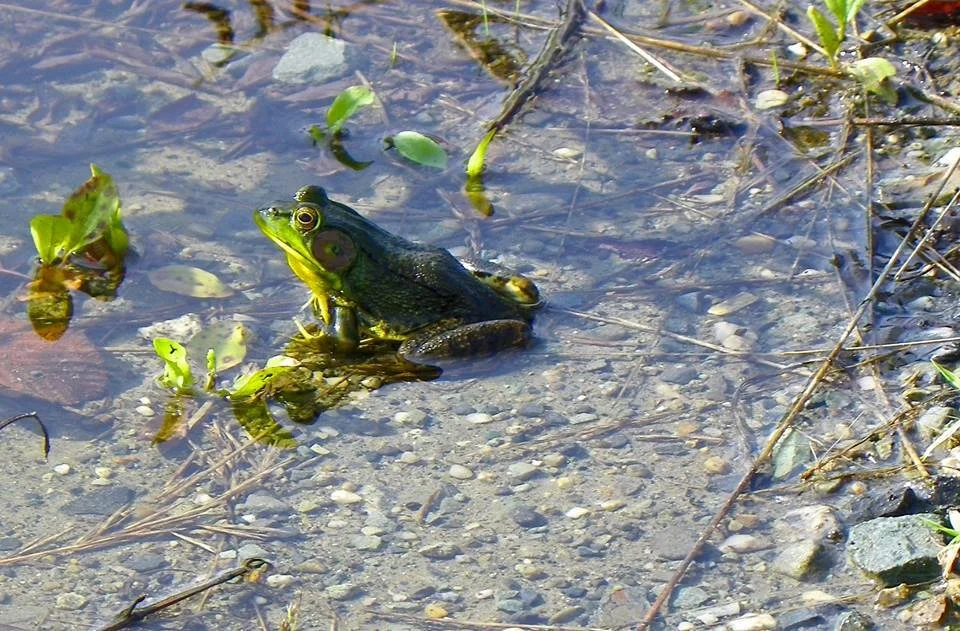
(Courtey Photo)