A Sweet History(That’s a Little Squirrely)
By Tanya Sousa

I’m not sure how many people know where the practice of maple sugaring originated from, but I wouldn’t be surprised if many would guess that we learned it from the Native Americans; You wouldn’t be too far from right. The various tribes known as the Eastern Woodland Indians, the most famous of this group being the Iroquois and Cherokee nations, were seen by Jacques Cartier tapping maples in 1540. Settlers soon discovered the Native Americans had a really good idea and began tapping trees on their own. It seems that the answer is quite simple then, but like most stories and histories, the answer is never that simple. Like most good stories, there’s a twist.
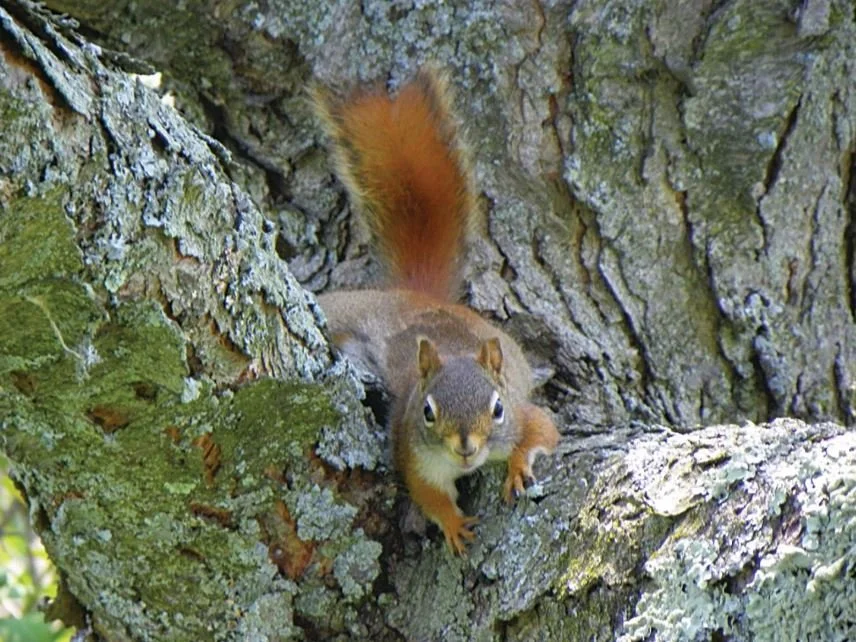
When author and professor Brend Heinrich of the Department of Zoology at the University of Vermont decided to study some long-reported but unsubstantiated animal behavior, it lead him to vast early spring maple groves in Maine and Vermont. It also led him to research on the maple tapping practices and myths of Native American people such as the Iroquois. He found the answer to the riddle of where maple sugaring came from – discovered the genius who made the sweet and lucrative business possible today – and it was a creature most in the maple sugaring industry consider a scourge and an arch-enemy – none other than the tiny red squirrel.
It’s true. The animal that chews through plastic tap lines on occasion to get sap may feel he has every right to do what he’s doing because he’s the very reason any of us have access to the delicious taste, and the money it brings, in the first place.
The Iroquois have an ancient myth about the red squirrel’s role in the discovery. A youth, it is said, was in the woods and saw a squirrel in a tree biting off the tip of a twig and licking the sap. The youth, curious, tried it too, and so a grand discovery was made. The myth may end there, but the details of how the Native Americans came to realize the usually watery sap could be thicker, sweeter, and even be turned to sugar is also thanks to the smarts and behavior of the small, nimble rodent.
When Heinrich studied the maple groves in 1989-1990, he watched red squirrels “systematically harvesting sugar and syrup from sugar maple trees,” according to his paper, Maple Sugaring by Red Squirrels. He studied twenty-three sites in the two states and saw the very behavior he’d heard about and read about but never saw real proof of before he paid attention, as so few of us do. Squirrels pruned trees by snipping buds with their teeth, snipped off the tips of other branches, or slashed v-shaped wounds in the bark and side of sugar maple trees with their teeth. The odd thing to Heinrich was that the squirrely critters didn’t lick the sap right away. Instead, they left the scene and returned hours or longer later when the sap had oozed onto the bark, the water had mostly if not all evaporated, and left the small furry maple producers with their own syrup or sugar, which they would then enjoy. Fully, I’m quite certain.
As if he needed more proof, Heinrich noticed an amazing similarity between the traditional Native American method of harvesting the sap. What was similar? They hack a V-shaped wound in the tree to release the flowing sap – just like the V-shaped wound, but larger of course, made by the smart little red squirrels.
At this point you might be frowning at what I’m trying to suggest. A pest is responsible for a wonderful human achievement? Someone is calling the behavior of a scourge, a mere rodent, “smart”? I imagine you’re especially frowning if you a human maple producer. But hear me out on this one:
Red squirrels are one of a tiny percentage of the entire world’s animals that stores food for winter. Humans are part of that small percentage. They place their stores in piles called “middens” or stuff their stashes under logs or in hollow places. Yes, they forget where they stored each and every one of these sometimes, but I don’t think that’s completely a slam against their intelligence. We misplace our car keys all the time, don’t we? Put things in “safe spots” and then don’t recall where the “safe spot” is that we were sure we’d always remember?
When stores of food run low in certain years, in certain springs, the clever squirrels learned that the sap could be useful. At some point, they even figured out, perhaps by happenstance, that there is much more energy and taste to be had by getting water out of the sap so the good stuff is left behind. These rodents are good stewards of the forest as well. They start harvesting the sap and sugar sometimes as early as January, but around the first of March Heinrich could see the V-shaped marks on the trees increased in number, but never too many. They took what they needed and the tree wounds were well healed by July with the trees no worse for the wear.
Who knows? Maybe those red squirrels see those plastic tap lines and think that after generations of going totally unappreciated, we recognized their gift to us, we such hairless and strange animals in our own right with hardly any survival skills at all, and thought we were returning the favor by giving them easier access. Ridiculous you say? I wouldn’t put anything past them!
Perhaps when they chide us for entering the maple groves with their chatters, screeches, whistles, chirps, rattles, growls, foot stomping and tail flicking, they have the right to try warding us off. Seems they were the first in the maple business after all.