
By Gary Moore
Vermont Coverts is a peer-to-peer community of landowners, professionals and others learning from and supporting each other to enhance wildlife habitats through sound forest management.
I interviewed Executive Director Lisa Sausville to learn more about Vermont Coverts for this column. I became a Coverts cooperator in 1998 and have interacted with Lisa for years. The late James Engle who lived in Peacham and also had a home and property in Groton was the one who got me interested in the program.
In 1983, the Ruffed Grouse Society received a grant to look at ways of reaching the millions of private forest landowners throughout the United States with wildlife management information. The Coverts project was developed by Vermont’s Extension Forester Thom McEvoy in cooperation with Connecticut Extension. The first Vermont Coverts Training took place in 1985.
Coverts is an English word dating to the 14th century, pronounced "cuh-verts" (not “coe-verts"). It refers to dense thickets that provide shelter for wildlife.
Vermont Coverts Woodlands for Wildlife is an independent non profit funded through an annual drive and also grant money that is leveraged through matches.
Coverts is no longer just in Vermont and Connecticut. It has spread across the US and is also in neighboring New Hampshire.
Vermont Coverts offers three-day trainings that include classroom and field studies. They also facilitate personal contacts among individual landowners, experts, public agencies and private organizations in the conservation arena.
Forest ecology, forest management, wildlife history, silva culture and legacy planning are among the topics covered in the classroom and in the field.
Cooperator training such as I took 28 years ago is offered two times a year, spring and fall. The next session is August 28-30 at the Green Mountain Conservation Camp in Castleton.
The three day trainings are not just for landowners, conservation commission members and others interested in forest and wildlife management are encouraged to attend.
The trainings are moved around state to make attending easy and they run Friday through Sunday. They are free and provide room and board and all materials. Such a deal!
There are so many opportunities to learn and share in addition to the three day trainings. Coverts and Fish and Wildlife support and promote the Bear Ambassadors program. Coverts has a You Tube Channel and a Book Group that meets remotely every two months.
Offered around the state are a wide variety of workshops and field visits to learn about everything from invasive to tree identification.
Legacy planning workshops are offered as it is important to plan for your land after you are gone. What do you want to happen to it?
Lisa said, “We want people who want to share information.” Peer to peer is the key. You can have a local cooperator walk your land with you or you can visit theirs.
I urge you to sign up for e-news which comes out every Friday. It includes training and workshops from other organizations as well.
Lisa says the goal is for “Landowners to move from interest to awareness to action on their property.”
Check Vermont Coverts out at https://vtcoverts.org/. You can also Email: info@vtcoverts.orgor call 802-877-2777.
Vermont Days This Weekend Waives Fees
Vermont Days Saturday, June 13 and Sunday, June 14 this year, is an annual weekend celebrating the arrival of summer with free admission to day-use areas at Vermont State Parks and state-owned historic sites and Free Fishing Day Saturday, June 13.
Both Vermont residents and out-of-state visitors are invited to celebrate summer in Vermont by spending the day on the lake, immersing yourself into Vermont’s past, or casting a line on Vermont Days.
https://vermontvacation.com/vermont-days/
“We’re fortunate to live in such a beautiful state with impressive landmarks and tightknit communities,” said Governor Phil Scott. “Vermont Days is a good way to welcome more Vermonters and visitors to these sites. Going outside, enjoying ourselves and connecting with our neighbors has never been more important. So, get out there and celebrate with us for Vermont Days.”
During Vermont Days, Vermont’s 55 state parks and six historic sites and museums will offer free admission to day-use areas. On June 13, residents and non-residents can also fish without a license for Free Fishing Day.
In addition to free admission to State-run parks and historic sites, family-friendly events occur throughout the weekend and the Vermont History Museum in Montpelier and Vermont History Center in Barre will offer free admission on Saturday, June 13.
Keep Loons Safe
Vermont Fish and Wildlife biologist Jillian Kilborn said, “We’re asking people to enjoy loons from a distance. If a curious loon approaches you, just enjoy it, but if a loon is constantly swimming away from you, they can become stressed and may even abandon their young.”
Bringing all fishing line home helps prevent loons from becoming entangled, which can lead to death for loons. Eric Hanson, biologist with the Vermont Loon Conservation Project and Vermont Center for Ecostudies (VCE), asks anglers to reel in for a few minutes if loons are diving nearby. “Loons will take live bait and lures, killing a few each year,” notes Hanson. “A few loons have even learned that anglers are a source of easy food, and just like bears, it is very important that loons do not learn this problem habit.”
VCE coordinates loon conservation efforts in partnership with the Vermont Fish and Wildlife Department, and they remind people to avoid using lead fishing tackle. Every year Vermont loons die from lead poisoning after swallowing lead tackle.
Hanson says most people are respectful of nesting loons and give them space, but people sometimes inadvertently harm loons without meaning to. “Loon chicks can be difficult to see, so we ask motorboaters to note where loon families are and to avoid those areas,” said Hanson. “We also ask that motorboaters obey ‘no wake’ laws within 200 feet of shorelines because boat wakes can flood and destroy shoreline loon nests.”
Volunteers interested in monitoring loons for the Loon Conservation Project should go to the VCE website loon participate page. Volunteers can sign up with the new online LoonWeb platform, https://vtecostudies.org/what-we-do/projects/loon-conservation/participate, for both LoonMonitor and LoonCount.
LoonMonitor is the program where volunteers follow loons all season long with a focus on lakes with loon pairs and nesting, but it is also for people who visit a lake at any time and want to report loon activity. LoonCount is the annual one-day survey that takes place on July 18 between 8 and 9 a.m. The goal is to survey all lakes greater than 20 acres at the same time, which provides a population count and checks on small lakes that are surveyed less often during the rest of the year.
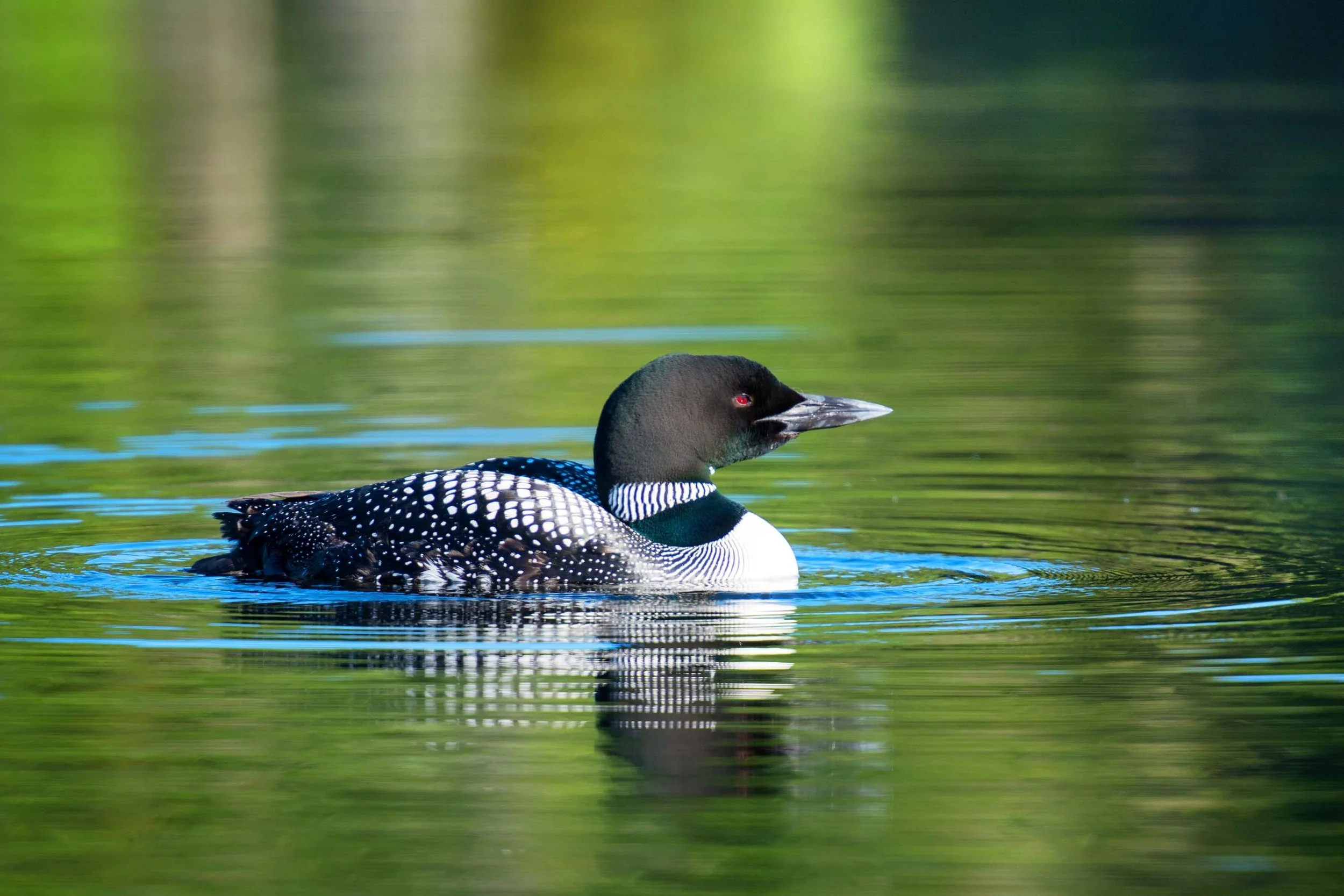
A loon watching for danger. Credit Vermont F&W
Bits and Pieces
Across North America, birds that use grassland habitat have experienced the steepest population decline among all bird groups in the past five decades.
Landowners can make a difference by altering the times of year they mow their fields, according to the Vermont Fish and Wildlife Department. “Landowners can help grassland species by waiting to mow their fields, giving the birds a chance to rear their young,” said Jillian Kilborn, biologist for Vermont Fish and Wildlife.
“People maintain open, grassy fields in Vermont for a variety of reasons, from producing hay to providing pasture for grazing, to simply maintaining scenic beauty,” said Kilborn. “For those who can afford it, the timing of mowing or brush hogging can be adjusted to allow grassland birds to successfully raise young.”
Bobolinks, Savannah sparrows, eastern meadowlarks and wild turkeys build their nests right on the ground, among the grasses and wildflowers. Deer fawns and other animals take refuge in grass fields, and other birds such as bluebirds, kestrels, whip-poor-wills, and northern harriers rely on grass fields for food.
According to Kilborn, landowners who do not need to mow for animal forage can accommodate nesting birds by cutting late in the summer, preferably after August 1. When you do mow, Kilborn advises to keep an eye out for unwanted plants.
Landowners who face a loss of income from delaying mowing can apply for assistance through the Natural Resources Conservation Service EQIP program or The Bobolink Project.
You can learn more about conserving Vermont’s grasslands on Vermont Fish and Wildlife’s website. You can also help grassland bird conservation in Vermont with a donation to the Nongame Wildlife Fund. Every dollar donated leverages up to three dollars of federal funds to help protect wildlife species at risk, including birds, bats and bumblebees.
***
The New Hampshire Fish and Game Department announced it is canceling public hearings scheduled for June 3 and June 10.
The press release said, “After reviewing all the input we received—and at the direction of the Governor’s Office—we will pause rulemaking related to fee adjustments and the Fis 400‑series fishing rules. We will return to these topics at a later date and continue working closely with the hunting, fishing, trapping, wildlife‑viewing, and hiking communities, as well as other stakeholders, to ensure the most open and transparent process possible.”
Do you think fee increases were not something the Governor wanted in an election year?
***
The New Hampshire Fish and Game Department is asking for the public’s help by reporting wild turkey brood sightings this spring and summer. If you observe groups of turkeys with poults (juvenile birds) between June 1 and August 31, report your sightings.
To learn more about the Turkey Brood Survey and how to report, visit www.wildlife.nh.gov/wildlife-and-habitat/wild-turkeys-new-hampshire/turkey-surveys.
***
For the convenience of those applying for permits to bait wildlife, the New Hampshire Fish and Game Department has a deposit box in front of its main entrance at 11 Hazen Drive in Concord, NH. The drop box is intended to collect application materials from the public including baiting permits, which may have been personally hand delivered to the Law Enforcement Division in previous years.
Permits to bait wildlife are required in the Granite State to hunt bear and deer, or take any other wildlife over bait, including for lands that are state owned or state managed as well as for privately owned property.
Completed applications to bait on state-owned or state-managed lands, which includes federally managed lands, may be left in the Fish and Game dropbox from Monday, June 1 through Monday, August 3, 2026. Applications may also be mailed, postmarked between June 1 and August 3 and sent to the New Hampshire Fish and Game Department, Law Enforcement Division, 11 Hazen Drive, Concord, NH 03301.
***
Mark Breen reports in the Fairbanks Museum's Skywatch Almanac that on
June 11, 1842: “A rare June snowstorm left 10 to 12 inches of snow in Barton and Irasburg, VT.”
Parting Shots
I drove back and forth to Coleman State Park in Stewartstown Saturday and Sunday to take a fly fishing course offered by New Hampshire Fish and Game. Moore on that next week.
Syndicated columnist Gary W. Moore may be reached by e-mail at gwmoore1946@icloud.com or at Box 454, Bradford, VT 05033. copyright 2026 Gary W. Moore