
Putting Collars On Snowshoe Hare
By Gary Moore
I have been involved in tagging black bears and putting radio collars on moose but never have I done either on little snowshoe hare. That changed when I was able to join two researchers working on the Nulhegan Basin Division of the Conte National Refuge.
I met up with Brittany McGill from UNH who had been working on the project all summer and Jeremy Fuller a University of Wyoming research assistant who had just arrived in Vermont the day before. We agreed to rendezvou on the Four Mile Road several miles into the refuge in Lewis.
The refuge is undertaking variable density thinning (VDT) hoping to return much of the forest to its natural condition before intensive logging by the timber companies that formerly owned the lands.
Brittany said, “The overall project is to study and evaluate the effects on and responses of wildlife such as snowshoe hares, a keystone species and other boreal forest obligates, like the state endangered spruce grouse to ecological silvicultural practices.”
In other words, how do the critters that traditionally called the area home react to changes in the forest.
She has been working with Dr. Alexej Sirén, a research ecologist and the principal investigator. He was a post doctoral at UNH while working at the refuge and is now at the University of North Dakota, UND.
Brittany is going to UND the first of the year to continue her studies and Jeremy will also be transferring to UND.
The study on the refuge is multi year and is building on previous research to provide land managers with information on the compatibility of alternative conifer regeneration practices with ecologically important wildlife species.
Brittany told me the the study is a collaborative project between the USFWS and Dr. Alexej Sirén with support from co-principle investigators at the University of Vermont, University of Massachusetts, University of New Hampshire, and Vermont Fish & Wildlife.
As part of the study, the team puts out about 50 Havahart traps each Monday and checks them every day before picking them all back up on Friday. Talk about hard work! Think carrying all those bulky traps into and out of the dense habitats favored by snowshoe hare.
Soon after daylight each morning they start checking traps and processing any hare they have captured. They weigh and measure the hare, clean the nose, ears and eyes with Neosporin, attach ear tags and then the radio collar. All the time silence is maintained and the hare is kept securely in a cloth sack to keep it safe and reduce the stress.
The hare is then released back to where it was captured and off it goes. I am told the transmitters generally work for at least a year allowing the researchers to learn where they are.
I was very impressed at how carefully they handled the hare to make sure it was not injured and to try and lesson its stress. Unlike the bears and moose I have worked with, they are not tranquilized and must experience fear.
Brittany said, “We will be looking at the distribution, movement levels, spatial usage, abundance, and survival of the snowshoe hares pre- and post-treatment, which is taking place over a two year period.
“The study will be looking at the short-term (1 year post-harvest) effects of two variable density thinnings (VDT) and gap and patch retention skip treatments. The two skip sizes will be 0.1 hectare and 0.2 hectares.”
Refuge manager Steve Agius had previously told me about the variable density treatments they were undertaking. Brittany pointed out that, “VDT was chosen because in theory, these treatments will create more habitat and stand diversity for both early and late-successional species, unlike pre-commercial thinning which can accelerate stand development and influence tree species composition but can have a long-term negative effect on ecologically important wildlife because of the homogenous post-treatment structural conditions of pre-commercial thinning.
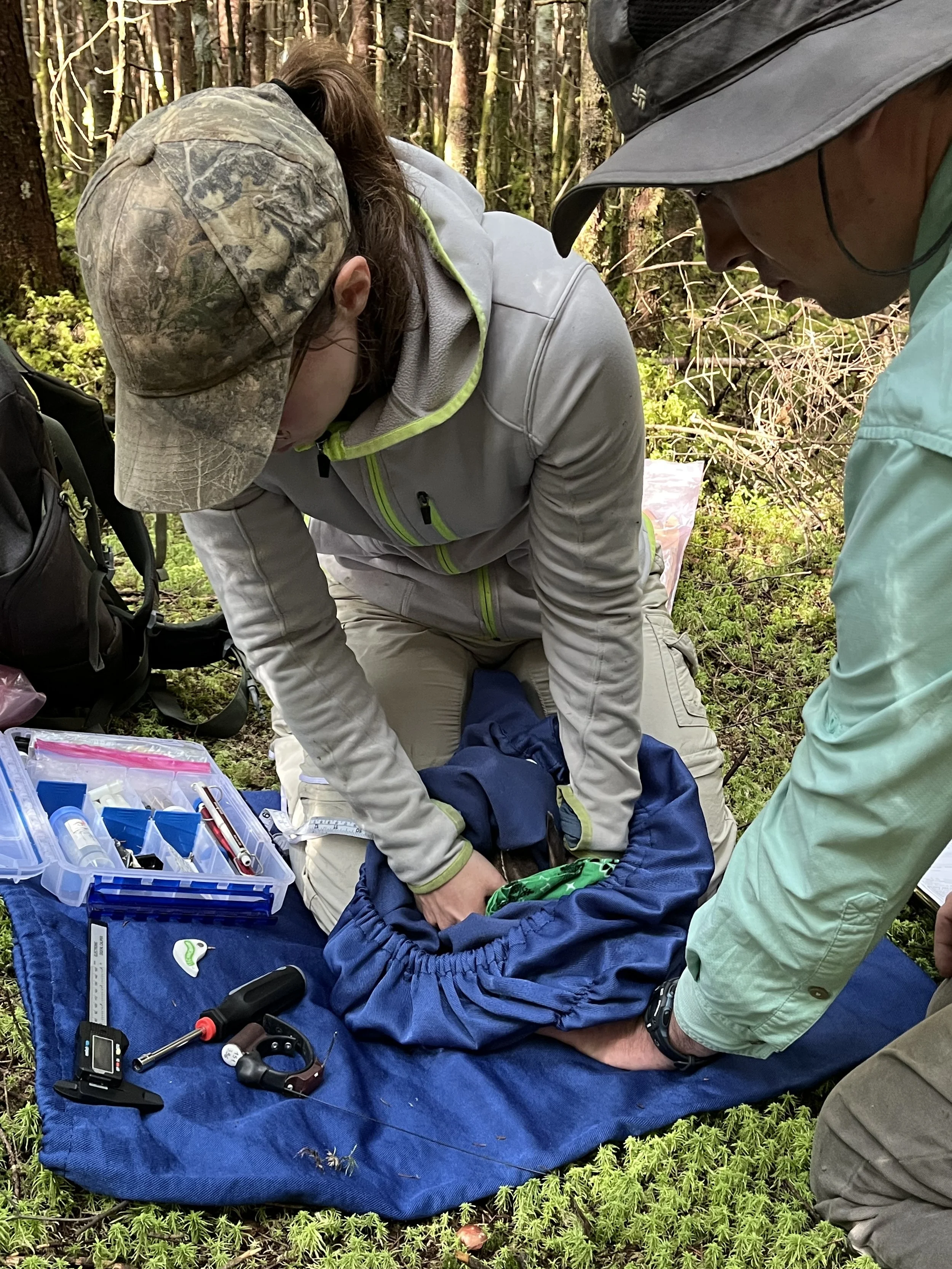
Processing a snowshoe hare held securing in the sack. Note the small radio collar on the ground cloth.
Bits and Pieces
Four Vermont Fish and Wildlife regulations have been amended and will go into effect on September 19.
“The Fish and Wildlife Board and Legislature have approved the amendments that we recommended to regulations regarding requirements for reporting big game, the use of leashed tracking dogs, crossbows, and the requirements for tagging and transporting big game,” said Commissioner Jason Batchelder. “These are basically house-keeping measures to simplify, update or improve these regulations, in some cases based on public input.”
The full annotated text of the rules can be viewed on the Vermont Fish and Wildlife website under “Newly Adopted Rules.”
***
If you enjoy wildlife be sure to make plans to attend the 25th annual Dead Creek Wildlife Day in Addison, Vermont on Saturday, October 3.
The free activities at Dead Creek Wildlife Day are especially for people who enjoy hunting, fishing, birdwatching, or learning about Vermont’s diverse wildlife and ecosystems. The event will be held at the Vermont Fish and Wildlife Department’s Dead Creek Wildlife Management Area on Route 17, west of Route 22A.
***
The New Hampshire Fish and Game Department has completed the conservation purchase of 1,308 acres in Marlow and Alstead, formally establishing the Theodore W. Walski Wildlife Management Area. Named in honor of longtime Fish and Game wildlife biologist Ted Walski, whose decades of work advanced the restoration of wild turkeys and their habitat across the state. The new WMA protects an ecologically rich landscape and ensures public access for wildlife‑based recreation.
***
The New Hampshire Fish and Game Department offers an excellent fundraiser for teachers, students, mentors, and small businesses. The 2027 New Hampshire Wildlife Calendar is an effective fundraiser for schools, clubs, and community groups and it supports NHFG’s work conserving wildlife and wild places.
Your group keeps $6 for each calendar purchased. The retail price is $12.
The calendar features: incredible wildlife photography; important hunting, fishing, and outdoor recreation dates; and wildlife-watching tips. The 2027 New Hampshire Wildlife Calendar is in stock and ready to ship or be picked up at NHFG Headquarters, 11 Hazen Drive, Concord.
Get a calendar sales kit or more information for your group or business today by emailing Jay Martin at Jay.Martin@wildlife.nh.gov.
***
Fish kills, where large numbers of fish die in a short period of time, are not an uncommon sight in the Granite State during the summer and most are due to natural processes, not pollution, but NH Fish and Game still requests reports of any. Small lakes and ponds in New Hampshire that are comprised of shallow, vegetated habitat and that support an abundance of panfish and other species can be susceptible to fish kills.
To report a fish kill, call the New Hampshire Fish and Game Department’s Inland Fisheries Division at 603-271-2501.
***
Mark Breen reports in the Fairbanks Museum's Skywatch Almanac that on September 20, 1845: “A powerful tornado crossed the Adirondacks, finishing as a water spout over Lake Champlain, crossing just south of Port Kent east to South Burlington.”
September 21, 1938: “The Great Hurricane of 1938 - the worst hurricane in New England’s history - crossed Vermont from Brattleboro to Burlington in just two hours, leveling tens of thousands of trees, and causing major flooding in southern Vermont.”
“September heat wave; 92, 92, 91, and 92 in Burlington, VT from the 30th to the 3rd. Springfield, VT roasted at 95 on the 2nd.”
September 9, 1821: “A tremendous severe weather outbreak; 3 inch diameter hail in Brandon, VT, a possible tornado in Hubbardton and Pittsford. A tornado crossed Sullivan County, NH near Lake Sunapee, continuing east to Tilton, killing 6 people.”
Parting Shots
Roger Damon passed away September 7 at age 97. He was an amazing man and a good friend whom I loved to chat with and looked forward to his letters and the items he sent that he knew I would be interested in.
He was a man whose expertise and interests covered a very broad spectrum.
We first became friends about 50 years ago when we were both members of the board of the Fairbanks Museum and found we shared so many interests from flying to hiking.
He was an avid hiker, skier and cyclist who men half his age could not keep up with. I can vouch for that firsthand. I remember one time years ago when we were hiking Magalloway Mountain in Pittsburg when he had to keep slowing down so I could catch up and I was 17 years younger.
Roger was an expert on avalanches and instructed courses on the subject all over the northern regions. He served many years on the Mount Washington Volunteer Ski Patrol in Tuckerman Ravine.
A few years ago I hiked in to Tuckerman’s one spring day to see him honored for his service.
***
Saturday, Linda and I went to the Silvio Conte National Wildlife Refuge and the Lewis Pond Boardwalk for David Feurzieg’s number 104 of his Play Every Town Concerts.
The program included Mozart’s little pieces K. 2-5 from 1762, when the town was chartered, as well as music from 1921, the year the hosting Wildlife Refuge’s namesake was born.
Even though Lewis is unpopulated, fiddler Bill Shepherd holds one of the few remaining leases in the refuge for his camp on the pond. He and Jenny Keller and Annelies McVoy joined David Feurzieg for the traditional dance tunes.
***
Friday, 9/11, we went to Sugar Hill to view the twin beams of the Honor Summit. Unfortunately we drove 70 miles and wasted 2-1/2 hours as we never saw the lights despite being in a prime viewing spot.
The much hyped event was to take place from 8-midnight but by the time we and many others left at 8:30 we had seen nothing.
Route 117 east of the village of Sugar Hill as well as both sides of Sunset Hill Road were lined with cars hoping t see the lights.
It was frustrating not being able to see the lights but waiting in the dark brought back memories for us as it did for so many.
One of those is what the citizens of Gander, Newfoundland did for all those whose planes were grounded there. Compare that to how Donald Trump is treating our friends and neighbors to the north and our major trading partner.
***
Labor Day traditionally marks the end of summer in this region. I took a dip in our very cold spring fed pond that day, likely my last until Memorial Day when I will have to enter the water again, at least for a short dip even though it will be far too cold to enjoy. The Memorial Day swim is something I have done since I was a kid and my family opened our camp on Nelson Pond.
Syndicated columnist Gary W. Moore may be reached by e-mail at gwmoore1946@icloud.com or at Box 454, Bradford, VT 05033. copyright 2026 Gary W. Moore