
A Unique Bridge Erected In Tucker Mountain Town Forest
By Gary Moore

It is well worth a drive to West Newbury to see a wooden arch bridge unlike any you will find anywhere else in the U.S.
It is the work of Newbury resident John Nininger and Adam Miller of West Corinth. The two highly skilled craftsmen’s work can be seen in many locations such as shelters along the Appalachian Trail and most magnificently Dartmouth College’s Ravine Lodge on the eastern side of Mt. Moosilauke.
John and Adam went to China last year to study how the bridges were built and to meet with many of the bridge builders and those who build and maintain them. That trip gave them the desire to build a similar style bridge for Tucker Mountain.
They put on a program at West Newbury Hall last winter about their trip and the many beautiful bridges they saw, many of which are very large. I and all those in attendance were amazed at the beauty of the bridges they showed photos of and how intricate they were.
Wooden arch bridges are found in Fujian Province and Zhejiang Province, along China’s southeast coast. According to a document I was provided, “The traditional design and practices for building these bridges combine the use of wood, traditional architectural tools, craftsmanship, the core technologies of ‘beam-weaving’ and mortise and tenon joints, and an experienced woodworker’s understanding of different environments and the necessary structural mechanics.”
The two craftsmen spent considerable time this spring and summer building the bridge in Adam’s Corinth shop. It was then disassembled and transported to West Newbury where it was erected on newly installed abutments.
As far as anyone can determine, the bridge is the only one in the U.S.
The bridge crosses a small stream a short distance from the east parking lot on the Town Forest. Check the trail map at the kiosk for directions.
You can view a short YouTube video, https://ich.unesco.org/en/video/78546, from the UNESCO Intangible Cultural Heritage to learn a lot about the Chinese arch bridges.
Fall Means Hunting Seasons And Also a Great Time to Hike And Enjoy Being Afield
New Hampshire Fish and Game offers some tips for non hunters who want to enjoy being in the woods and mountains of our beautiful twin states during the hunting seasons. I am sure Vermont Fish and Wildlife would agree, both can be done safely.
Be aware of your surroundings. This seems like common sense, but remembering and acknowledging that it is hunting season will improve your awareness. Know the dates of hunting seasons in your area by looking them up online or in the NH Hunting and Trapping Digest or Vermont Hunting & Trapping Guide.
Pick the right trail. During the fall, stick to established hiking trails. Hunters generally avoid heavily used hiking paths because activity in the woods usually frightens game species. As a result, hunters will be situated deeper in the woods.
Pick the right time. Legal hunting times for most game run from a half hour before sunrise to a half hour after sunset. Wildlife, and consequently hunters, are most active at dawn and dusk. Midday hikes when light conditions are optimal are best for the fall. You are also much less likely to run into a hunter during mid-week hikes because the majority of hunting takes place on weekends.
Wear hunter orange. An orange hat, handkerchief, vest, or shirt is a must for this time of year. This will make you more visible to anyone in the woods. Don’t forget to also put some orange on the family dog and consider putting them on a leash at all times for their safety.
We can all enjoy being outside in the fall, hunters and non hunters alike.
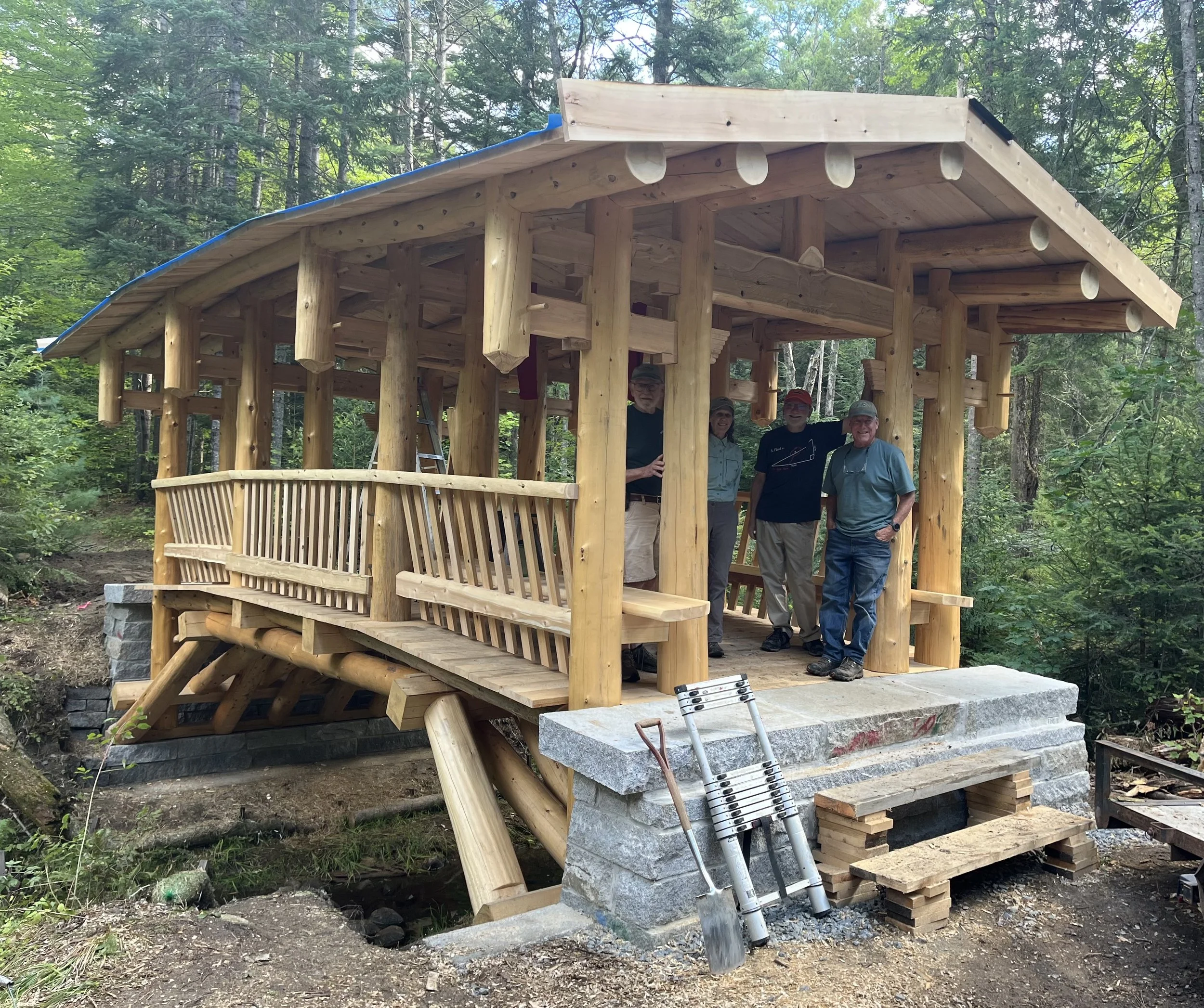
Working to put finishing touches on approaches to bridge.
Left to right: Tom Kidder, Hannah Narowski, Dana Caldarone, John Nininger.
Bits and Pieces
Tonight, Tuesday, September 22, the Autumnal Equinox, the beginning of Fall, occurs at 8:05. Summer went far too fast for me.
***
Play Every Town’s Concert number 106 will be in Danville at the Congregational Church at 6 p.m. this Friday, September 25
***
Vermont hunters will be able to report turkeys and some deer they harvest this fall online through the Vermont Fish and Wildlife Department’s website.
Turkeys may be reported online or in-person at a regional big game reporting station.
Deer may be reported online or in-person during the muzzleloader seasons and most of the archery season.
Deer taken during the youth and novice deer hunting weekend on November 7-8 must be reported in-person. All deer taken November 14-29, including regular season and archery season deer, must be reported in-person. This in-person reporting requirement allows biologists to collect important information from deer during these seasons.
Bears must be reported in-person at a regional big game reporting station. The hunter must also submit a premolar tooth from the bear at the time the bear is reported or within 30 days. The tooth provides important data on the age structure and size of the bear population. Envelopes for submitting teeth are available at all big game reporting stations.
Hunters are required to report deer, bear and wild turkeys they harvest during the hunting seasons within 48 hours. Deer and bear must be field-dressed prior to reporting, and a hunter must take a warden to the kill site of a deer or bear if requested.
The online reporting links for deer and turkey as well as a map and list of big game reporting stations is available under “Hunt” on the left side of Vermont Fish and Wildlife’s website. Photos are required for online reporting of deer and turkeys.
Fish and Wildlife urges hunters to review the 2026 Deer Season Hunting Guide also available on the website home page.
***
To help fuel curiosity about the wildlife and wild places of the Granite State, the New Hampshire Fish and Game Department offers a diversity of educational resources to connect youth of different ages with their natural environment.
From training for educators to curriculum kits to a variety of programs for various ages, Fish and Game can help.
To learn more about these and other exciting Fish and Game educational programs, visit www.wildnh.com/education
***
New Hampshire’s hunting season for pheasants gets underway on October 1 and continues through December 31 with a special youth hunt this weekend, September 26–27. This fall, some 9,500 adult ring-necked pheasants will be released in all 10 counties with an average of 130 pheasants stocked per site.
All pheasant-stocking sites will be closed to pheasant hunting until 2 p.m. on in-season stocking days which include October 8-9, October 15-16, and October 22-23. The full list of towns to be stocked, including sites stocked for youth weekend, can be viewed by visiting https://www.wildlife.nh.gov/hunting-nh/nh-pheasant-stocking.
***
The 2027 New Hampshire Wildlife Calendar is now available from the New Hampshire Fish and Game Department. This award-winning calendar features close-up images of native wildlife and includes hunting, fishing, and recreational season dates for the Granite State. They make a great gift.
Every calendar purchase helps support the New Hampshire Fish and Game Department’s work managing the state’s natural resources for all to enjoy.
Visit www.wildlife.nh.gov/shop-and-support/shop-wild-nh to purchase calendars online and receive free shipping. Or stop by the New Hampshire Fish and Game Department, 11 Hazen Drive in Concord, NH, Monday–Friday, 8:00 a.m. to 3:45 p.m., where you can purchase calendars and gift certificates before the holiday rush begins.
***
Mark Breen reports in the Fairbanks Museum's Skywatch Almanac that on September 25-27 – 2017: The latest heat wave on record seemed out of place in the early days of Autumn; Springfield reached 93, Burlington 92, and St. Johnsbury and Woodstock peaked at 91.
Parting Shots
I know I am an old curmudgeon but can anyone explain to me a couple of fashion trends I just can’t understand?
A hat has a visor to shade the eyes. Why do so many wear it backwards? It looks ridiculous. The only ones who used to wear the hat backwards were the catchers on the baseball or softball teams.
When I was growing up we wore our jeans until they barely held together. It was because they cost money we did not have a lot of. They were worn to the barn and around the farm but never to town.
Being seen in public with jeans full of holes would have been embarrassing for us and would have mortified our mothers.
Today we see many, even adults, wearing jeans they purchased that are full of rips, tears and holes. Why intentionally dress to look like some down and out homeless person?
Syndicated columnist Gary W. Moore may be reached by e-mail at gwmoore1946@icloud.com or at Box 454, Bradford, VT 05033. copyright 2026 Gary W. Moore