
Over 60 vendors greet “Wells River’s “So Long Summer, Hello Fall!”
Event honcho Richard Roderick announced on Saturday noon, September 5, 2026 that he has been “in town and on the street for every event for the past 14 years and this year is the biggest I have seen yet,” he exclaimed to The Bridge Weekly as we strolled by his table under a tent that protected him from the sun’s rapidly heating rays.
He said the businesses and organizations that have been a part of the gala have enjoyed it over the years. He said this year he counted over 60 of them had signed up, a full 10 more than last year.
Bernie Marvin
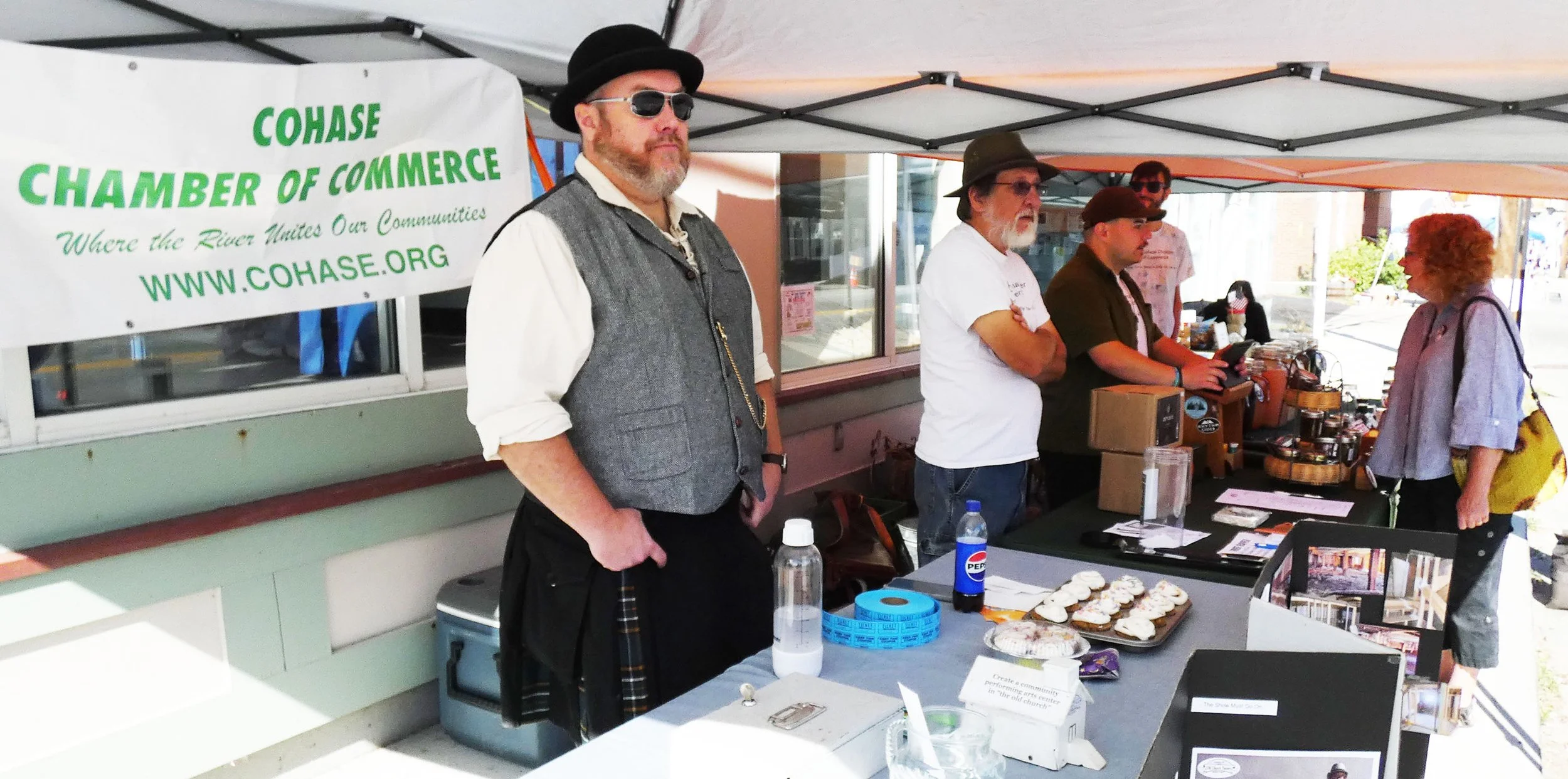
Lined up along Main Street in Wells River for the end of summer gala festival held last Saturday, September 5, 2026, are, left to right, John Hunt representing the Old Church Theater, and three members of the Cohase Chamber of Commerce Board, Gary Scruton, Joe Mitchell and Darren Sherburne. It was a busy time for all vendors stretching along Main and Railroad Streets. The Bridge Weekly/Bernie Marvin
Wells River, VT – Car and truck traffic on Route 302 and streams of people traffic on the sidewalks marked the 14th Annual “So Long Summer, Hello Fall” Festival, the happy child of the Wells River WRAP Program that has been growing larger ever since it began 14 years ago with just 10 entries.
Event honcho Richard Roderick announced on Saturday noon, September 5, 2026 that he has been “in town and on the street for every event for the past 14 years and this year is the biggest I have seen yet,” he exclaimed to The Bridge Weekly as we strolled by his table under a tent that protected him from the sun’s rapidly heating rays.
He said the businesses and organizations that have been a part of the gala have enjoyed it over the years. He said this year he counted over 60 of them had signed up, a full 10 more than last year.
And it showed. Traffic through town slowed as walkers used both the sidewalks and roads to mosey up and down Main and Railroad Streets taking in the wide variety of everything imaginable that was presented to the public that day between 9AM and 2PM.
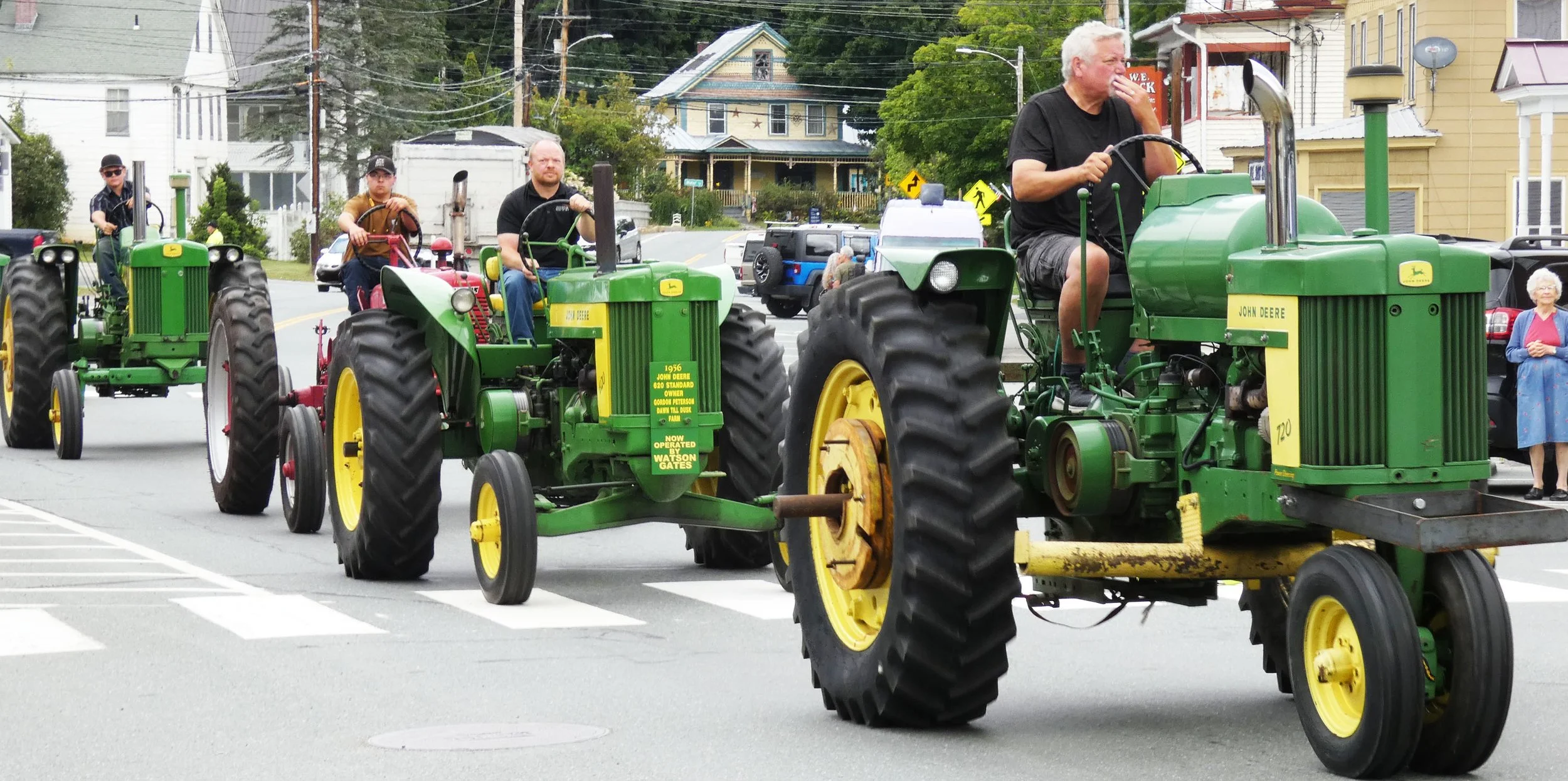
At 11AM, a super show of farm tractors, end to end came slowly through town on route 302 in the west and proceeded to parade over to the Wells River Chevrolet parking lot where they assembled for the crowd to visit and inspect the ag giants.
He was helping hand out tickets for three different raffles, one including the July 4th Woodsville/Wells River activities, also the American Legion was sponsoring a raffle, he said, adding that it was always good to see a lot of people and family activity in the Wells River Village as they all say “So Long to Summer.”
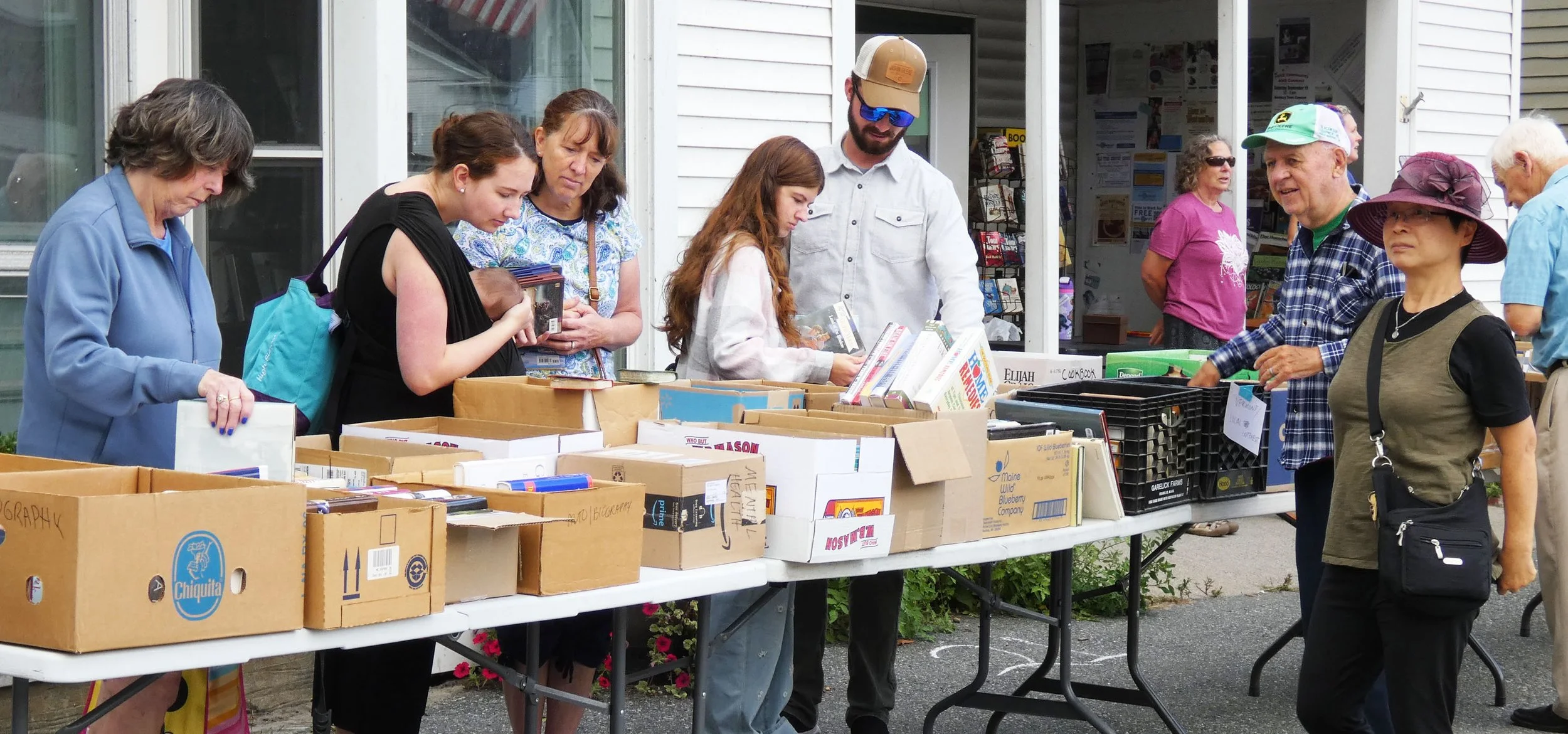
Book lovers gather at the Baldwin Memorial Library each festival year to look over hundreds of books placed for sale out front. It was a busy place all day. The Bridge Weekly/Bernie Marvin
A long line of tractors paraded through Wells River last weekend during the Wells River "So Long Summer, Hello Fall" event, drawing large crowds. The Bridge Weekly/Bernie Marvin.
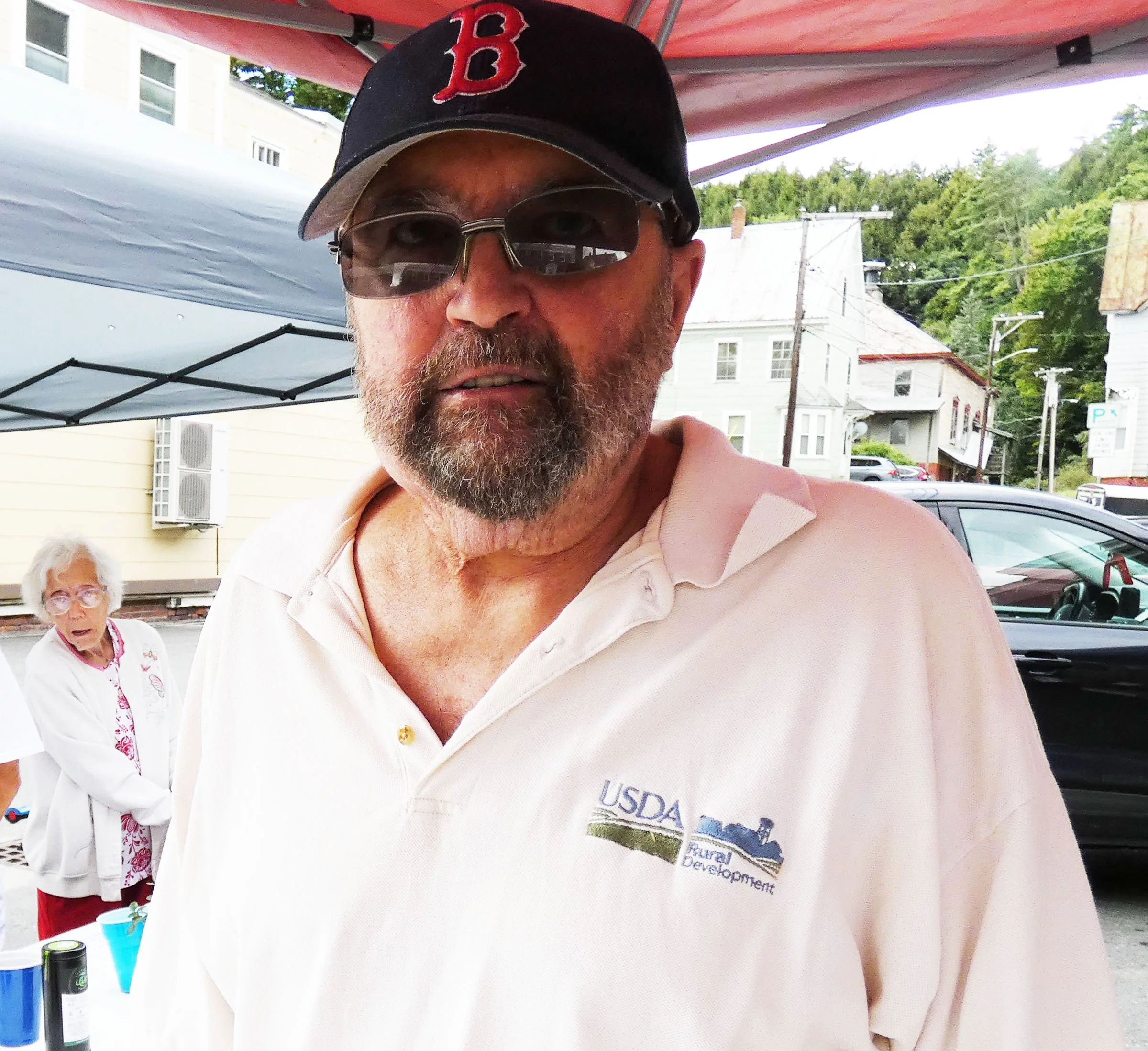
Long-time helper and boss Richard Roderick tends the raffle table and information booth during the Wells River "So Long Summer, Hello Fall" Festival held last weekend in Wells River. The weather was perfect, and Roderick said it was the largest event in their 14-year history. The Bridge Weekly/Bernie Marvin.
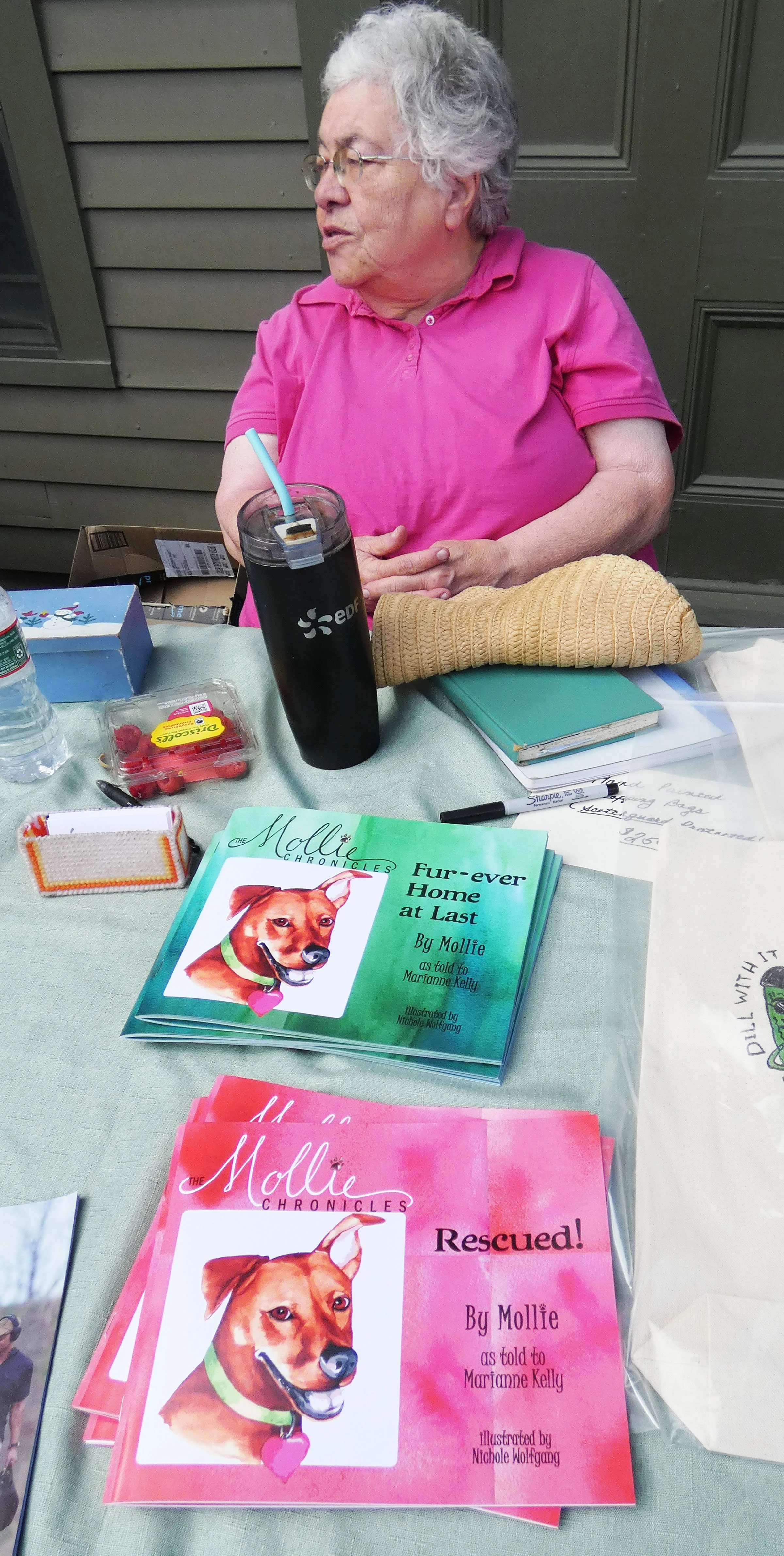
Author Marianne Kelly, a long-time exhibitor at local festivals, book sales, and author events, sells her books and other goodies during the Wells River "So Long Summer, Hello Fall!" Festival, September 5, 2026. The Bridge Weekly/Bernie Marvin
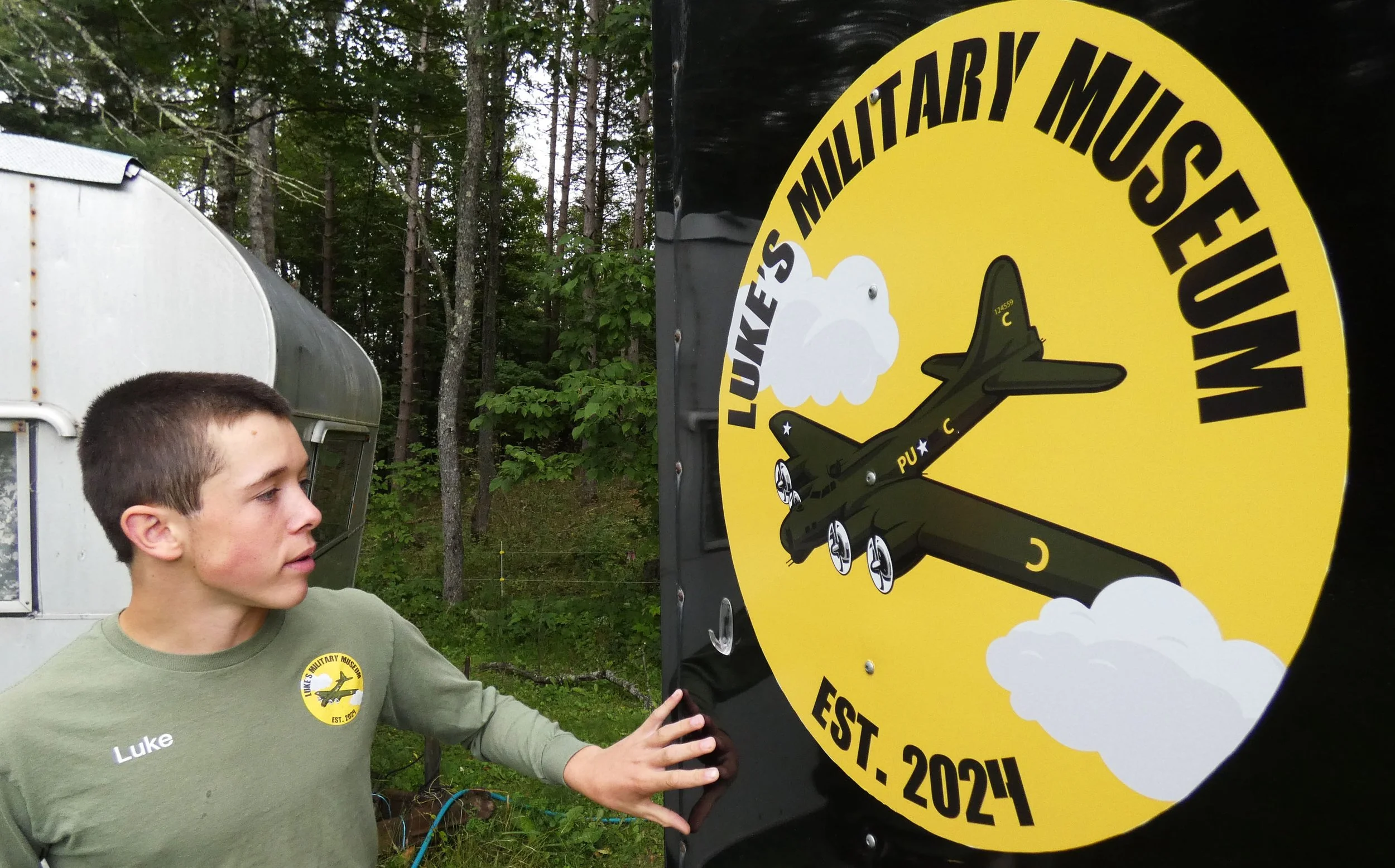
Danville's Luke Morrison, 15, Is A Bright, Young Military Collector With His Own Museum.
Morrison is 15 years old and a Ninth-Grade student at the nearby Danville School. His marks are good, he tells me, even though over the past year or so his chores and job tasks at home have increased many times over. Luke seems very able to promote his new military museum, and he has met with early stardom after the New York Times published a story a month or so ago, "The 15-year-old Keeping War Memories Alive."
Bernie Marvin
Luke Morrison looks over the logo he designed for his unique military museum at his home in Danville, Vermont. The Bridge Weekly/Bernie Marvin.
Danville, VT – In this small, handsome, typical Vermont town, there are many things visitors find attractive: a variety of small and large animal farming, not much vehicle traffic, a variety of good restaurants that serve breakfast, and a popular military museum.
That's the thing that surprises folks who travel through town on Peacham Road and Harvey's Hollow: there really is a museum in this town, and it carries its own fascinating story about Luke Morrison, the founder and manager of the museum.
Morrison is 15 years old and a Ninth-Grade student at the nearby Danville School. His marks are good, he tells me, even though over the past year or so his chores and job tasks at home have increased many times over. Luke seems very able to promote his new military museum, and he has met with early stardom after the New York Times published a story a month or so ago, "The 15-year-old Keeping War Memories Alive."
The story highlights donations Luke received from area veterans who had personal stories to share about the items. Luke can repeat a story about any piece in his museum, including the story of the Ploesti Oil Fields bomber crew member who somehow survived one of those terrifying raids on what was, in 1943, Hitler's main oil supply depot in Romania.
Luke's military museum is located inside a small camping trailer adjacent to the family's tidy goat farm. The trailer, by the way, is now the first of two trailers, needed because of the increasing number of military items donated to Luke's efforts to feature an even wider spectrum of warrior clothing, photographs, unit patches, media stories, helmets and implements, and a whole lot more!
There it is, laid out there among the parked four-wheel drive recreational vehicles, a dirt bike, animal trailer, 20 goats, a neatly cut yard area, a wooded pasture, and a brace of young oxen Luke's brother Caleb was trying to coax into the pasture.
Luke's little sister Natalie was in the house helping his mom, Carolyn Morrison, and Dad, Earl Morrison, was at work tending to the business efforts of Morrison's Garden Store in St. Johnsbury and the Feed Mill in Barnet among the family businesses the family and many employees tend to.
Both parents get a load of credit from Luke for helping him keep the military museum running smoothly and lugging him and his wares around the area when necessary. Luke has no vehicle operator's license, so their help is essential, he told me.
Early one morning last week, my son, Spencer, and I visited Luke and his mother, Carolyn, at their home and farm area. Luke's main military museum trailer sits with the other smaller travel trailer unit and is also filled with military paraphernalia Luke showed during four grueling days at the nearby Caledonia Fair.
Luke said several hundred guests toured his Caledonia Fair display space, and many promised return visits when his museum opens, usually on weekends. Although he said it seems he has always had an interest in the military, he began his serious military collecting in 2024. He said he has been pleased with the acceptance his museum is receiving so far.
His plan includes accepting donations he will use for expenses and to purchase additional military materials and equipment for the museum. Looking to the future, Luke said he is hoping to eventually find or build a structure to hold his fast-growing inventory. When or where that will be is unknown at this early point.
The trailer that holds most of the museum's artifacts at one time belonged to his great-uncle Dright Cooley, a World War 2 veteran. Luke has nearly doubled his capacity by spending $2500 on another trailer that sits proudly nearby, bulging with war mementos offered by Luke for his military museum.
Anyone who wants to contribute to Luke's military museum efforts or would like to set up a visit can contact him by email at lukesmilitarymuseumvt@gmail.com.
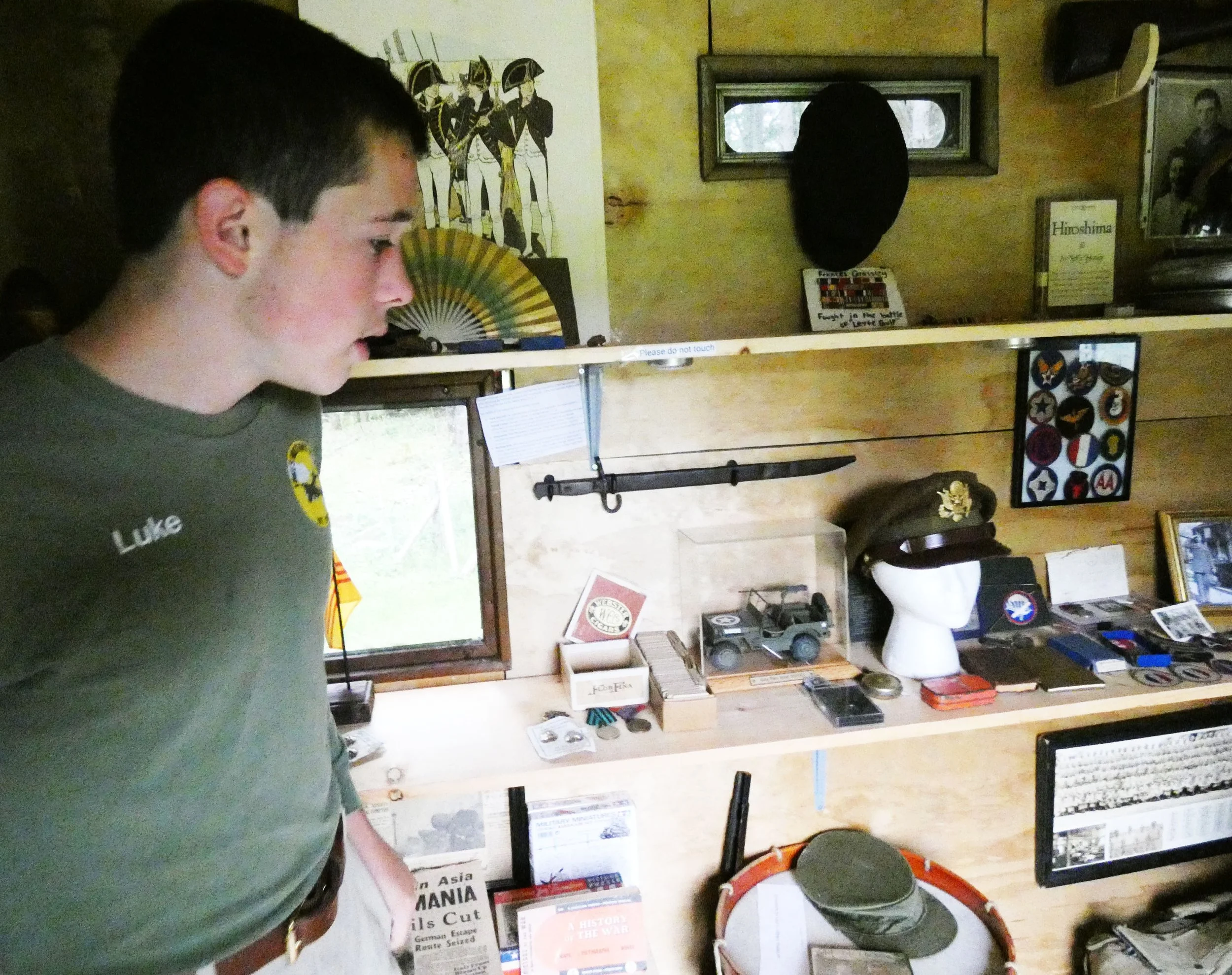
Luke Morrison, 15 years-old, checks on one of the many displays in his military museum. The Bridge Weekly/Bernie Marvin.
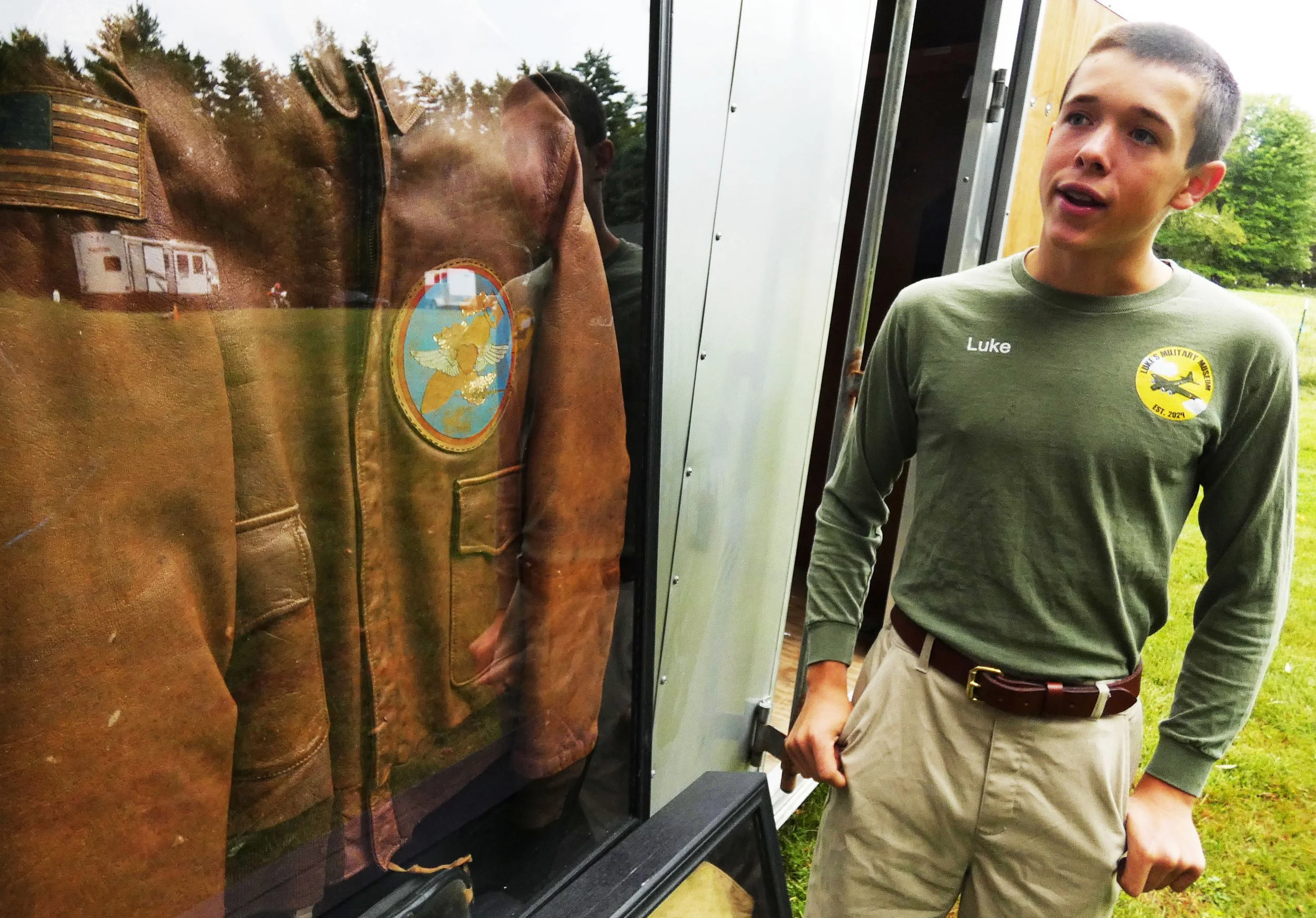
Luke Morrison admires a B-24 bomber crew member’s leather flight jacket worn during bombing raids on the Ploesti Oil Fields in Romania during World War 2. The Bridge Weekly/Bernie Marvin.
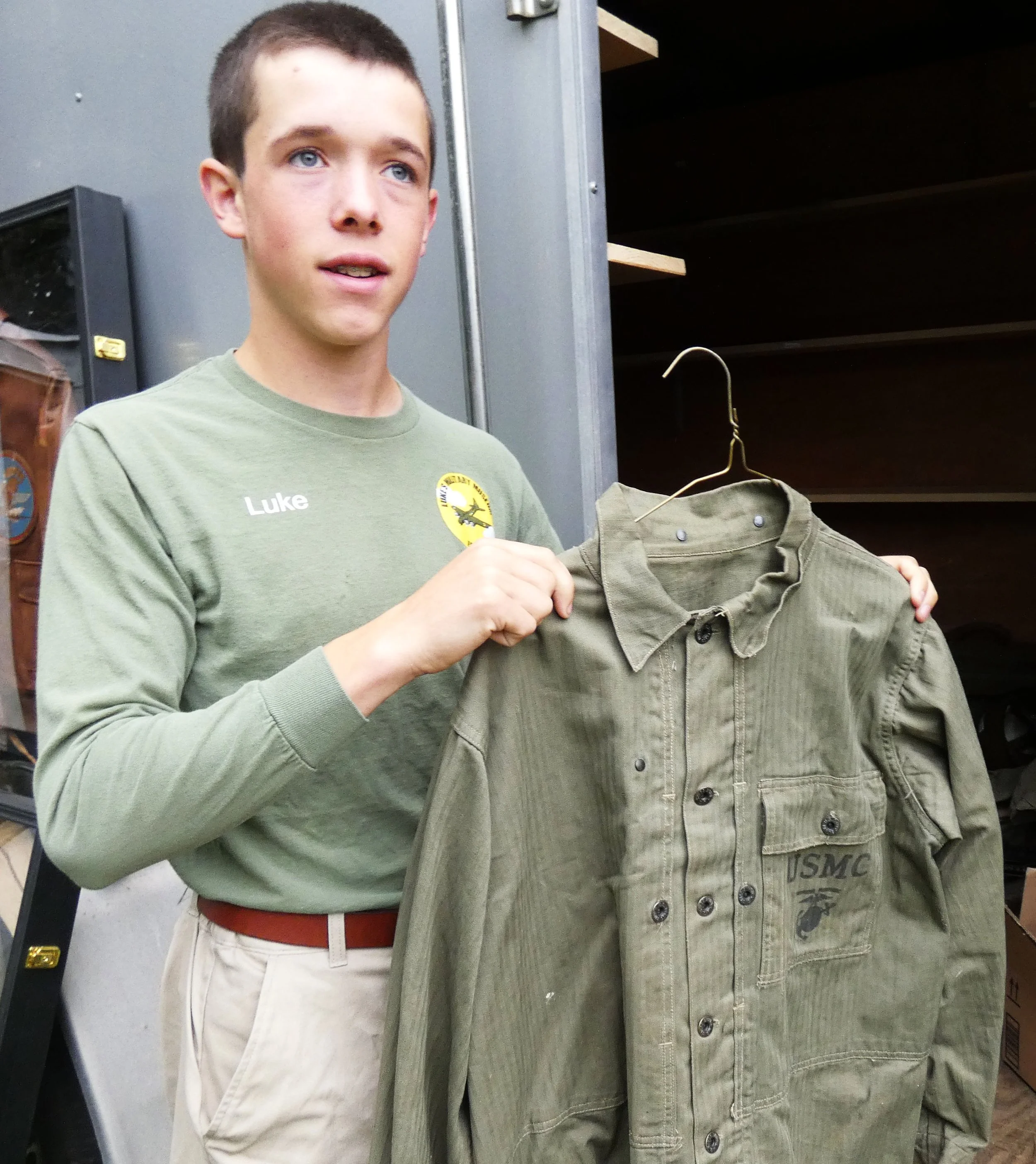
Military Museum owner Luke Morrison holds a prized authentic US Marine Corps herringbone twill utility jacket. The Bridge Weekly/Bernie Marvin.
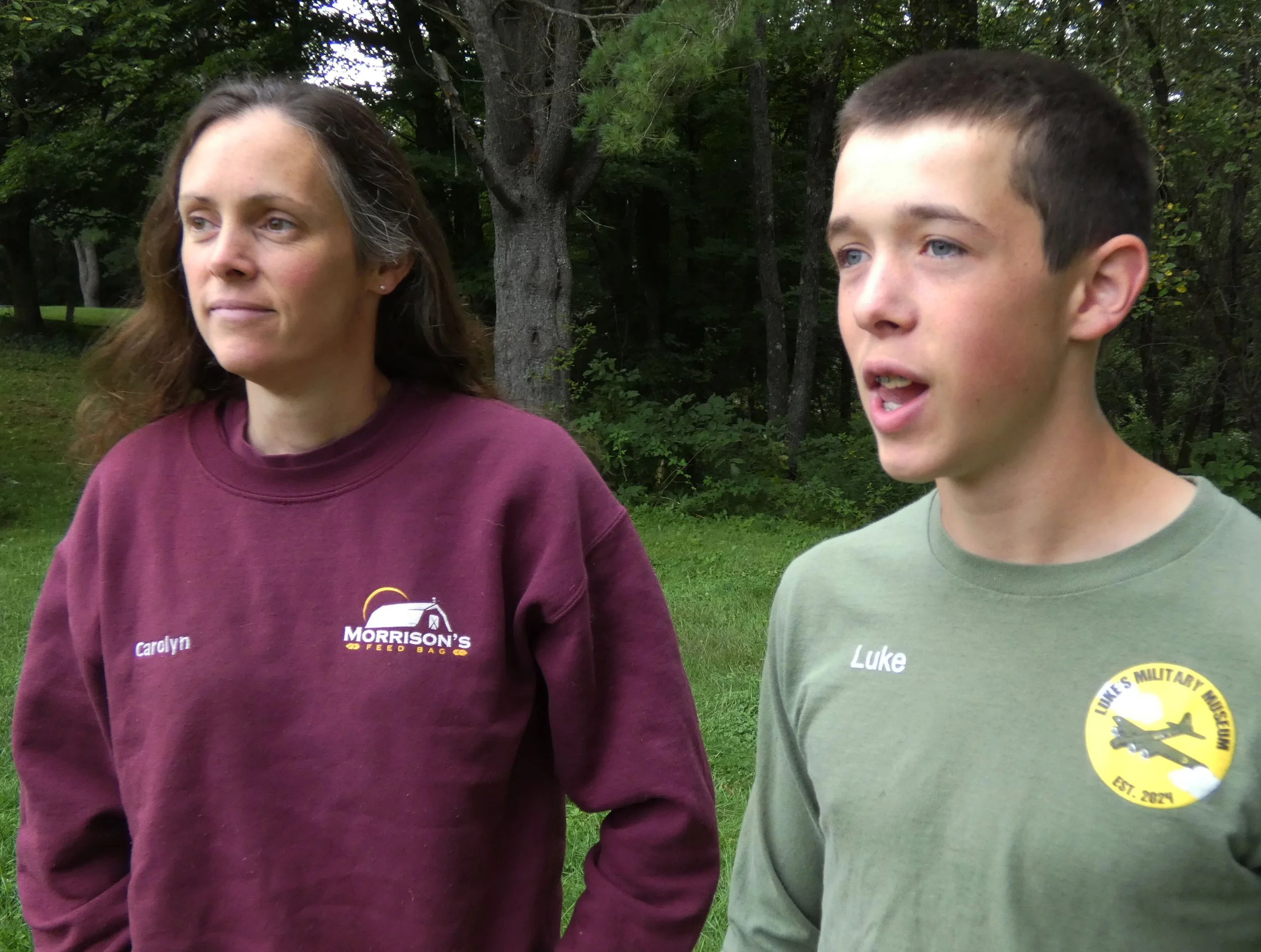
Carolyn Morrison, at left and her son, Luke Morrison. He is the 15-year-old owner of Luke’s Military Museum in Danville, Vermont. The Bridge Weekly/Bernie Marvin.
Apples, Old Implements, Music, and Logging: It Was All There For Tucker Mountain Day
This free event was a great excuse for lawn chairing and just plain sitting or standing around and chatting with neighbors or newcomers as the kids explored or watched any number of demonstrations with a working draft horse named Leaf, artifacts found in local barns, or a chance to see and discover just how an ox team can listen to and obey commands from its driver, Miles Conklin.
Bernie Marvin
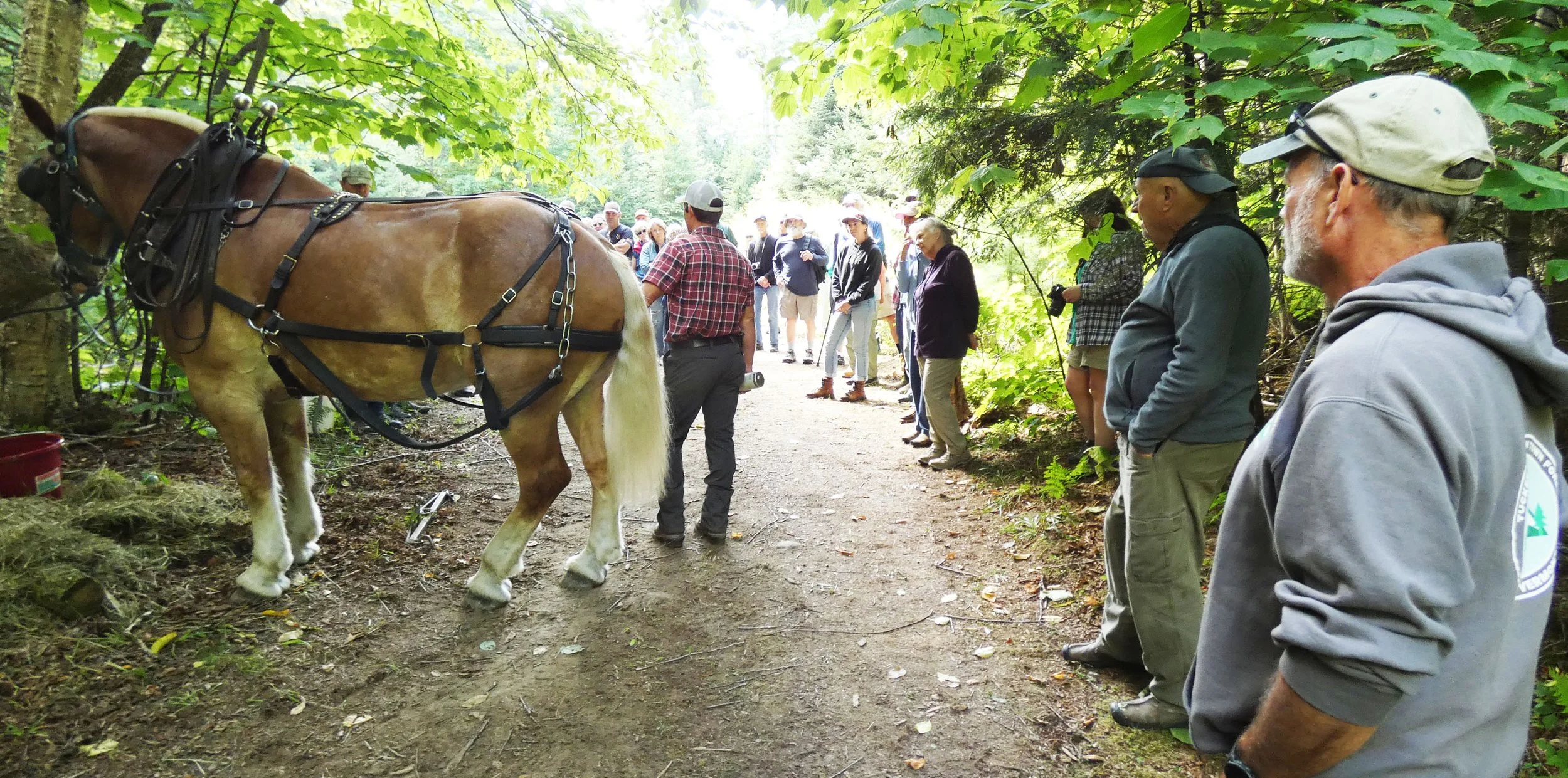
Visitors and Tucker Mountain Town Forest Board Member Jeff Goodell, on the right, observe draft horse logger John Jayne of Newbury as he speaks to the crowd about low-impact horse logging and ecologically sensitive timber harvesting at last weekend's Tucker Mountain Day. The Bridge Weekly/Bernie Marvin
West Newbury, VT – With great weather and those high Vermont puffy clouds most of last Saturday, August 29, 2026, nothing could go wrong that would mar another perfectly executed Tucker Mountain 250th Anniversary Day.
For four busy hours, the East Parking Lot saw a steady stream of people coming aboard the neat layout of the grounds and enjoying themselves in the shadows of majestic Tucker Mountain. The program was brought to the public by the talented members of the Newbury Historical Society and the Tucker Mountain Town Forest Committee.
This free event was a great excuse for lawn chairing and just plain sitting or standing around and chatting with neighbors or newcomers as the kids explored or watched any number of demonstrations with a working draft horse named Leaf, artifacts found in local barns, or a chance to see and discover just how an ox team can listen to and obey commands from its driver, Miles Conklin.
A full trip down memory lane was in store for visitors to Tucker Mountain Day, as people connected with the Grande Montagne made sure there was enough of everything on location to have a very successful program that was supposed to end at 2:00 PM, but hung over that final limit because folks did not want to leave.
Music was also at hand, as the Tucker Mountain Boys and the Sacred Heart Singers entertained guests during the day. Picnics were enjoyed as groups participated in fun projects such as apple pressing with Rick and Emmy Hausman and learning about the wonderful geologic history of the rugged grounds everyone had come to see from County Forester AJ Follensbee..
Organizers did not forget the rich history of Tucker Mountain, as they celebrated 250 years of this mountain's heritage as part of the town's incorporation in the long years of experience from its founding in 1763 to today's vibrant Newbury township in 2026.
Newbury and its outer territories of South or West Newbury, and Wells River, have long attracted an interesting base of people from throughout the United States. Read the 2018 story, “A History of Tucker Mountain” by Tom Kidder and you will get the complete story of Tucker Mountain Town Forest as it was honored last weekend.
It's the people that make events in the Newbury environs so interesting, whether it is a Goodbye Summer program in Wells River, a superb sit-down home-cooked turkey dinner at the West Newbury Town Hall, or a busy land-based education program on the wonders of the 635-acre Tucker Mountain Town Forest.
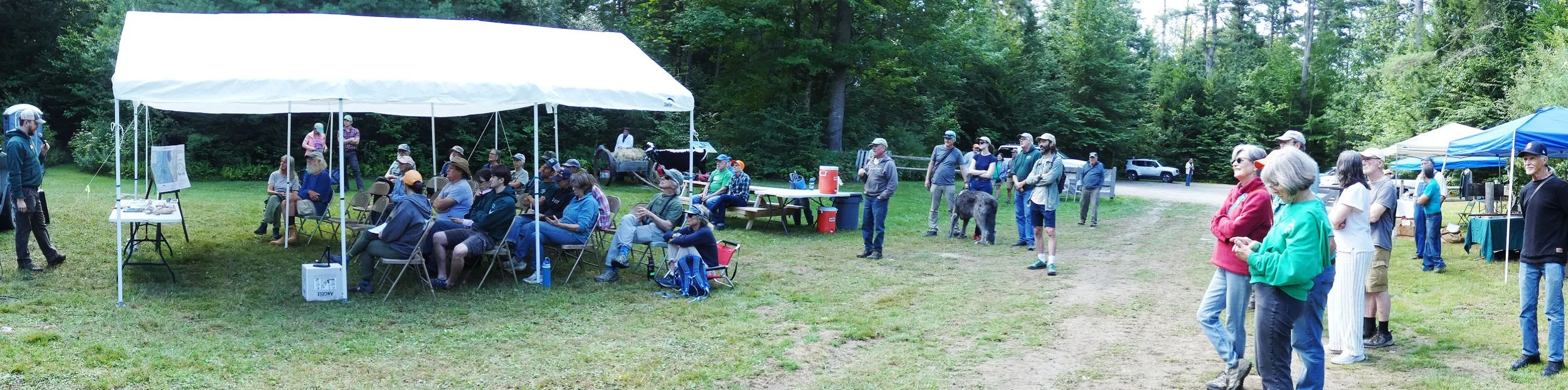
County Forester AJ Follensbee of the Vermont State Forest, Parks and Recreation, at left, speaks to an early group of visitors attending Tucker Mountain Day about the highlights of the forest and fauna that can be found throughout the grounds of the Tucker Mountain Town Forest. The Bridge Weekly/Bernie Marvin.
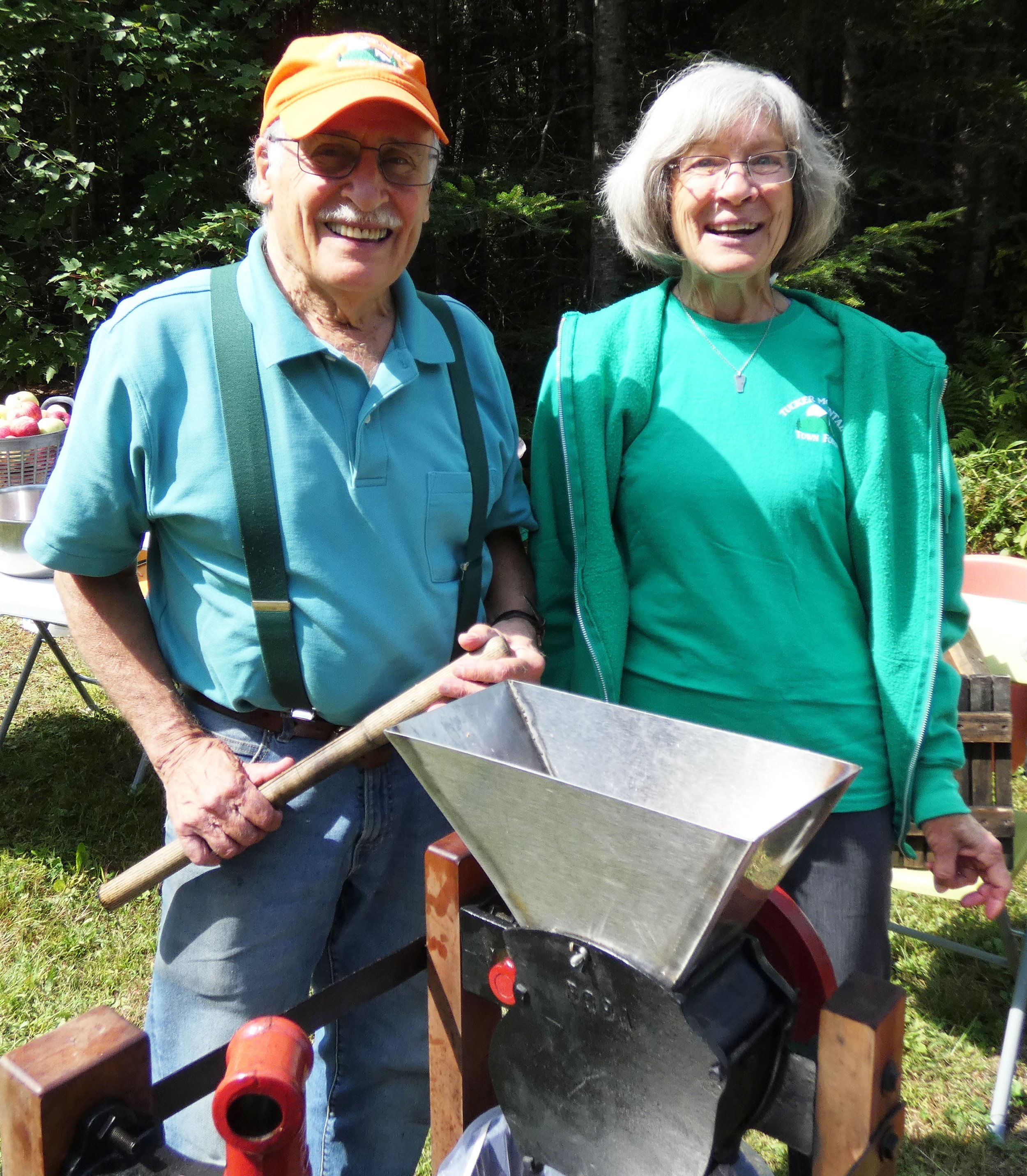
Rick and Emmy Hausman assisted visitors with the fine art of crushing first-of-the-season apples. They are experienced in making quality fresh Vermont apple cider. The Bridge Weekly/Bernie Marvin.
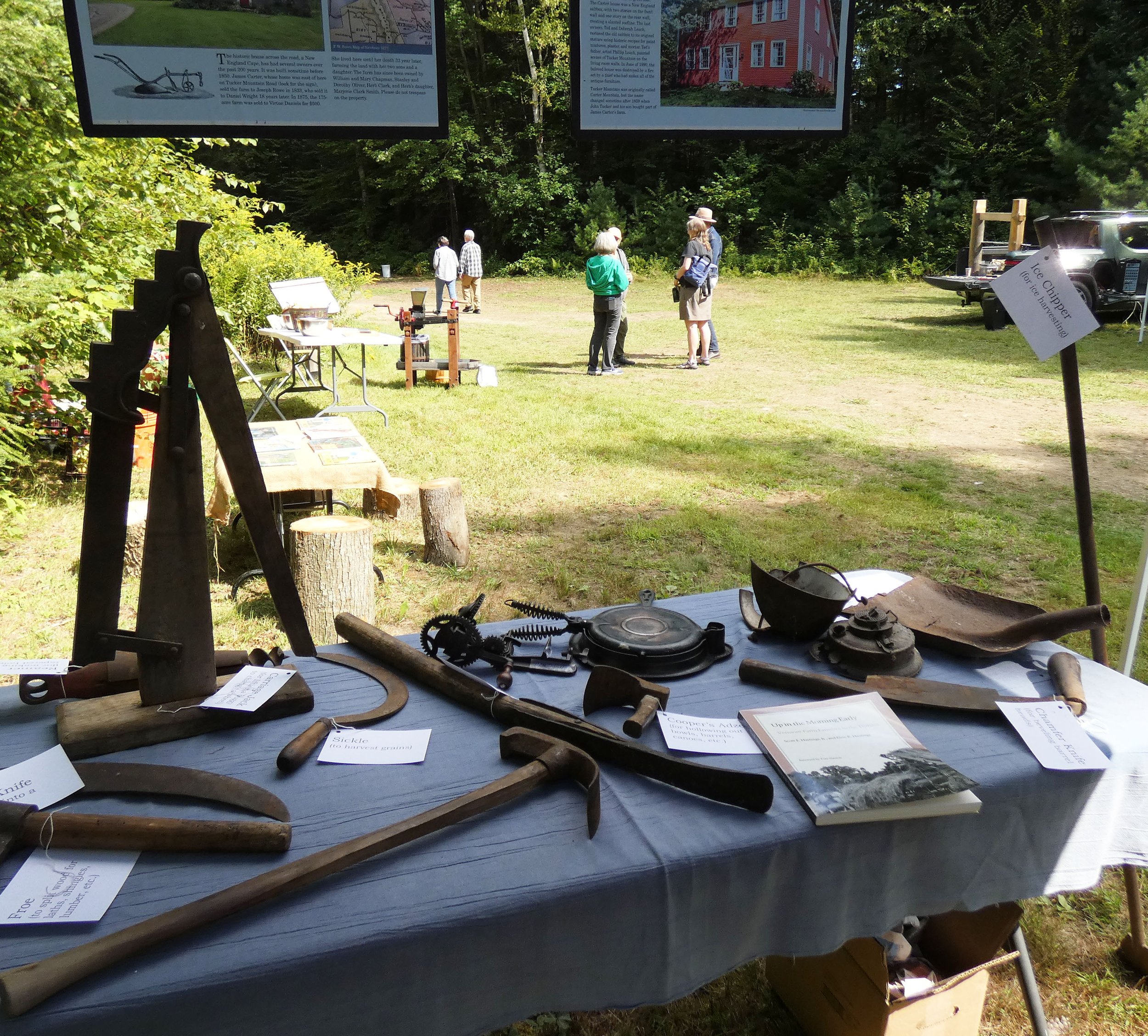
An interesting display of early farming implements and books that visitors found interesting at the Tucker Mountain Day program. The Bridge Weekly/Bernie Marvin.
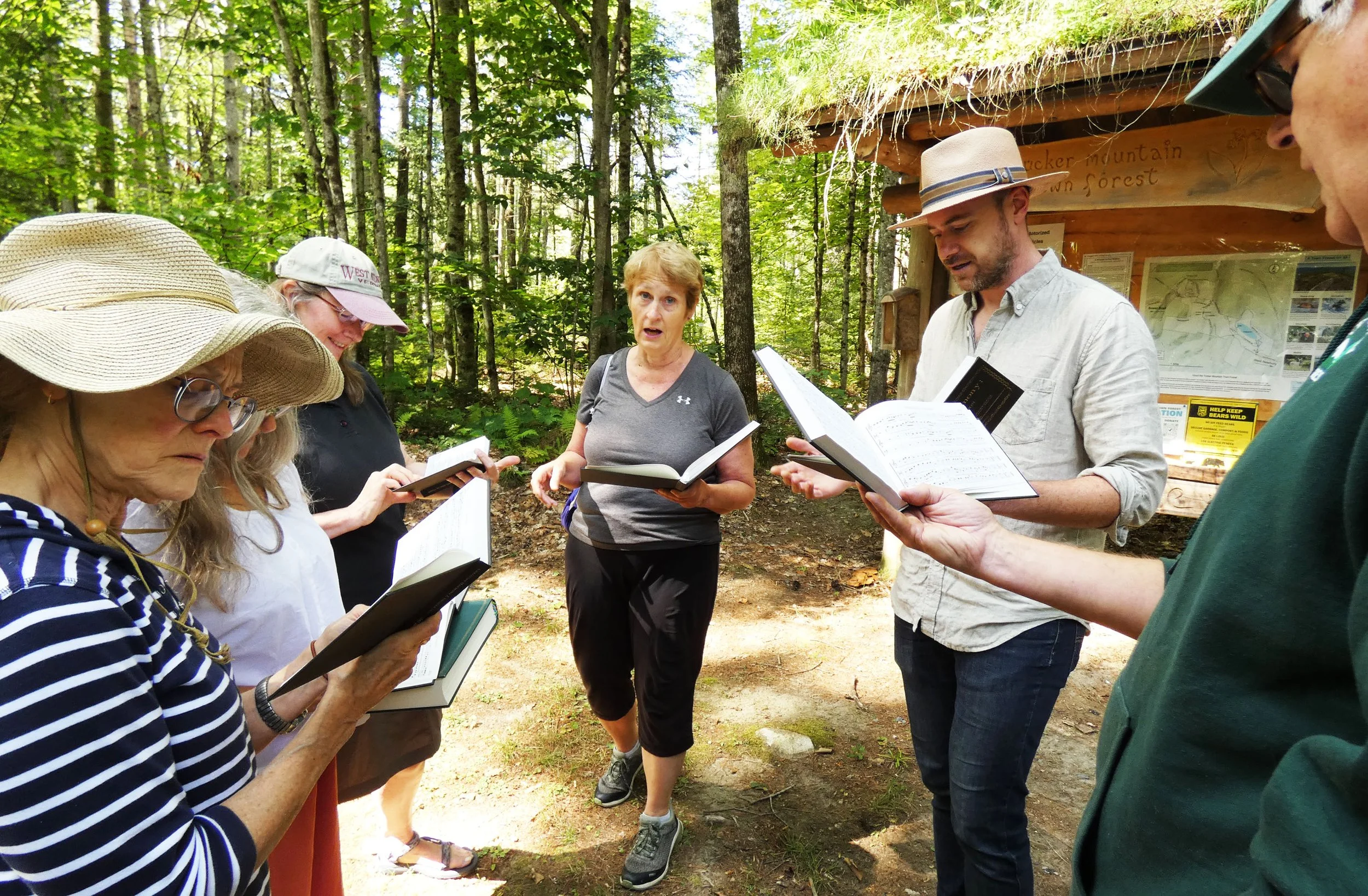
This talented group of Sacred Harp Singers was getting ready to present a complete set of vocal music to the Tucker Mountain Day visitors last Saturday, August 29, 2026. The Bridge Weekly/Bernie Marvin
Cherished Quilt of Valor presented to WW2 veteran Earl Aremburg
Aremburg, a popular and well-known lifelong resident and retired businessman in the area who is approaching his 100th birthday, was there with a large group of family, friends, and veteran well-wishers, including his daughter Marie Bigelow and son Raymond Aremburg.
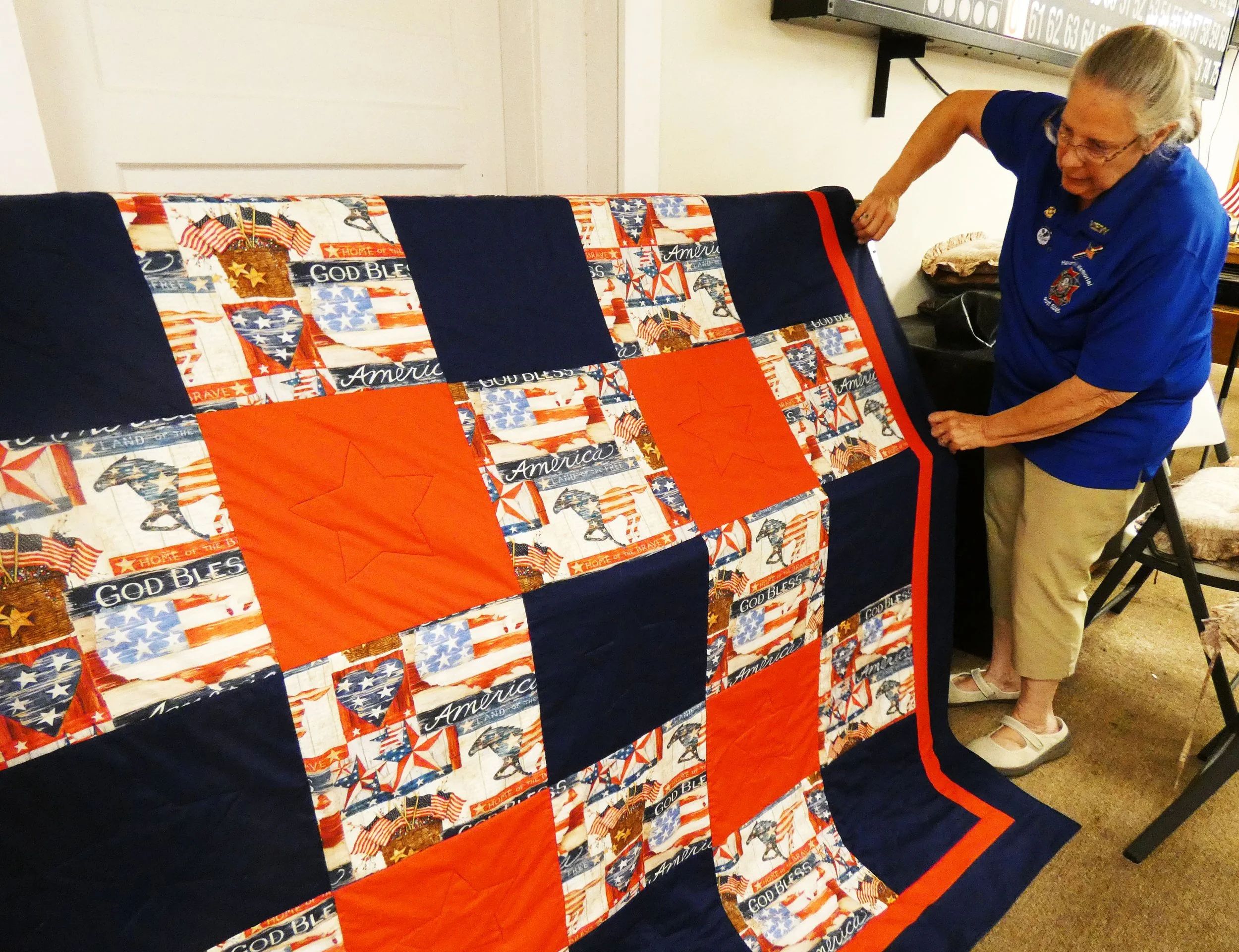
The large quilt, resplendent in bright and patriotic colors, was hand-stitched by VFW Auxiliary member Bonnie Burroughs. She was present for the ceremony, as were Jane Graham and Carolyn Bruckner of the QOV organization.
Bernie Marvin
Veterans of Foreign Wars Auxiliary member Bonnie Burroughs, who created the Quilt of Valor that was presented to WW2 Sailor Earl Aremburg last week, displays the quilt for all to see and admire. The Bridge Weekly/Bernie Marvin.
North Haverhill, NH – The honored Quilt of Valor (QOV), a homemade quilt presented to WW2 Veteran Earl Aremburg as a way to say "Thank You" for your service to our country by members of the National Quilts of Valor organization, was presented at an impressive service at the Veterans of Foreign Wars building on Thursday evening, August 20, 2026.
Aremburg, a popular and well-known lifelong resident and retired businessman in the area who is approaching his 100th birthday, was there with a large group of family, friends, and veteran well-wishers, including his daughter Marie Bigelow and son Raymond Aremburg.
The large quilt, resplendent in bright and patriotic colors, was hand-stitched by VFW Auxiliary member Bonnie Burroughs. She was present for the ceremony, as were Jane Graham and Carolyn Bruckner of the QOV organization.
Members of the Sew Far North Quilt of Valor group of Littleton displayed and presented the quilt. The QOV organization was founded in 2003. The organization's mission is to honor veterans and active service members who have been touched by war, with a quilt to say thank you for your service to our country.
The local group was organized in 2021, and to date they have awarded 130 quilts; nationally, 454,000 quilts have been awarded, and more than 11,000 QOV members make and award these highly praised quilts.
A Quilt of Valor is a reminder that those of us who made them remember all who have made the sacrifice of service for our freedoms. The QOV has three layers; the top layer has many colors and shapes of fabric. These represent the communities and the individuals who stitch the quilts, representing the love, gratitude, and sometimes the tears of the maker.
The center layer, the batting, provides warmth and represents hope, comfort, and peace, offering healing to the individual who receives the quilt. The back layer, called the backing, is the strength of the quilt, and the binding that holds all the layers together.
The Quilt of Valor is priceless; it cannot be bought, sold, or raffled. It is not a birthday or Christmas gift. The value is a thank you for your service and your sacrifice.
The VFW Honor Guard, under the command of Jr. Vice Commander Bill Burroughs, began the ceremony; there was a call to order, and the Pledge of Allegiance was recited. Chaplain Fred Delman offered prayers, with the ceremony being conducted by Jane Graham and Carolyn Bruckner of the Quilts of Valor organization. Assisting in the ceremony and with the display of the Quilt of Valor, Bonnie Burroughs was the VFW Auxiliary member who created and sewed the Quilt of Valor that was presented to Earl Arenburg.
During the ceremony, Earl Aremburg was wrapped in the quilt to symbolically show how it will provide warmth and comfort to the recipient.
Fireman First Class Earl Arenburg joined the U.S. Navy in 1943 at the age of 17. He trained as a gunner in Norfolk, Virginia, and was assigned to a 36-man unit on the SS Taylor, a cargo ship. His first trans-Atlantic trip was in a convoy of 100 ships carrying troops, equipment, and supplies to the Mediterranean. During the 30-day voyage, German submarines posed an ever-present danger and sank many of the convoy's vessels.
His ship was then assigned to carry cargo around the Mediterranean from North Africa to Naples, Italy, before returning to the United States. In Baltimore, he was transferred to a second Liberty ship with a mission to refuel ships that were on their way to action in northern Africa.
After the war in Europe ended, Earl was transferred to the Pacific theater in advance of the planned invasion of Japan. He served as a gunner and a machine gunner aboard the USS Manila Bay. Earl continued his service in the Marine Corps Reserves until August 1956, when he retired as a Sergeant of Marines.
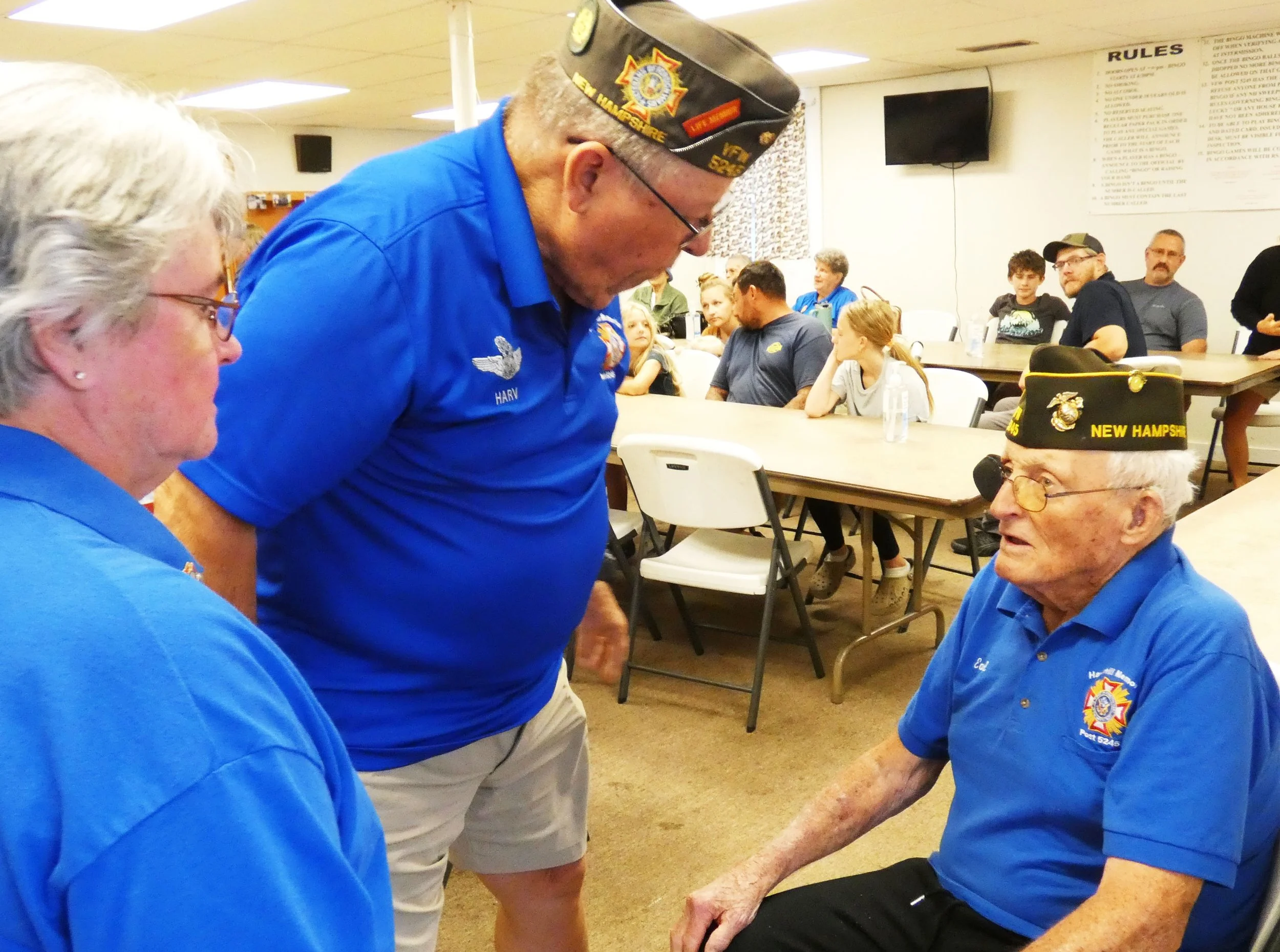
Earl Aremburg of North Haverhill, at right, received an award of a Quilt of Valor at ceremonies last Thursday night, August 20, 2026. With him are his daughter, Marie Bigelow, on the left, and fellow VFW member Harvey Keyes. The Bridge Weekly/Bernie Marvin
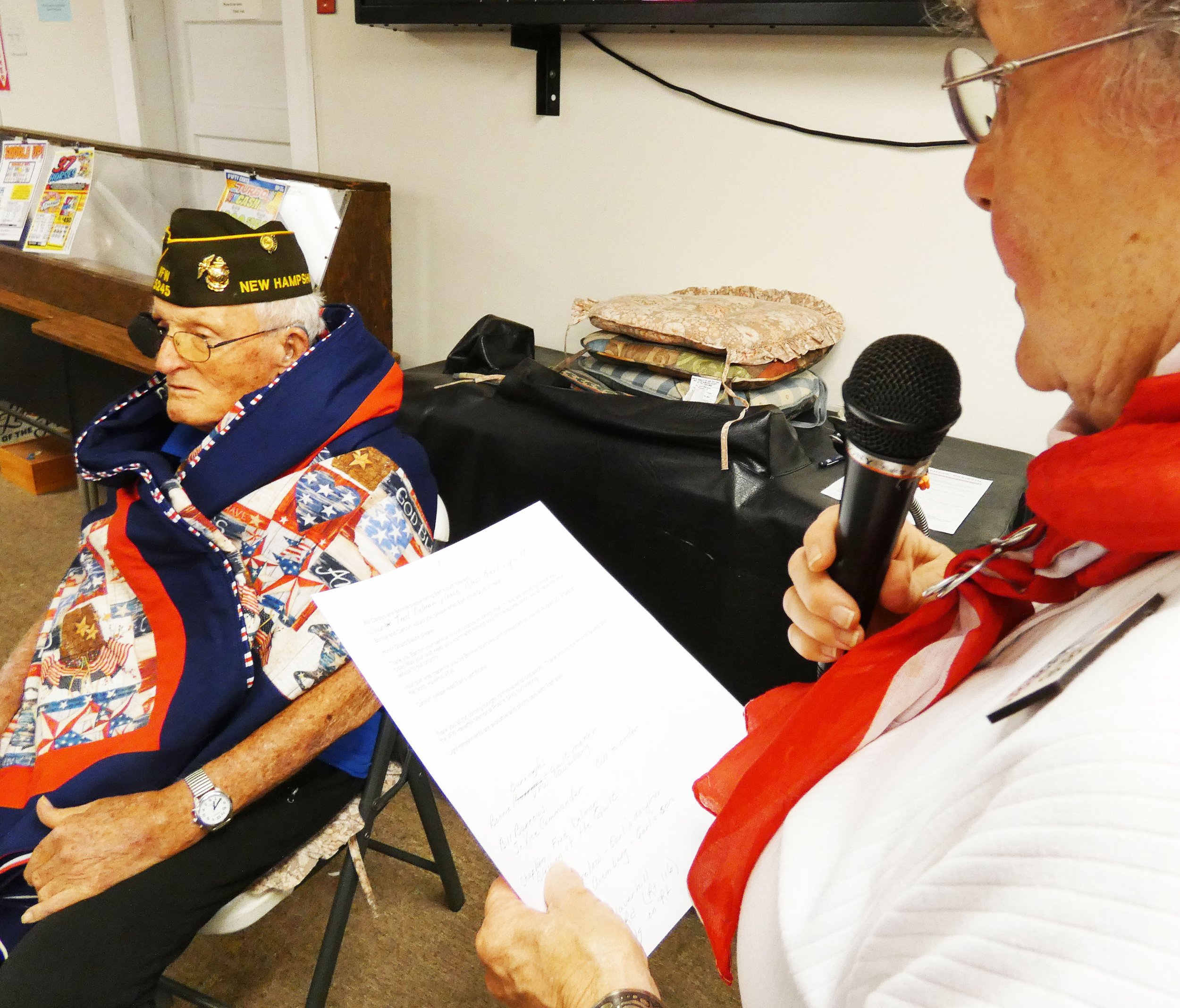
Wrapped in the Quilt of Valor in ceremonies at the Veterans of Foreign Wars building in North Haverhill is WWII US Navy veteran Earl Aremburg, with Quilt of Valor official Jane Graham at right as she narrates the presentation program. Aremburg received the Quilt of Valor for his service during WW2 in two different theaters. The Bridge Weekly/Bernie Marvin.
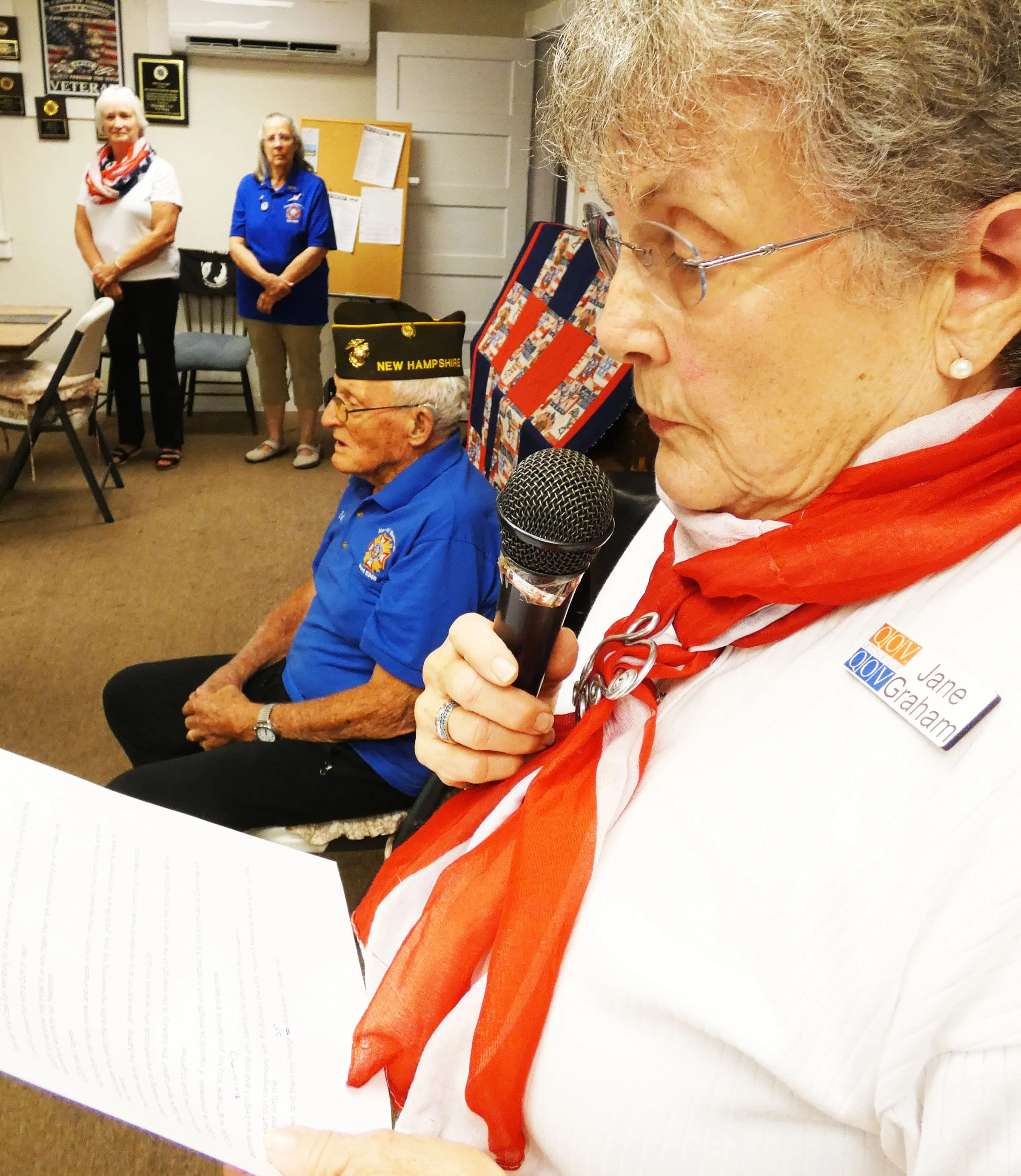
Presenting the cherished Quilt of Valor at recent ceremonies to WW2 US Navy veteran Earl Arembiurg, seated at center, were Quilt of Valor official Jane Graham, at right. Also at rear, Quilt of Valor official Carolyn Bruckner, at left, and the quilt creator, Bonnie Burroughs, at right. The Bridge Weekly/Bernie Marvin.
Civil Air Patrol Members Hit The Ropes
There was plenty of activity on the perfect summer day. Throughout the area, visitors enjoyed the vendor booths, listening to several political candidates chat with voters, and hearing some great music by the group Counting by Sevens during the picnic session.
An interesting historical exhibit by the Newbury Historical Society was enjoyed at the one-room schoolhouse just down the road from the Hall.
Bernie Marvin
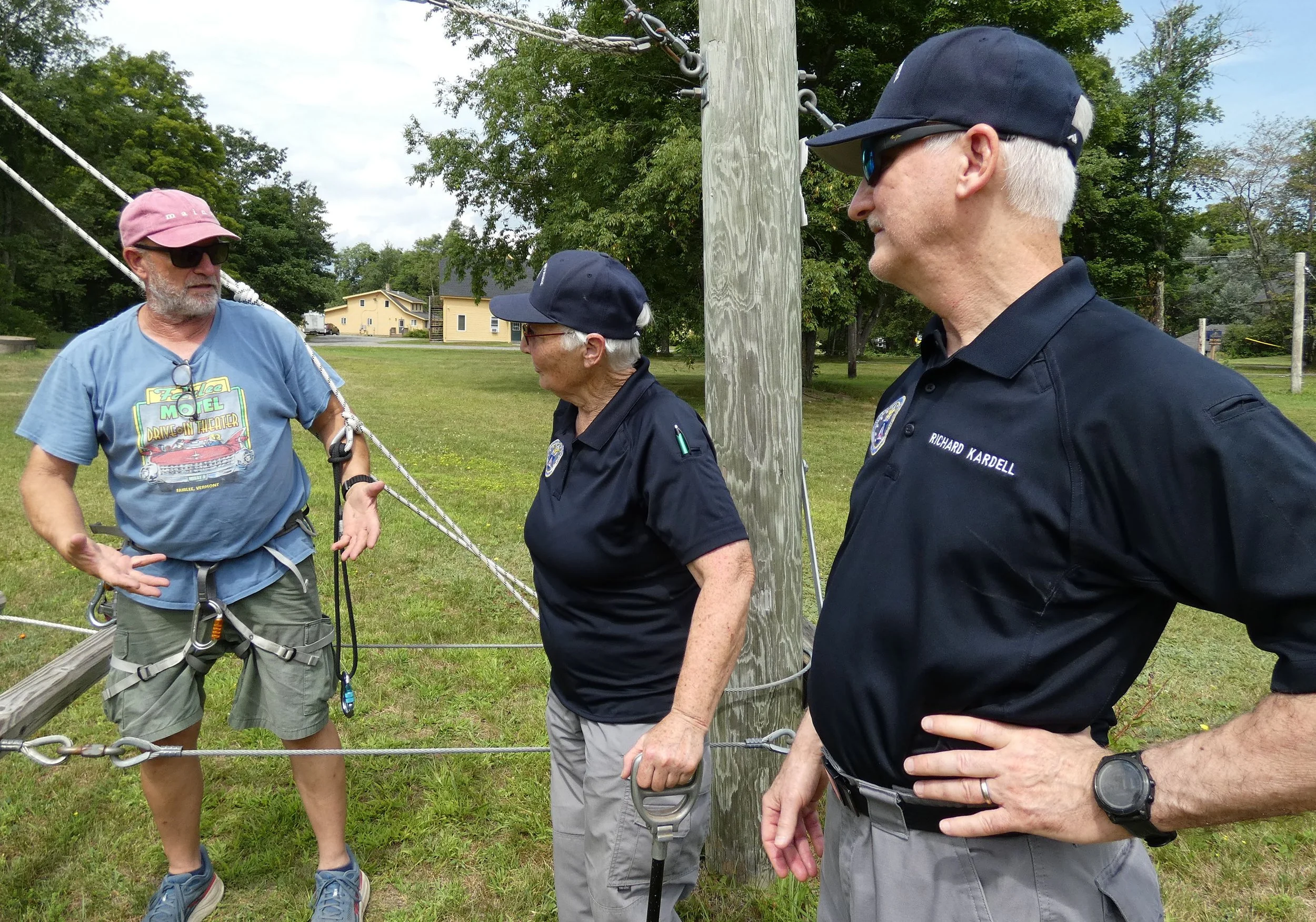
Upper Valley Stewardship Center’s Ropes Course Instructor Mike Adamkowski, at left speaks with Civil Air Patrol officers during a recent session on the intensive course. Seen from left to right are Adamkowski, Captain Evelyn Chadwick and Major Richard Kardwell. The Bridge Weekly/Bernie Marvin
East Haverhill – A total of 15 Civil Air Patrol Cadets from three squadrons in the New Hampshire North Country hit the intense ropes course located at the Upper Valley Stewardship Center in East Haverhill two weeks ago, and according to people passing by or who participated, it was a spirited and eager participation by enthusiastic Cadets.
Captain Evelyn Chadwick told the Bridge Weekly during a roadside interview that her Cadets had been working on the ropes course for the past five years, and they were happy to be back there learning more techniques.
Captain Chadwick was there with cadets from squadrons in Whitefield, Woodsville, and Laconia. She said each year the group grew larger; it was only the White Mountain Cadets back then, but as word spread about how exciting the ropes course was, more attended each year.
Major Richard Cardell said that the ropes course provides an excellent chance for Cadets to practice leadership and teamwork skills, as they spend their day assisting others to do more, go higher, and improve their rope techniques. He had great praise for the ropes course director, Mike Admakowski, who has worked with the Cadets for the past five years.
Navigating the ropes course directly fulfills the CAP's weekend activity mandates for character development, team building, and rigorous physical fitness training. The Cadets were challenged to solve complex physical and technical problems as a team, building mutual reliance and overcoming personal fears.
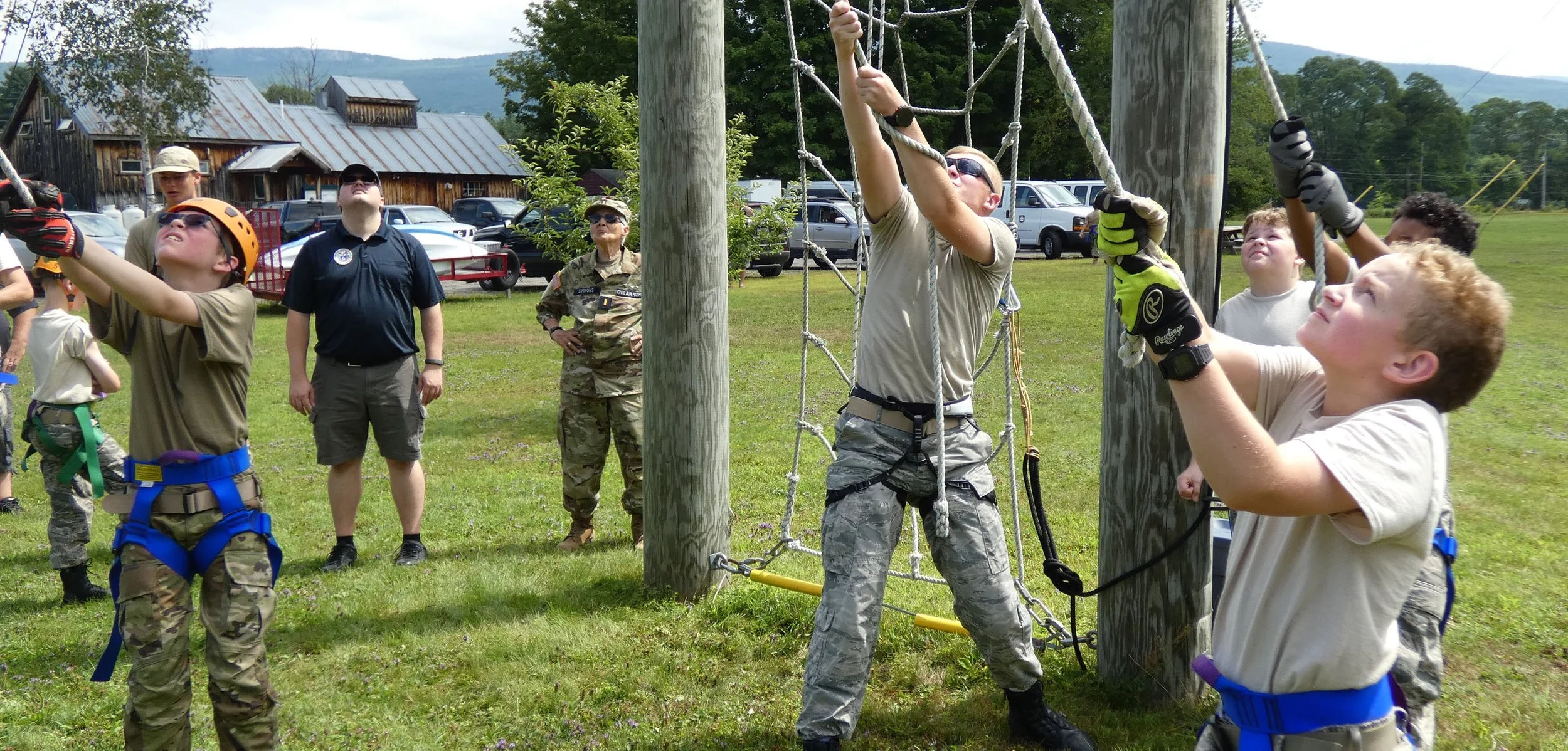
Members of three Civil Air Patrol Cadets Squadrons at work doing the ropes course at the Upper Valley Stewardship Center in East Haverhill. The students work on ropes that guide and belay other Cadets who are high atop the pole structures, accomplishing various aerial maneuvers to move from one station to another. The Bridge Weekly/Bernie Marvin.
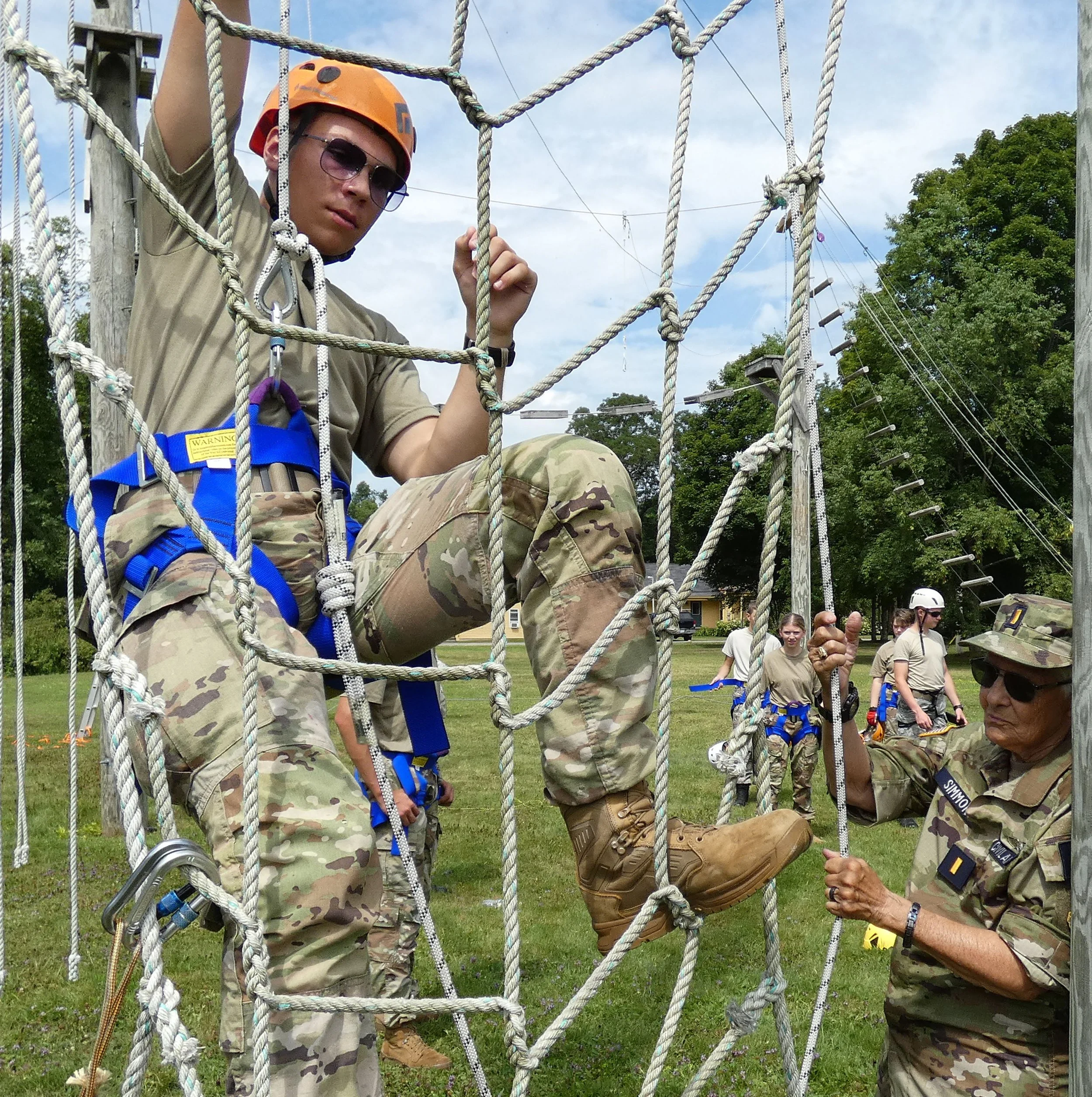
A Civil Air Cadet Instructor completes his session on the ropes course located in East Haverhill at the Upper Valley Stewardship Center. Checking his progress is the Squadron Commanding Officer, Captain Evelyn Chadwick, at right. The Bridge Weekly/Bernie Marvin.
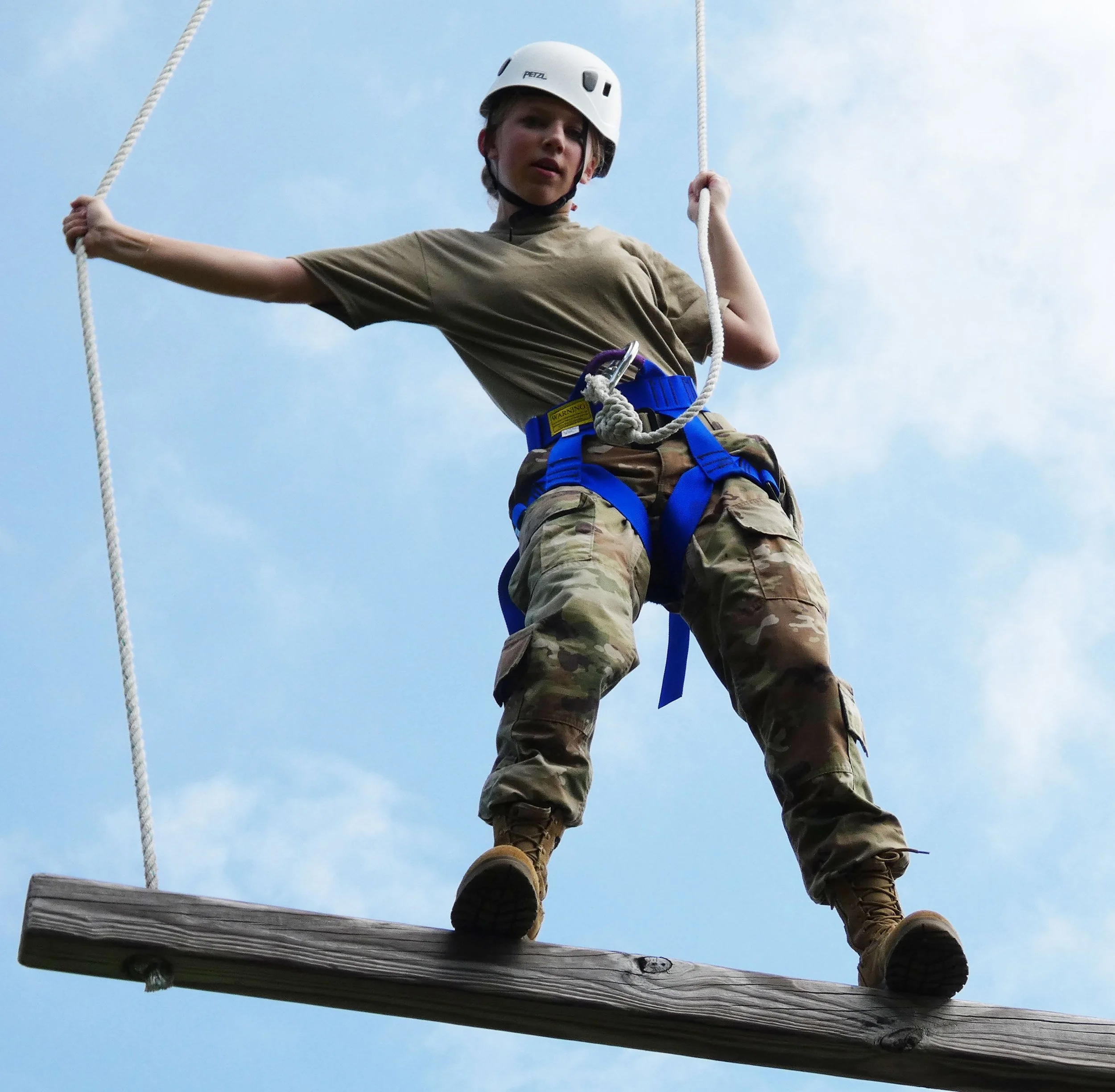
A tricky act of balance and confident ropes work are guiding this Civil Air Patrol Cadet onto her next station at the Upper Valley Stewardship Center Ropes Course, where three different Squadrons of Cadets trained on the course on a recent weekend. The Bridge Weekly/Bernie Marvin.
Big turnout for West Newbury Summer Festival events
There was plenty of activity on the perfect summer day. Throughout the area, visitors enjoyed the vendor booths, listening to several political candidates chat with voters, and hearing some great music by the group Counting by Sevens during the picnic session.
An interesting historical exhibit by the Newbury Historical Society was enjoyed at the one-room schoolhouse just down the road from the Hall.
Bernie Marvin
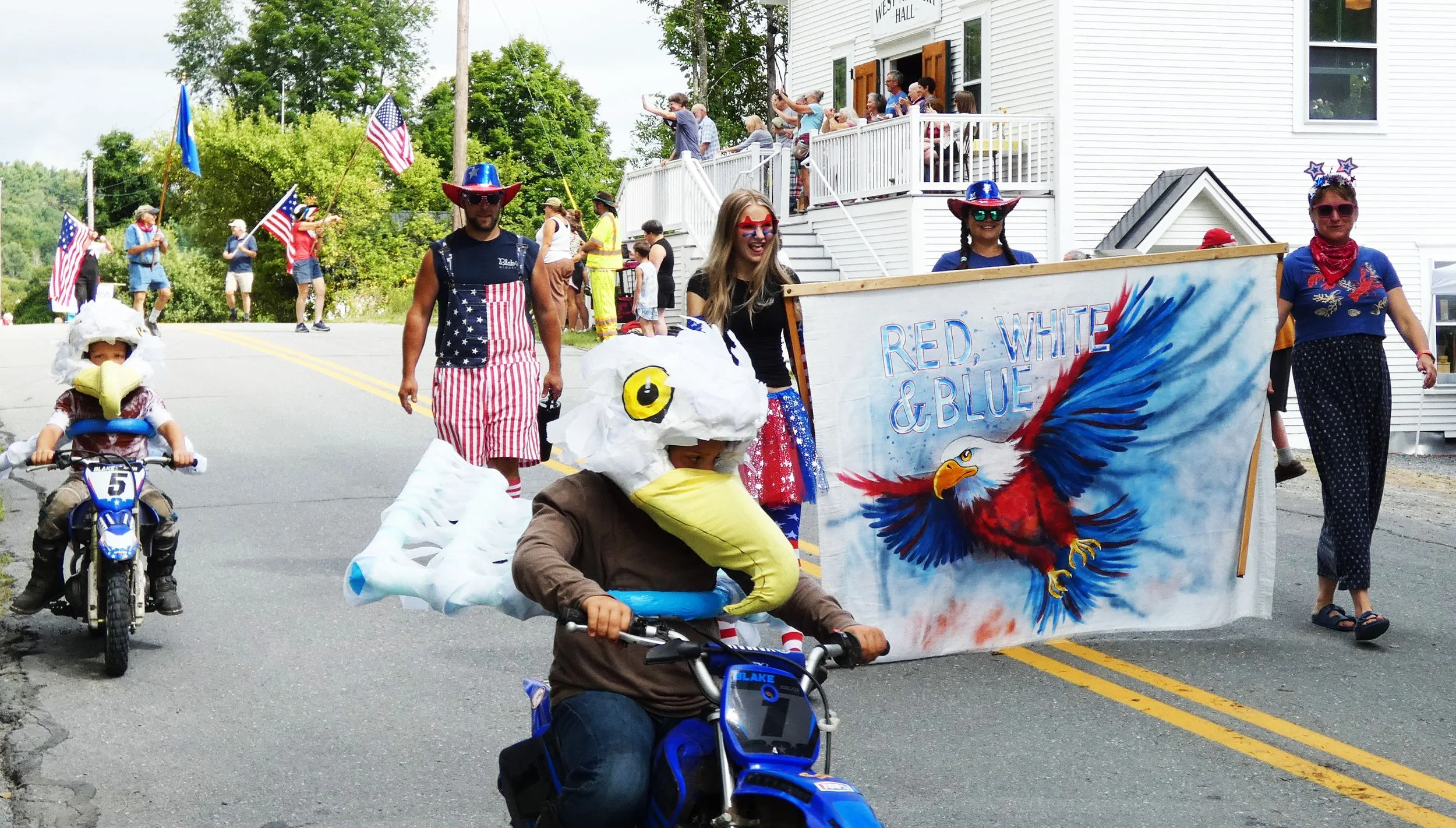
Banner carriers, at right and left, Elsie and Alison Kidder parade proudly in the before noon sunlight as they are flanked by others in the lead unit of the Summer Fest Parade. Seen at left are two baby eagles, Tucker and Burke as they circle about the group. Their mom, Betsy Blake created the parade banner and dad, Cortney Blake, are with them. The Blake family lives in West Newbury and Betsy have been making the parade banners for at least 10 years. The Bridge Weekly/Bernie Marvin
West Newbury, VT – On Saturday morning, August 8, 2026, you could hear the happy laughter of the kids, the neat drumrolls of the Summertime Marching Band, and the rumbles from those bright red Newbury Fire Department trucks as they rolled up Tyler Farm Road in another grand parade announcing that the West Newbury Summer Festival was in town.
And indeed, it was. From their usual huge White Elephant Sale and Silent Auction to the pulled-pork sandwich lunch, there was a day of warm-weather activity throughout the West Newbury Hall and church area.
There was plenty of activity on the perfect summer day. Throughout the area, visitors enjoyed the vendor booths, listening to several political candidates chat with voters, and hearing some great music by the group Counting by Sevens during the picnic session.
An interesting historical exhibit by the Newbury Historical Society was enjoyed at the one-room schoolhouse just down the road from the Hall.
Cathy Kidder told The Bridge Weekly that “this year was remarkable for the amount of buy in from our larger community. The three trucks from Newbury Fire Departments came, Newbury Women's Club, Newbury Recreation Committee, local Indivisible and Third Act Chapters, six candidates for House Rep and Senate, Court Street Arts, Clara Martin, EC Fiber, Old Church Theater Summer Youth Troupe all came, to join our regulars: the Summertime Marching Band from many points north, Window Dressers, Tenney Library, Wells River Savings Bank, and local makers and producers.”
And then there was “the tremendous support from local businesses and individuals for Silent Auction donations. We grossed over $9,200, but even better, the Festival brought together people and organizations from a wider area, working together for a common goal: to keep the West Newbury Hall a place where community is celebrated and, with our new elevator, a place that is truly open to all.”
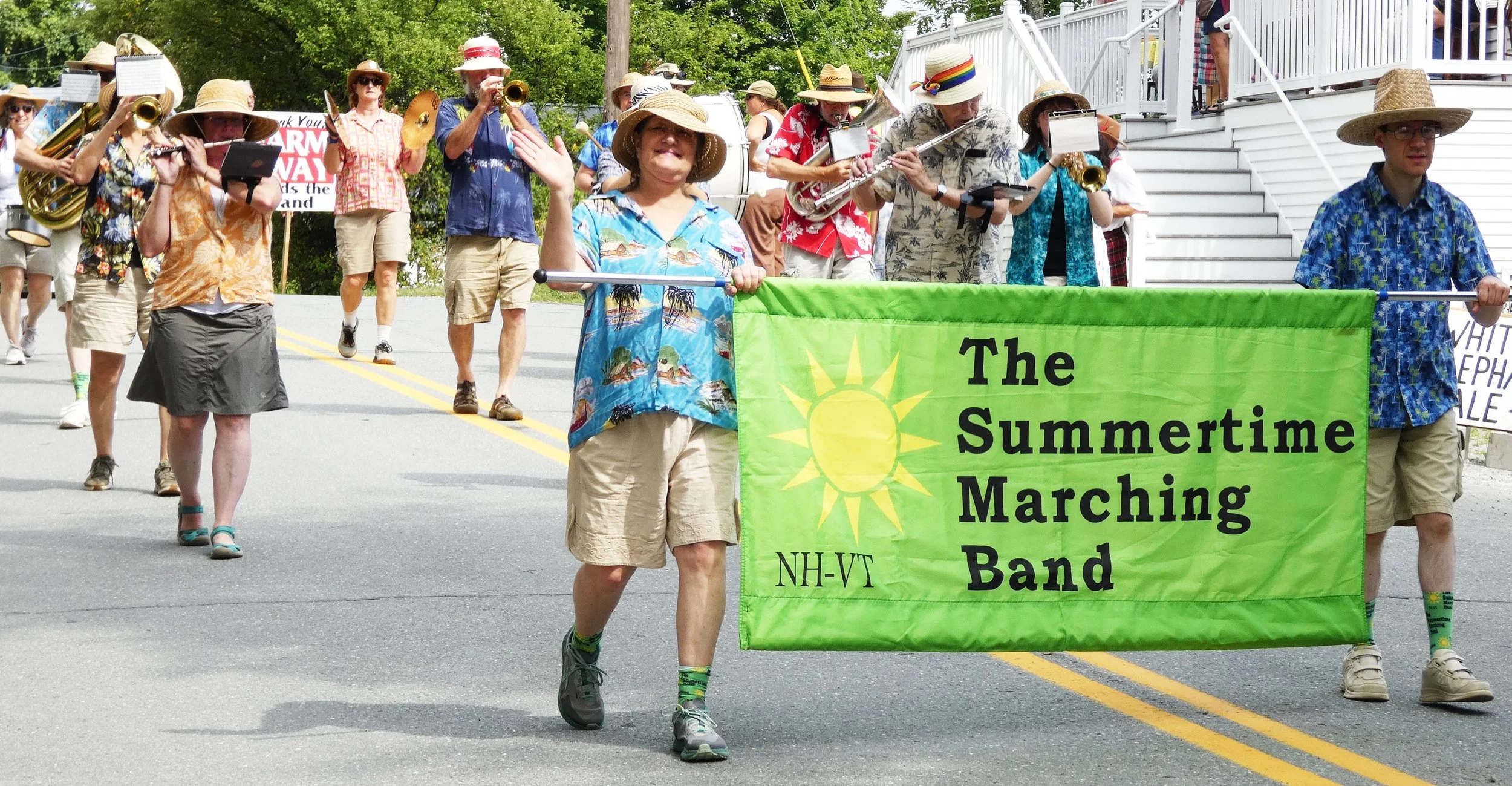
The Summertime Marching Band is always a hit at local parades and ceremonies. One thing the crowds love is that this spirited group marches. They are all in step and have been drawing rave reviews for many years. Always the favorite part of any parade! The Bridge Weekly/Bernie Marvin.
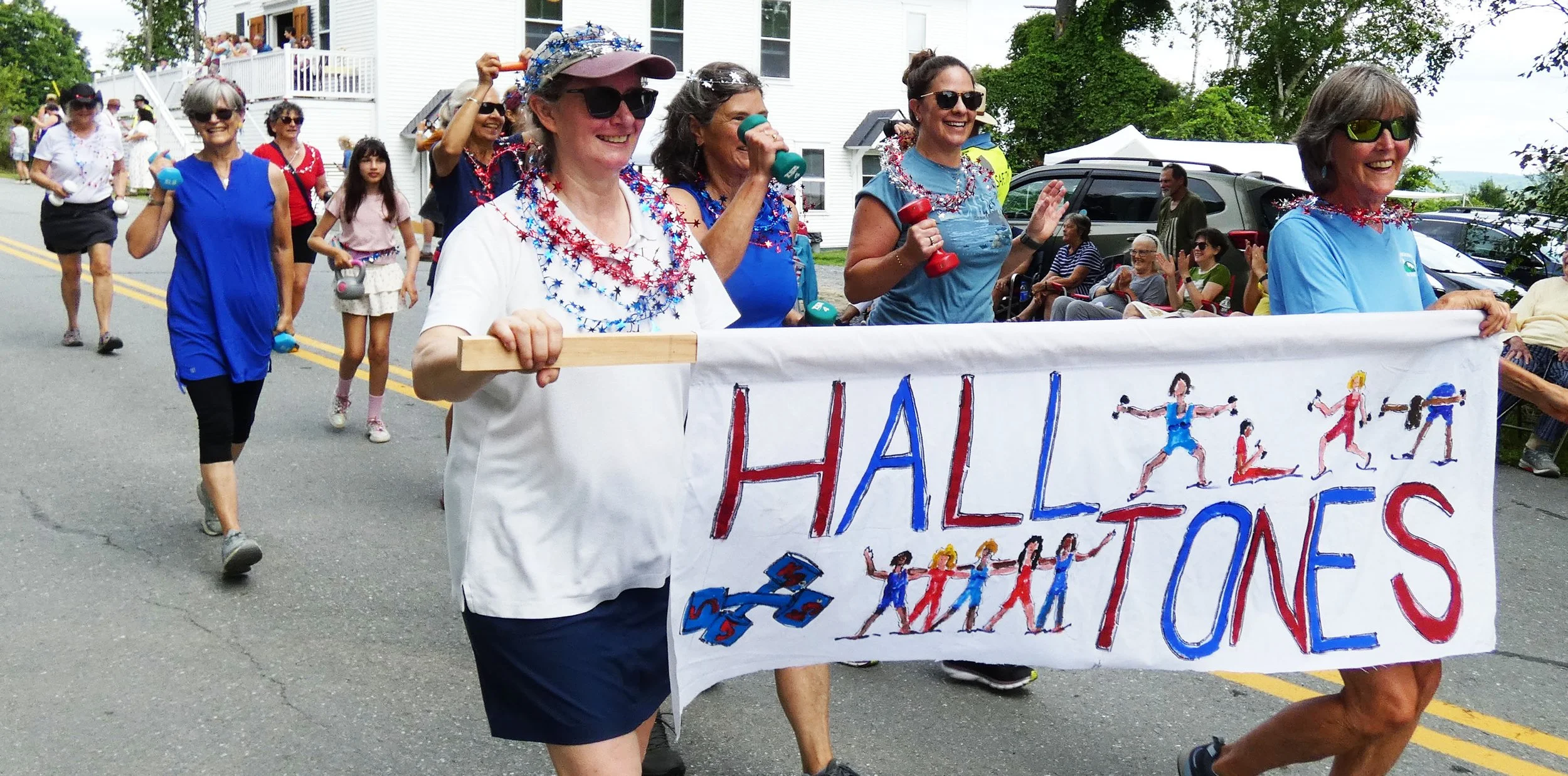
The Hall Tones are a homegrown strength training class held twice weekly at West Newbury Hall and led by Carolyn Marsh, seen 2nd from left. Holding the banner are, left, Laurie Williams and Caroline Nininger. The Bridge Weekly/Bernie Marvin.

Cathy and Tom Kidder, who do so much to make the West Newbury Festival such an annual success. They also help with many other events, too! Thanks to you two!! The Bridge Weekly/Bernie Marvin
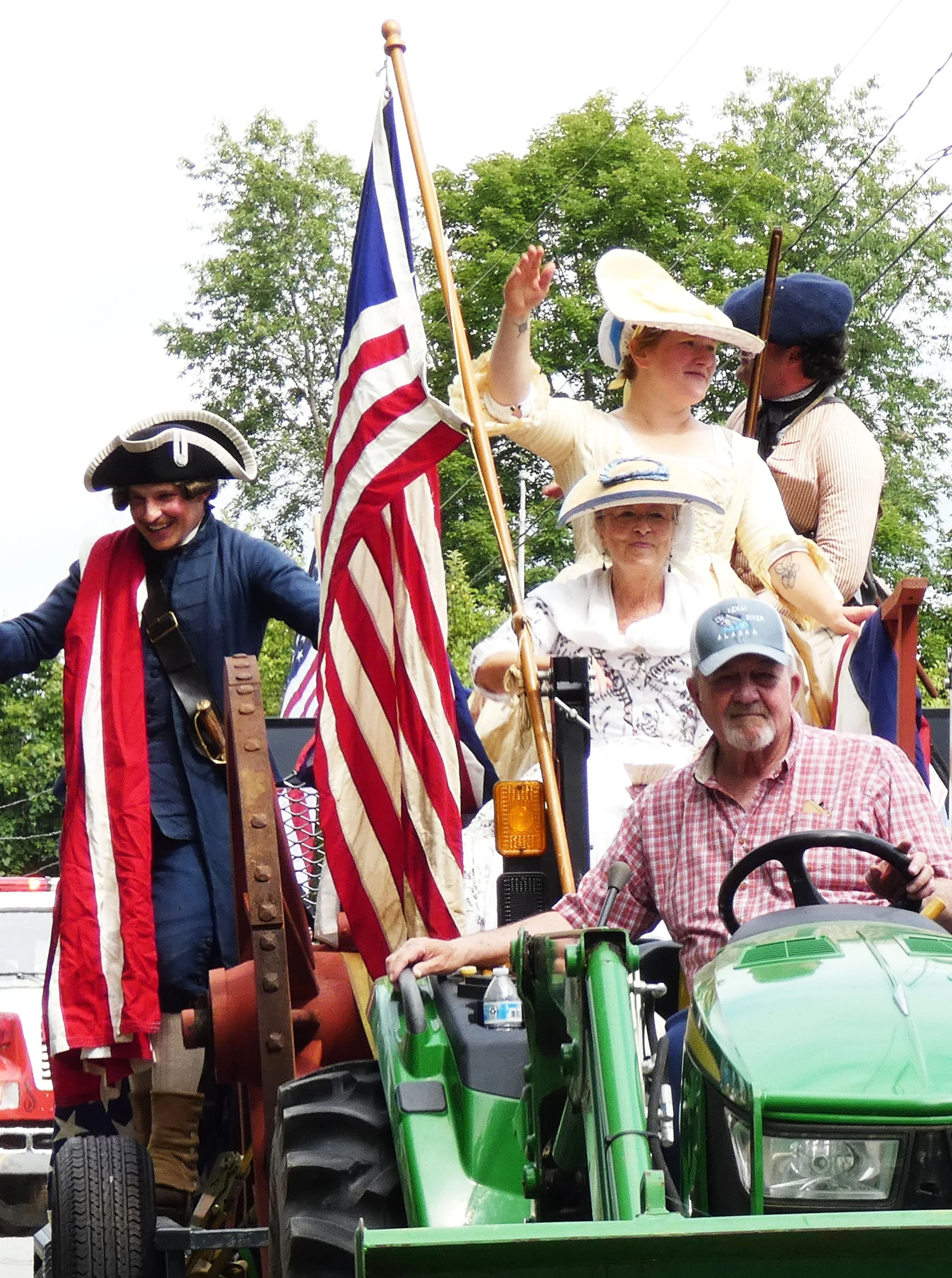
The 250 group is an outgrowth of the Backroad Warriors trivia team of West Newbury folks and friends. Adam and Esther Hodge-LeClair, of Haverhill Corner but currently residing in West Newbury, are reenactors with an extensive collection of period clothing they're happy to share, as well as an antique ox cart (on a trailer pulled by a tractor). Left to right are Gavin Cole, Lisa Jones, Esther Hodge-LeClair, Steve Cole (driving), Adam Hodge-LeClair. The Bridge Weekly/Bernie Marvin
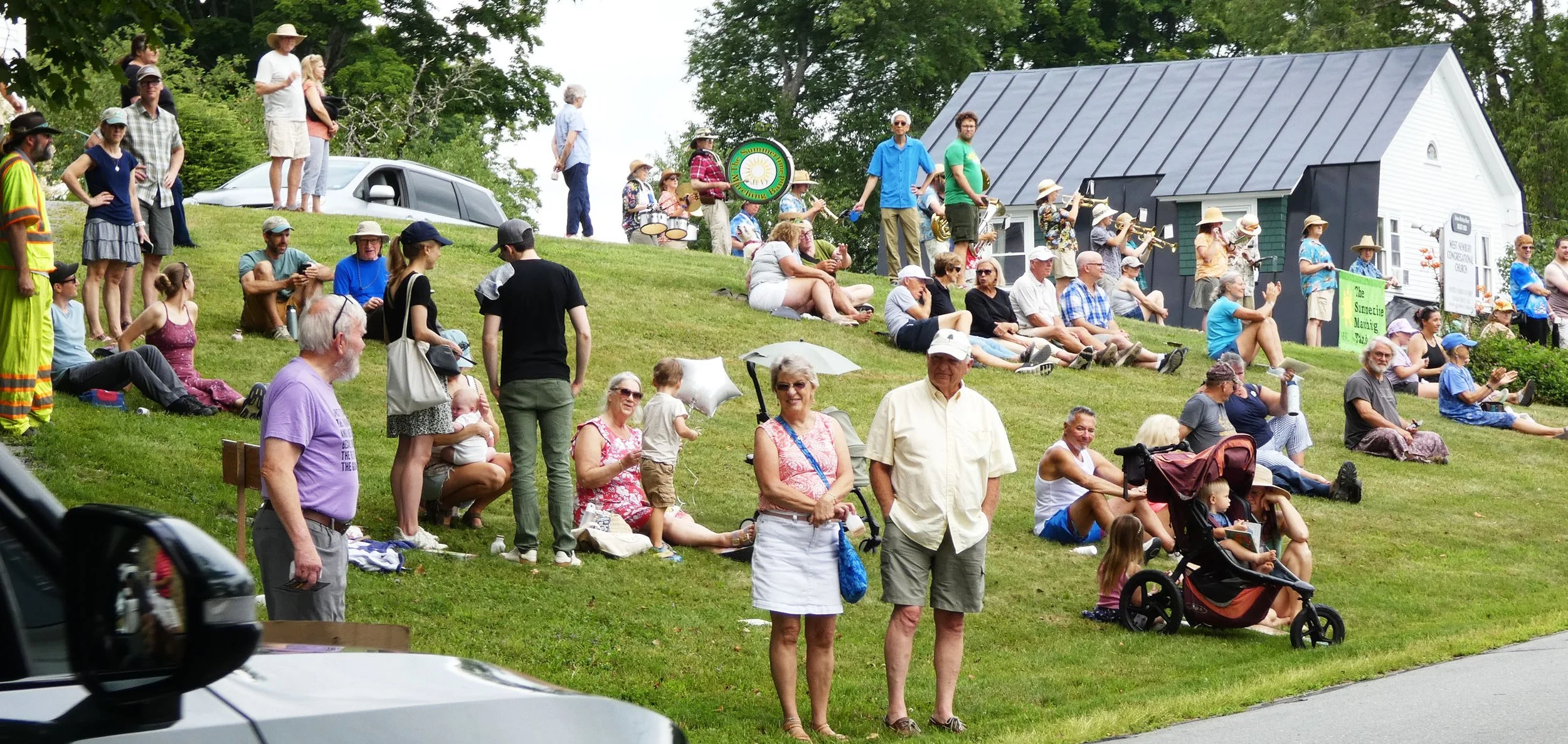
Lounging on the lawn in front of the West Newbury Congregational Church has always been the pastime when the annual West Newbury Summer Festival parade passes by. The Bridge Weekly/Bernie Marvin
Local VFW Post named one of five top posts in NH
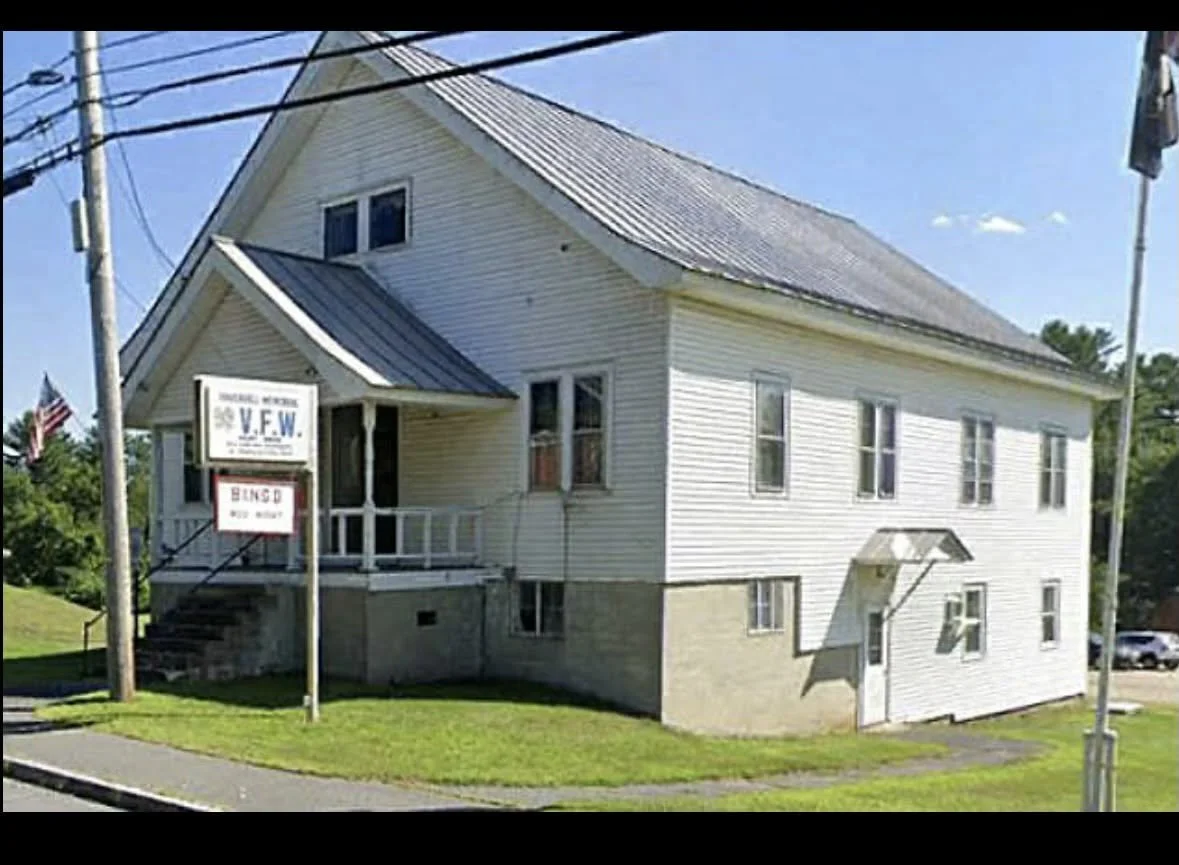
Word has been received that the local Post 5245 of the Veterans of Foreign Wars has been selected as one of five top posts in New Hampshire in their outstanding programs of giving back to the community.
Bernie Marvin
Courtesy Photo
North Haverhill, NH – Word has been received that the local Post 5245 of the Veterans of Foreign Wars has been selected as one of five top posts in New Hampshire in their outstanding programs of giving back to the community.
Post member Harv Keyes, himself a veteran of 32 years in the US Air Force and one of the active members, told The Bridge Weekly that because of the distinction of their busy schedule of giving to the community and to their fellow veterans, the organization has been named as an "All American Post."
Keyes said recently that the post maintains a list of about 80 members, many of whom are active; others are unable to participate because of their age, work schedules, or availability. No matter, Keyes said, they all contribute what they can to make the post one of the top posts in the state and nation.
He noted that the Veterans of Foreign Wars is America's oldest major organization of overseas combat veterans. VFW was established to secure rights, medical care, and benefits for service members returning from foreign wars.
VFW traces its roots back to September 1899, following the Spanish-American War; returning service members arrived home wounded or sick to a nation that had no veteran pensions or dedicated medical care system. To advocate for themselves, veterans formed local chapters across the country.
Today, the VFW operates as a huge advocacy network with over 1.5 million members across more than 6000 VFW posts throughout the world. Keyes said that Post 5245 is easy to join for veterans who qualify with overseas service.
More information can be obtained from Commander Larry Elliott 802-249-5878; N. Haverhill, Steve Wheeler 603-236-2754, and Dale Pierson 603-616-7106. Both are in Woodsville. In the North Haverhill area, there is Joy Henson 937-797-7471 and Gary Hebert 603-359-8830.
Out in Mountain Lakes area, contact Bill Burroughs 603-787-2911, down in the Orford area Dave (Tim) Cole 603-353-4359 will gladly help. Mike Conrad 603-989-5980 in Pike or East Haverhill, then down in Glencliff and Warren area is Eddie Ball 603-989-5528. Or call Harv Keyes in Haverhill Corner 603-359-4030.
Harv Keyes says “Our motivation comes from the motto ‘No Man Left Behind’ and that translates into our dedication to our community through local support. We invite you to join us if nothing more than just be with us through your membership. Remember it’s not the cost of an annual membership but the ‘Sacrifice you’ve already made just to be eligible.’
In reviewing some of the post's accomplishments that gained it the distinctive award recently, members sell $3000 to $5000 worth of lapel “Buddy Poppies” each year to help fund some of the community work they do. According to the records, members volunteered 2500 hours and drove 11,000 miles serving others.
He said the post also has provided honor guards and flag details for more than 15 funerals each year and cares for and pays for four Little League sports fields for teams that include 60 local kids, plus two soccer fields that host 1000 young players.
The local Post 5245 members provide services for their care and rehabilitation. He said that members of the post have made 70 visits to area hospitals in support of veterans, and nearly 4,000 hours were given to veterans’ service programs.
He said that VFW members gave a total of about $117,455 to the community for school scholarships and financial assistance.
He said that the care and maintenance of the VFW Field in North Haverhill includes two ball fields, a playground, bathrooms, and a maintenance shed. Ball fields host over 17 local communities with more than 36 teams, with each team fielding nine to 15 players plus coaches and staff.
At other times during the year, the ball fields are converted to soccer fields, with the average maintenance and mowing, plus upkeep and cleaning of the seals and bathrooms, requiring volunteer work of up to 22 hours weekly. All this is done by members of the post 5245 and its auxiliary at no cost to the taxpayers of Haverhill, Keyes said.
He said the post maintains no bar or alcohol facilities. The post's only income is from Wednesday night bingo programs. He said the post does have one annual raffle with the proceeds being dedicated to local youth activities.
The North Haverhill Fair celebrates its 82nd year with perfect weather
It was about a mile from that spot that the fair was born, as the Pink Granite Grange Fair, in 1946, after being set up for a couple of years as a one-day agricultural event for local kids and their 4-H animals.
Bernie Marvin
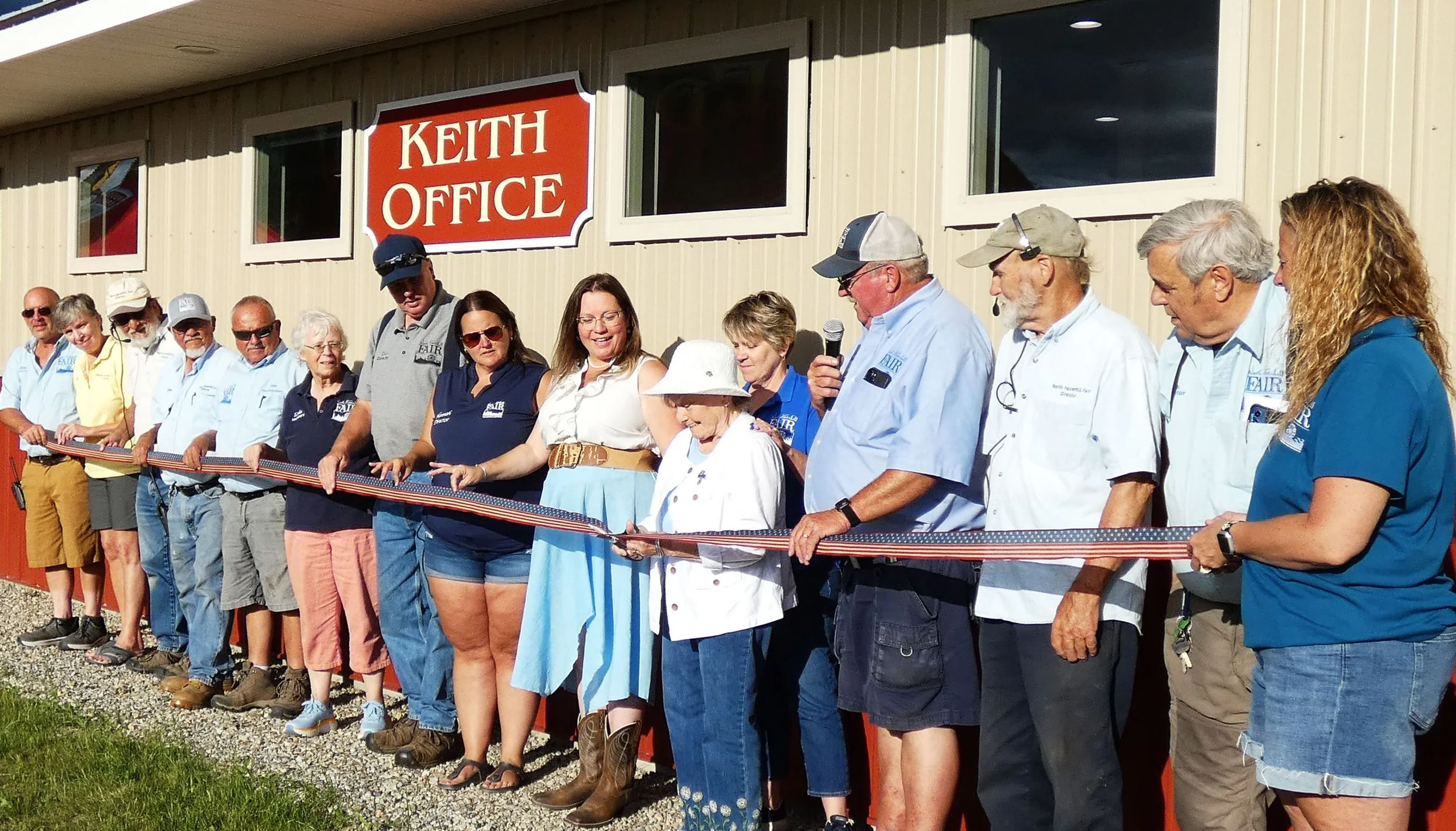
North Haverhill Fair directors and visitors lined up for the official ribbon cutting that opened the new Keith Office were, left to right Mike Perkins, Diane Ingalls, Gary Scruton, Jim Aldrich, John Aldrich, Linda Stoddard, Chris Dellinger, Hannah Leland, Executive Councilor Karen Liot-Hill, Debbie Bigelow, Linda Keith, President David Lackie, Bob Stoddard, Tim Clough and Amy Crocker. The Bridge Weekly/Bernie Marvin.
North Haverhill, NH – It was a rare weekend last week that allowed the North Haverhill Fair to be in town for five straight rainless, stormless days. It was perfect fair weather, and the crowds attending this 82-year-old North Country family tradition were happy with all they could see, eat, and ride on over the five days from July 11 to 26, 2026.
The 45-acre fairgrounds were first occupied by the fair and its associated buildings in 1982 after leaving its former home behind the present-day James R. Morrill Municipal Building on Route 10 just north of North Haverhill Village.
It was about a mile from that spot that the fair was born, as the Pink Granite Grange Fair, in 1946, after being set up for a couple of years as a one-day agricultural event for local kids and their 4-H animals. Nothing has changed as far as that goes, but the entire fair management organization and its volunteer base have grown significantly to accommodate and host the annual North Haverhill Fairs, which draw hundreds of support personnel.
Over the years, under a series of fair directors, presidents, and other fair helpers, it has blossomed into one of the North Country's premier early-summer events, attracting thousands from across New England and beyond.
As I look back at my participation with the North Haverhill Fair, I actually began my commitment that has lasted from 1979 to the present, first as a member of the Haverhill Police Department, one of several officers walking the beat throughout the fair's presence in town.
Back then it was only a couple of days in the early fall; then they added days here and there; now it is in session for nearly five full days. When you look over the schedule of exhibits, activities, contests, competitions, and other events, you sometimes wonder how they did it all in two or three days.
This year, the entertainment included Taylor's Story, a musical narration of Taylor Swift's greatest hits, as well as performances by the up-and-coming local hometown artist Karri Blood. Along with Thayer Stage entertainment, fairgoers enjoyed a truck show, a log-loading contest, a big-wig truck pull, many motorized events, daily animal-pulling contests, the ever-popular racing pigs, and live music shows every day.
Throughout the five days of the fair, visitors wandered through art and photography shows, crafts and collections, scarecrow art and Lego creations. There were a multitude of contests and shows, including the popular King Arthur baking contest, a classic car show, a demolition derby, a glowing competition, and other popular shows throughout the vast fairgrounds.
The animal programs are exciting for the public and for 4-H participants, with continued programs inside the Rutherford Building, one of the most popular structures on the fairground acreage.
This year, as the new Farm Museum fills up with an amazing array of implements, tools, and early American farming machinery, it has proved to be a very popular area for fair visitors to visit, often at the same time as the Doc and Katharine Blaisdell Maple Museum.
The highlight of the fair was the construction and opening of the new Keith Office, a sterling building with ample space for the staff who manage the fair's activities. From the outside, it looks a bit like a long barn and is a handsome addition to the buildings already there that have been either moved there or built there since the fair relocated to that field in 1982.
Kevin Fagnant and crew built the new Keith office, which features a typical New England structure atop the roof amidships (in the middle), known by many as a cupola. As David Lackie will tell you, it is not a cupola; it is a belvedere.
He offered that Mr. Fagnant commented that it was a belvedere. Although it looks like a cupola, a belvedere is an Italian word meaning a structure on the top of a building that provides an elegant view. Of course, a view of the fairgrounds is an elegant view and will remain so for many years to come.
It was a happy occasion, with many of the Keith clan gathered to salute the family's involvement, along with many other families who have taken the time to volunteer for this very nice program, born and raised in North Haverhill, NH.
The actual cutting of the ribbon at the start of this year's fair on Wednesday evening came after some introductory words and a brief fair history. On hand for the event were many former directors and their families, friends of the fair, and a few others with connections to state government in Concord.
They included Executive Councilor Karen Liot-Hill and Haverhill resident Rick Ladd, who, for many years, was an education leader in Concord and served for 18 years as an elected representative. He announced his retirement earlier in the evening to the surprise of many. He was a friend of the Town of Haverhill, where he lives, and of the North Haverhill Fair.
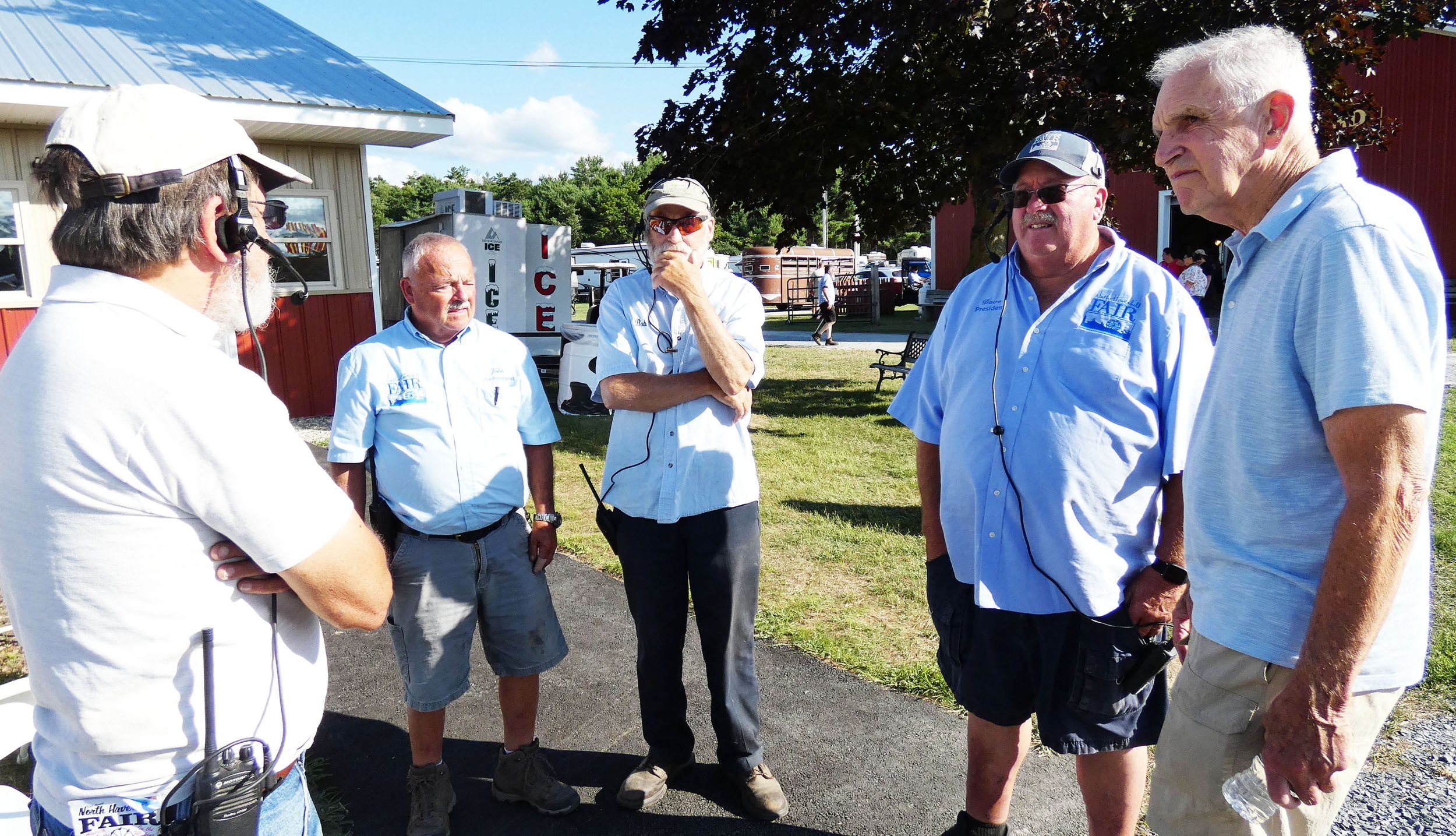
Taking a little time to speak about the great weather and crowds who flocked to the fair over last weekend, are fair directors, left to right Gary Scruton, John Aldrich, Bob Stoddard, President David Lackie and NH Representative Rick Ladd. The Bridge Weekly/Bernie Marvin
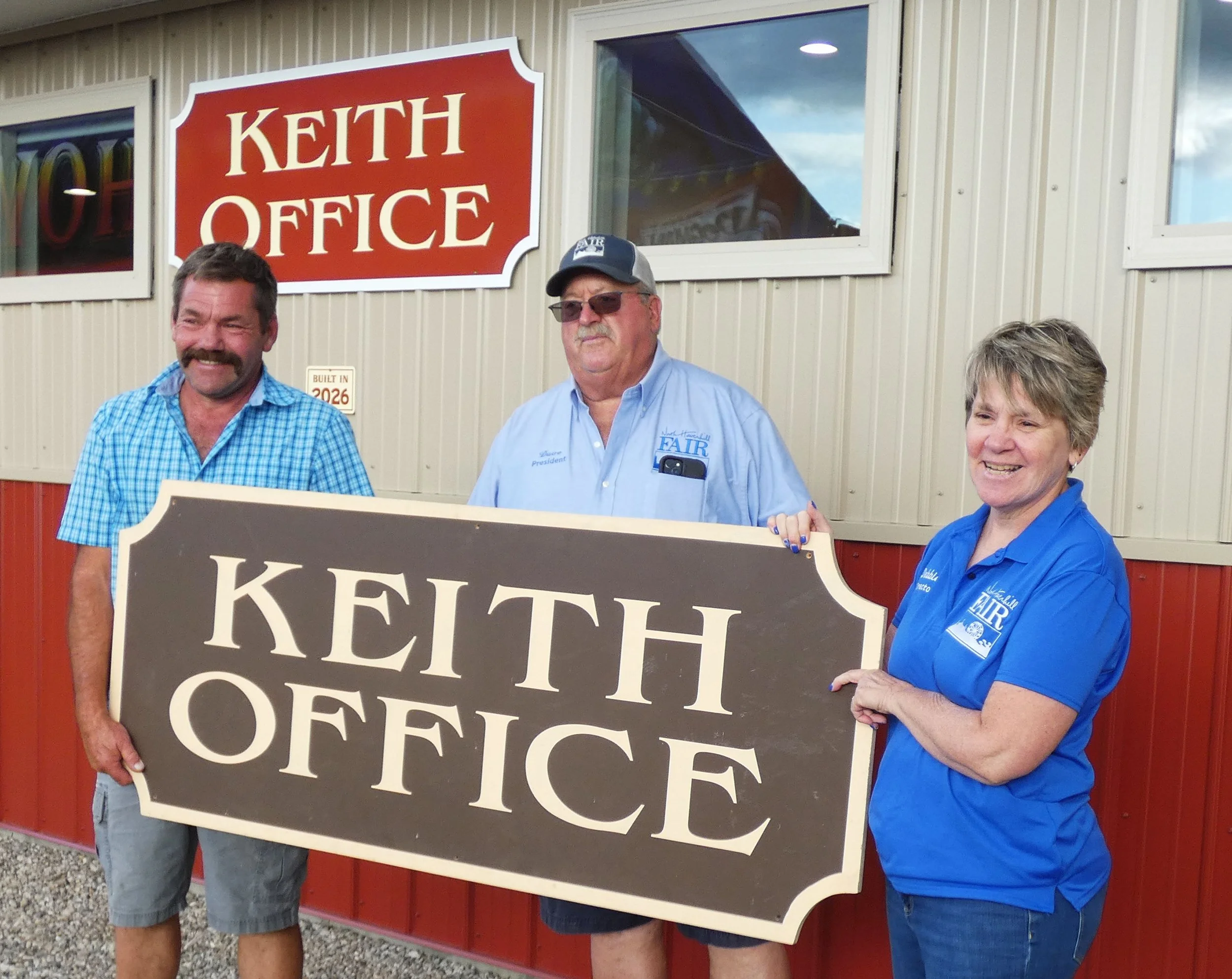
Showing a new sign for the Keith Office that will be permanently displayed on a newly constructed administration building at the North Haverhill Fairgrounds are left to right, a Keith son, Tom, Fair President David Lackie and a Keith daughter, Debbie Bigelow at the North Haverhill Fair that was in town from Wednesday through Sunday last week. The Bridge Weekly/Bernie Marvin
In its 50th year, the Orford Flea Market still offers a variety of food and neighborly fun.
The area has been in love with the Orford Flea Market for 50 years. It has taken place on the spacious Orford Common, and as they say, "If it is not at the Orford Flea Market, it ain't nowhere!"
Bernie Marvin
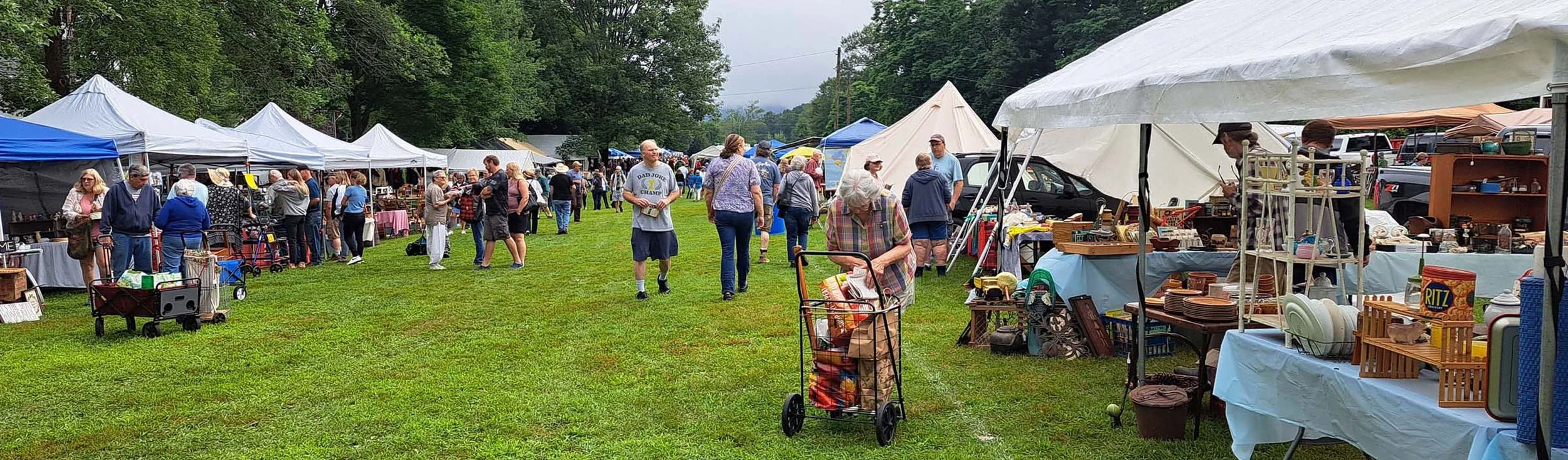
Here is a typical view of the Orford Flea Market showing folks walking around the area chatting, bargaining, and telling tales. It is a great two days of social fun and visiting. The Bridge Weekly file photo/Bernie Marvin.
The area has been in love with the Orford Flea Market for 50 years. It has taken place on the spacious Orford Common, and as they say, "If it is not at the Orford Flea Market, it ain't nowhere!"
The event is coming up on Saturday and Sunday, August 1 and 2, from 9 AM to 5 PM on Saturday and from 9 AM to 4 PM on Sunday. It is a very different kind of show, and it is vast, creative, and usually crowded with people who really enjoy browsing and buying.
We have personal experience with the Orford flea market. For the past five years, we have been a participant there, selling my volumes One, Two, and Three of Bernie's Beat books, plus selling Humanitarian Food Rations (HFR) and Meals Ready to Eat (MRE).
As always, we had success selling books and meal pouches. The military food drew many interesting comments from veterans who stopped by our display, including "I remember those hockey pucks we had in our MREs!" He was referring, of course, to the hamburger or pork patty, a delightful round portion of meat that looked and tasted (most) like a hockey puck.
That was only one of the fond remembrances of military food we heard while at the flea market. There were many others, and the comments were fun and quite creative, most of which I cannot repeat here in this family newspaper. The military and humanitarian food comments from some flea market shoppers evoked memories of their days far from home in the military, when they had the opportunity to love or hate MRE meals.
Time spent with Bernie's Beat books and visitors to the Orford Flea Market was delightful, as always. The stories in the books are about local people I know or have met along the way. They are not fiction or opinion pieces. They are stories about life, work, family, and situations. The Bernie's Beat columns and books are fun to write, and they are fun to talk about because people not only buy them, but they also talk about stories of their own that were prompted by just having the books on the table being offered to the public.
But even more fun than that are the opportunities to meet friends who come to the Orford Common for these two days each summer and wander around looking and admiring all those things laid out before them. Acres of stuff, some really old and valuable, and not much junk.
The Orford Flea Market is 50 years old. It is a success and is provided for the benefit of the Orford Volunteer Fire Department. It is a mammoth occasion where the vast, majestic Orford Common is filled with vendors selling everything under the sun and moon. For the past 50 years, the stretch of Route 10 from way beyond the old Equity Publishing building to the north, down to the Orford fire station in the south, is dedicated to flea market parking for the two days of the flea market.
The common is filled with 200 dealers, each planted in their 20-by-20-foot space. For each flea market day, thousands of people meander up and down the aisles, checking out the myriad of wares all along the way. During their visit, they will find anything they want or don't need, but they buy it anyway.
The Orford Volunteer Fire Department offers food at its booth, and the church offers an assortment of breakfast sandwiches and, later, pie and ice cream.
They come armed with shopping lists, backpacks, and shopping carts. They make offers, they bargain, and they buy, or they don't buy. Sellers spend hours loading their wares at home, then unloading them in Orford. As Sunday approaches, many will tell you they don't have to worry about packing the stuff back into their vehicles because they've sold most of it.
The event runs smoothly, and one reason it does so without problems is that Ruth Hook was at the helm of this enormous project for many, many years. She was the go-to lady, the head boss of the flea market, and had done a great job for many years. She cruised the main corridors, plus the nooks and crannies of the flea market in her Gator vehicle. She took names and assigned spaces, and if you had a question about anything at the Orford Flea Market, she was the one who answered your questions.
The Orford Flea Market is an exciting place to visit. You can't escape from the common without taking home some oddity, an unusual knick-knack, a real piece of China, heirloom table wear, or an old photo.
It is a wonderful weekend experience, and as in the past, the weather promises to be beautiful (we hope!)
Nice Weather, Happy Crowds Greet Warren Old Home Day Weekend Events
Grand Marshal for this event was the Warren Historical Society, and two members of that great organization were on hand in one of the lead-off parade vehicles. The Grand Marshal vehicle in the parade featured Historical Society Vice President Don Bagley at the wheel—a nice honor for a group that has done so much to preserve Warren's long history.
Bernie Marvin
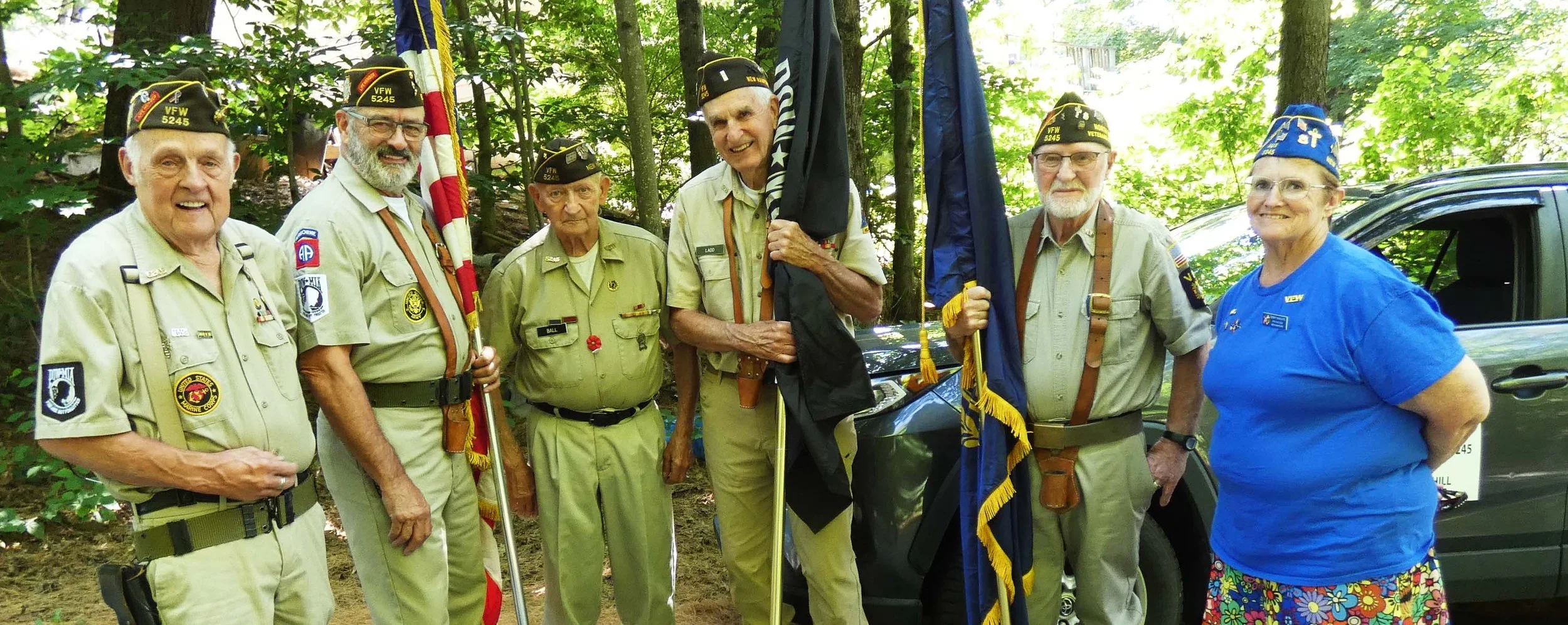
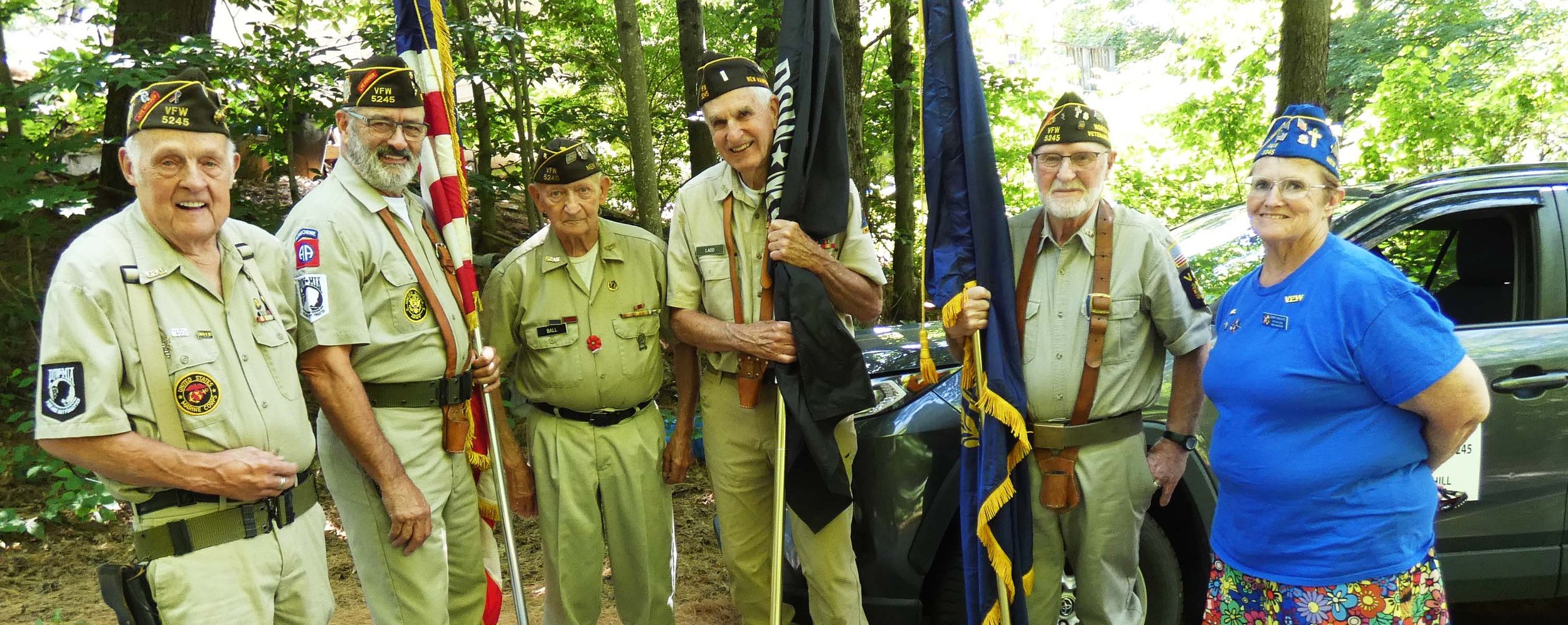
Preparing to march the Warren Old Home Day Parade route last Saturday, July 11, 2026, were members of Post 5245, North Haverhill, Veterans of Foreign Wars, left to right: Commander Larry Elliott, Sr., Gary Hebert, Edward Ball. Rick Ladd, Fred Delman, and VFW Auxiliary member Terry Knights. The Bridge Weekly/ Bernie Marvin
Warren, NH – The Founding Fathers-themed Warren Old Home Days weekend was chock-full of activities, starting on Friday at 4 PM, as the Warren Volunteer Fire Department fired up the BBQ grills and hosted their Chicken Barbecue behind the Warren Village School. From there on, the weekend was non-stop Warren Old Home Days right through to Noon on Sunday, July 12, when they scheduled kids' games on the Common.
Friday evening also saw music played on the Common with fireworks later presented by Whitcher's at dusk.
Saturday's activities for the Warren Old Home Days started early with the Kyle Mooney Prouty 5K walk that stepped off at the fish hatchery. Helicopter rides were scheduled to begin at 9 AM, and the Founding Fathers Parade stepped off at the Sanford Memorial Field on Lund Lane at 11 AM sharp.
Grand Marshal for this event was the Warren Historical Society, and two members of that great organization were on hand in one of the lead-off parade vehicles. The Grand Marshal vehicle in the parade featured Historical Society Vice President Don Bagley at the wheel—a nice honor for a group that has done so much to preserve Warren's long history.
The Mount Moosilauke ATV Club presented a noon poker run, and on the Common there was live music by the Red Hat Band.
Again, this year, there was a very well-attended open house at the Warren Historical Society Museum and other activities that included strawberry shortcake, the annual corn hole tournament, a Taekwondo demonstration, candy bar bingo, and an open mic program hosted by Jim McHugh, and at 6:30 PM, the Colonial Wrestling Alliance presented a wrestling show on the Common.
Sunday's event began at 7 AM with breakfast at the Masonic Lodge, a kids' fishing derby at the Morse Museum Pond got underway at 9 AM, and the Warren traditional Old Home Day Pig Roast on the Common began serving at noon.
During the Pig Roast, there was also live music on the Common by The Roll on Buddies Bluegrass Band, and the weekend events ended with kids' games there.
The parade that rolled out of Sanford Memorial Field included a wide array of family floats and decorated ATVs, a nice selection of classic vehicles, and we saw some political folks running for a variety of offices. They were assembling at the field, getting ready for their trip into town, walking or riding along the parade route. They were Democrats Brie Choate, seeking the Grafton County Register of Deeds office; Paul Goundrey of Orford, running in the Democratic Primary, and Dusty Vigneault, who is running for the Representative seat from the Haverhill area.
Also seen at the parade were Grafton County Commissioner Katie Hedberg and State Senator David Rochefort.
Leading the parade was the usually fine, spirited music of the Baker Valley Band and the stalwart war heroes of the North Haverhill Veterans of Local Wars Post 5245, carrying the national and state colors proudly down the street, as they have for so many years at the Warren Old Home Day Parade.
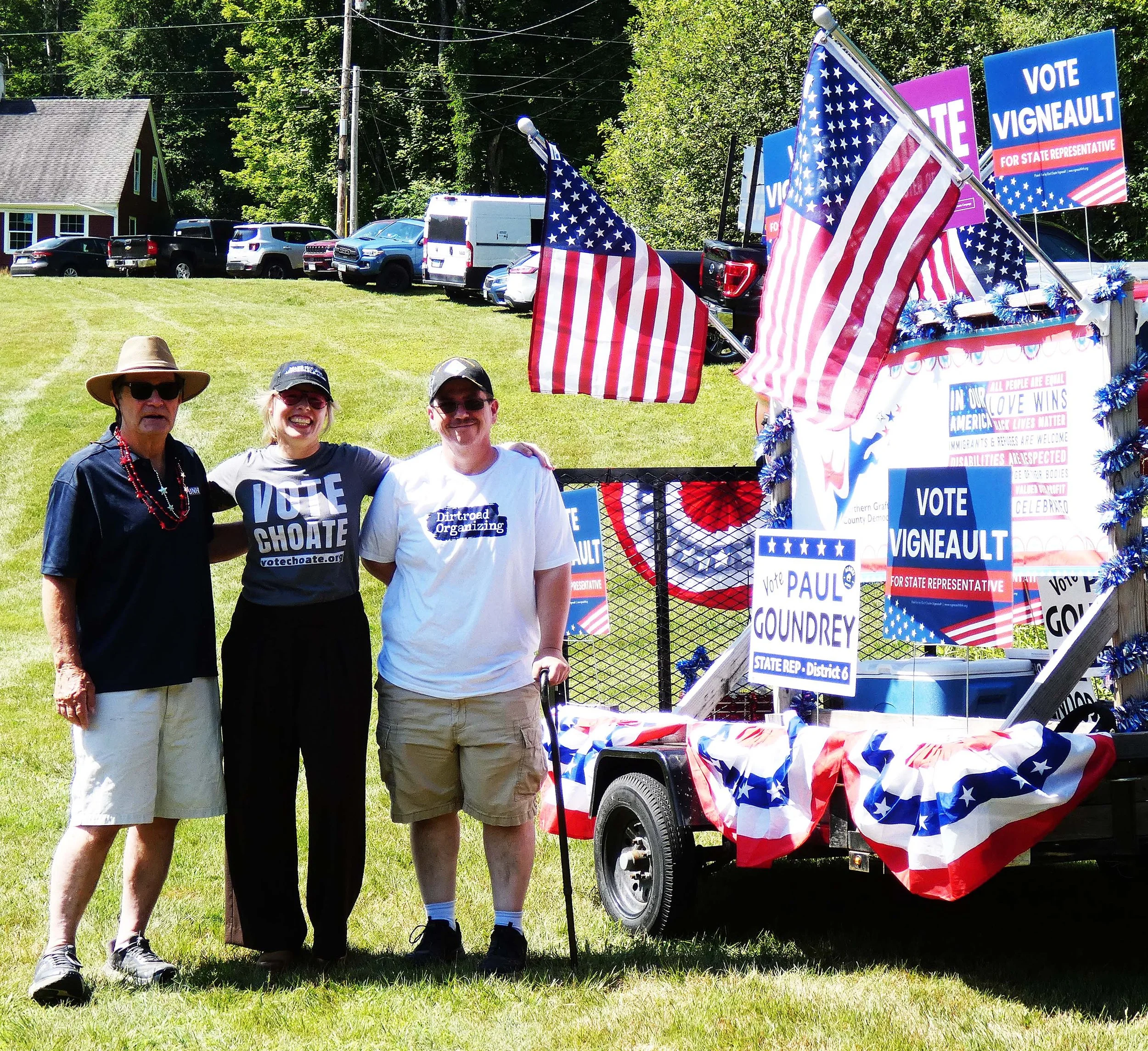
Three candidates appearing in the Warren Old Home Day Parade last Saturday, July 11, 2026, are, left to right, Paul Goundrey, District 6 Representative of Orford; Brie Choate, for the Grafton County Register of Deeds and Candidate for the Haverhill area State Representative Dustin Vigneault. The Bridge Weekly/Bernie Marvin
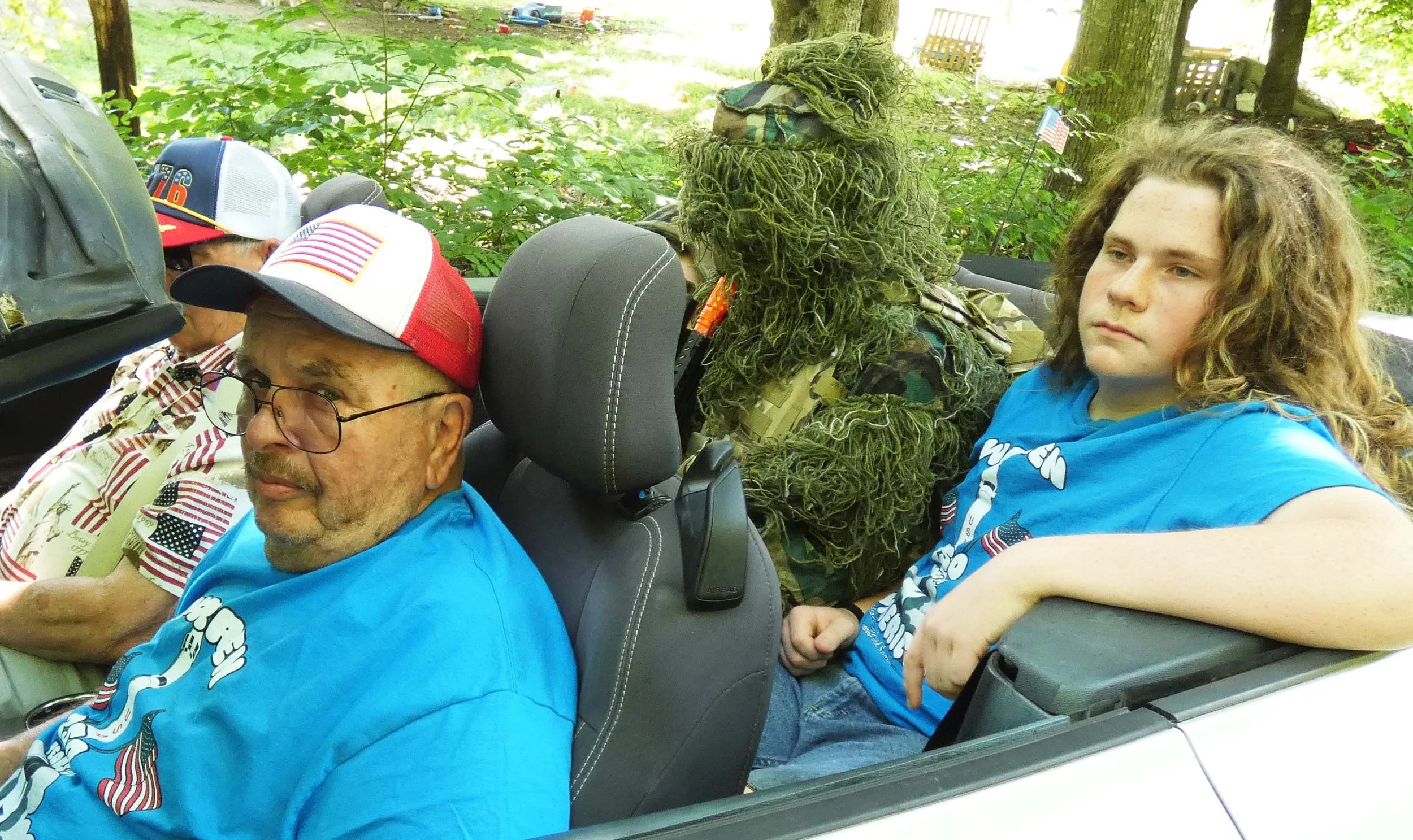
The Warren Old Home Day Parade Marshals included, front left vehicle driver, Don Bagley, Vice President of the Warren Historical Society. Others in the vehicle with Bagley were along for the ride to enjoy the beautiful parade weather. The Bridge Weekly/Bernie Marvin
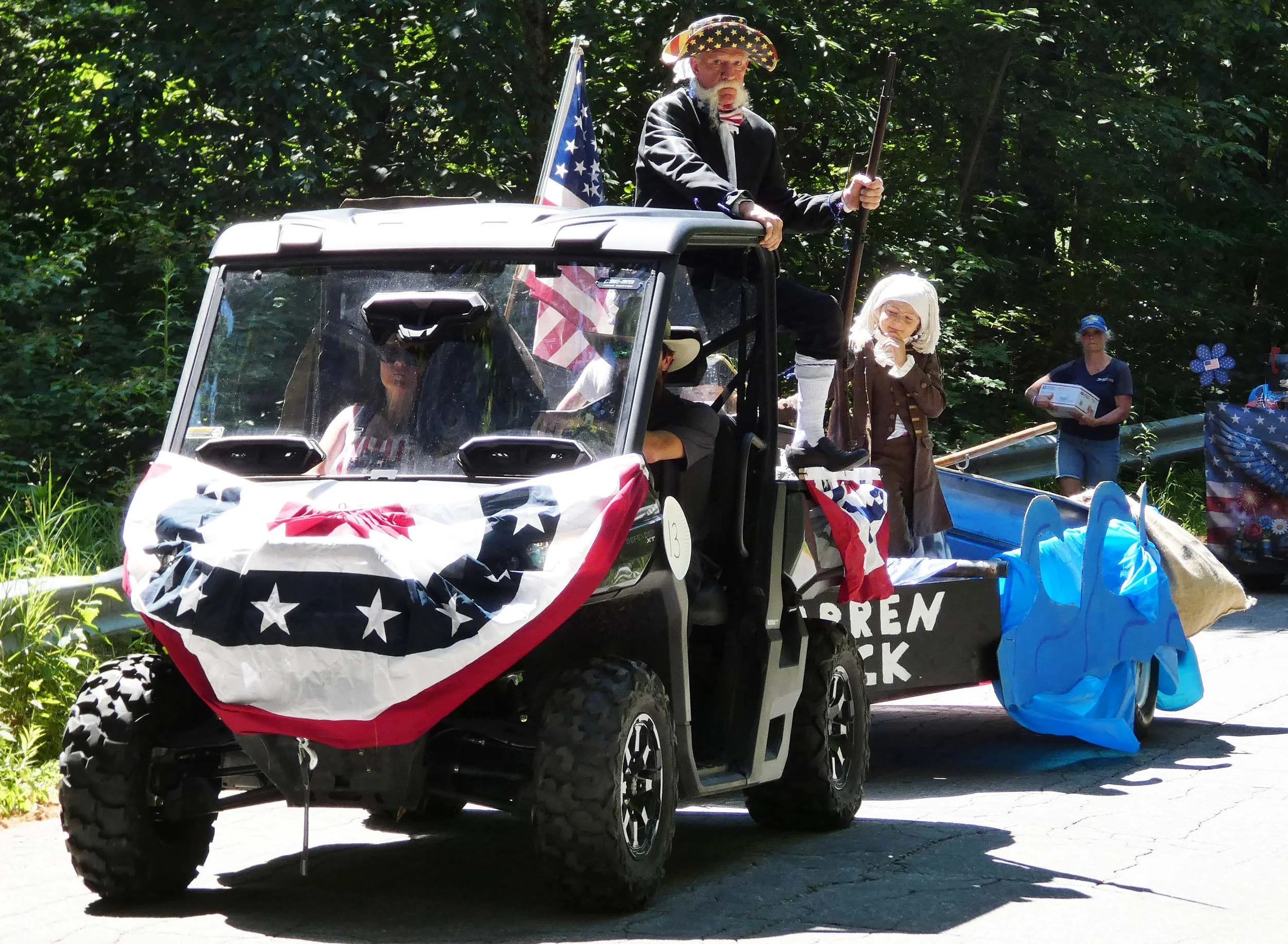
The Godfrey Clan on their float as they begin their ride last Saturday morning in the Warren Old Home Day Parade. The Bridge Weekly/Bernie Marvin.
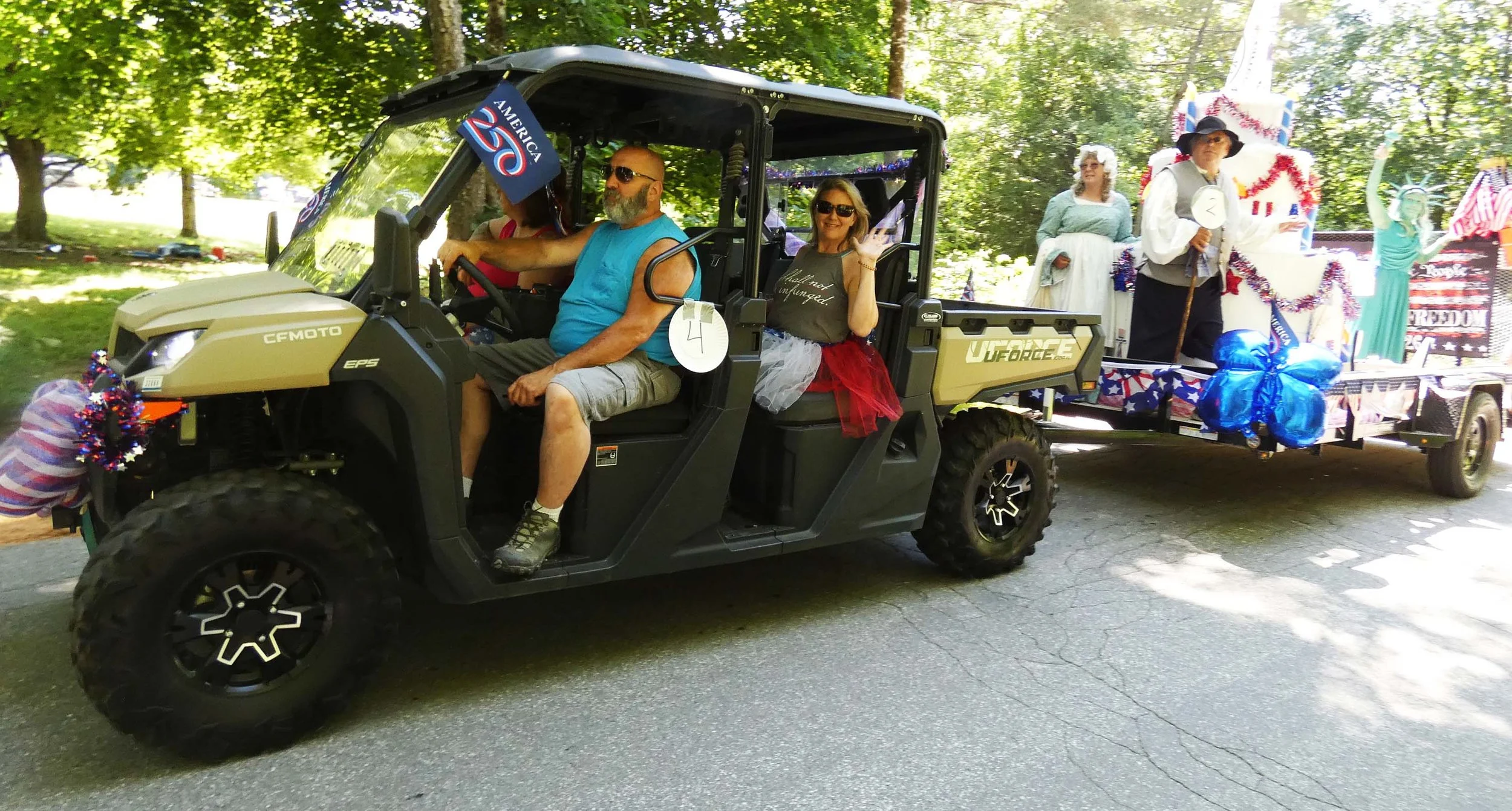
The Warren Old Home Day Parade featured several groups on their family floats. The Bridge Weekly/Bernie Marvin
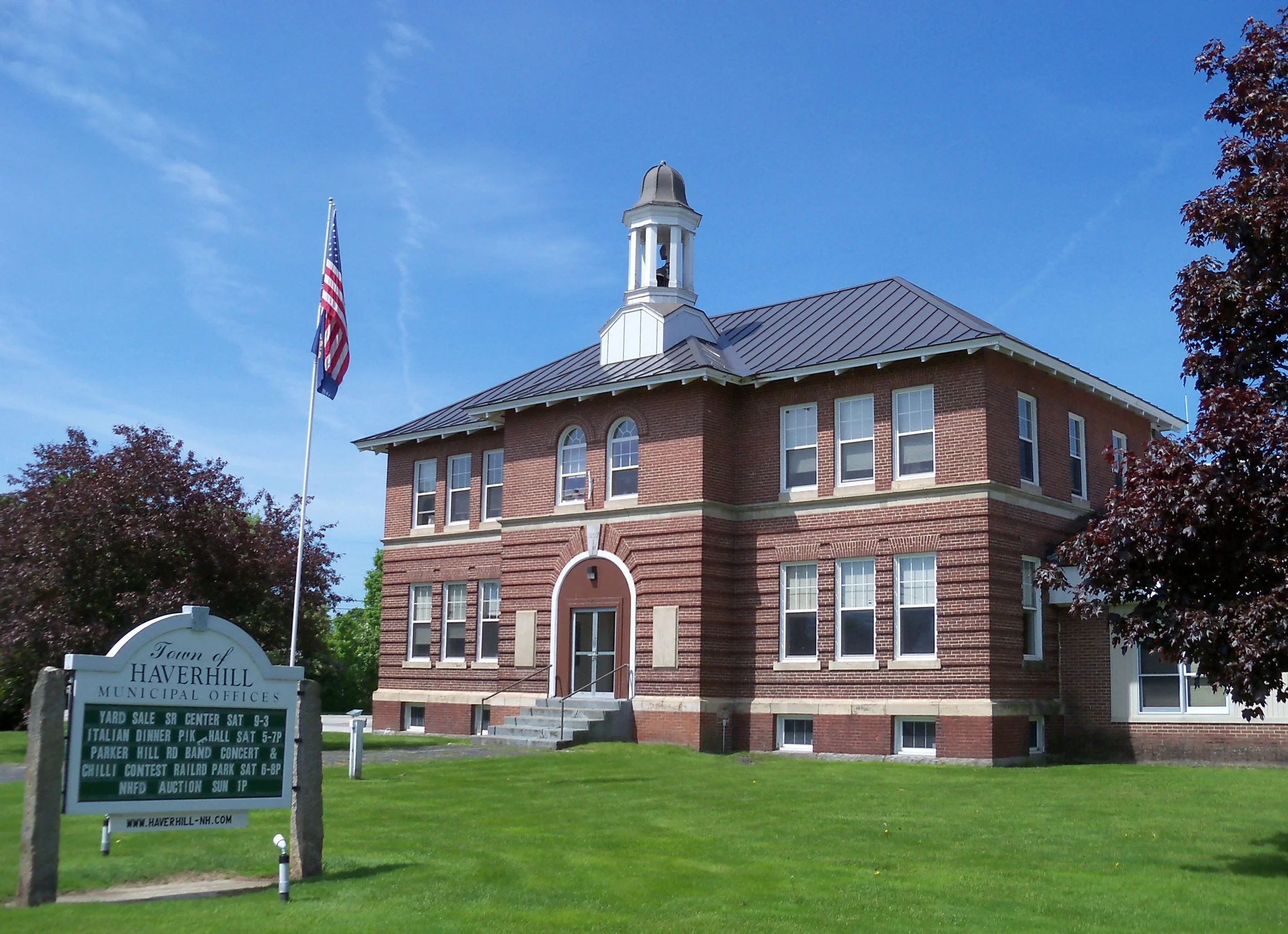
Population Of Area Towns Both Up And Down Between 2020 And 2025, Study Shows
At the same time, growth among the state’s three biggest cities, which include Manchester, Nashua and Concord, has, according to the study, remained static over the past five years of the study. But some smaller suburbs and rural areas have seen population declines.
By Bernie Marvin
Photo by Alexius Horatius, Wikimedia Commons, CC BY-SA 3.0
The US Census Bureau has released a report which indicates that New Hampshire’s population grew by a total of 36,590 people. That is a 2.7 percent increase in the overall population statewide.
Many of the state’s smaller towns and cities and the larger locations led in municipal growth in this most recent study. Not surprisingly, the Lakes Region and White Mountains towns also experienced population increases, probably driven by retired people and remote workers moving to that region.
At the same time, growth among the state’s three biggest cities, which include Manchester, Nashua and Concord, has, according to the study, remained static over the past five years of the study. But some smaller suburbs and rural areas have seen population declines.
This uneven population shift, some say, highlights broader challenges that include the rising cost of living and increased housing costs, which probably are deterring young families from coming to New Hampshire to settle.
An interactive map that accompanied the study shows that area towns including Haverhill, had a 2020 population of 4590 people and in 2025 the population was estimated to be 4667 people. That's a population changed total of 1.7 percent upward growth.
In Bath, the 2020 population was set at 1077 and grew to 1112 through 2025, a 3.2 percent increase. In Piermont, it was a different story between the years of 2022 and 2025. There, the population reduced from 771 in 2022 to 763 in 2025 for a 1 percent decrease in current population.
For the town of Orford, the 2020 population was 1240 and in 2025 the population was estimated at 1229 for a .9 percent reduction in population. In Warren, the population was estimated at 830 in 2020 and reduced to 823 in 2025 for a .8 percent change to less population.
From 2020 to 2025 31 New Hampshire communities, including Piermont, Warren and Orford saw population declines, while 98 others grew slowly, more slowly than the state overall average. During this period 105 municipalities saw growth rates that were similar to or faster growing than the state’s average or overall rate.
And during those five years, 24 communities, which were mostly the low population townships in the northern parts of the Granite State, saw no estimated population changes during that time.
The town of Epping saw the fastest population increase among all of New Hampshire’s towns, adding about 820 residents over the five-year period which is an 11.5 percent increase. Several other communities in central New Hampshire saw some of the state’s largest percentage population gains during the years of the study from 2020 to 2025. These included Epping’s neighbors, like Brentwood, Dunbarton, Boscawen and Salisbury, and Auburn which led population gains. Lebanon, the popular economic area in the Upper Valley just below this location, saw the fastest population increase among the state’s 13 cities with Lebanon adding 1172 new residents.
The report noted that New Hampshire’s uneven population growth pointed to the fact that while more people may be moving to economic centers for employment opportunities and to certain smaller towns for those preferred and amenities, broader affordability challenges and housing constraints may slow down growth in some of the states’ larger communities.
There have been policy approaches, for instance zoning changes, aimed at increasing the availability of housing and other financial investments which could help spur housing development that would possibly attract younger families and have an influence on future population growth across the State of New Hampshire.
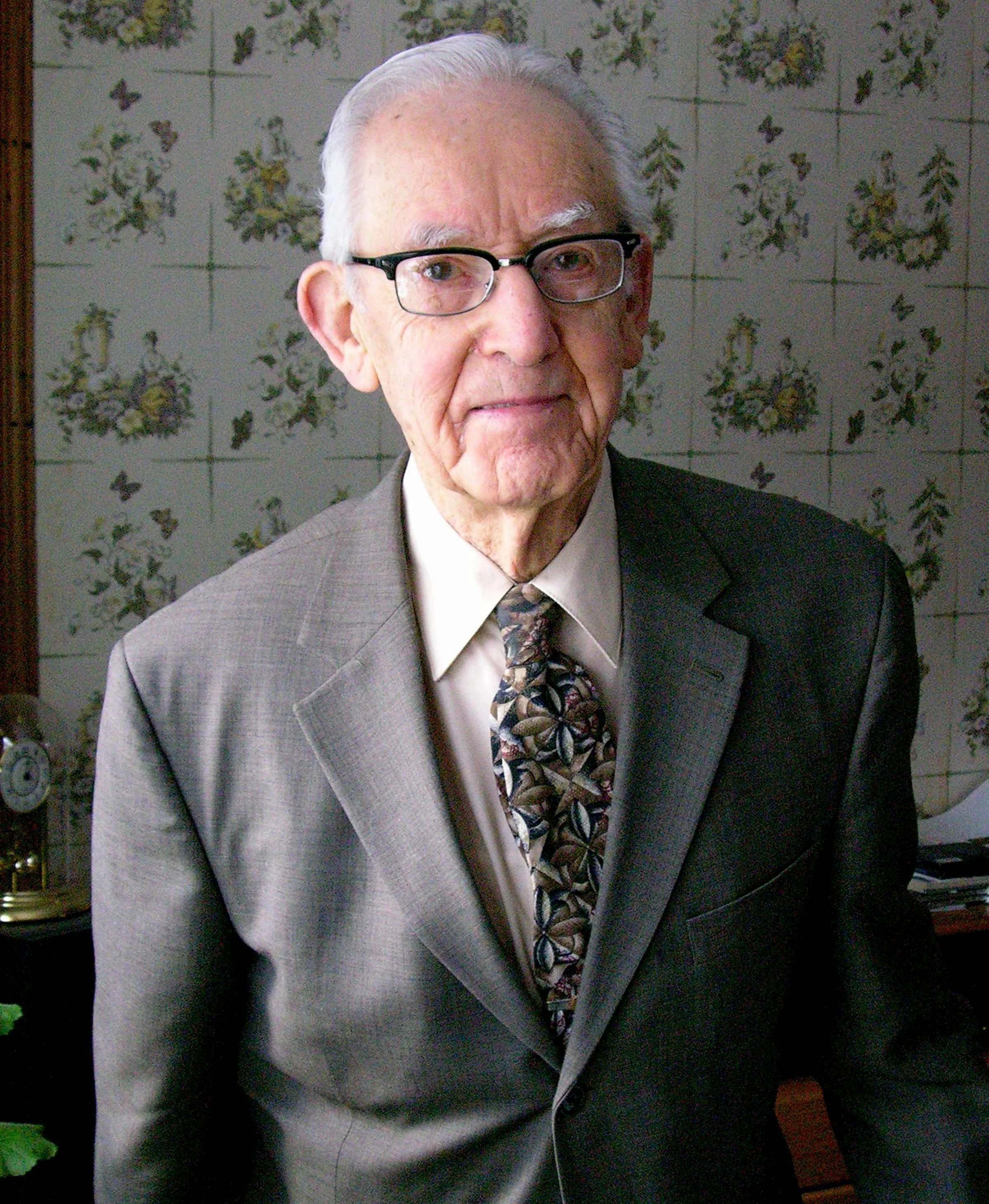
Dr. Harry and Mary Rowe's Wells River Clinic is now in its historic 80th year!
Little Rivers Health Care CEO Andrew Barter said that the Dr. Harry Rowe and Mary story on their bold plan of setting up the original Wells River Clinic after he returned from his difficult war service is a wonderful story.
By Bernie Marvin
Dr. Harry Rowe, photographed in 2000 at his original office of the Wells River Clinic, founded by him in 1946 after his return to the area from his US Army medical officer assignments during World War 2. The Wells River Clinic was the foundation which grew into today’s Little Rivers Health Care, with medical offices in Wells River, East Corinth, Bradford and Newbury. The Bridge Weekly file/Bernie Marvin
Wells River, VT - The Wells River Clinic, now part of the Little Rivers Health Care (LRHC) with offices in East Corinth, Bradford, Wells River, and Newbury, was founded by a Vermont country doctor who had fought in World War 2 and returned to Vermont to continue to take care of the sick and injured in the Green Mountain state he loved. Dr. Harry Morrison Rowe was born in nearby Peacham in 1912. He graduated from Peacham Academy in 1930 and from the University of Vermont in 1936 with his bachelor's degree. While studying at UVM, he met and married Mary Whitney in 1940, and he earned his medical degree in 1943. The popular couple raised a family of six children: David, Betsy, Susan, John, Alan, and Jane. With World War 2 raging, Harry joined the 78th Infantry Division, was promoted to Captain, and assigned to the 303rd Medical Battalion. He eventually served as a Battalion Medical Officer during the furious fight for American troops to enter Germany and bring the war to a close. During his military service, Dr. Rowe served in Texas, Virginia, and West Virginia. Also overseas in England, France, and Germany. Dr. Rowe was awarded a Bronze Star for his service at the Bridge at Remagen over the Rhine River, a battle that lasted 18 days. Americans held their positions at the bridge crossing that, surprisingly, had not been destroyed. The furious fighting in and around the crossing location hastened the American entry into Germany by three weeks. Throughout his 15-month deployment and combat duty, he and his wife, Mary, wrote letters to each other every day. Upon Mary's death in 2002, those precious letters were discovered and read again by Dr. Rowe. These letters, written over the long time she waited for the war's end, and Dr. Rowe's fight in Germany until the war's completion, inspired him to compile them into a personal memoir. Local Vermont authors Terry Hoffer and Beth Champagne collaborated with Dr. Rowe to write and publish a book in 2009 about the letters between Dr. Rowe and his wife, Mary. The book sold well locally because of interest in these two people, who were heavily involved in their community of Wells River and the surrounding towns. The book was published by Athenaeum Press in St Johnsbury. The bulk of Dr. Rowe's life's work up until that time, along with oral histories, tapes, and other researched materials used in the production of the book, is now preserved in the Harry M. Rowe Collection at the Vermont Historical Society. In April 1946, Dr. Rowe and thousands of other service personnel who had served in Europe during the war went home to be with their loved ones. As Harry told it, "I came back to New York by ship," he said, then we were transferred to Boston by train. Mary met me in Boston. Words cannot describe how glad I was to be back in the United States and finally home on leave. We stayed in a rooming house in Boston for a day or two and then went to see friends in New York. A few days later, we headed for Vermont and home in Burlington." According to comments by Little River Health Care Physician, Dr. Steve Genereaux, Dr. Harry and Mary Rowe, with no colleagues and little actual training in rural primary care medicine, settled in Wells River along with their two-year-old son, David. In 1946, they set up a small medical practice in their home, which they purchased just south of Jock Oil on Route 5, which was, at a later time, Attorney John Morale's law office. They started seeing patients in their front room. Later, as the practice grew, they moved to the present larger site of the Wells River Clinic, now Little Rivers Health Care, at 65 Main Street in 1952. During that time, Harry reported in his book, The Grass Grew Greener, "that Mary and I were running the office pretty much alone. She had given up playing the violin with the Vermont Symphony to help. She was doing the bookkeeping, and I showed her how to do some of the lab work. I was seeing patients, and she would come, if necessary, that is, if I was doing a female exam. It became quite a busy practice. Mary was actually my nurse, secretary, cook, assistant, lab girl, and housekeeper." In 1962, Dr. Rowe officially launched his Wells River Clinic with the philosophy of "Anyone who needs to be seen will be seen," meaning that if someone did not have funds for medical services, they still received them from Dr. Rowe. Dr. Elizabeth Berry joined the practice soon after that. She was the first female physician to practice in the area and remained at the clinic until she retired in 1992. She would be seen frequently throughout the area with her husband, Dr. Kenneth Berry. This loving couple presented Wells River with what is now Berry Park, a large grassy area just outside the village, on the south side of Route 5. Dr. Rowe's son, John Edward Rowe, MD, joined his father at the clinic after finishing his medical residency. He practiced with his father for more than 10 years, relocating to North Carolina in 1992. Dr. Rowe was a traditional Vermont country doctor, practicing his medicine with house and office calls, working weekends and nights. He was also the sought-after on-call physician for the nearby Grafton County Nursing Home in North Haverhill. He was very proud to have delivered more than 1,400 babies throughout the area. Dr. Rowe practiced full-time for more than 60 years, finally retiring in 2006 at the age of 93. After that, he continued to lead a busy life, serving others in many capacities and organizations. He passed away in 2012, just short of his 100th birthday. To ensure that the area continued to receive quality medical care, as it had for so many years since the establishment of the Wells River Clinic, others have joined the effort to keep the business going. Dr. Rowe's son, Dr. John Rowe, joined the clinic with his father in 1982, was joined by Dr. Fay Homan in 1993, and, shortly thereafter, Dr. Steve Genereaux came aboard. This added depth to the ranks at the Wells River Clinic and allowed Dr. Harry to step back a bit. According to Dr. Genereaux, in 2006, the business transitioned from the Wells River Clinic to Little Rivers Health Care, and over the past 20 years, offices have been established in Bradford, East Corinth, and at Cottage Hospital in Woodsville. Community members such as Al Stevens, Dr. Sarkis, Harry Rowe, Reverend Jane Wilson, and others submitted grant applications to the federal government so that the three offices could come together for the inclusive medical practice. This action took all of three years and finally included offices in East Corinth, Bradford, Wells River, with another building in Newbury on Route 5, and a new large addition constructed at the Wells River site. This allowed the practice to include behavioral health, plus at a fifth location in downtown Wells, River at the former site of Jiffy Mart, a dental office that will soon include a dental hygienist and eventually, a dentist. LRHC owns all five buildings and the grounds involved in this expansion of what was once a small medical practice established 80 years ago in Dr. Harry and Mary Rowe's living room. As for the new space recently constructed in the Wells River Clinic building, Dr. Genereaux told The Bridge Weekly in a subsequent interview, "Having the extra space here is great." He said there are six personnel working at the clinic, three or four days a week. He said that upstairs in the new wing, behavioral health staff, social workers, and counselors are tending to patients. He noted that the staff upstairs is just as busy as on the first floor. "Over time," Dr. Genereaux said, "we have seen the number of patients here slowly climb." He said that, from an economic viewpoint, the community's salaried jobs for our 90 employees approach the budget numbers of the nearby Blue Mountain Regional School district at about $13 million. Comments from friends and residents of the area about the Wells River Clinic indicated that Dr. Rowe and Mary Rowe, together, were really community-minded and would be at the clinic, along with their first clinic nurse, Betty Minot, to answer every phone call, no matter the time of day or night. They were all there to meet community needs. Mary was eventually named director of the North Country Chorus. She was teaching at the Wells River School, giving music lessons and taking care of the growing family. As Dr. Genereaux said, if anything happened in the community and help was needed, the Rowes were usually the first to know and first to be there to help. Relative to the importance of what was begun 80 years ago by Dr. Rowe and his beloved wife, Mary, is well acknowledged by Madison Culver, a staff member of the Wells River Clinic, which remains an important part of the Little Rivers Health Care organization. She told The Bridge Weekly that: “As a nurse practitioner at the Wells River Clinic, I have seen firsthand the vital role Little Rivers Health Care plays in our community. Having grown up in the North Country and living with a chronic illness myself, I understand the challenges many of our patients face in accessing quality healthcare close to home. One of the things I value most about the Wells River Clinic is our ability to provide comprehensive, evidence-based care locally. Our patients deserve the same high-quality care they would receive at a larger academic medical center, without the burden of traveling long distances. Whether managing chronic conditions, addressing acute illnesses, or focusing on preventive care, we are able to partner with patients to help them achieve their health goals in the community they call home. What makes Little Rivers Health Care especially unique is the breadth of support available under one roof. In addition to primary medical care, patients have access to behavioral health services, case management, a food pharmacy, and other resources that address the social and economic factors that influence health. This integrated approach allows us to care for the whole person, not just their medical condition. I am proud to be part of an organization that has served this community for 80 years and continues to meet the needs of rural Vermonters. -Madison Culver, APRN, FNP-C The influence and community appreciation and love for Dr. Rowe extended well out of the Wells River locus, indeed to the east and across the Connecticut River in Woodsville, his many years of devoted duty at Cottage Hospital while serving a growing community in Vermont, led to Cottage Hospital to name a new medical office building across Swiftwater Road from the Cottage campus as the Rowe Health Center. Little Rivers Health Care CEO Andrew Barter said that the Dr. Harry Rowe and Mary story on their bold plan of setting up the original Wells River Clinic after he returned from his difficult war service is a wonderful story. He said it was typical of community-centered Dr. Harry Rowe who had returned home from fighting a world-wide war and who immediately set his mind to taking care of folks at home through strong community service. Mr. Barter said that Dr. Rowe and his wife “cast the foundation for what is now a health system for the entire area, something that is needed for everyone was his vision of 80 years ago.” He noted that some of the dedicated clinicians who worked with the Rowes are still with the medical practices set up so many years ago, citing the long and dedicated service of Drs. Stephen Genereaux and Fay Homan. “The Rowe’s home in Wells River still provides a base for medical services,” he said in a recent interview. He noted that what the Rowe’s did in serving their community is inspiring “for us today. Their dedication lives in lots of ways, and it can be seen and experienced by so many.” The Little Rivers Health Care organization took three years to become a federally qualified health center, Mr. Barter said, being founded by Drs Genereaux and Homan. “The strength in that beginning was right in Wells River. It is an important part of the area’s history and the legacy of the Rowe family and others who were part of it as it grew over the past 80 years.” “For myself and many others, it is a privilege to be a part of this story, Mr. Barter said.”
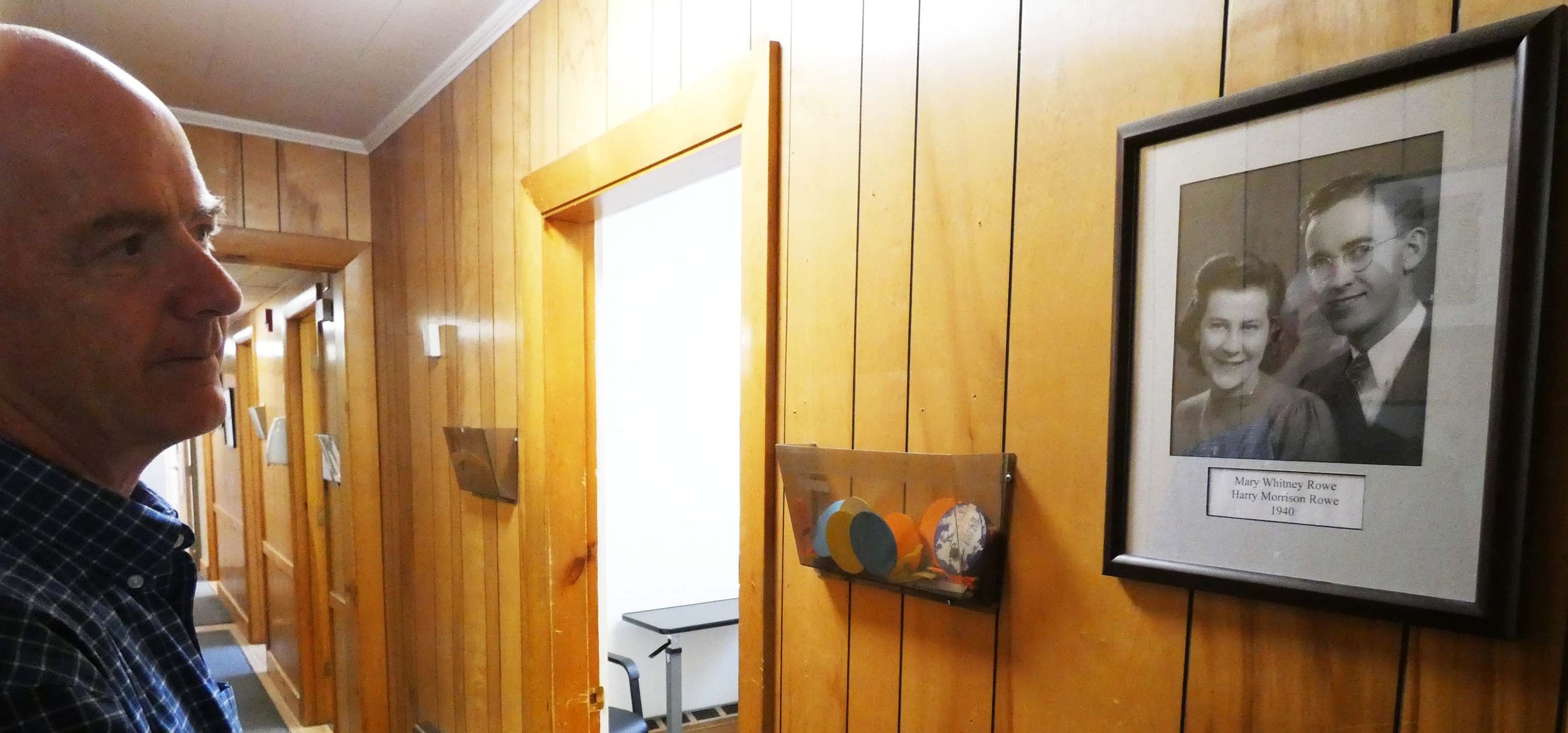
Dr. Stephen Genereaux observes a 1940 photo of Dr. Harry Rowe and his wife, Mary Rowe. The photograph is part of a historic display of photos that is dedicated to the history of the 1946 founding of the Wells River Clinic that is part of the present Little Rivers Health Care organization. The building is on Main Street in Wells River Village. The Bridge Weekly/Bernie Marvin.
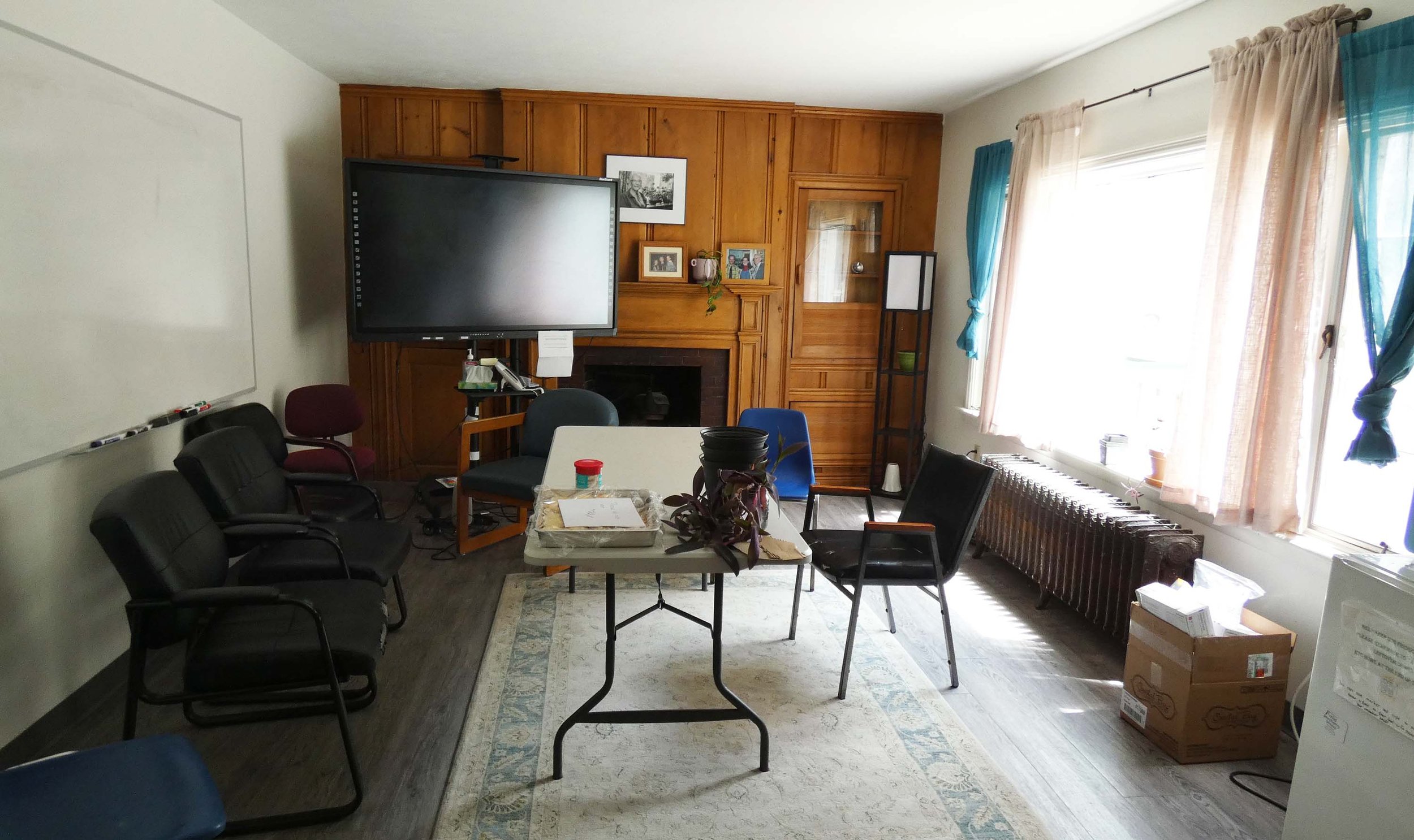
The main living room in the Dr. Harry and Mary Rowe home in Wells River Village as it is seen today. It was preserved when renovations were made to convert the home from a private residence and doctor’s office of the Rowe family to one of the medical buildings of Little Rivers Health Care. Although it is a meeting room, it appears much as it did in 1946 when the Wells River Clinic was founded by Dr. Rowe. The Bridge Weekly/Bernie Marvin
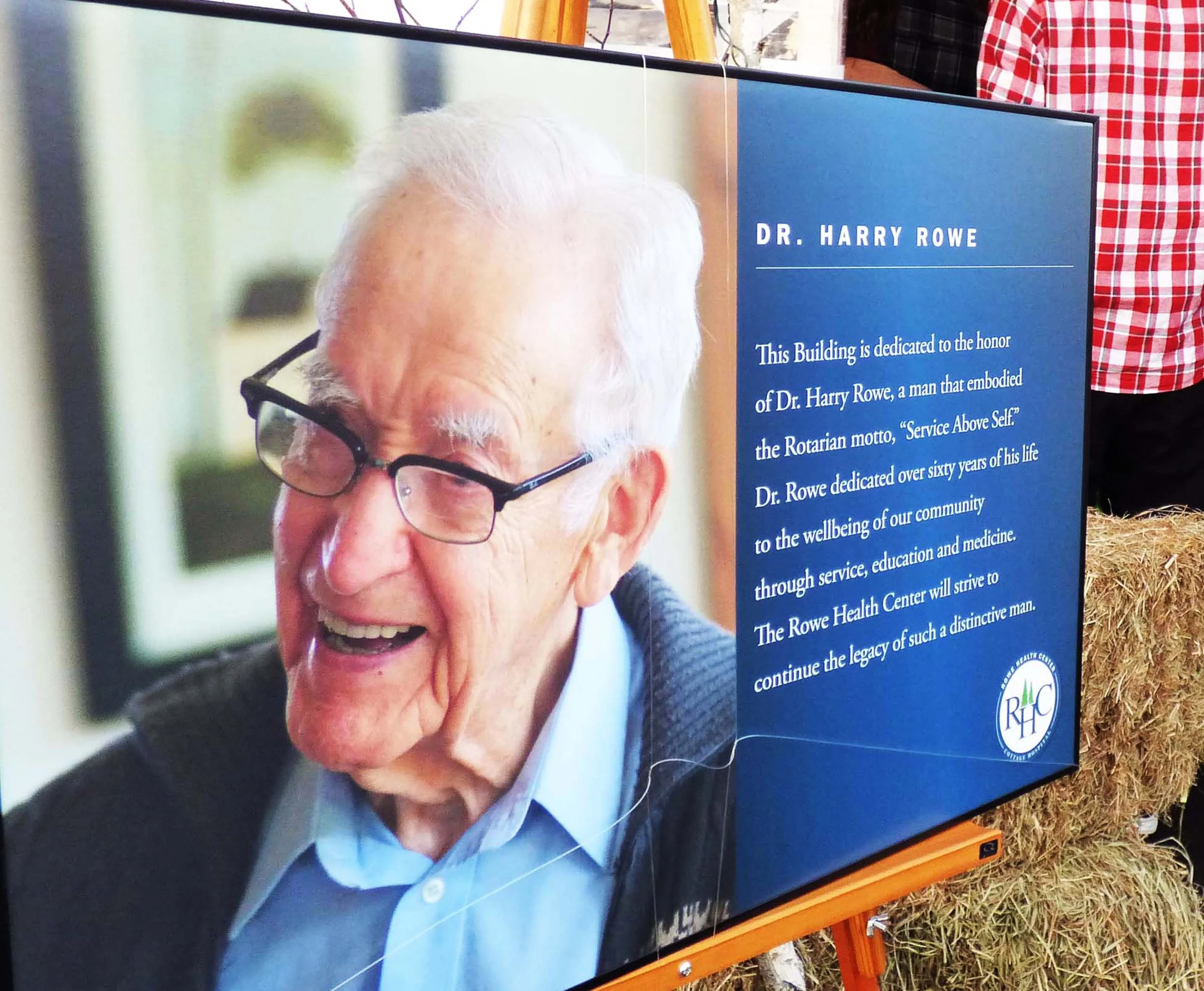
A large poster used during the opening ceremonies of the Rowe Health Center at Cottage Hospital in Woodsville, features the center’s dedication “To the honor of Dr. Harry Rowe, a man who embodied the Rotarian Motto “Service Above Self.” The Bridge Weekly file /Bernie Marvin
On King's Plain, Woodsville High School graduates its 130th Senior Class
Getting to the center of the graduation ceremony, Senior Elijah Vasconcelos stepped to the microphone to offer his high honors speech, his Valedictory Address. He is the Woodsville Valedictorian for the class of 2026. He plans to study aerospace engineering.
By Bernie Marvin
Outstanding weather greeted graduating Seniors, their families and friends for the 130th Woodsville High School graduation, held at the school last Saturday, June 13, 2026. The Bridge Weekly/Bernie Marvin
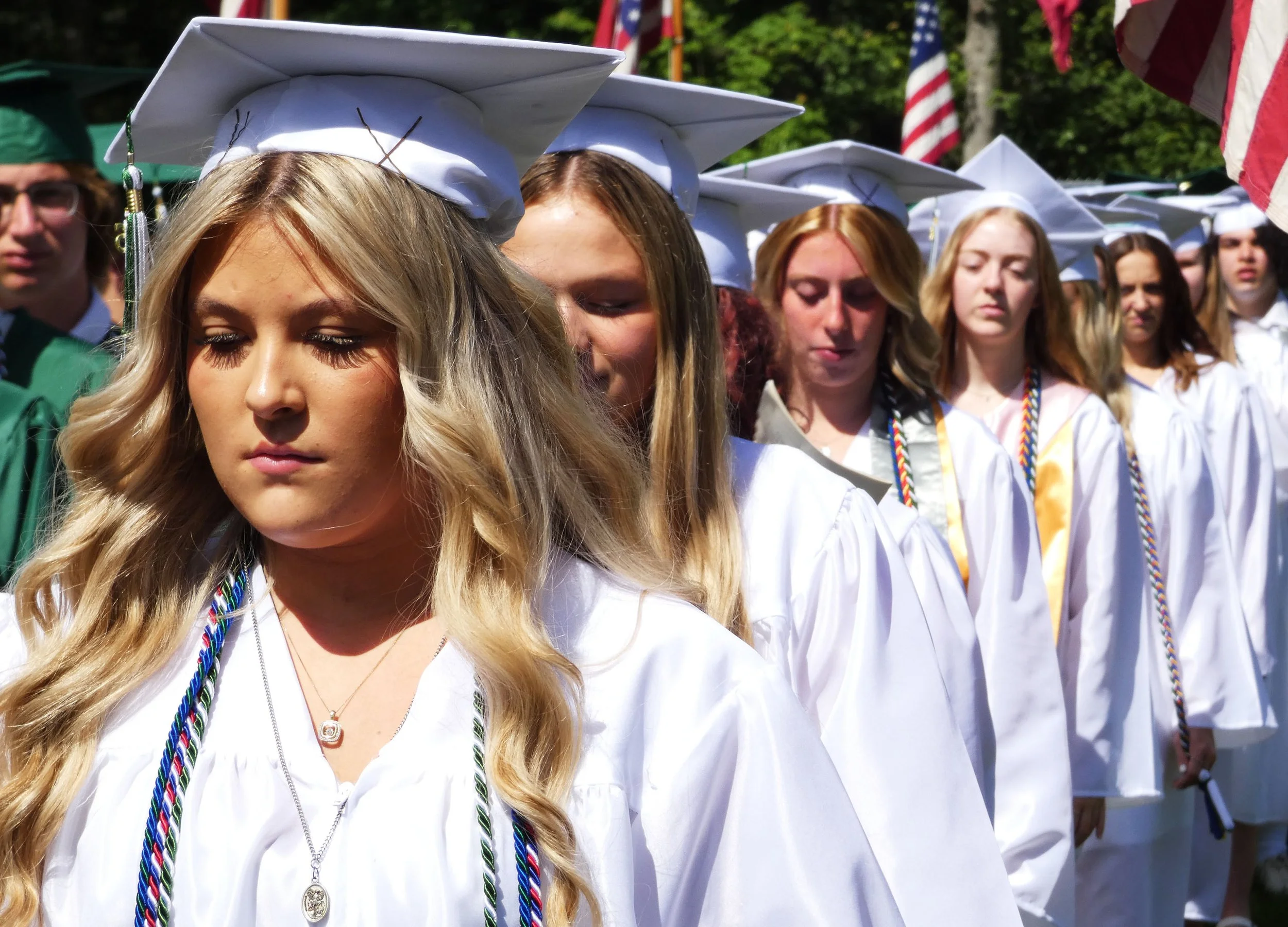
Woodsville, NH – The weather held back its pressing humidity for the special day of June 13, 2026, as the proud class of 50 Woodsville High School graduates under the twin batons of Class Marshals Taydin Glynn and Lincoln Williams stepped off for their short walk down the grassed aisle bedecked with high flying American flags, to the front of the gathering of family and friends assembled on the historic King's Plain.
The opening processional of Elgar's Pomp and Circumstance was rousing, as the WHS Band, under the direction of Music Director Will Wright, provided the musical background of a very well-photographed group of handsome graduates as they paraded downfield to their seats facing the audience, their green and white gowns flowing in the gentle breeze that cooled the field.
The National Anthem followed, with opening remarks being offered by Principal Hayden Coon, a welcome by Katherine Houston. Makayla Walker offered the Salutatory Address. Makayla is officially recognized as the Class of 2026 Salutatorian by earning the second-highest academic ranking in the graduating class. She is a scholar-athlete and was recognized for maintaining elite academic standards while competing on the Woodsville Varsity Basketball team.
Ms. Walker, when thinking about what she was going to write about in her salutatory address, said to her mother, “I don't know." After that, she would follow up with a reminder that the speech would not be something she could just come up with; it would take time and meaningful reflection to anchor it all for the big day.
She said she caught herself returning to a specific novel by a novelist she had read, The Alchemist by Paulo Coelho, a story about a young shepherd boy named Santiago, leaving behind routine and comfort in pursuit of the treasure he has only dreamed about, a treasure hidden far from what is familiar to him. His journey, he said, was driven by courage and the willingness to embrace the unknown.
"In many ways, his journey parallels ours," she said, describing how she encountered uncertainty and learned to adapt when expectations shifted. She closed her speech, “So to my classmates, sometimes uncertainty is thought of as something that needs an answer, ideally immediately. What we have learned, though, and what we will continue to learn, challenge that idea.
Ms. Walker offered, "At the start of Santiago’s journey, he is told, “When you want something, all the universe conspires in helping you achieve it.” On the surface, those words may sound like external forces that always guarantee success. But the universe conspiring is about establishing a clear purpose, developing the eagerness to pursue it, and realizing that the universe will not simply hand out what you ask for. Rather, it will respond to those who are committed enough to pursue their goals.
“So, to my classmates: sometimes uncertainty is thought of as something that needs an answer, ideally immediately. What we have learned though, and what we will continue to learn, challenge that idea. What I want to leave with all of you is simple. Value change. Embrace challenge. Trust your journey. Know that fear is ever-present, but manageable. And remember that what is meant for you WILL find you if you continue to move with intention and persistence. Thank you.”
Getting to the center of the graduation ceremony, Senior Elijah Vasconcelos stepped to the microphone to offer his high honors speech, his Valedictory Address. He is the Woodsville Valedictorian for the class of 2026. He plans to study aerospace engineering.
He said, "As I stand here today, I am reminded of a book I first read in 5th grade, my first year in New Hampshire."
“The Giving Tree by Shel Silverstein is a children’s book about a tree and a boy. The boy climbs the tree's branches, picks its apples, and rests in its shade. As the boy grows older, he keeps returning to the tree to ask for things. He picks its apples to sell, takes its branches to build a house, and cuts down its trunk to build a boat and sail away. In the end, the tree, reduced to a stump, offers its now old and frail friend a place to sit and rest for a while. And the tree was happy.”
“I believe we can all relate to the boy. But our trees don't grow leaves and apples."
"Our trees are the ones who packed our lunches and drove us to school before we could do so ourselves. They are the ones who helped us with our homework until we no longer needed help. They are the ones who showed up to soccer games and concerts without fail sacrificing sleep and time for our benefit, never once asking for recognition."
Valedictorian Vasconselos said that after today, “as we step into a larger world, we are not losing our families. Instead, we are carrying them with us in our work ethic, our resilience and our integrity. They are with us in the way we won’t quit when college gets hard. They are with us in our choice of a career.”
His speech was dedicated to the class families. “To the families of the class of 2026 – especially my own – this accomplishment is as much yours as it is ours. Thank you for being our trees.”
Others recognized as outstanding students from the class of 2026, Third Honors went to Ryan Walker, and fourth honors went to Grace McLellan. The top CTE Student was Dylan Marshall.
WHS Principal Coon and Assistant Principal Matthew Kelly presented scholarship awards to the Class of 2026, followed by the presentation of diplomas to the Class of 2026 by Haverhill Cooperative School Board Chair Sabrina Brown and Michelle Reagan.
The combined Class of 2026 and the WHS Band played and sang the school song, “On King’s Plain.” Graduate Ryan Walker offered the Farewell Address, tassels on the students’ mortarboards were turned, indicating that they were now graduates, not undergraduates.
They queued up and marched off the field to the congratulations, group photography and some gifts from parents and relatives. It was a happy occasion for all.
Class of 2026 Graduates include:
Leon Manuel Alcala, Samuel Milton Aldrich, Trenton James Alling, Isaiha Anderson, Riley Elizabeth Boutin, Thomas Gabriel Boutin, Jada Rose Brill, Jayde Lynn Brown-Colby, Trey Edward Colangelo, Morgan Elizabeth Crocker x, Kiarrali Minerva Cruz, Marion Jefferson Cummins Jr , Gavin Joseph Michael Davidson x, Josephine Iza Drake, Addison Jane Eck +x, Riley Marshall Emmerton x, Alyssia Maria Fenn x, Mason Lance Furyes, Felix Demetrio Garcia +, Eyrleigh Sedona Hambrick + x,. Katherine Ellen Houston x, Justin Sean Hutchins, Caleb David Ilsley, Kaleb Joseph Johnson, Cowan Peter Kimball x, Korina Lynne L’Heureux, Gavin Frederick Lakin, Dylan James Marshall +^ x, Taylor Ann McFarland, Grace Mae McLellan ^ x, Anthony Michael Mencia, Madison Leighann Monterosso, Savannah Marie Murray, Ethan Jacob Nalette, Wyatt Christopher Perkins, Michael Patrick Plachetzki , Gabriel Fernand Roy x, Jillian Iona Roy x, Kody Nickolas Sherman, Collin Michael Smith, Jaden Robert Ste. Marie, Shubh Ashishkumar Suthar , Ciarra Jasmine Therrien, Cassidy Ann Thompson , Calvin Staszek Tice, Elijah Roy Vasconcelos ^ x, Makayla Lyn Walker ^ x, Ryan Douglas Walker ^ x, Shawn Gavin Walker, Jameson Stephen Willard.
Key to Honors
*National Honor Society Members, ^ Magna Cum Laude, +National Vocational Technical Honor Society Members, +^Magna Cum Laude for RBCTC, x NH State Pin - Graduate met the requirement for an “Academic Diploma with Distinction.”

A panoramic view of Woodsville High School’s 130th graduation held Saturday, June 13, 2026. The weather was gorgeous as were the 50 graduates who marched in to receive awards and diplomas at the impressive ceremony. The Bridge Weekly/Bernie Marvin
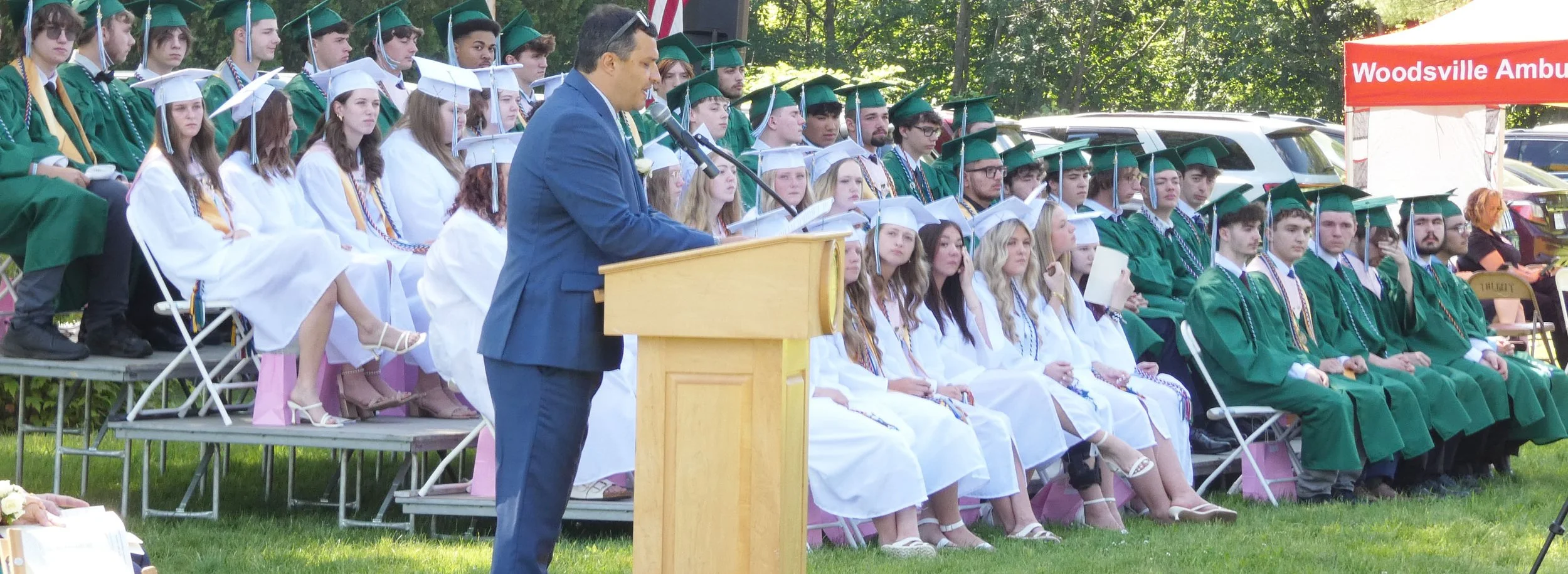
Woodsville High School Principal Hayden Coon gave his opening remarks that began the 130th ceremony for the graduating class last Saturday, June 13, 2026. The Bridge Weekly/Bernie Marvin
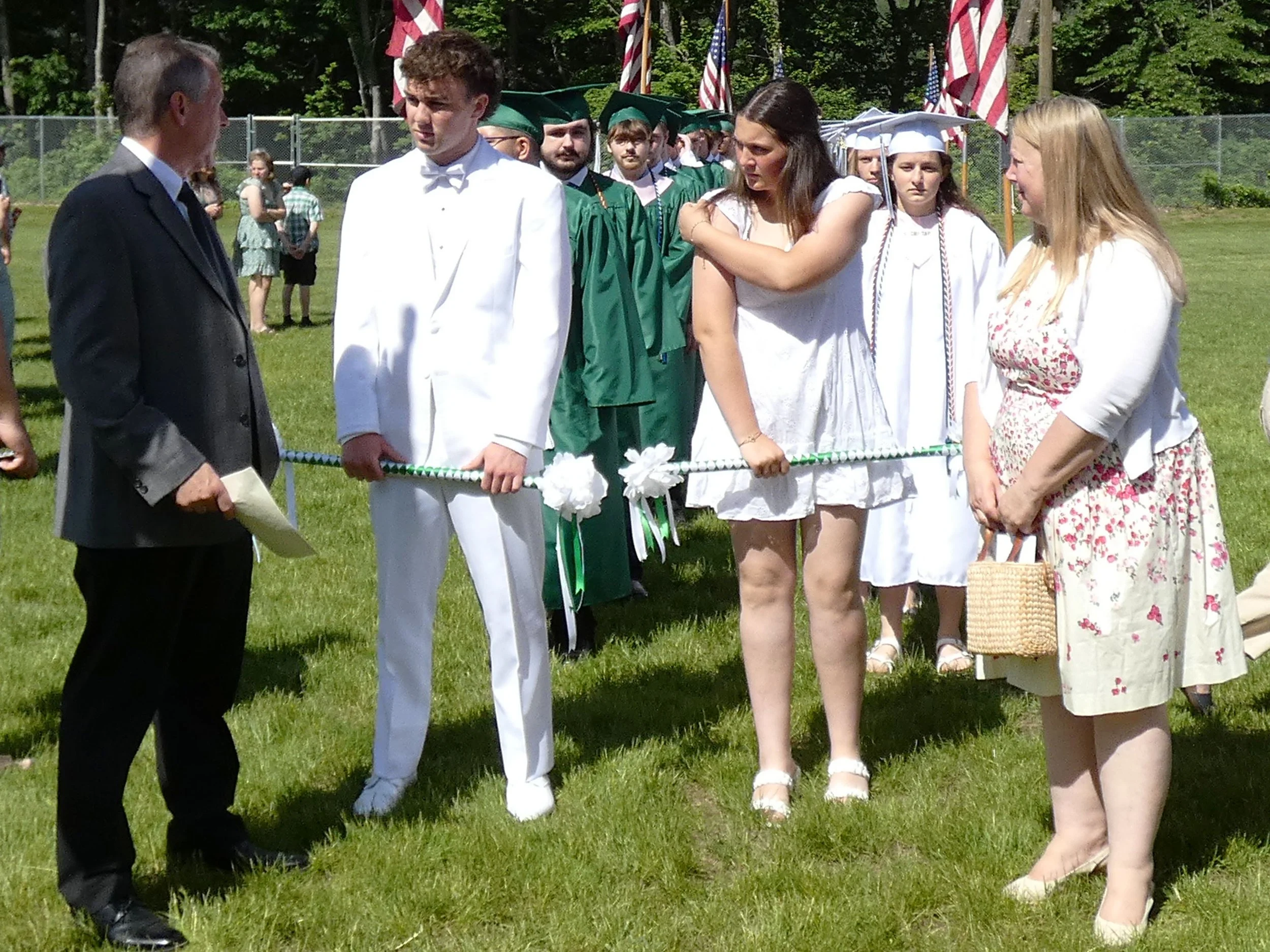
Queued up and ready to march into their graduation ceremony on Saturday morning, June 13, 2026, is the Class of 2026. Seen left to right are Class Advisor Robert Scianna, Class Marshals Lincoln Williams and Taydin Glynn, with Class Advisor Jodi Maccini. The Bridge Weekly/Bernie Marvin
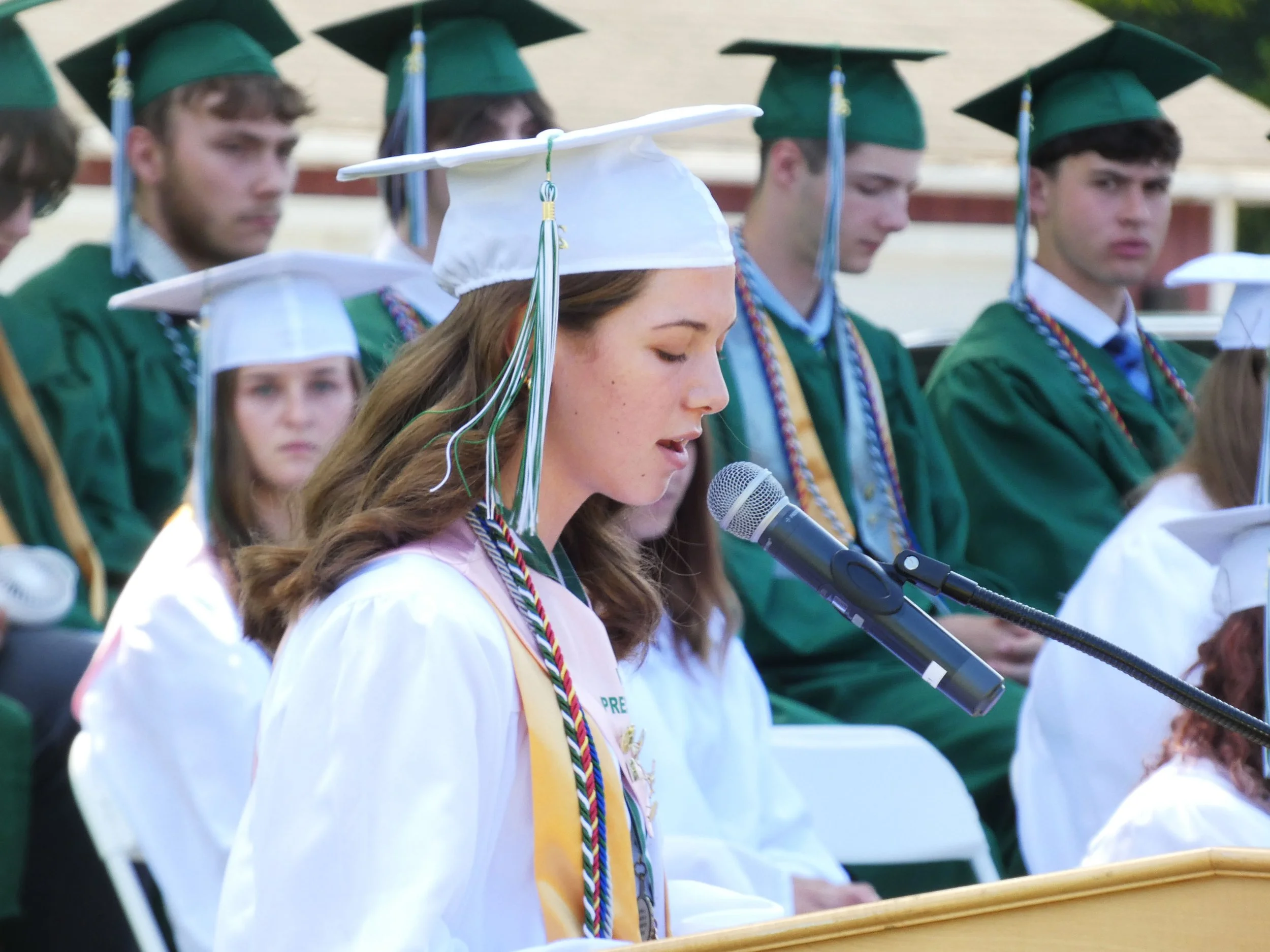
Woodsville High School graduating Senior Katherine Houston offers her welcome during the graduation ceremony held at the high school last Saturday, June 13, 2026. The Bridge Weekly/Bernie Marvin.
Piermont student water testing performed for traces of manganese
The alert was set off several years ago by a social media comment noting that a medical professional in Warren had begun a study of the possible high incidence of cancer among some residents living along Route 25C and 25 from the Piermont area over Ore Hill and into Warren.
By Bernie Marvin
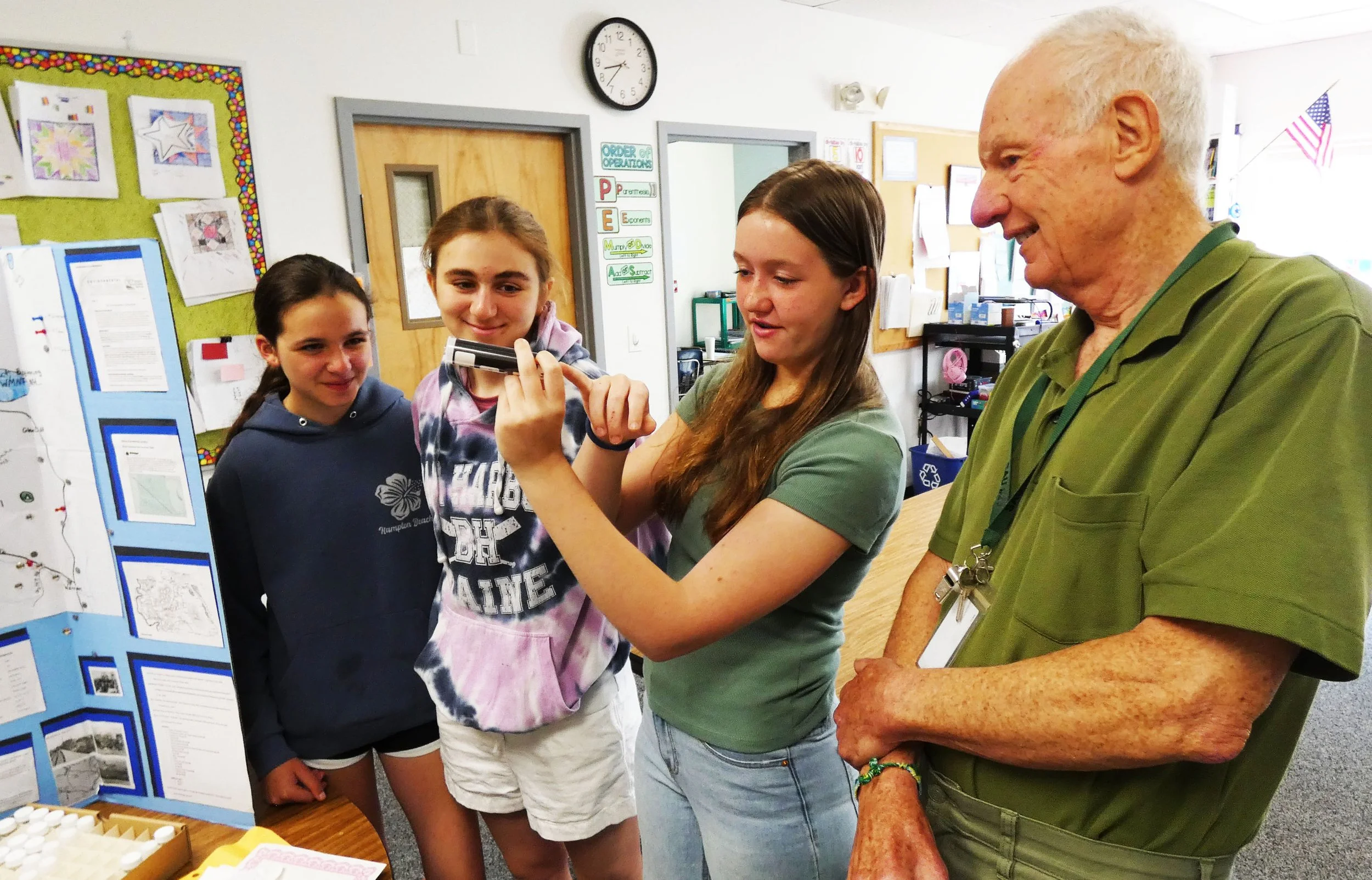
Piermont Village School students, left to right, Sam Hogan, Isabelle Spooner and Kate Donnelly show Science Teacher Geoff Ashworth how they measured water samples from properties in the Haverhill, Piermont and Warren areas for manganese content. Those results were used by the students as the subject of a New Hampshire Middle school Science Fair exhibit held last month at the New Hampshire Technical Institute. Samples from two locations in Warren revealed there were .3 parts per million of manganese in the water. Residents of those two locations were notified of the findings. The Bridge Weekly/Bernie Marvin.
Piermont, NH – A group of science class students and their teacher from the Piermont Village School recently tested several groundwater and well sites along Route 25C between Piermont and Warren, and along sections of Route 10 and 25 in Haverhill, a large area where mining was once conducted. They were concerned about the presence of manganese in the area's water sources, which could have been released when the mines were abandoned many years ago.
Piermont Science Teacher Dr. Geoffrey Ashworth, who has been at the Piermont Village School for six years, and three students, Kate Donnelly, Isabelle Spooner, and Sam Hogan, were alerted to the possible presence of harmful chemicals in the water being consumed by residents in the three towns, where, between them, lies Ore Hill, the site of a large mining operation many years ago.
The alert was set off several years ago by a social media comment noting that a medical professional in Warren had begun a study of the possible high incidence of cancer among some residents living along Route 25C and 25 from the Piermont area over Ore Hill and into Warren.
Mining on Ore Hill many years ago, the writer indicated, could have been the culprit behind contaminated drinking water caused by poor excavation practices in the area. With that in mind, the three Piermont students spoke with Dr. Ashworth about conducting some research into the possible presence of manganese in the water.
At the same time, plans were being made for the school to have a presence at the New Hampshire Middle School Science Fair at the Technical Institute in Concord on May 21, 2026. They decided that studying the harmful chemical would be a strong topic for their Science Fair project.
Dr. Ashworth told The Bridge Weekly in a recent interview at the school that water from areas where students lived was tested. Scientific research testing equipment was purchased by the school, with other supplies being donated to the experimenters by the New Hampshire Academy of Science at the Crossroads Academy in Lyme.
He said the sample bottles they received were placed with the families, and water testing samples were drawn. He said the group was pleased that there was little manganese present across the entire range of properties tested and that only two homes in Warren were found to have more than a trace amount of manganese, measured at the .3 parts per million limit. The families were notified of the chemical's presence by the school, Dr. Ashworth said.
He noted that he would recommend that the two residences where manganese was found have a full water test conducted by the state to determine whether there are more chemicals in the water beyond a trace of manganese.
Dr. Ashworth said that student Sam Hogan came up with the idea to do the water testing program. The group talked about how they would perform the testing and find the results for each water sample submitted by the residents in the three-town area that was being tested. The information about the water testing program was presented graphically on a large cardboard sheet and displayed in the science fair exhibit.
At each test site, a tap or well water sample was gathered. The group found only two samples from the Route 25 area that measured manganese at 3 parts per million. The testing program remained blind throughout, with the sample bottles being numbered. Dr. Ashworth said the samples were tested for color depth, which corresponded to the manganese percentage in each sample.
That would determine just how much manganese was contained in the water sample. Dr. Ashworth said he and the three students traveled to the May 21 science fair, where there were 60 or more exhibits being judged. He said the judges' comments to the Piermont team were superb; they received high ratings, but unfortunately, they took home no awards.
The students and Dr. Ashworth figured that their experiment, which was presented at the fair, was probably too well done for that particular science fair. They agreed that what they had done in sampling and gathering the information was "reaL science." He said they feel good about what they did and that their science project, presented at the fair, was well done.
He said that next year Kate will move on to the ninth grade, Sam and Isabelle will be eighth graders, and he is looking forward to another great science fair exhibit. He said the students should be proud of what they did. "Real science with real people, and they got real science results," he said.
The state guidelines for manganese are set at 0.3 on the scale, and they found two cases of local water exceeding that level. "That's real science," Dr. Ashcroft said.
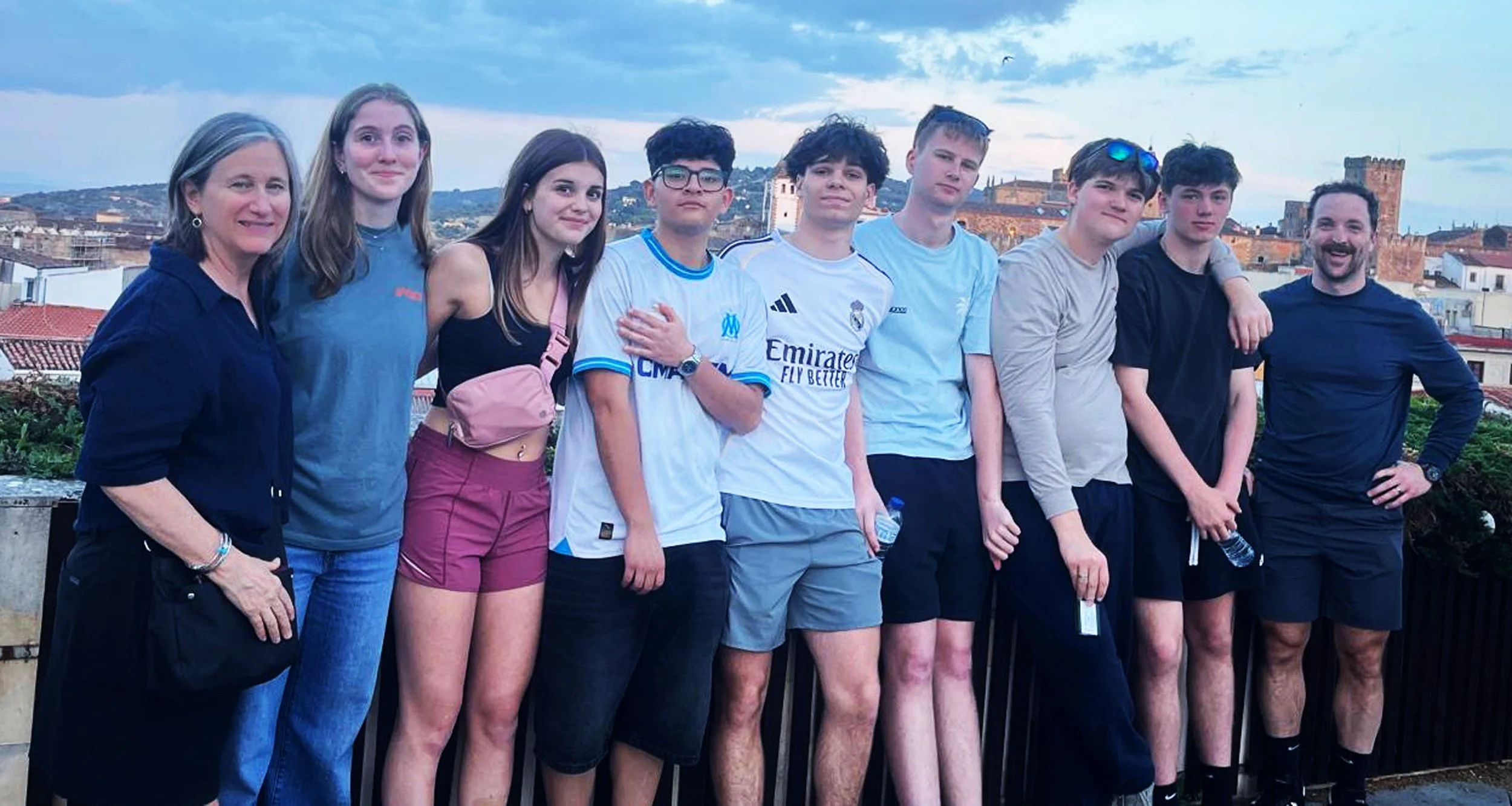
A Unique Rivendell Overseas EducationProgram Takes Students To Spain This Year
The program at Rivendell continues to be a deep-rooted part of the Orford school that has allowed those who have been a part of this travel program to be immersed in the cultural make-up of the population they meet through their own eyes, their experiences with those people, and to be part of a well-managed, safe adventure that develops an intellectual curiosity about what is going on beyond our shores.
By Bernie Marvin
While in Spain for their April 2026 trip, students and staff included, left to right Rivendell Academy Principal Patricia Rella with students Lily Murray, Lindsey O'Hearn, Alessio Stefanelli, Wyatt Parker, Evan Woodward, Nolan Bourn, Nathaniel Daisey and Rivendell Counselor Jeffrey Eckert. Courtesy photo
Orford, NH - Worldwide school curriculum travel experiences for French and Spanish classes at Rivendell Academy are more than a tourist-level plane trip to Europe to try out a grande assiette or piatto plano of spicy food or read a museum's descriptive four-color brochure about an art display in Madrid or Paris.
For the participating students at Rivendell, the overseas learning program at this school provides early awareness of other people around the world and how they live. These foreign trips might also inspire Rivendell students to pursue further study of what they have experienced on their travels, and to realize that their early pursuit of excellence might last a lifetime.
The program at Rivendell continues to be a deep-rooted part of the Orford school that has allowed those who have been a part of this travel program to be immersed in the cultural make-up of the population they meet through their own eyes, their experiences with those people, and to be part of a well-managed, safe adventure that develops an intellectual curiosity about what is going on beyond our shores.
The foreign travel program is but one of the many great ways for the kids to study social structures, political profiles, or intellectual curiosities of those they meet while overseas. Rivendell Academy has a superb foreign travel program for French and Spanish students. This very active and popular program has been running for several years, with each language class taking a trip every other year.
Last year, it was the students' turn for the French trip, and this April, during an extended school break, seven students traveled to Spain and spent 11 days immersed in this program, a well-known Rivendell favorite for a long time.
The Spanish class has been an important part of this long-standing international exchange and study program. This year's group included Rivendell Principal Patricia Rella and Counselor Jeff Eckert, who traveled with students Wyatt Parker, Nathanial Daisey, Lily Murray, Lindsey O'Hearn, Evan Woodward, Nolan Bourne, and Allesandro Stefanelli.
Comments from staff and students involved with both last year's French class and this year's Spanish class indicate that the educational trips are as popular as ever and are among the most important parts of the participants' educational and life experiences at Rivendell, they reported.
The school information catalog outlines travel opportunities, noting they are a "robust program of regional, national, and international travel," that includes the long-standing exchange program with a school in France, immersive language and culture-focused trips to Latin America and Spain, and long-distance bicycling trips to nearby places such as Quebec City and Lake Champlain.
According to those who have been on these trips (The Bridge Weekly interviewed some of them over the past two years), the fundraising requirements can be fun but demanding. Preparation for overseas trips is a huge responsibility for individual students and families, who must raise at least $4,000 per family for the travel package.
The foreign travel programs show how well the school manages activities with students and their families. The trips receive rave reviews from the kids, parents, staff, and others who accompany them on these adventurous learning trips.
Although they were serious about their travels around Spain for those 11 days in April, they still had time to talk about what they saw and enjoyed while in the country. Two of the seven students The Bridge Weekly spoke with this year both commented on their seven-hour plane trips, saying they were long but not too difficult, and they would do it again if the opportunity came around.
They said they enjoyed the Spanish food they had, but after a few days, it became repetitive. One student mentioned he liked going back to American food, "something I am used to," he offered. They enjoyed seafood; there was a lot of it, like seafood paella, usually made with clams, shrimp, calamari, and a rich base of tomatoes, herbs, and other meats.
A big assist for the trip was that Principal Rella had lived in Spain for over three years and knew places the group could visit that were educational and safe. She knew about the motels and hotels that were clean, safe, and reasonably priced. With that prior knowledge from having lived there, Principal Rella built an itinerary for the Rivendell group to follow for this year's trip.
She noted that many parts of the trip were immersive, giving students opportunities to live with Spanish residents in the area whom Principal Rella knew and was familiar with. She said she tried to arrange visits to places she knew and to places where Spanish people she knew lived or worked.
Those folks joined them so the Rivendell group could be around real Spanish people, and it wasn't just a tourist thing. "For most of our trip in Spain, we had a Spanish person with us," Ms. Rella said.
Back in 2001, during the September 11 terrorist attacks on America, the overseas trip was intended to have the Rivendell group stay in homes for the duration of the trip. When the terrorists struck, all planes in the air were ordered to land at the nearest airport immediately. The plane carrying the Rivendell class members was over the Atlantic Ocean, heading east to Europe. It turned around and headed back to the United States.
Rivendell Counselor Eckert told The Bridge Weekly that when the students, he, and Principal Rella returned to their school and classrooms, it was always a "tricky thing" to keep track of a group of high school kids while they were in their care. He said they are very active and want to "explore everything."
He said during the trip, the chaperones have to act like parents and make sure no one gets lost. They traveled to cities such as Toledo and Madrid and found the smaller places safer to travel with young people, and as the trip progressed, the kids gained more freedom.
There were nightly phone calls between Spain and America as the travelers kept their parents up to date on their day's activities. No pen pals were resulting from the trip, and post cards were sent to parents and friends.
Counselor Eckert sent a postcard from Spain to his mother-in-law and was informed that it took an entire month to reach its destination, and it was reported that the group came back with some souvenirs. photos and lots of sweets for families.
Principal Rella said that the trip members will submit a report on their program to the school board soon. Eleven days is a long time to be away, but it was enough time for the kids to see the vast differences in how Spanish people live compared to the American kids.
Interesting, too, for the American visitors: in Spain, they noted that no family or school students they met worked any afternoon or summer job. They also don’t begin a work schedule until after their college years are completed, something they will probably be discussing with their parents and the school board.
Rivendell Principal Rella, who had considerable input on the trip and who was also one of two chaperones, said in her statement: "The trip to Spain was intentionally designed as a true cultural and language immersion experience. I wanted students to move beyond tourism and engage authentically with the people, language, customs, and rhythms of daily life in Spain. One of the most valuable aspects of the trip was having a local Spanish guide and community member with us for much of the journey. Their perspective, language support, and help navigating local culture gave our group a deeper and more meaningful experience.
"What impressed me most was how fully the students embraced the opportunity. They were open-minded, flexible, and collaborative. They tried new foods, adapted to the later Spanish schedule, navigated unfamiliar situations with maturity, and consistently supported one another. Watching students step outside of their comfort zones and rise to the challenge was incredibly rewarding. The experience reinforced the value of travel as an educational opportunity that builds independence, cultural understanding, communication skills, and confidence in ways that are difficult to replicate in a classroom. The Rivendell community places high value on international travel, and the resources invested are well worth it!
In his follow-up comments on the trip, where he also served as a chaperone, Rivendell School Counselor Eckert told The Bridge Weekly:
“Experiential learning is my favorite way to educate students. Yes, we saw beautiful sights and ate incredible food. It sounds like a vacation, and it was in some ways. However, I saw each student grow and change in a way that we cannot replicate in school. When students are on a trip-- whether it is in the mountains on an outing club trip or in Spain-- they are intrinsically motivated. They really want to be there. But the real world does not adapt to their needs. The students have to adapt. They have to deal with a different language, time zone, bed to sleep in, food to eat, and more. The kids rose to the challenge, and I was so impressed with their growth in maturity and independence!”
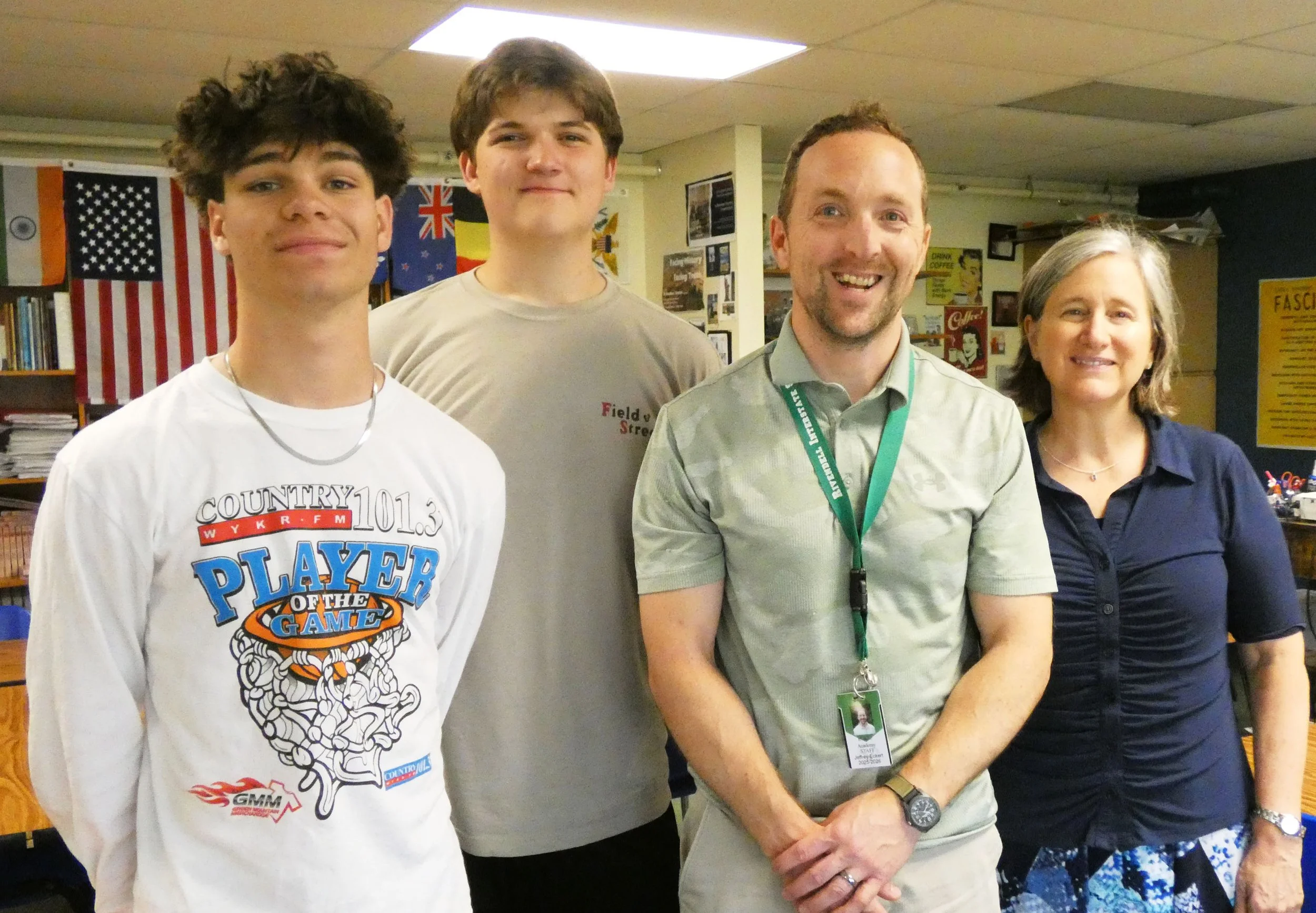
Rivendell Academy staff and students interviewed for the Bridge Weekly story on their Spanish Class trip included, left to right, students Wyatt Parker and Nathaniel Daisey with Rivendell School Counselor Jeffrey Eckert and Rivendell Principal Patricia Rella. The Bridge Weekly/Bernie Marvin.
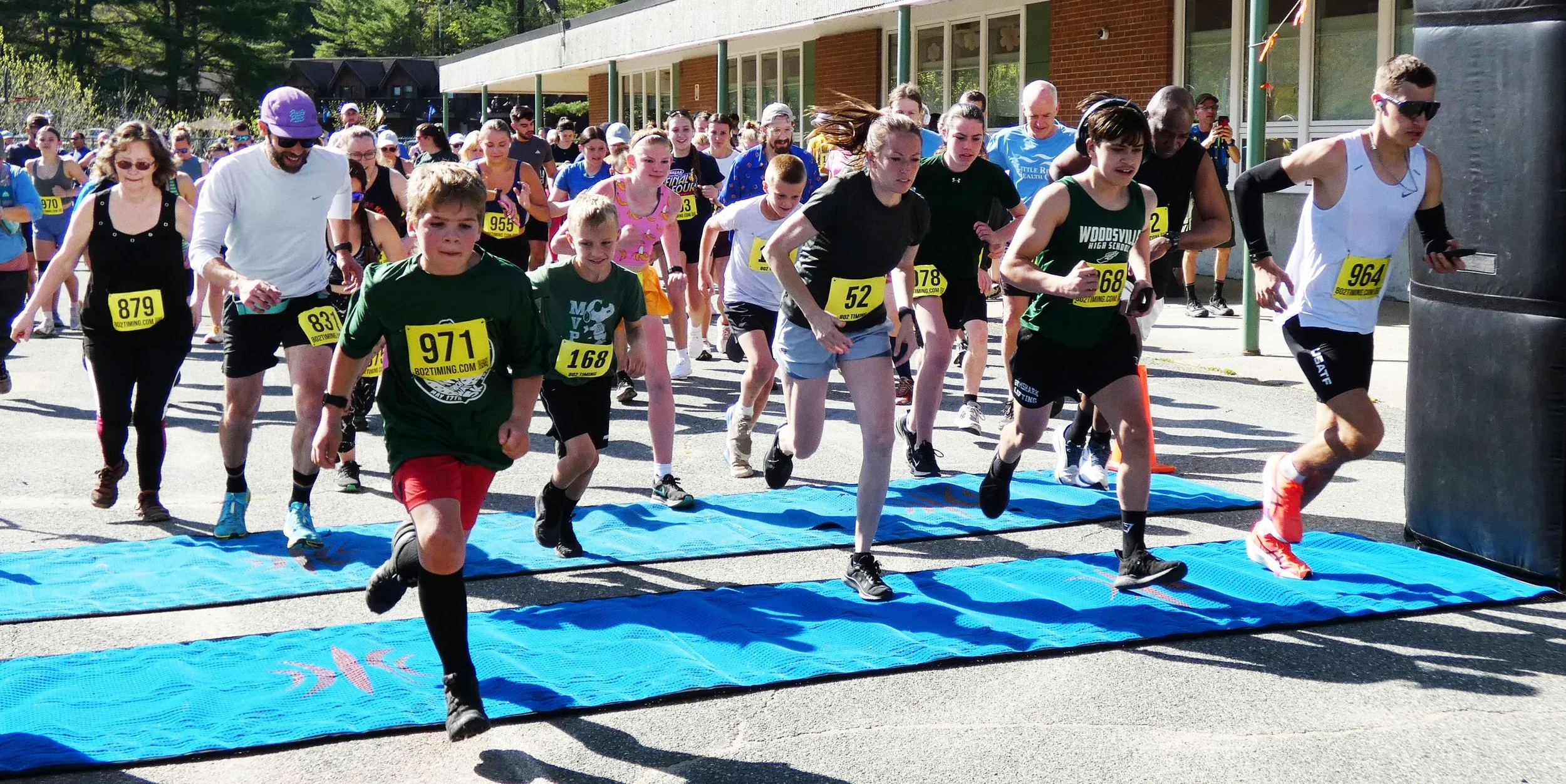
Cottage Hospital “Any Which Way” Event Fields 70 Runners
With nearly 70 participants in the 5K event, many other families of walkers lined up at the 802 Timing Company’s start line at 9 AM to hear Jakub Kubkowski’s air horn signal the start of the event, which took runners and walkers through the quiet morning streets of Woodsville.
By Bernie Marvin
They’re off and running the Cottage Hospital Any Which Way Walk and Run 5K race that began at the Woodsville Elementary School and wound its way through Woodsville streets last Sunday morning, May 17, 2026. The Bridge Weekly/Bernie Marvin
Woodsville, NH - The 6th Annual Cottage Hospital Any Which Way 5K Run and Walk was greeted early last Sunday morning, May 17, 2026, by a warm sun and clear skies, much to the event organizers’ approval after a stretch of drizzly, below seasonal temperatures.
With nearly 70 participants in the 5K event, many other families of walkers lined up at the 802 Timing Company’s start line at 9 AM to hear Jakub Kubkowski’s air horn signal the start of the event, which took runners and walkers through the quiet morning streets of Woodsville.
There were some good times logged this year. Liam Genereaux, age 31, paced his run that brought him over the finish line at just 19:22, followed by Jake Danis, age 16, at 19:24; Matt Cote, age 36, at 20:02; Jason Chester, age 44, with 20:56, and the top female runner, Christa Ferguson, age 36, at 21:15.
Other top females included Rylynn Hambrick, age 14, at 22:11; and Rachel Stanton, age 39, at 24:07. Top male runners included W. Lang, age 9, at 26:00; B Sawyer, age 12, at 28:04 and P Hunter, age 12, at 28:08.
In a course-side interview prior to the race, Cottage Hospital CEO Holly McCormack told The Bridge Weekly that this, the 6th year of the event, saw a very robust sign-up with quality runners from throughout the North Country and beyond.
She said Cottage Hospital, an independent hospital and one of just two in the North Country, has had a good year, with successful job recruiting and popular hospital programs.
She said the race is a fundraiser for Cottage Hospital’s Operating Room renovations, an ongoing project that also promotes local wellness initiatives while providing important funding for several infrastructure programs planned throughout the hospital.
Ms. McCormack said this is the sixth race she has entered during her years as Chief Operating Officer at the hospital. She said that as she looks around the sea of runners and walkers, she recognizes many faithful participants who have also attended every event each year.
The race this year, as it has for many years, kicked off from behind the Woodsville Elementary School, where there has always been ample parking for the event in front or behind the building at the junction of Routes 10 and 302.
The timed event got underway at 9:00 AM sharp for runners, and the family walkers followed that group The route is 3.1 miles long and includes several interior Woodville roads and streets, ending about 20 minutes later at the finish line located at the rear of the Woodsville Elementary School playground.
Several strong local organizations assist in sponsoring this event. Companies and groups such as DJ Kev’s DJ Service, WYKR Radio 101.3 FM, the Cottage Hospital Auxiliary, The Brick Store, Northcountry Healthcare, and many others.
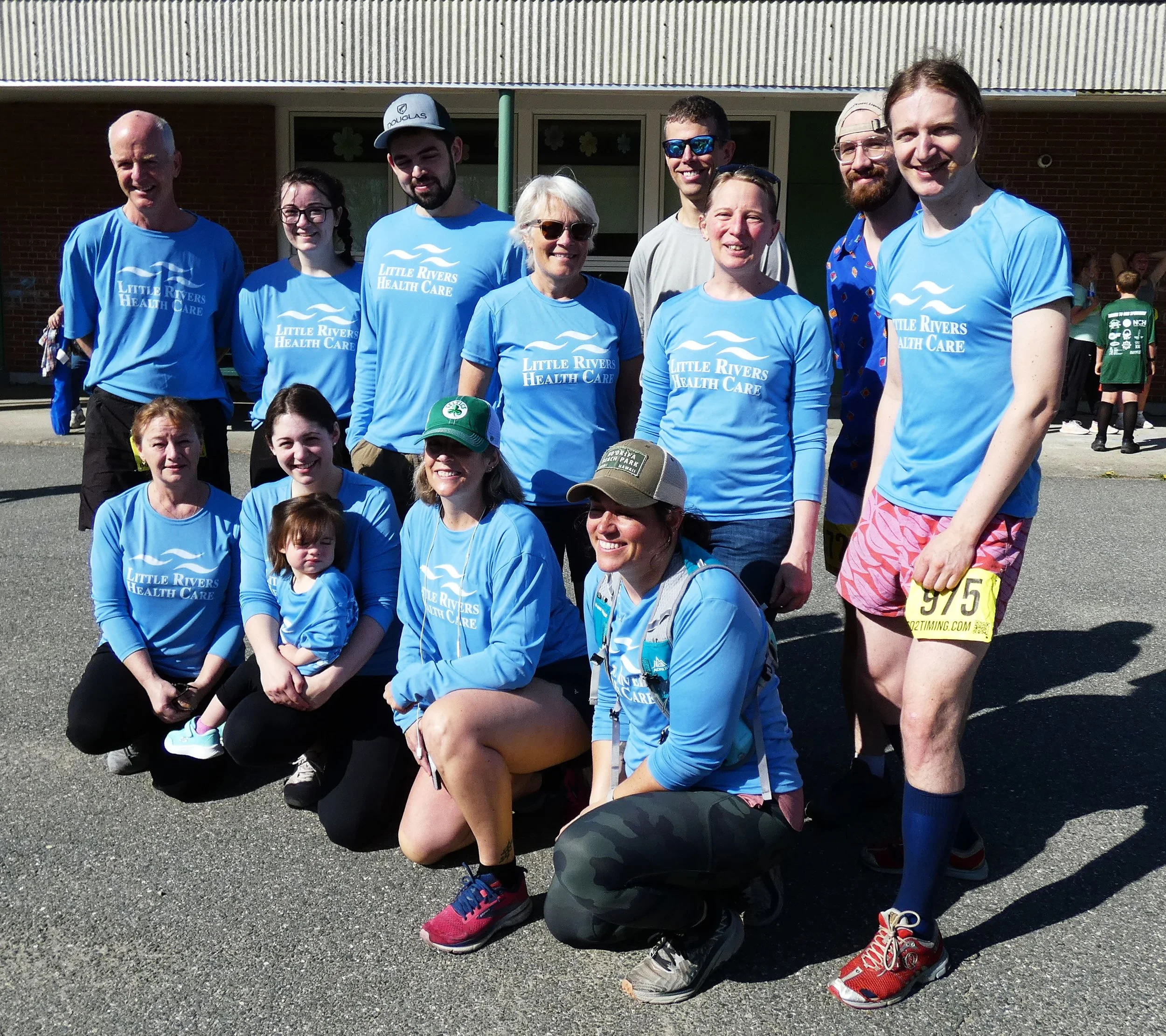
Running in the recent Cottage Hospital Any Which Way 5K run & Walk were these participants from Little Rivers Health Care; kneeling, left to right are Jackie Gilmour, Rebecca Partington holding Raelynn Partington, Lisa Pearson and Amanda Regis. Standing, left to right are Dr. Stephen Genereaux, Bri Aila, Brandon Partington, Dr. Fay Homan, Tracy Thompson, Liam Genereaux, Rick Evans, Owen Davies (standing behind Tracy and Liam.) The Bridge Weekly/Bernie Marvin
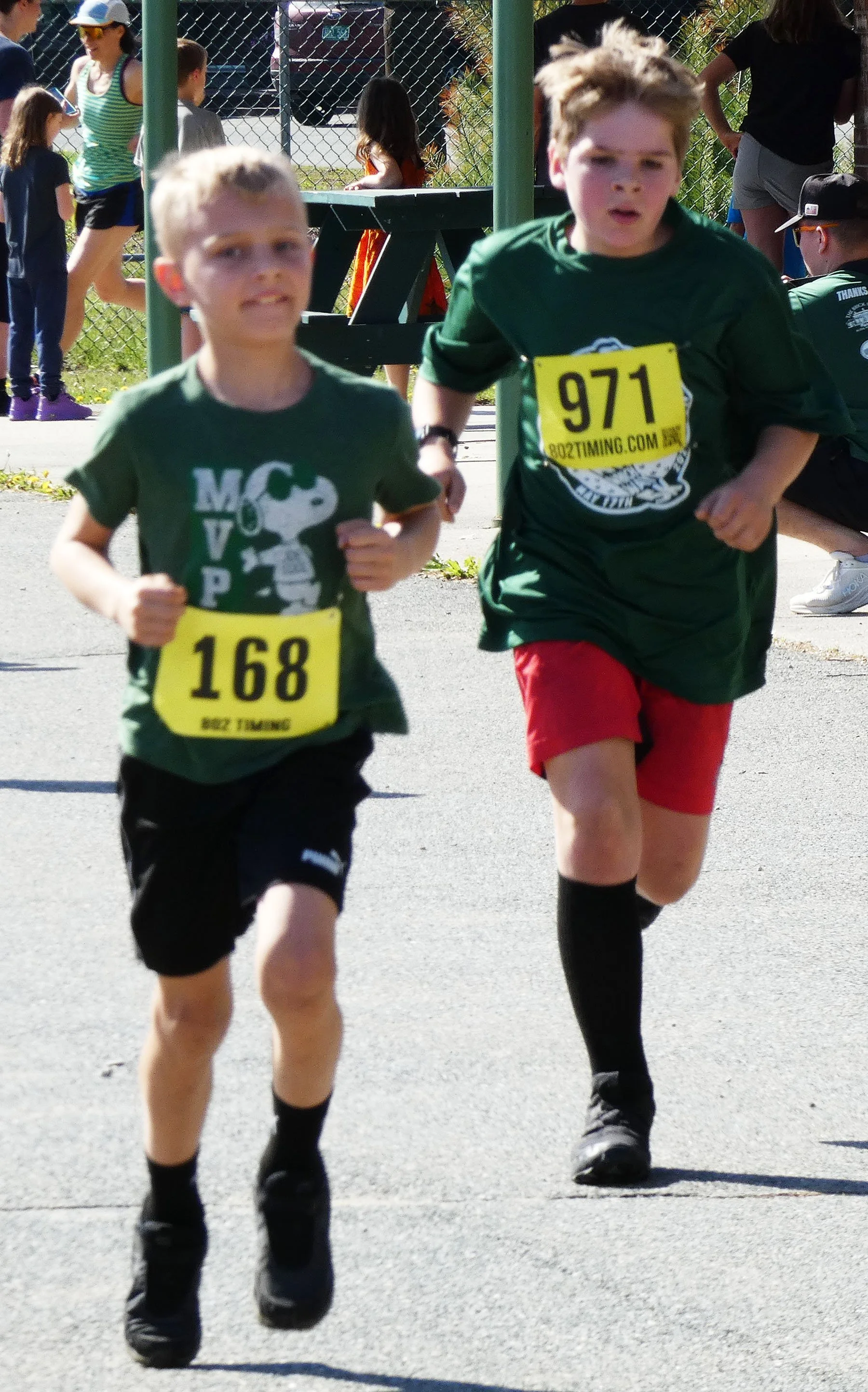
Left to right are W. Lang and A. Roy as they run the 5K Any Which Way event sponsored by Cottage Hospital last weekend. The Bridge Weekly/Bernie Marvin.
Cottage Hospital CEO Holly McCormack at the finish of her 5K race last weekend in Woodsville. Holly has run every one of the six 5K races the hospital has produced. The Bridge Weekly/Bernie Marvin
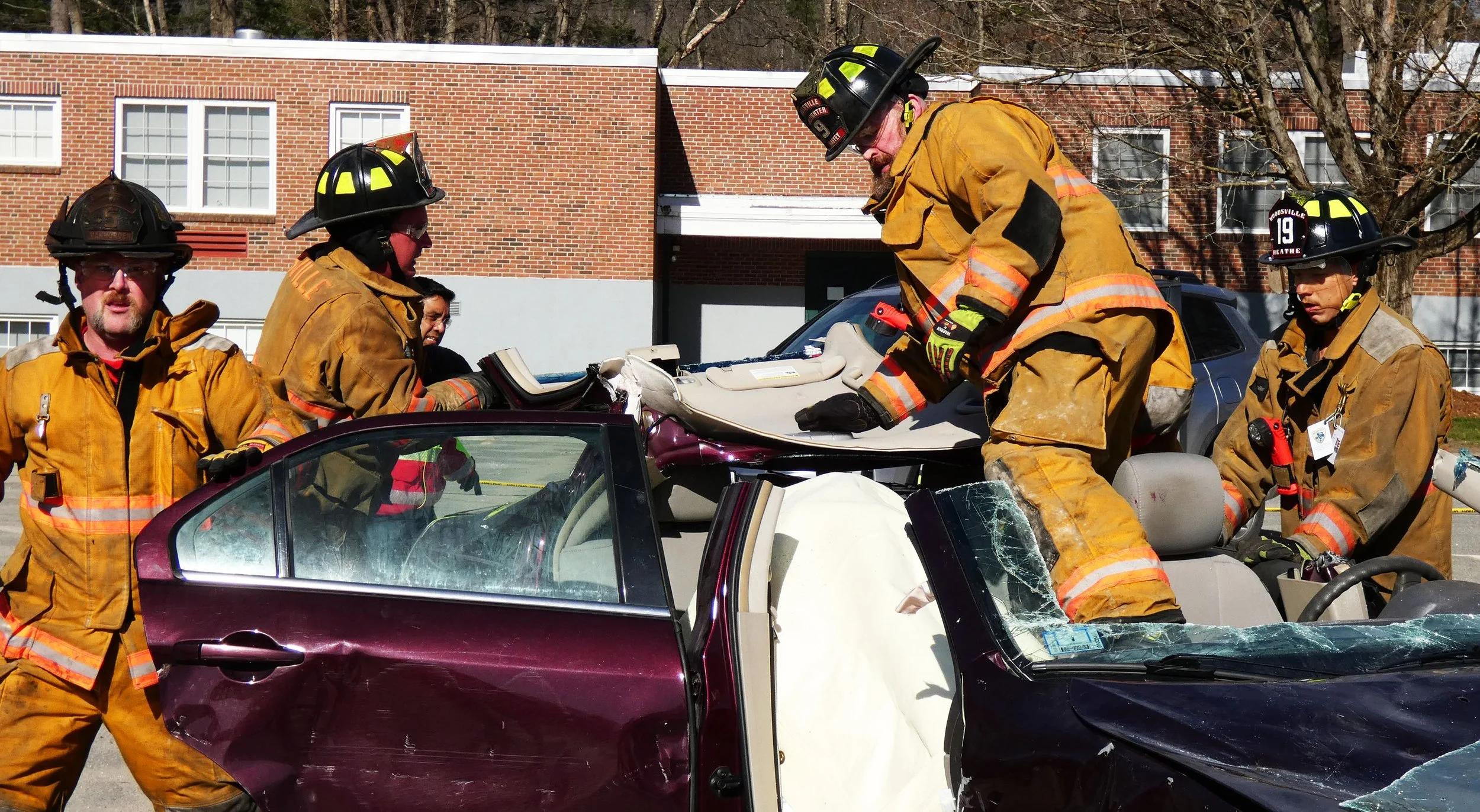
Talent and hard work make the WHS Three-Day CRASH effort sadly realistic
In the mayhem playing out before more than 200 people, who included students, staff, parents, and members of the public, watched and commented on the work being done close to the observers' view. The action going on was described over the school's sound system by long-time medical responder and Emergency Medical Technician Richard Guy.
By Bernie Marvin
Woodsville, NH – A three-day project produced last week by many dedicated people from around the area ended up as a life-like experience with a death-like result located adjacent to the Woodsville High School parking lot.
With superb play-acting right from the early morning opening scene, wailing sirens from responding emergency vehicles to an indescribably wild scene of two mangled vehicles, an assortment of emergency vehicles, medical personnel, and rescue responders poured onto the tarmac of Woodsville High School parking lot to go to work and hopefully save a life and reduce suffering of other souls involved in the madness of a seriously bad mock motor vehicle crash. The entire scenario was planned, set up, and executed with the same seriousness as a real crash.
In the mayhem playing out before more than 200 people, who included students, staff, parents, and members of the public, watched and commented on the work being done close to the observers' view. The action going on was described over the school's sound system by long-time medical responder and Emergency Medical Technician Richard Guy.
I can't count on both hands and feet times two the number of years EMT Guy has been at the scene of the Woodsville High School mock crash scenes from the past, but I know my first experience with this type of program was in the early 1980's, and he was there at the locus of the accident set-up for that school project at the old Butson's Supermarket parking lot.
That means that Mr. Guy and others of the Woodsville Fire Department and medical team have been doing this for a long time and have lots of experience with both the actual, fatal crash scenes and the fake crash scenes, like this one, as well.
Injured passengers in varying degrees of moulage (mock accident injury applications) in each crash vehicle were high school students who included Trent Alling, who was deceased as a result of his injuries, along with others who were injured, including Grace McLellan, Katie Houston, and Makayla Walker.
In the second involved vehicle, students suffering immensely realistic moulage injuries included Taylor McFarland, Maddie Monterosso, Jill Roy, and Eyrleigh Hambrick.
Woodsville Fire and Medical units arrived on scene at 8:30 sharp on the first day of the three-day program. The injured were cut loose from the wreckage and transported to Cottage Hospital by ambulance. The deceased student driver was transported from the scene in a Ricker Funeral Home hearse. Ensuring that proper legal requirements were intact, the Medical Examiner, in a role played by Haverhill Recreation Director Sherri Sargent, was on the scene.
Also, on scene for the one-hour action staging was Grafton County Attorney Martha Ann (Marcie) Hornick. She was on board later in production as the prosecutor who led the proceedings against the impaired vehicle operator that the deceased student was in.
With the shrouded body of the Alling student lying in plain view of the 200 observing students, the scene was solemn and remained so until the hearse had cleared the parking lot. But the sadness of that incident would be returned for Part Two, as creators at the school had also scheduled a full funeral for the deceased student at the Dr. John A. Bagonzi Community Building that was held the next day with flowers, music and testimonials, including an officiant Melissa Gould, pall bearers, and a visiting speaker, Derek Curtis of Groton, who had lost a child, Blue Mountain Union High School student "TC" Curtis, as a result of injuries suffered in an auto crash in 2018.
The Community and State partners who are assisting with the Mock Crash include: Haverhill Police Department, Grafton County Sheriff Department, Grafton County Attorney's Office, Ricker Funeral Home, Woodsville Cottage Hospital, Woodsville Emergency Medical Services, Woodsville Fire Department, AAA Northern New England, NH Liquor Commission, NH Department of Transportation Driving Toward Zero, NH Department of Highway Safety, Woodsville High School Band, Haverhill Recreation Department, JTB Towing and Recovery, Hatchland Farm, Copies and More, Private Citizens and WHS Students.
Day Two of the program opened inside the Dr. John A. Bagonzi Community Building, where the high school classes once again assembled to observe and some to participate in the funeral of the student killed in the mock fatal crash that played out before the students who gathered at the school's parking lot early the previous day.
Student and faculty pallbearers included Principal Hayden Coon, Teachers Robert Scianna and Glen Page, also Assistant Principal Matt Kelly, and students Maddox Furyes and Grace McLellan.
The casket, memorial photos, flowers, and signs were placed around the gym as seniors and staff made their entrance and took their seats in designated areas. An intermittent slideshow was held to commemorate the life of deceased student Trent Alling, with appropriate background music provided by Music Director Wright.
Opening the service was Derek Curtis, father of BMU student TC Curtis, who was killed in a vehicle crash in 2018. The students listened intently to his words as a father who had experienced the death of a child.
Student speakers were Grace McLellan, Josie Drake, and Mila Townsand.
Vocalist Mila Townsend sang Amazing Grace, as the vista of flowers and students marked the realistic setting of a memorial service for a student loved by friends and classmates, his short life snuffed out the previous day in a motor vehicle crash. Melissa Gould was an officiant throughout the program, something she does professionally with great feeling and love.
The service was closed with a reading and a poem recitation by Melissa. Pallbearers assembled once again to carry the casket out of the Community Building, and students returned to the Roundhouse with their teachers.
Teachers then facilitated discussions on the mock funeral they had just witnessed.
Day Three of the three-day event began at noon on Friday, May 1, 2026, and included a mock court trial, featuring Grafton County Attorney Marcie Hornick, Defense Attorney Amanda Jacobson, a Lead Assistant County Attorney, and Judge Tara Heater, a Deputy County Attorney.
During the court proceedings, students observed and heard the arraignment and bail hearing for the defendant charged in the staged mock crash scene. Also, they witnessed the trial proceedings, including witness testimony, evidence presentation, closing arguments, and the defendant's sentencing.
An important part of the program included the day's activities on the final day, Friday, May 1, 2026. It included large-group sessions on safe driving, reducing impaired and distracted driving crashes, a lunch period, and the mock trial from noon to 1:30 PM.
Assembled in the parking lot for student visits and discussions were AAA Northern New Hampshire and programs that included distracted-driving glasses, impaired-vision goggles, and a program by the New Hampshire Liquor Commission that included a golf-cart operation activity and impairment glasses.
The New Hampshire Department of Transportation cargo trailer was set up alongside other outdoor stations for student access during student rotations. The program ended at 3 PM.
At the mock crash produced recently at Woodsville High School, Woodsville Fire Department rescue crews work to free injured students trapped in a wrecked vehicle. The Bridge Weekly/Bernie Marvin
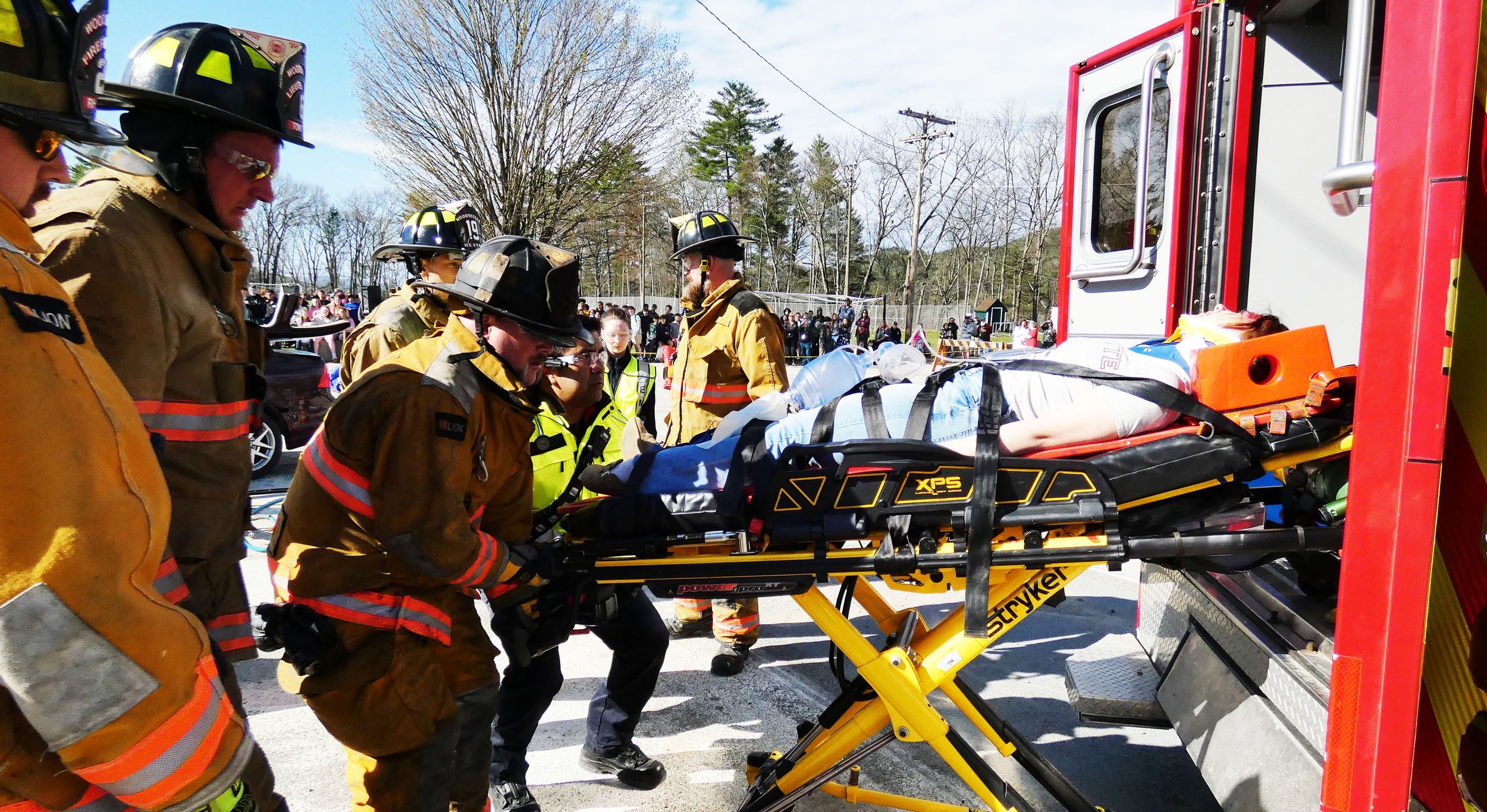
Injured Woodsville High School student is loaded into a Woodsville ambulance, after being freed from a crashed vehicle during a school-wide mock accident, funeral, and court trial awareness exercise held at the school over April 29, 30, and May 1, 2026. The Bridge Weekly/Bernie Marvin
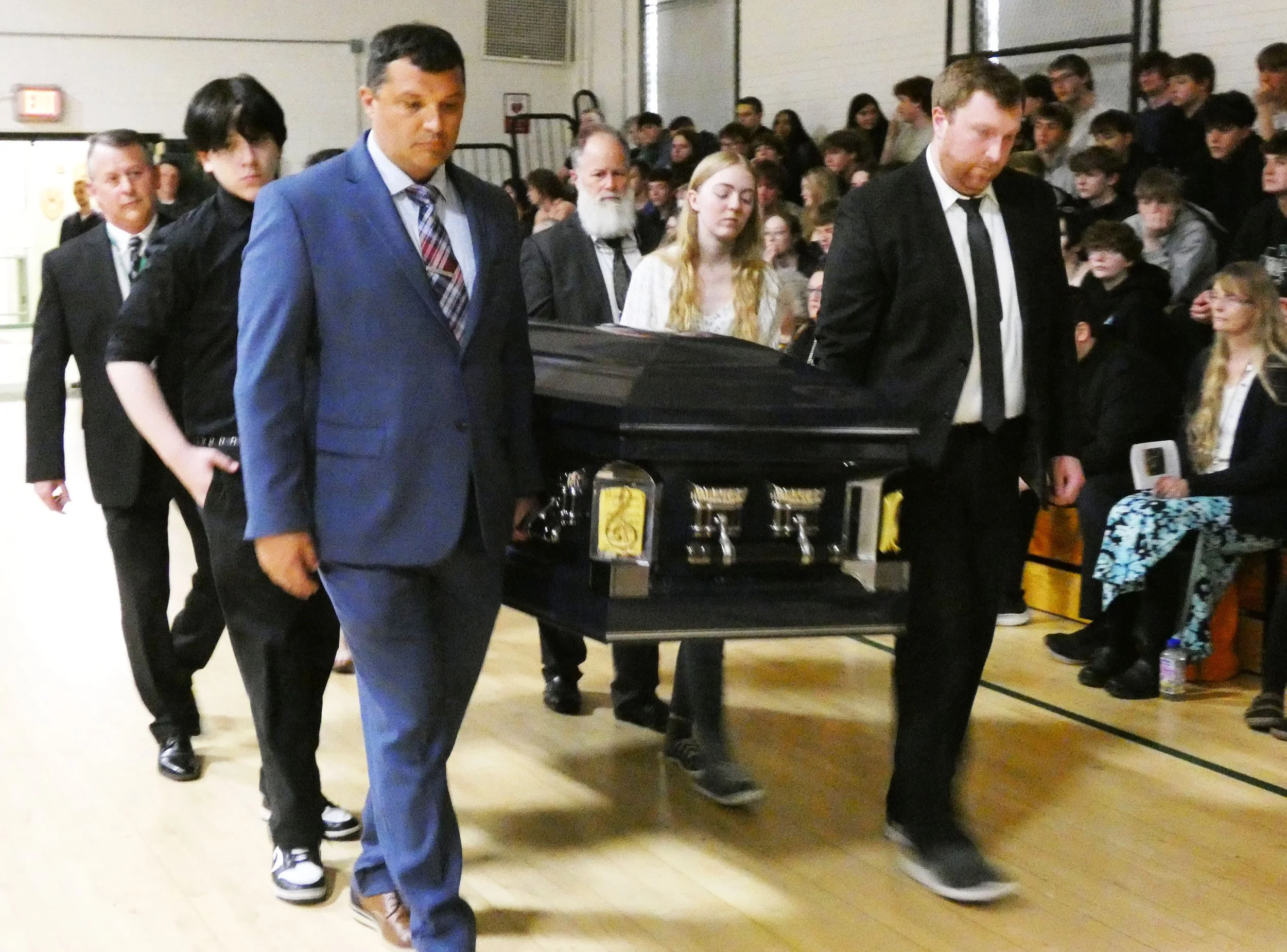
During the funeral services staged for a victim of a mock motor vehicle crash at Woodsville High School, pallbearers bring in the coffin of student Trenton James Alling for funeral services at the Dr. John A. Bagonzi Community Building. From left to right, seen are Teacher Bob Scianna, Maddox Furyes, Principal Hayden Coon, Teacher Glen Page, Grace McLellan, and Assistant Principal Matthew Kelly. The Bridge Weekly/Bernie Marvin.
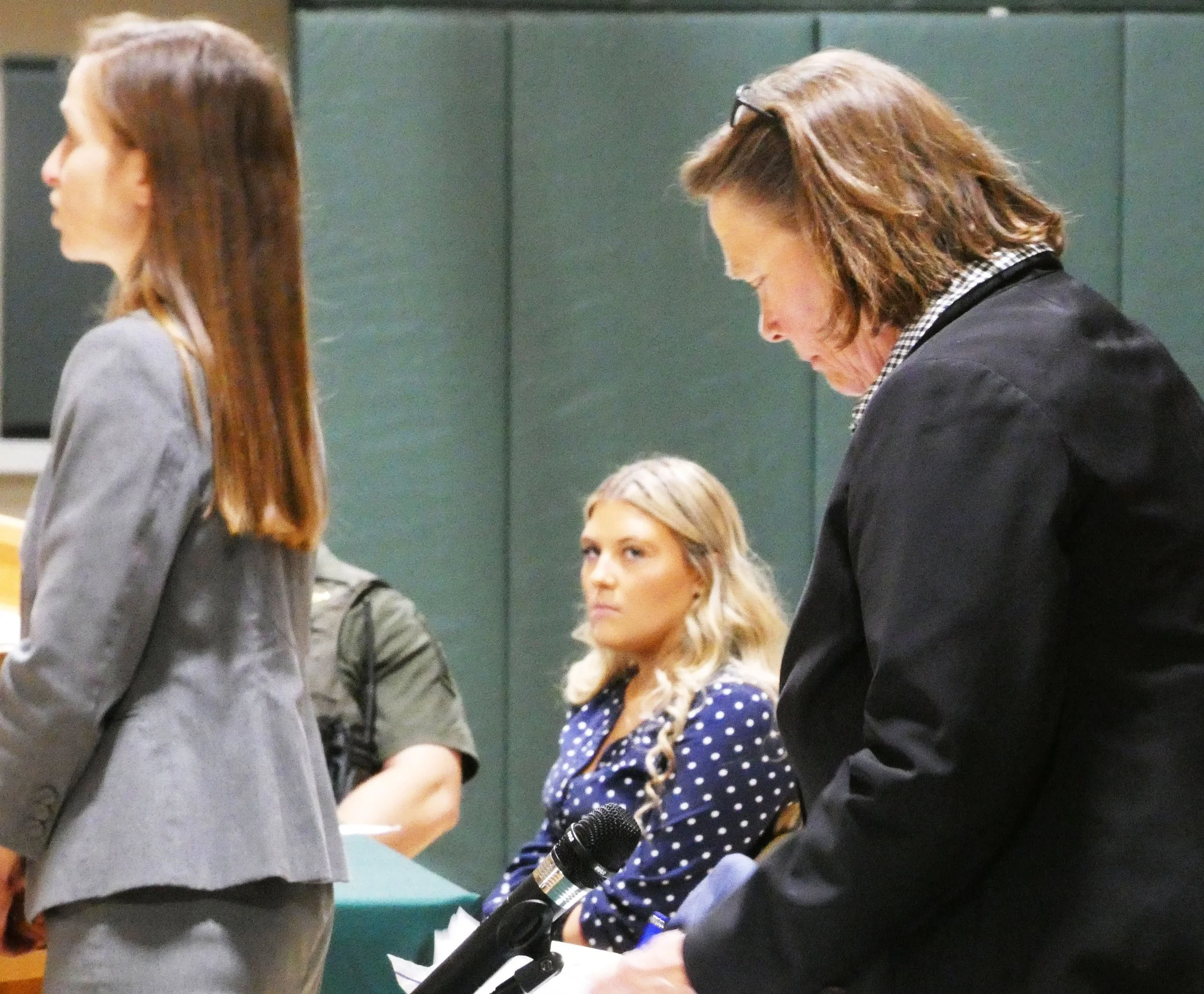
At trial on the third day of the WHS Crash program, defendant Taylor McFarland, a Woodsville High School student, at center, listens as Grafton Country Attorney Marcie Hornick, at right, and defense lawyer Amanda Jacobson, argue the charges leveled against McFarland. The Bridge Weekly/Bernie Marvin
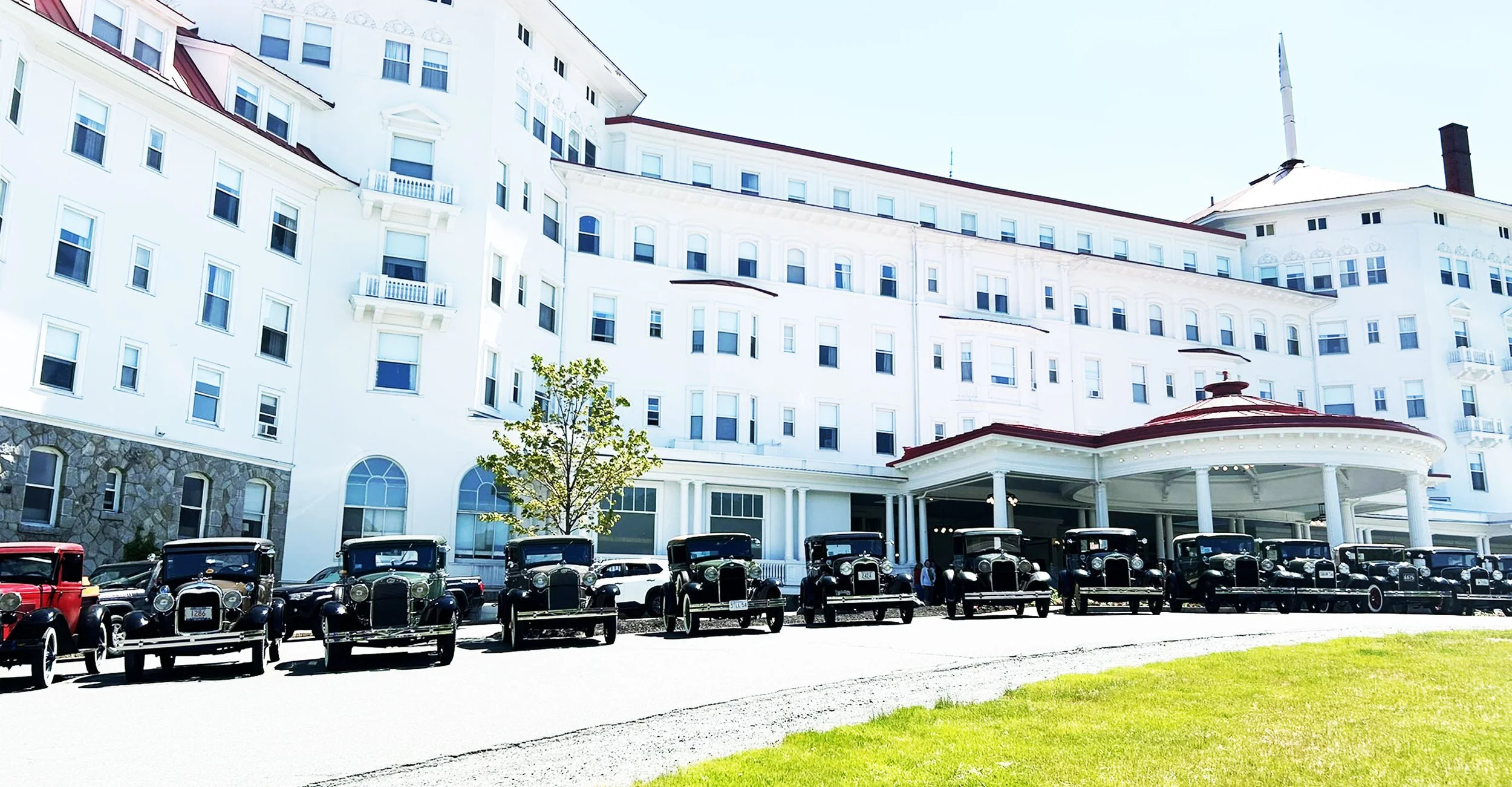
New Model A club forms for Northern NH and NE Kingdom
“We are excited to build a friendly, local community around these cars. Model A owners are invited to join us as we explore back roads, share knowledge, and keep these historic vehicles on the road,” said Club President Eric Zaharee.
By Bernie Marvin
Lisbon, NH – A newly chartered Model A club has been formed for New Hampshire’s North Country and Vermont’s Northeast Kingdom. The club’s membership has been accepted by the Model A Ford Club of America (MAFCA).
The new club held its first meeting earlier in April, which marked the official launch of the club that will be serving the Granite and Green Mountain States’ Model A enthusiasts. The Northern Valley A’s, a 501(c)7 social club was created to bring together owners and admirers of the 1928–1931 Ford Model A. The club plans to host seasonal tours, informal gatherings, technical troubleshooting sessions, and showcase the vehicles at community events in the area.
“We are excited to build a friendly, local community around these cars. Model A owners are invited to join us as we explore back roads, share knowledge, and keep these historic vehicles on the road,” said Club President Eric Zaharee.
Club members are anxiously waiting for the weather to warm as bit and hopefully the final mud will dry, and members can drive their vehicles. The group will be holding monthly meetings through October. Members are planning each month but there are no trips in the schedule, yet.
If you live in the area and own or are restoring a Model A, you are welcome to connect with the club and participate in upcoming activities. For more information or to get involved, contact the Northern Valley A’s at northernvalleyas@gmail.com. Visit us on Facebook facebook.com/NorthernValleyAs.
A long line of Model A vehicles lined up in front of the Mount Washington Hotel during a recent club meeting of the Worcester County Model A Club. The trip was arranged by members of the Northern Valley A’s Club, a new club in the North Country. Courtesy photo
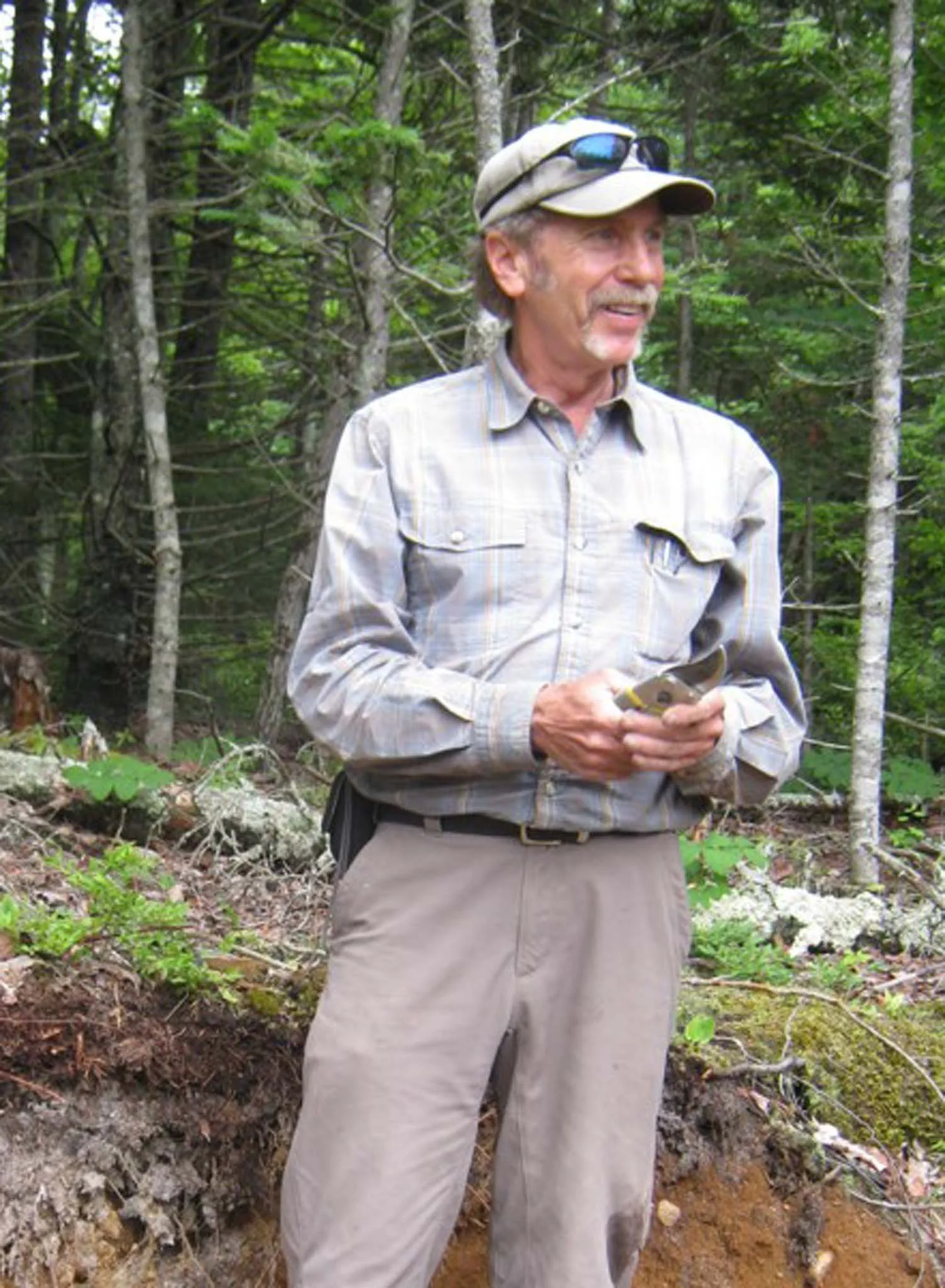
Soil Scientist Joe Homer Talks About Sugar Hill Dirt
Joe's speech in Sugar Hill was for the Sugar Hill Improvement Association, and according to those who were there, it was an engaging and informative talk. Joe explored the fascinating world beneath their feet, mainly soil. He spoke on how soil forms and why it plays a crucial role in agriculture, environmental health, and climate resilience. Attendees said they gained a deeper understanding of why healthy soil matters to everyone.
By Bernie Marvin
Sugar Hill, NH – Soil Scientist Joe Homer is well known in these parts of the North Country because of his long-time work with soil. He recently presented his "Let's Talk Dirty" program at the Carolina Crapo Building.
Joe has served as the New Hampshire State Soil Scientist for the USDA–Natural Resources Conservation Service. He retired after more than 33 years of service with that organization and has performed and managed mapping and fieldwork throughout New England, with additional work in New Mexico, Arizona, Texas, Oregon, and Minnesota.
He has also served as a field soil scientist, soil survey project leader, and assistant state soil scientist in New Hampshire. He is the author of the Grafton County and Coos County Soil Survey reports and has conducted hydric soils and wetlands identification and delineation for the USDA in New Hampshire, and has trained other federal and state agency staff, as well as New England consultants.
Joe's speech in Sugar Hill was for the Sugar Hill Improvement Association, and according to those who were there, it was an engaging and informative talk. Joe explored the fascinating world beneath their feet, mainly soil. He spoke on how soil forms and why it plays a crucial role in agriculture, environmental health, and climate resilience. Attendees said they gained a deeper understanding of why healthy soil matters to everyone.
Joe brought his years of experience in soil science and environmental education to the crowd. His approachable style and passion for the subject make complex scientific concepts accessible and enjoyable for audiences of all ages.
The event was open to the public and was underwritten as a part of the Carolina Crapo Education Fund. It was established by Henry Crapo in honor of his wife, Carolina, shortly after the Sugar Hill School burned down in 1948. The Sugar Hill Improvement Association administers the funds for projects identified to better the Town of Sugar Hill.
The Carolina Crapo Trust Fund also provides book awards for students pursuing their education or training, in addition to bringing speakers to the town. There was no fee to hear soil scientist Homer speak.
Soil Scientist Joe Homer presented a program on the benefits of soil’s role in food production, and strong soil conservation. Courtesy photo
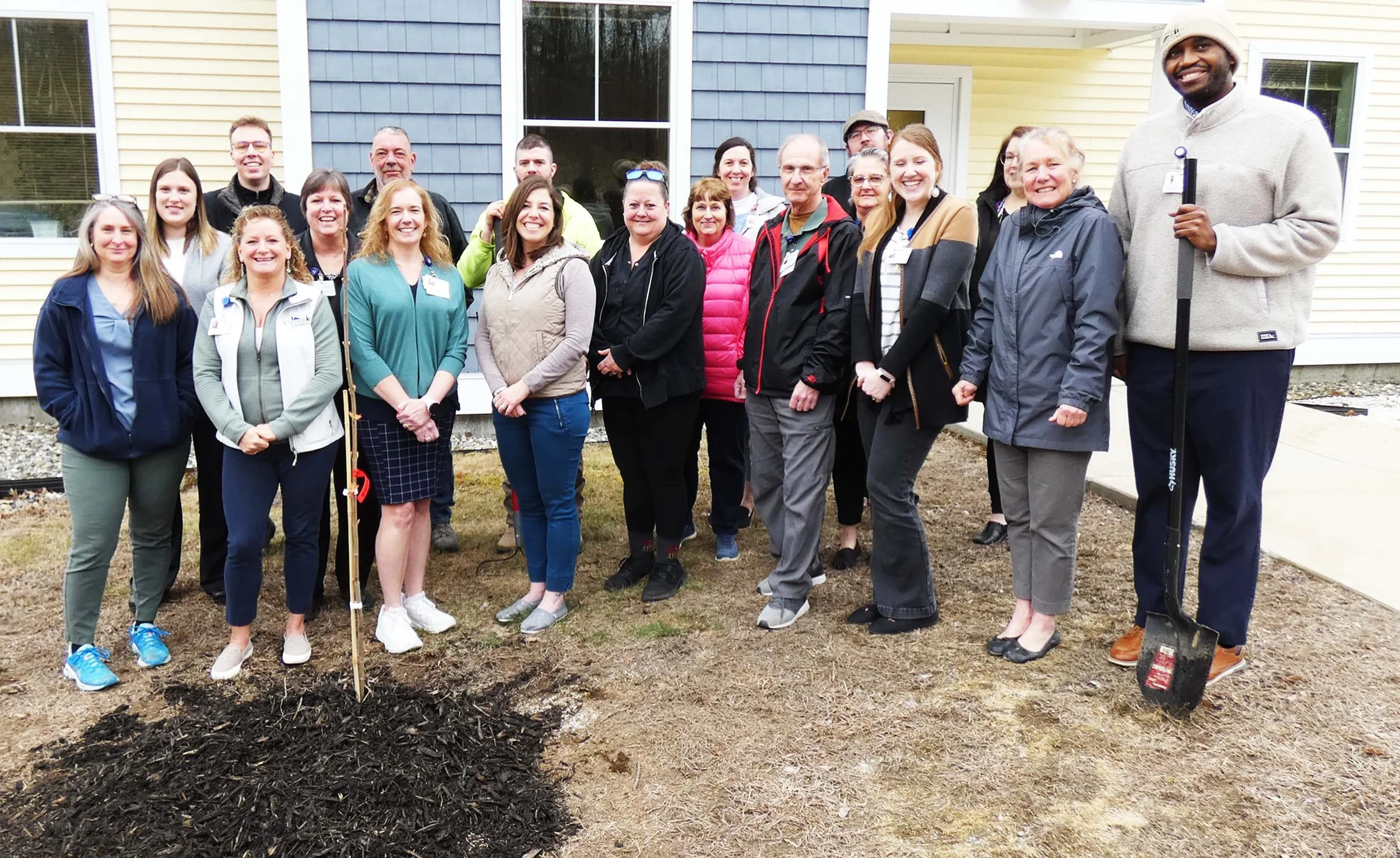
Cottage Hospital's Donate Life Week Featured Two Important Events
According to hospital officials "The tree stands as a symbol of hope, strength and the lasting impact of generosity, because, like a red maple tree, strength (and trees) come in all sizes. We all look forward to watching this tree grow alongside our organization, rooted in giving and a reminder of the lived forever connected through a program of donation."
By Bernie Marvin
Woodsville, NH – Cottage Hospital has been observing Donate Life programs for the past 10 years, usually by raising a special Donate Life flag out in front of the hospital on Swiftwater Road, then later in the week or month, a different special event would be observed.
This year they raised the Donate Life flag in the usual robustly breezy April noon time program and for their second event, they held a special red maple tree planting across Swiftwater Road on the rolling lawns of the Rowe Building, where a group of Cottage Hospital employees gathered around while CEO Holly McCormack placed the first shovel full of loam onto the tree's root ball, to the cheers of those watching.
This commemorative tree planting honored hospital staff and community members who have given or received gifts of life through the donation program that is so popular throughout the nation.
According to hospital officials "The tree stands as a symbol of hope, strength and the lasting impact of generosity, because, like a red maple tree, strength (and trees) come in all sizes. We all look forward to watching this tree grow alongside our organization, rooted in giving and a reminder of the lived forever connected through a program of donation."
According to Cottage Hospital, New England Donor Services, the federally designated nonprofit organization responsible for coordinating organ and tissue donation across the region, presented donor participation awards to hospitals that go above and beyond in supporting donor awareness and education. Recipients are selected based on their dedication to best practices, collaboration, staff engagement, and meaningful efforts to increase public understanding of organ and tissue donation. This includes initiatives such as educational programs, community outreach events, and awareness campaigns designed to inform and empower individuals to register as donors.
According to Cottage Hospital Community Relations Director Kuba Kubkowski, assisting CEO McCormack with the program and organizing the Donate Life events at the hospital was Quality Director and Donate Life Liaison Kelly Hussey.
It was a busy time at the hospital as they celebrated Donate Life programs. National Donate Life Month and hospital programs reminded the community of the tremendous impact of organ, eye and tissue donations and the power of giving the gift of life.
During the week, Cottage Hospital held its annual Donate Life flag raising, which brought the staff together in a meaningful show of support, they said. As part of the special moment, they also wrote messages of hope, filling each of them with gratitude, remembrance and encouragement for those whose lives have been touched by donations.
They offered that "we are so grateful to our staff who took the time to come out, reflect, and stand together in support of this important cause. Their compassion and commitment help keep hope growing in the community."
One donor can save up to eight lives and enhance the lives of over 75 others. Behind every donation is a story of hope, resilience and strength shown by the community for those waiting on a transplant list, it can mean more time with loved ones and more moments that truly matter.
They said that at Cottage Hospital they recognized Donate Life month to help educate the community and shine a light on the lifesaving impact of donations. They noted it is time to learn, reflect and honor the individual and families whose decisions have made a lasting difference. Together, they recognized the power of giving, and their lives were forever changed because of it, they said.
Cottage Hospital CEO, Holly McCormack, third from left, was assisted by several hospital employees in a special Donate Life tree planting last week to observe the National Donate Life program. The red maple tree was planted on the side lawn located at the hospital's Rowe Building, across Swiftwater Road from the hospital. The Bridge Weekly/Bernie Marvin