
Before Self-Publishing Had a Button, Ruth Fisher Putnam Had a Pedal Press
By Joshua Smith
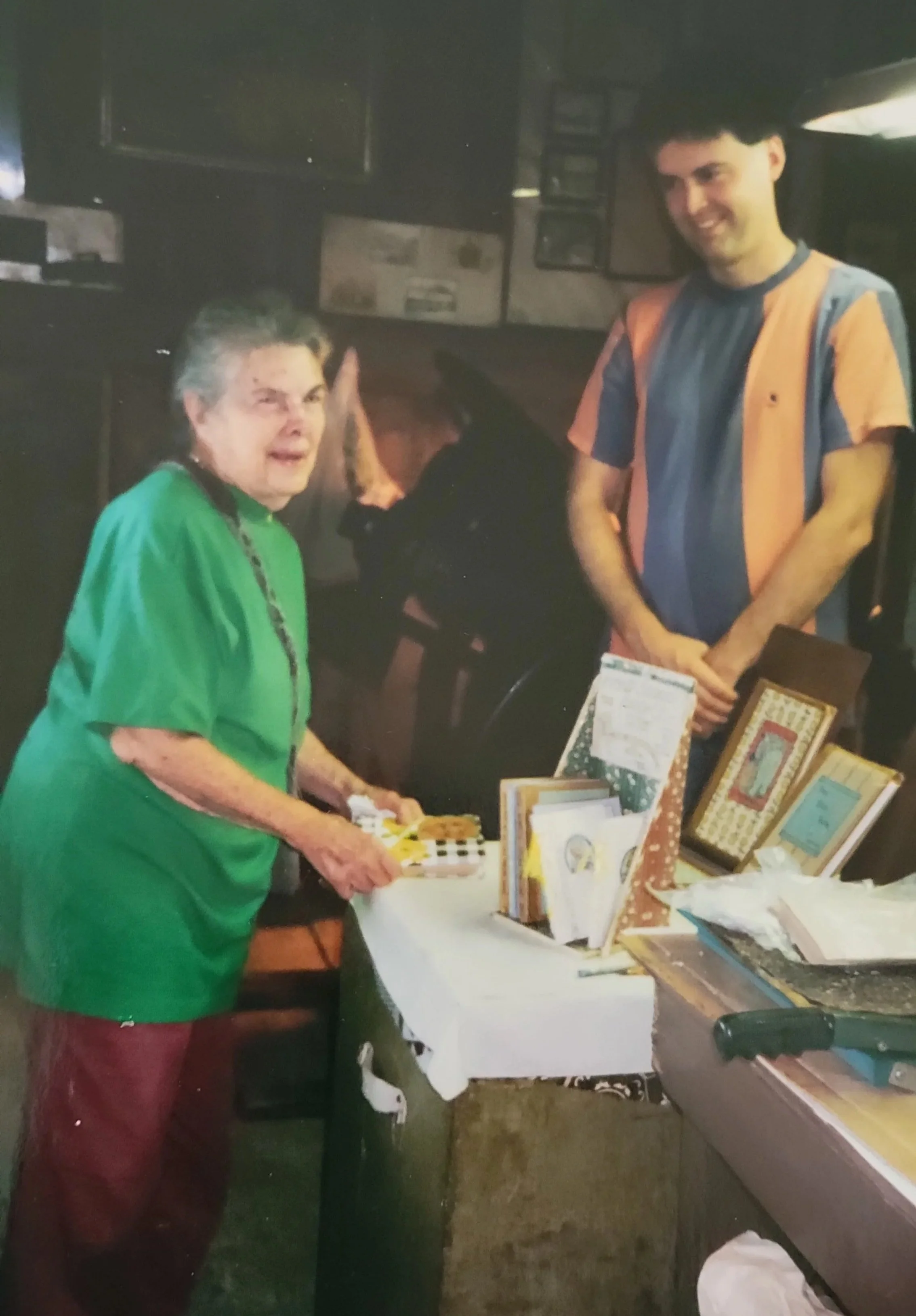
A family photograph shows Ruth Fisher Putnam’s books displayed together during her lifetime, offering a glimpse at the handmade work that became such an important part of her creative life in Groton.
GROTON — Today, someone with a story to tell can sit down at a computer, finish a manuscript, upload a cover and, without ever setting foot inside a traditional publishing house, become a published author. Platforms such as Amazon Kindle Direct Publishing allow writers to publish e-books, paperbacks and hardcovers themselves, while IngramSpark offers print-on-demand production and distribution to bookstores, libraries and online retailers around the world. What once required access to a publisher, printer, distributor and warehouse can now be done from a spare bedroom with a laptop and an internet connection.
Long before any of that was possible, Ruth Fisher Putnam was doing much the same thing in Groton. She just had to do it the hard way.
There was no upload button, online storefront or worldwide print-on-demand network waiting for her. Instead, Ruth had an old woodshed converted into a workroom, a very large and very heavy manual printing press, stacks of paper, homemade glue, discarded materials that could be given a second life and an apparently endless supply of determination. Readers knew her work as Ruth Fisher, while her small publishing operation carried a wonderfully appropriate name: Pedal Press. Ruth wrote and illustrated her own books and took on much of the work needed to physically turn those ideas into something a child could hold in his or her hands.
Her children, Bill Putnam, Paul Putnam and Janet Homan, are now well into adulthood with decades of memories to draw from, but when asked what they see when they think back to their mother making books, those memories are still remarkably clear.
“Somebody very proud and happy about doing what she was doing,” Bill and Paul recalled. They remember her sitting behind a small workbench, putting pages together, organizing them and trying to figure out how the pieces of a new creation would fit together. Janet remembered much the same thing. “I think she just loved being there, being creative and, you know, doing something for other people that she could share.”
The place where much of that creativity happened was hardly a formal publishing office. “We called it a workroom. It used to be an old woodshed,” her sons said. Ruth transformed it into something closer to an artist’s studio. Janet remembers barn boards, huge beams overhead, a little wood stove, paintings and pictures on the walls and plenty of natural light coming through the windows.
“It was cluttered,” she said, “but I think she knew where everything was and what she needed was right there.” To Janet, it was “a really warm, cozy place to work.”
From that Groton workroom came books that would eventually be recognized far beyond Vermont. In late 2022, the Mulvane Art Museum at Washburn University in Topeka, Kansas, mounted an exhibition devoted to Ruth’s work. The museum described her books as colorful, whimsical, hand-lettered and hand-pressed, noting the multiple pressings required to add color, the hand-stitched bindings and her resourceful use of wallpaper, Styrofoam meat trays and grocery bags. The museum called the books “marvels of invention” and welcomed Ruth’s work into the collections of both the Mulvane Art Museum and the Thomas Fox Averill Kansas Studies Collection.
That Kansas connection was not accidental. Ruth was a Washburn graduate. A notice in the university’s Fall 2005 alumni magazine identifies Ruth (Fisher) Putnam, BA ’65, of Groton, and records that she died July 4, 2005, at age 88. It also notes that she taught special-needs junior-high students, belonged to the Groton Historical Society and served as a Groton Library trustee.
According to the Mulvane Art Museum, Ruth’s first book was Auntie Em’s Elephant, the story of a woman who moves into an apartment where pets are not allowed and disguises a young elephant as a stuffed animal. As the elephant grows, the secret becomes increasingly difficult to conceal — a children’s-book version of the proverbial elephant in the room.
A surviving copy provides another tangible connection to her Groton publishing operation. An antiquarian listing for Auntie Em’s Elephant identifies it as having been published by Pedal Press in Groton in 1981. The bookseller describes it simply as a “hand bound home made book.”
The press used to make Ruth’s books was no tabletop hobby machine.
“It was very big and very heavy,” her sons remembered with a laugh. The press had a round disc, and Ruth would line up what she intended to print before setting it in motion. Her methods also changed over time. Her children remember her sitting on the couch sketching out ideas, later incorporating a computer into her writing, and using local printers, including Tuck Press in Wells River, for some portions of production. When bundles of pages came back, Ruth would sort and organize them herself before continuing the process of turning them into finished books.
Perhaps no detail captures Ruth’s personality better than the materials she used. She was apparently not inclined to throw something away simply because it had already served its original purpose. Wallpaper, grocery bags and Styrofoam meat trays could potentially find a place in her work.
She even made her own glue.
Bill inherited some of his mother’s recipe boxes, and alongside recipes for food were instructions for making adhesives, including how ingredients should be mixed, heated and then painted onto the covers of books.
Janet said her mother’s resourcefulness went well beyond publishing.
“She didn’t cut corners, but she sure did use everything she had in a creative way,” she recalled.
One family story involves Ruth needing to repair the muffler on a Volkswagen. Her solution involved an old orange juice can.
That resourcefulness makes Ruth’s story feel surprisingly current. Today’s self-publishing platforms are built around giving writers a level of control that once generally required access to an established publishing operation. Amazon KDP allows authors to upload their own manuscript and cover, set a price and have paperback and hardcover copies printed as customers order them. IngramSpark similarly offers authors print-on-demand production and access to a large distribution network.
Ruth had none of that infrastructure.
She essentially built her own.
Making a book, however, is only part of the job. Every independent publisher eventually faces another problem: finding readers. Ruth did not have social media, online bookstores or email newsletters. Her children remember books being placed in stores on commission, copies traveling with her when she went places and much of the rest happening through word of mouth.
Her solution for direct sales was particularly memorable.
Ruth took an old refrigerator box and turned it into a little bookstore in the front yard. The setup was convincing enough that an insurance man once stopped, looked at it and asked whether there was actually a refrigerator outside.
“No,” came the explanation. “It’s just the box.”
The little publishing operation may have been homespun, but people noticed. Her children remember NPR coming to interview their mother and recall at least one newspaper story about her work, although the family has not yet located all of the older clippings.
Ruth even wrote about the very thing she was doing. Surviving bookseller records list a 1985 Pedal Press title called Practical Self Publishing, for the Practically Penniless Poet and Other Writers. With self-publishing now an established part of the book world, the title sounds remarkably contemporary for something Ruth was producing four decades ago.
Despite selling the books, Janet does not believe money was what kept her mother at it.
“I think making and sharing was her motivation,” she said. “I’m sure she appreciated the money she got from them,” but Janet believes much of it probably went right back into paper, ink and other supplies. “I think it was the creativity and sharing that was her main goal.”
Bill and Paul agreed.
Ruth was also doing something else now familiar in the independent creative world: she was building a community around the process. Her sons remember local children coming into the workroom, where Ruth would help them develop their own stories and then teach them how to make books.
“They’d actually write their own little stories and then bind their own books,” they recalled. Around Groton, they said, Ruth became known as someone who wrote and illustrated her own books.
That connection to children was no accident. Janet remembers her mother always having projects for the family and later bringing the same creative instincts into teaching.
“She always loved children,” Janet said.
Ruth worked as an art teacher, according to her daughter, and Janet believes creativity and education were inseparable parts of her mother’s work.
“I think teaching was her love and her goal with the books that she wrote.”
The stories often contained something beneath the surface as well. Paul remembers a moral running through many of them, something an adult reader might recognize even while a child simply enjoyed the characters.
“Each of her stories had kind of a moral to them,” he said. For adults, he believes Ruth hoped they would recognize “the value in the morals,” while for children it was simply the joy of sharing a story.
Her children still have their favorites. One chose Auntie Em’s Elephant, another The Mockingbird. Janet’s favorite remains The Maplecake Tree.
There is still some mystery surrounding exactly how much Ruth produced. The family remembers many books, editions and copyrights, but a complete catalog has not yet surfaced. Janet believes library and copyright records may eventually help reconstruct a definitive list. What is clear from both the family and surviving institutional records is that this was not a single project that briefly captured Ruth’s attention. It was a substantial body of work carried on over years.
Much of that work survives. The old press is still there. Her books are scattered among her children, grandchildren and collections around the country. Some manuscripts remain upstairs in an attic, while others are held by family members. Near the end of her life, illness slowed Ruth down, and the family believes there may have been one story she never finished.
There is something fitting about the journey those handmade books eventually took. A woman sitting in a converted woodshed in Groton, piecing together books with a pedal press, homemade glue and salvaged materials could hardly have known that decades later an art museum would display those same creations and praise their design, craft and inventiveness.
When I asked Bill, Paul and Janet what their mother would have thought of the museum recognition, they immediately knew the answer.
“I think she would have been overjoyed,” came the response.
In a phrase the family said sounded just like Ruth, she probably would have been “proudest punch.”
“That sounds — that’s exactly right, what she would have said,” Janet replied.
It would be easy to look at Ruth’s pedal press, homemade glue and refrigerator-box bookstore and see only a charming example of how things used to be done. The more interesting interpretation may be almost the opposite. Ruth Fisher Putnam was doing something that has since become a major part of the publishing world. She maintained control of her work, created her own publishing imprint, figured out production, worked with local businesses when she needed assistance, found her own readers, sold directly and even taught other people how to create books themselves.
She was an independent author and independent publisher before technology made either one particularly easy.
Today an author can upload a manuscript and potentially make it available around the world. Ruth had to reach readers one book at a time.
Her children say that behind all of that creativity was someone far less interested in recognition than her work might suggest. They remember a simple, humble and loving person who made do with what she had. Janet said her mother “didn’t live an easy life, but she sure made the most of everything that she had.” Her sons remember how much she loved Groton and its people and how naturally she looked for something positive in almost any situation.
“If it would rain,” one recalled, “she’d…find a way to find happiness in the rain.”
Perhaps the best ending to Ruth’s story, though, comes from Ruth herself. Near the conclusion of my conversation with her children, one of her sons remembered something she once told him.
“She said that she really hopes that she’s been remembered.”
Ruth Fisher Putnam died more than two decades ago. Her printing press remains. Her books survive in family homes and institutional collections. Her work has been displayed in an art museum. Her children can still picture her sitting at that little workbench in the converted woodshed, happily working on whatever came next.
And here in Groton, people are still talking about her.
“By golly,” her son said, “I think she’s…done that.”
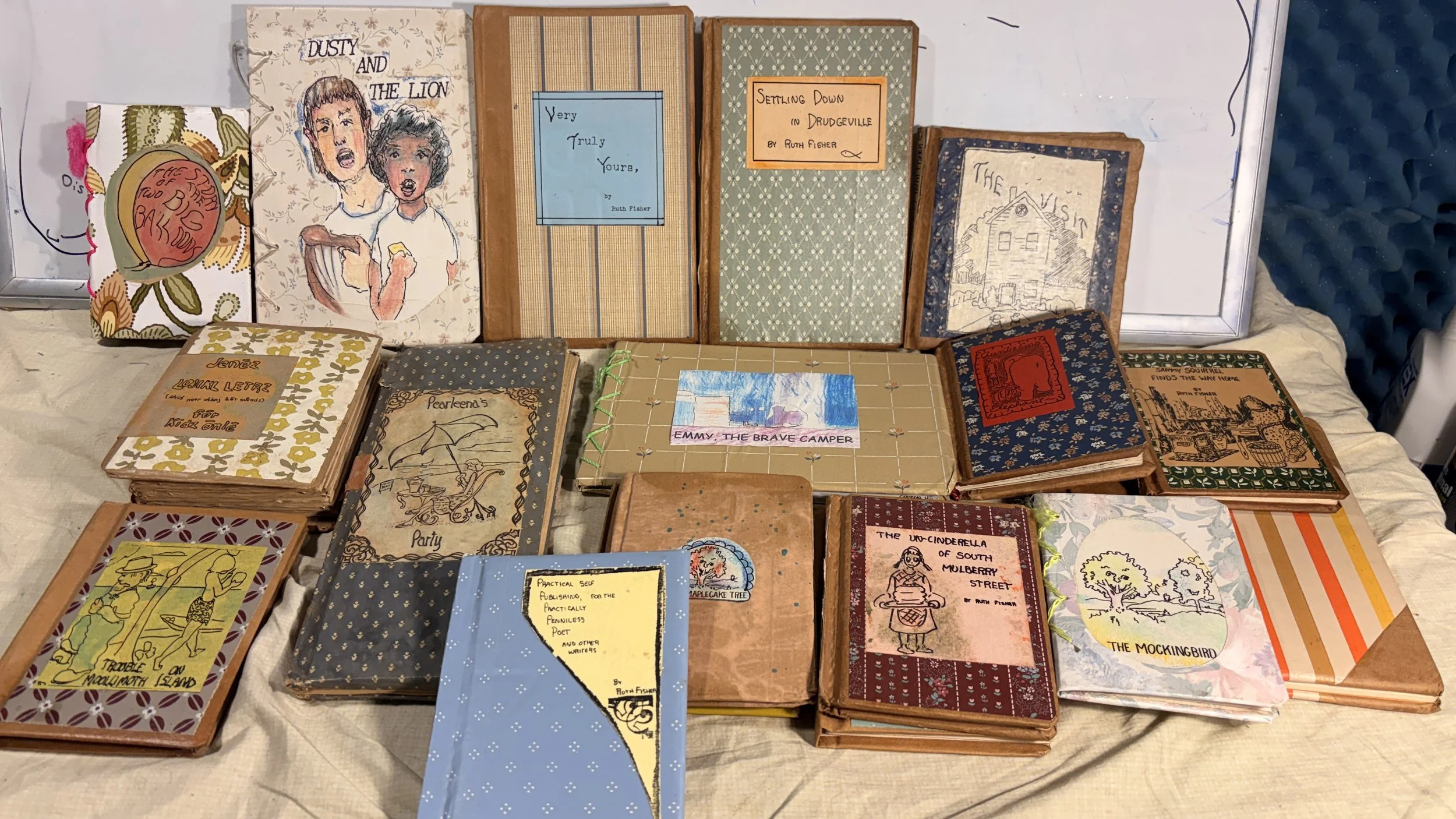
A collection of Ruth Fisher Putnam’s Pedal Press books shows the remarkable range of titles, bindings, recycled materials and handmade cover designs she created over the years from her Groton workshop.