
By Tanya Sousa
For four years I owned a small cottage in a small village next to a small post office. The village has a small general store and, a short walk away from my cottage, a small border crossing. Everything human about the village of Norton is small, but the natural surroundings are absolutely the opposite. It is an expanse of fields, trees, lakes and ponds – full of life.
When I walked along the snow machine trails in winter, I was able to take steps off the human paths onto packed-down wildlife highways. There were main drags that had evidence of many kinds of animals using them, and species-specific ones that branched thinner off of those. For instance, I’d see trails that were mainly turkey tracks, others that belonged to scampering squirrels. Deer claimed their own lines, but all of those specific trails would come together. Of course there were places where I’d see a bobcat’s tracks close to those of turkeys or squirrels, hinting at the hunt that clearly went on. The diversity of travelers, and the way they moved throughout the forest in quite an organized way, reminded me of how huge the community of Norton really is. It isn’t just a community of human people.
The truth that all of the area critters are part of this greater community was never more apparent than in the very early hours of the morning, when it was still dark or had barely a blush of light kissing the Alaskan-like pine trees and mountains. I often walked along Norton’s main road and side roads at those hours with my small dog (appropriate for her small village). There were many times that we’d see a shadow up ahead of a red fox. I assumed it was a red fox – I couldn’t make out the color since it seemed mostly washed-out grey in the half-light. Little Pogo would whine softly and strain at her leash a bit as if she wanted to meet this wild cousin.
There were raccoons sometimes, an occasional coyote, deer here and there, but more often than not we saw the fox. All the animals would cross the roads as one would expect, but just as often they’d use the otherwise empty roads as another highway of their own, and Pogo and I were just another set of beings moving along. Pogo became more and more interested in going for walks at those hours as time went on. She seemed to enjoy having this distant relationship with her neighbor the fox. She’d see the shape of him and leave him a pee-mail. Apparently he’d answer, and the “conversation” would go on. I had my human post office and Pogo and the fox shared information in their wild one. We never saw the fox clearly, just in its shadowy form, ahead, always just ahead.
Pogo and I woke one morning at 4:00 a.m. as usual and settled together on the glassed porch daybed before our morning stroll; I sipped hot coffee. Even the small village had street lights, and they were all I needed for a soft glow where we snuggled, making it almost like sitting under a full moon. Pogo suddenly barked once, urgently, at the window. I looked to see the red fox lope into view under the street lights, exactly down the middle of the street. We could see him clearly at last. His fur rippled as he ran, his full and bushy tail out straight behind him. He continued to run easily down the middle of what he clearly deemed as much his pathway as mine or anyone else’s. I waited for him to dart off into bushes or grass, but he continued using the pavement in a straight line until he finally faded into the early morning grey, then disappeared from our sight like a wisp of softly flame-reddened smoke.
Pogo was effervescent. I drove the roads to work later with even more care than usual.
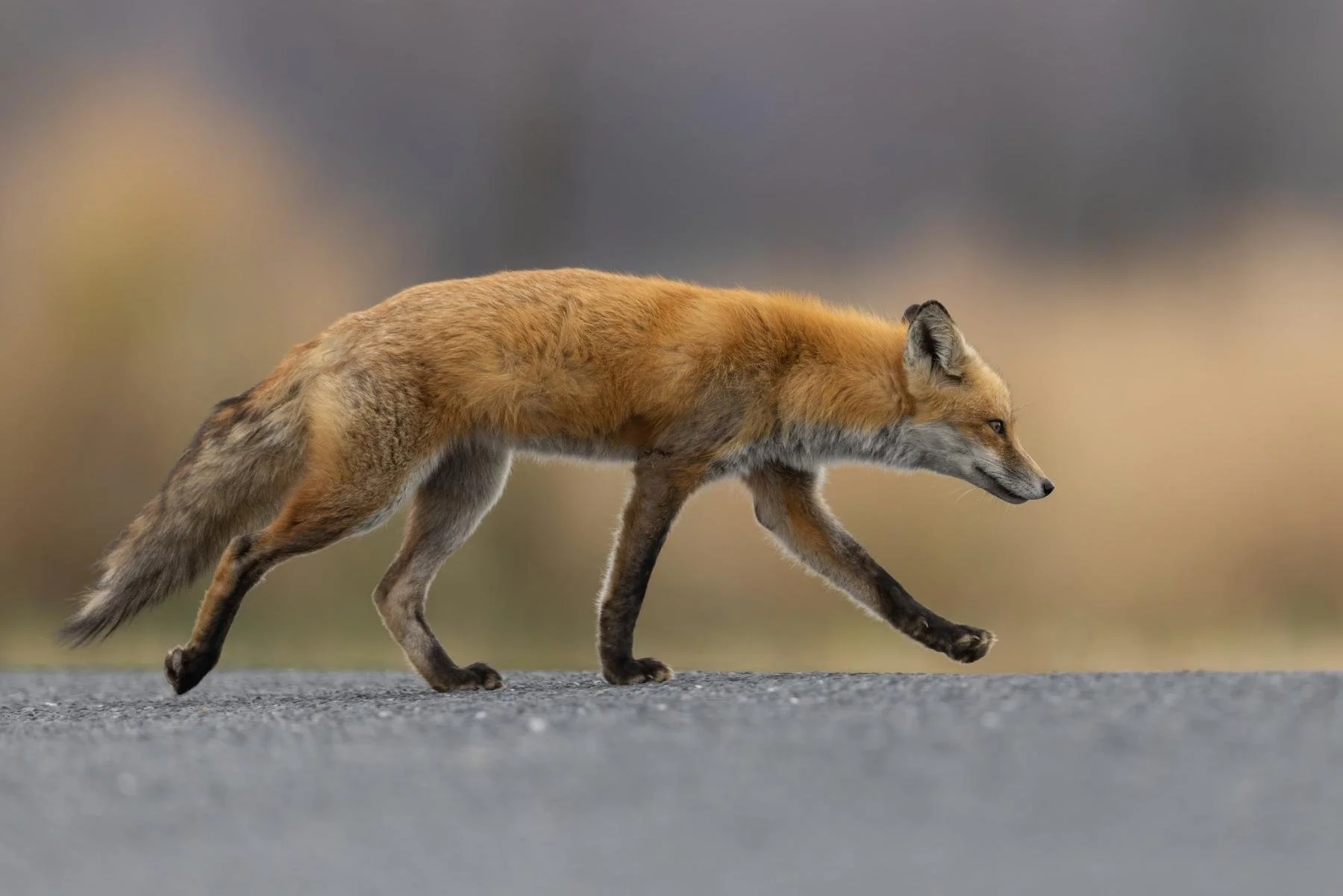
A red fox travels along a roadway. In a reflection on life in Norton, Vermont, Tanya recalls the wild neighbor who regularly shared her early-morning walks. (Ronald Laubenstein, U.S. Fish & Wildlife Service)