
Farming Wildlife
By Tanya Sousa

My first egg-laying hens were ravaged by raccoons. When the game warden heard me describe the carnage, he said, “Ah, it was a mother bringing young out for a training exercise.” For a training exercise, it was a messy and horrible sight because the young raccoons were just learning what to do.
In defense, I installed an electric mesh fence around the henhouse to keep my new girls safe. A fellow chicken enthusiast looked at what I’d set up and grunted. “Some expensive hens.” He thought it would be much cheaper to have him come over with his gun. He’d even sit out there at predawn. No charge.
It did cost more money to invest in a large stretch of electric mesh fence than free-ranging. It would have been cheaper to keep them in a small dirt run, but that’s not what I enjoyed about keeping chickens. I enjoyed seeing them scratching in grass. I enjoyed watching them run, flapping with excitement as they moved after some flying insect.
It would have been cheaper, at first glance, if I had someone come shoot raccoons, but I believed in the raccoons’ right to eat too.
Another chicken farmer grinned at me, the hobby farmer; he set a hand lightly on my arm. “If you’re going to raise animals or crops, you’re going to have to kill something. I don’t like killing, but I have to do it. Even small farming is a business.”
“I need to do things differently,” I smiled back at him when he finished his speech. I wondered if I could turn this challenge into an opportunity.
I wondered. Wondering led me to investigating. I found it’s only recently that farming became very specialized. According to an educational site on Vermont agriculture, in the late 1700s, most Vermonters lived on self-sufficient farms, consuming most of the food they produced. They didn’t just raise dairy cows, or one crop, or sheep. They found a wide variety of ways to survive. They did choose to trap and shoot the predators and competing wildlife around them, though.
However, if I squinted my mind’s eye to look at the situation, I saw that the crux of survival depended on diversification. It didn’t matter how. If there was a way to make money out of something, it helped the farm get through. New England has a short growing season – it’s rough, but diversification was key and could still be.
Even after the Civil War, there were still a variety of items being sold from farms: pies, jams, wool and knitted items, or whatever the family had to offer. As family farms struggle to stay afloat, diversification is more important again. Dairy products, for instance, are increasingly not the only things small dairy farms sell.
When I was hobby farming, I realized there will always be raccoons and other animals. Since they are going to be around, and since no matter how many we shoot there will always be a new animals moving into the vacant territory, then why not have them pitch in and make money?
I did this on my tiny hobby farm of hens, fruits and vegetables.
The definition of farming is that you grow or raise something. I didn’t actually raise raccoons or hatch great blue heron eggs in an incubator, but I made money on the critters. Some of them would normally be considered harmful to a farm’s bottom line just by living as they live. Others, like the herons, didn’t bother me, but I knew fishermen who frequented the river and wetlands around me and shot them illegally, feeling that those modern dinosaurs wrongly ate the fish they wanted to catch.
I devised a plan to farm raccoons and all their wild colleagues—got them to pay for the very devices I needed to keep my birds and plants safe.
First, I wrote about them. I made enough money writing articles for magazines and newspapers on one animal or another to pay for what they cost me. I also took pictures of any wild thing that crossed my path. I sold them with articles or individually in dozens of ways. A farmer or family member could collect the best pictures for calendars, prints, journal books with wildlife photos on the covers, T-shirts—the possibilities are endless and could be sold along with produce at farmer’s markets, crafts fairs, and some stores. A really special shot might end up in a magazine.
The serious or hobby farmer can benefit from cooperating with what’s around them; it’s a different way of being diverse. Maybe a dairy goat farmer does sell her cheese and soap and milk. But perhaps she also has photos of coyotes to sell to tourists who have never seen the more wolf-like eastern variety. Perhaps there’s a walking trail through a part of the property where visitors view the natural world before stopping at the farm-stand. Even the most problematic critters can be part of a successful farm too.
I know a woman who struggled with birds in their fields, feasting on seed corn or finding smaller seeds in the garden. I don’t know how it began, but she started photographing the birds and eventually grew so passionate about it, she invested in a better camera. Between feeding, milking and cleaning up after cows, she uses a camera set up in her kitchen window. She’s been posting her photos on social media and began entering them into contests. She’s seeing the photography’s potential, and loves it. She loves her cows too, but the once troublesome birds have helped her spread her own wings.
I farmed wildlife long enough that I had more than the bleeding heart all my fellow hobby farmers knew I had. I had numbers. At worst, I broke even on anything I spent because of wildlife. At best, I made a profit.
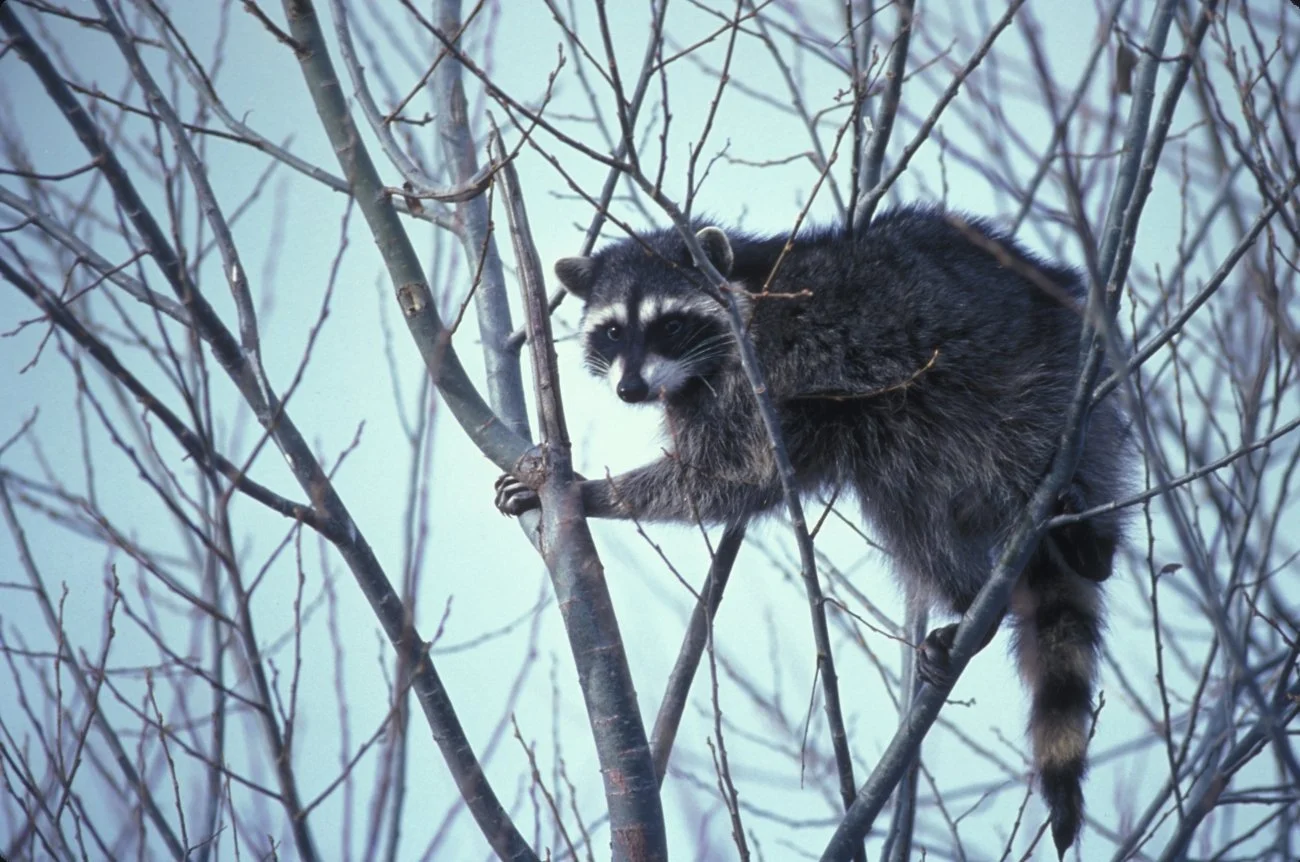
Raccoon in a tree on the Lower Klamath National Wildlife Refuge (Menke, Dave/USFWS)