
Basking In The Rare
By Tanya Sousa

There is something decadent about walking through a grocery store: I can live inland and find a tuna steak. Though my home is in Vermont, with its brief growing season and in Gardening Zones Three and Four, any fruit or vegetable is at my fingertips in any season. Raspberries in winter? Sure. Name it and you can have it. Bright lights shine over everything and everyone as we push our carts in the world of plenty.
But today I’m walking through the forest instead. It’s a place I go back to every year in late July and early to mid-August. There is a hallowed darkness. The light that does shine on me filters between tall trees. It’s quiet except for the rustle or crunch of my feet on fallen twigs, a few birds whistling through the canopy, and the occasional churr of squirrels. I’m moving toward the damp area where cedar trees keep their toes moist—to find something my German-born mother called pfifferling.
Pfifferling are a peachy to orange-colored wild mushroom, a delicacy, something that we haven’t been able to farm. They smell a bit like apricots and are known more often by the French name, Chanterelles.
I’m prepared with a basket and paring knife to cut the mushrooms off, leaving some stem so they will return next year. However, even with that care, there is no guarantee I’ll see them here again. They are mystical, finicky, and I’ve seen bumper-crop years at this location and then visited another year to find hardly a one. This year is average.
I spot my first cluster of orange in the distance and move toward it, hoping it isn’t a scattering of fallen leaves. I am well aware I might find the prize I’m searching for, and I might not.
As I draw closer, I see they are, in fact, the mushrooms, and I bend with my knife to cut them and drop them in my basket. These are absolutely beautiful. Crawling insects with curious antennae and gentle, slow-moving slugs, who also love them, haven’t discovered them yet, and the pfifferling are just far enough along to be the best for eating.
I hold one to my nose and breathe in deeply, taking in the earthy, slightly fruity scent.
My mother first brought me mushroom hunting when I was nine, after a German friend of hers said she’d found pfifferlingduring a hike. I remember the look on my mother’s face as we found stretches of cedar forest and combed the area; she was so focused and hopeful. We scanned the woods thoroughly until we found some popping up brightly in the dimness. I could nearly feel Mom’s joy in my own bones. She turned the first mushroom upside down and explained what I needed to look for to make sure it really was pfifferling. Later, she sautéed them with butter and onions, and I had my first taste of a gentle, peppery/fruity flavored mushroom kissed with a firm texture. They weren’t like any mushroom I’d eaten before. There were days of enjoying them until they were gone. Then they were just that—gone. The next great pleasure of having them was a year away.
My mother was gone too soon as well, sick in her fifties and gone before sixty. She wasn’t able to do much mushrooming in the last years of her life, and I knew that, unlike me with our pfifferling, we wouldn’t enjoy each other in a year.
But I have always held on to the joy and tradition of the pfifferling hunt. My mother is with me every step I take in the woods, and her joy is my own, a lightness and jaunt as I find another patch. This one has been visited by lucky forest creatures before me, but there are still some mushrooms in good shape. I’m not angry. The forest dwellers waited all year just like I have.
I cook them as Mom did, with onions and butter, but I also sprinkle them on a white pizza and make a wild mushroom rose sauce that blankets artisan noodles I buy just for this purpose. I eat them differently than most other foods I have—with time. I close my eyes. I smile.
My mother is smiling at me too, from a painting I made from a photograph of her. She is a small child, crouched down, feeding hens that surround her. She lived with her grandmother on the outskirts of a tiny village, sent there to escape the bombing of Berlin. Her grandmother raised most of their food, and it was there my mother wandered through woods with adults leading the way. It was there her eyes were opened to the joy of searching for and finding the apricot-colored mushrooms, and then basking in the joy of eating them for a brief time.
I can’t enjoy these mushrooms anytime I want. I can’t wander through a market, reach for a bag of them, and toss it in a metal cart. I never know if I will have many or only a few. I have to wait and imagine all year, then journey through forests to find them—and that makes the having all the sweeter.
Pfifferling can’t be farmed, and I hope that no well-meaning culinary artist, scientist, agriculturalist, or any other “ist” unlocks their mysteries and makes them available year-round.
Let me dream for months, yearn for the flavor, and leave me the pleasure of basking in something I can’t have whenever I want. I want to enter the cedar stands when it’s time.
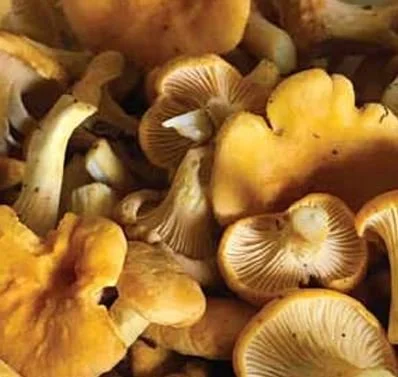
Pfifferling are a peachy to orange-colored wild mush room, a delicacy, something that we haven’t been able to farm. They smell a bit like apricots and are known more often by the French name, Chanterelles.- Courtesy photo.