
By Joseph A. Citro
To the traveler heading north, the Shelburne Museum, located between Vermont Route 7 and Lake Champlain, will appear for all the world like a small fenced-in village.
It comprises 39 buildings, 25 of which were moved to the museum grounds for their historic importance. You’ll find houses, barns, a meeting house, a one-room schoolhouse, a lighthouse, a jail, a general store, a covered bridge, even a 220-foot steamboat. The structures not only contain exhibits, but they are exhibits themselves.
And one of them is hauntingly unique.
The Dutton House, relocated there in 1950, was the first of the museum’s architectural collection. Its former life was in Cavendish, Vermont, about 100 miles away.
Constructed in 1782—not long after the Revolutionary War—by Salmon Dutton, the house began life as a typical colonial saltbox. But over the years, Dutton descendants expanded it with continual additions. At different times, it was used as a family residence and as places of business, including a tavern, inn, and offices.
During the first half of the 20th century, it was abandoned, neglected, deserted. Uninhabited for four decades, the old scary-looking place picked up the reputation for being haunted. Locals knew to avoid it because ghosts dwelled inside. Perhaps Salmon Dutton himself walked the empty rooms and collapsing stairways. Or perhaps it was his wife Sarah, some family member, or one of the many people who stayed, or died, at the inn.
Scads of scary stories developed about the derelict saltbox. When I was a boy, my father told me of the time—in the mid-1930s—that he and two of his friends ventured there, stoked-up by fright and irresistible curiosity. While he and another boy peered through the slats of boarded windows, the third lad searched for a way to enter.
Suddenly my father was startled by a frightened cry. The third boy ran from behind the house and dashed across the street. From the safety of the other side, he cried for the others to hurry. “We gotta get out of here!” he said over and over, his face wild, his eyes glassy with tears.
In all the years between then and 1970 when my father died, Dad’s friend would never reveal what he had seen that had freighted him so much.
By the 1940s the empty house—now a local eyesore—was in danger of being torn down to widen the road. But the Shelburne Museum rescued it. In 1950 they carefully took it down, piece by piece, and reassembled it where it stands today on the museum grounds.
Now here’s the odd thing: The Dutton House ghost moved with it.
A growing collection of inexplicable experiences proves that the Shelburne Museum exhibits a true oddity: a real haunted house.
We’re still not sure who this traveling ghost may be. For the most part we’re certain that it’s not an unfriendly spirit.
I first learned about the ghost from a retired woman who volunteered as a guide at the museum. “They don’t much like us to talk about it,” she told me. “But anyone working in the house knows about it. Even some of the visitors have had experiences . . . ”
Experiences?
In October of 2004 I spoke with one of the museum security guards, Mr. Burt Levitt. He told me that he’d routinely entered the Dutton House at night. Alone. On certain occasions, he said, he could feel the house charged with a discernible mood. Sometimes he felt completely comfortable. Sometimes inexplicably tense, as if he had walked into a room where an argument was going on. Of course, these visits were after hours when the museum was closed, and there was no one else in the building.
Mr. Levitt habitually checked the whole house to be sure no one was hiding anywhere, but before he’d leave and lock up, he’d stop by the door and listen. Often, he’d hear footsteps walking around upstairs. Footsteps in a room he knew to be empty.
He’d go back up to double-check and discover the adult-size cradles—that look very much like coffins—were rocking all by themselves.
Other security guards reported hearing kids’ laughter in the upstairs rooms. One saw an unearthly face hovering outside an upstairs window.
In general, the ghost—whoever it may be—seems to favor the upstairs where people have seen flashing lights or felt inexplicable cold breezes blowing through the rooms on hot summer nights. One of the ghosts occasionally takes a rest, it seems. And when he—or she—does so, it is on a specific upstairs bed. Employees repeatedly find that bed disturbed in the morning, as if someone had been lying on it. Sometimes an impression is clearly visible. At other times the bedclothes are discovered in disarray.
On rare occasions full-form phantoms have been seen in the Dutton house. Although these visual phenomena bring us no closer to identifying the house’s spectral occupants, they do suggest there are more than one.
On one occasion, two security guards (now they travel in pairs when visiting the Dutton House) heard feet pounding across the upstairs floorboards. One guard remained by the door as the other raced upstairs, certain he was about to trap an intruder. What he found was a terrified little girl at the foot of one of the beds. As he turned away to call his partner, the girl vanished, leaving only a bewildered guard in the upstairs bedroom.
One elderly volunteer tour guide, the pseudonymous Gladys Whipple, was working in the room above the tavern. Though she hadn’t seen or heard anyone come in, she suddenly felt as if she were not alone. Furtively glancing up, her eyes met those of a dark, unsavory-looking individual standing in a corner. There was something very wrong about this out-of-place stranger. The clothing. The scowl.
When the specter actually growled at her, Gladys left. As she hurried down the stairs, the apparition followed her. Then it pursued her outside, into the yard.
Not surprisingly, Gladys says she’ll never enter the Dutton house again. In fact, over the years many museum employees and volunteers have preferred not to work in this building alone—though it can be argued that no one is ever alone in the Dutton house.
Some years ago I joined Erin Conners at the Dutton House where we filmed a Hallowe’en segment for WPTZ Channel 5. We talked with museum employee Katie Krieger, who’d had a horrible experience her very first day on the job.
She hadn’t had time to hear any of the ghost stories, but, she told us that while looking through the attic of the Dutton house, she heard something that sounded like a growl. There, in a dark corner of the attic, huddled under the eaves, she saw the crouching figure of a man. His white shirt first caught her eye, then she quickly realized the scruffy-looking fellow wore antique clothing.
The apparition disturbed her so much that she left hurriedly and refused to go back inside.
With great difficulty—and with a whole TV crew for backup—we coaxed her to go back in for another peek. It was broad daylight, but the poor young woman never stopped shaking. Her fear was genuine, obviously based on what for her had been a real and terrifying experience.
Back in Cavendish, the lot where the Dutton House once stood is no longer vacant. It has been converted into a pleasant little public park containing a highly detailed memorial plaque to one of America's oddest celebrities: Phineas Gage. Mr. Gage was a local railroad man who suffered a horrible accident. A thirteen-pound iron rod was blown into his skull, through his brain, and out the top of his head.
Not only did he survive, he never even lost consciousness.
But that’s another story…
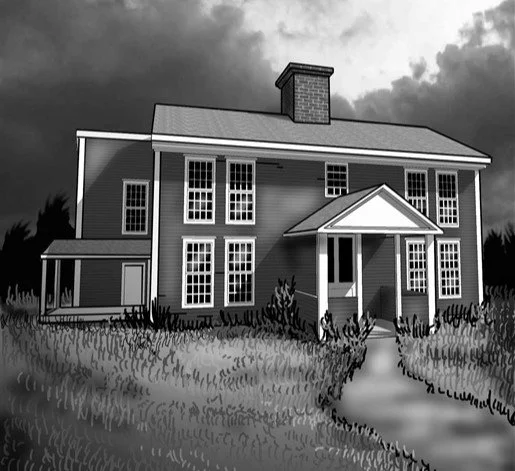
Illustration by Robert Waldo Brunelle Jr. from the book The Vermont Ghost Experience by Joseph A. Citro. Used with permission.
Joseph A. Citro is a Vermont author and folklorist known for collecting New England’s ghost stories, legends, and strange-but-true lore. His most recent book is The Vermont Ghost Experience, available at local bookstores or wherever books are sold. You can also ask your local library to order it for your enjoyment and the enjoyment of other library patrons. In Passing Strange, Citro shares folklore with a curious eye, a storyteller’s warmth, and just enough mystery to make you look twice on the ride home.