
The Pursuit of Happiness
Those words have always fascinated me.

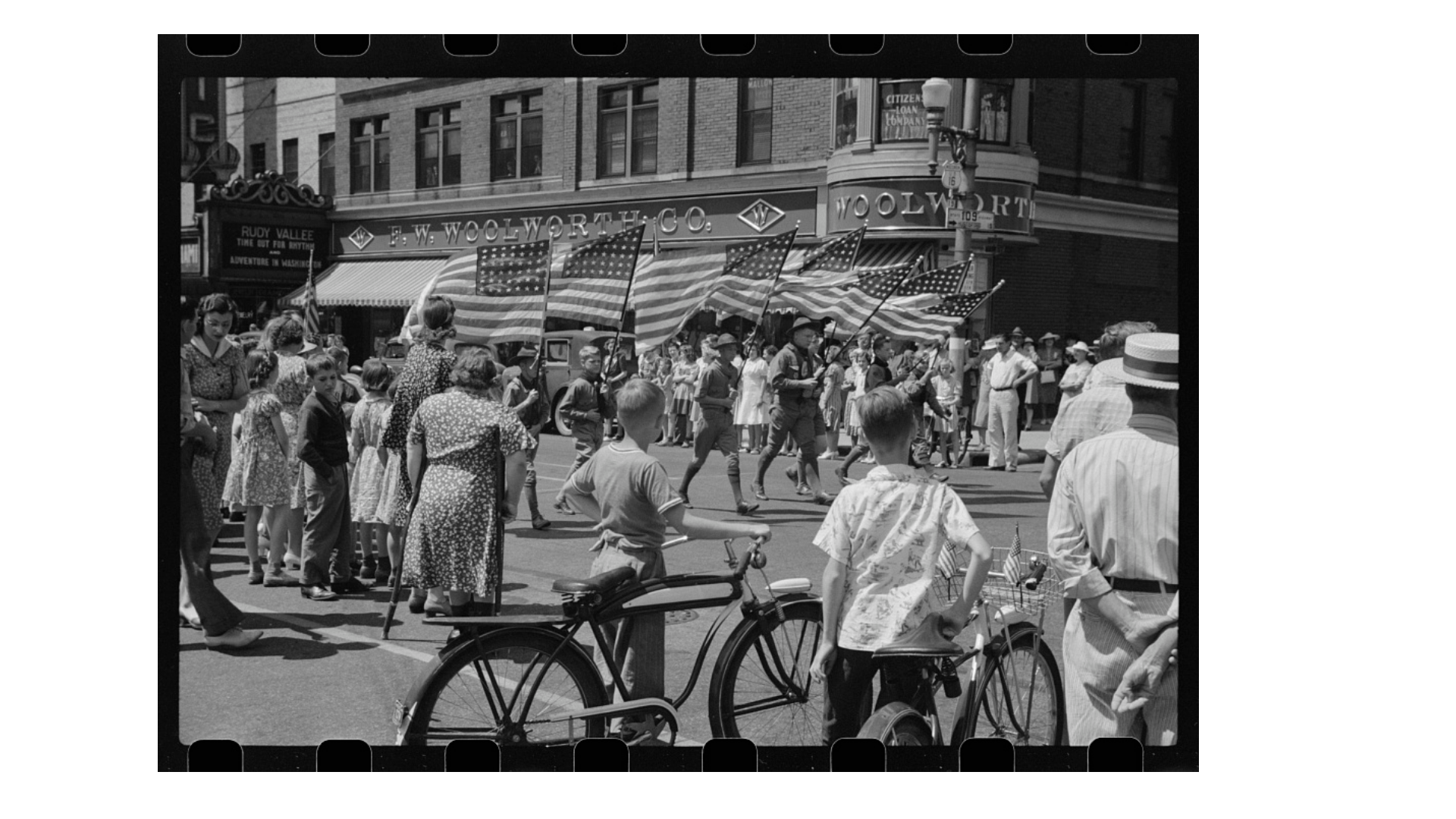
Fourth of July parade, Watertown, Wisconsin. 1941 (Library of Congress)
Every Fourth of July, our family does what millions of American families do. We find a parade, spend time with friends and neighbors, eat more hamburgers and hot dogs than we probably should, and stay up just a little too late waiting for the fireworks. As the first rockets climb into the sky and children point upward in amazement, I usually find myself thinking about what we're really celebrating.
Of course, we're celebrating America's birthday. But I think we're also celebrating an idea.
Not that America is perfect. Anyone who has lived here for any length of time knows we're still a work in progress. Every generation inherits new challenges, solves some old ones, and leaves a few for the next generation. That's simply part of being a country.
The idea we're celebrating is opportunity.
Before owning WYKR and The Bridge Weekly Sho-Case, I spent more than a decade living overseas with the Peace Corps and Doctors Without Borders. Those years changed the way I see the world, but perhaps more importantly, they changed the way I see home.
Living in other countries gives you an opportunity to look at America through someone else's eyes. People would ask where I was from, what life was like here, and what made America different. The answer was almost never about our buildings, our highways, or even our economy.
It was about possibility.
One of the things I came to appreciate while living overseas is that many societies still place tremendous weight on where you were born. Your family name, the village you grew up in, your religion, your parents' occupations, or your family's social standing often shape expectations for the rest of your life. That's not to say people don't dream or work hard—they absolutely do—but the opportunities available to them are often far more limited than many Americans realize.
Returning home gave me a renewed appreciation for something I had always taken for granted.
Here, your future doesn't have to look like your past.
Now, there are limits, of course. At fifty years old, standing about five-foot-eight with what can generously be described as a dad bod, I'm probably not getting a call from the NBA anytime soon. Granted, my driver's license still insists I'm five-foot-ten, and I've decided not to argue with it. The NBA scouts, however, may have a different opinion.
One of my favorite pieces of advice came from my father. Whenever I questioned whether I was capable of trying something new, he'd simply say, "People no smarter than you do this every day."
I've carried that sentence with me for years because it's both funny and encouraging. Most of the people doing remarkable things aren't necessarily the smartest people in the room. They're simply the ones willing to begin.
I was reminded of that during a Doctors Without Borders training many years ago. I met a physician who looked to be well into his seventies, and during a conversation I asked him how long he'd been practicing medicine.
"About a year," he said.
For most of his life, he had been a massage therapist. Then he decided he wanted to become a doctor.
So he did.
I've never forgotten that conversation because it challenged something many of us assume—that life has a schedule. Graduate by this age. Find a career by that age. Retire at another age.
Life doesn't always work that way.
If you had asked me twenty-five years ago what I thought I'd be doing today, I never would have guessed this path. I spent years serving in the Peace Corps and with Doctors Without Borders. Later, I had the privilege of serving as the executive director of a nonprofit supporting individuals with disabilities. Today, I own a country radio station and a community newspaper, and I spend my days talking with maple producers, authors, firefighters, teachers, musicians, business owners, coaches, and the countless volunteers who quietly make our communities stronger.
None of those jobs naturally lead to the next one.
Yet somehow, each one prepared me for what came after.
That's one of the things I've come to appreciate most about being an American.
The Declaration of Independence doesn't promise happiness.
It promises "the pursuit of happiness."
Those words have always fascinated me.
The founders didn't guarantee success, wealth, or comfort. They recognized something far more important—the freedom to pursue the life you believe you're meant to live.
Sometimes that pursuit means starting a business.
Sometimes it means going back to school.
Sometimes it means changing careers after twenty years.
Sometimes it means moving away.
Sometimes it means coming back home.
I've met people who completely reinvented themselves at fifty, sixty, and even seventy-five years old. They remind me that our lives aren't measured by how early we find our purpose, but by whether we're willing to keep growing when new opportunities appear.
As I watch my own children grow up, I find myself thinking less about what careers they'll choose and more about how they'll approach life. The world they'll inherit will almost certainly have jobs that don't even exist today. They'll solve problems we haven't imagined and use technology that hasn't been invented yet.
More than anything, I hope they never feel trapped by the idea that one decision has to define the rest of their lives.
I hope they have the courage to try something difficult, even when success isn't guaranteed.
I hope they understand that changing direction isn't failure. Sometimes it's growth.
I hope they remember that learning doesn't stop when school ends and that it's never too late to discover a new passion or answer a different calling.
Most of all, I hope they always believe they have the freedom to write the next chapter of their own story.
This Fourth of July, as we gather with neighbors, watch parades, flip burgers on the grill, and wait for the fireworks to begin, I hope we remember that one of America's greatest strengths isn't found in our buildings, our technology, or even our history.
It's found in possibility.
It's found in the belief that your story doesn't have to be written for you, that where you begin doesn't have to determine where you end, and that every one of us has the opportunity to grow into something new.
That's the America I hope my children inherit.
And for me, that's what the Fourth of July has come to mean.
Not the certainty that every dream will come true.
But the freedom to keep pursuing the next one.