
Wild Ammonoosuc River Dam Removed
By Gary Moore
Owned by Woodsville Water and Light, the dam on the Wild Ammonoosuc River in Landaff was not being used and was a liability for Woodsville. It is now no longer an impediment to the passage of fish.
The Connecticut River Conservancy has worked with a variety of entities to get funding and the permits necessary to remove the dam. The CRC’s project manager Becky Budd has been on site daily to make sure all goes smoothly and that water quality is not affected.
I met up with Becky at the site adjacent to Route 112, the Lost River Road. Later I interviewed her on my show on WYKR. What follows is some of what I learned about the project.
Since 2014 the CRC has overseen the removal of 26 dams, upgraded six large culverts and restored 431 miles of river habitat to improve fish passage and flood resilience. I have visited and written about several of those sites.
The Wild Ammonoosuc dam was originally built to supply water to Woodsville. It has not been used in years since Woodsville upgraded its water system.
Becky has worked on many dam removals for CRC, but this one is different. She said, “This is the first I have taken from grant writing to design to construction and implementation.”
Each dam removal is different but all require years of preparation and involve partnerships. Becky pointed out that this lead up was much quicker thanks to the cooperation involving many entities responsible for permitting and funding.
Among those responsible were Woodsville Water and Light, the U.S. Forest Service, NH DES, NH Fish and Game, the Town of Haverhill and the NH Charitable Foundation.
The Foundation funds came from the Upper Connecticut River Mitigation and Enhancement Fund created by New England Power as part of the relicensing of the Fifteen Mile hydro complex some 25 years ago. The Fish and Game funding came from the Fish Habitat Fund and the sale of Moose license plates
Physical work started July 8. A bridge to access the west side of the river first had to be built to allow for heavy equipment to cross to the old access road and the pump house. A staging area then needed to be cleared before the actual removal of the concrete could begin.
All of the project is on U.S. Forest Service land so the work had to be approved by that agency.
Before work in the concrete could begin, water diversion had to be implemented to keep from putting sediment in the river.
Lynch LLC of North Stratford was the lead contractor. Led by Mike Lynch, the company has done several dam removals for the CRC. They have demonstrated again and again how to safely and environmentally sound they can remove structures in rivers.
Assisting in some of the rebar removal and the hauling and disposal of the concrete was local contractor Chief Boogie.
Once the dam and wing wall have been completely removed the contractor will return the banks to a natural slope. Flood plain restoration is a big part of the project so excess fill that was put in when dam was built will be removed to allow the water to spread out in flood events.
This fall tree planting will take place to stabilize the banks and more will be done in the spring.
Once completed the area across the river will be returned to a natural state.
Becky used to live in Franconia so this project became a bit personal. She said, “I am extremely proud and glad that I could be here for this project.”
To learn more about the many things the CRC does to enhance the Connecticut River watershed go to: https://www.ctriver.org/.
The CRC mission statement says, “The Connecticut River Conservancy restores and advocates for clean water, healthy habitats, and resilient communities to support a diverse and thriving watershed.
“Through collaborative partnerships in New Hampshire, Vermont, Massachusetts, and Connecticut, CRC leads and supports science-based efforts for natural and life-filled rivers from source to sea.”
Becky wants to encourage people who care about the river to participate in the 30th annual watershed-wide Source to Sea Cleanup, September 18-19 or a date that works best for them.
I urge you to stop by the site on Route 112 and take a look at what has been done. There is a small pull there and you likely will find Becky who will be happy to tell you about the project.
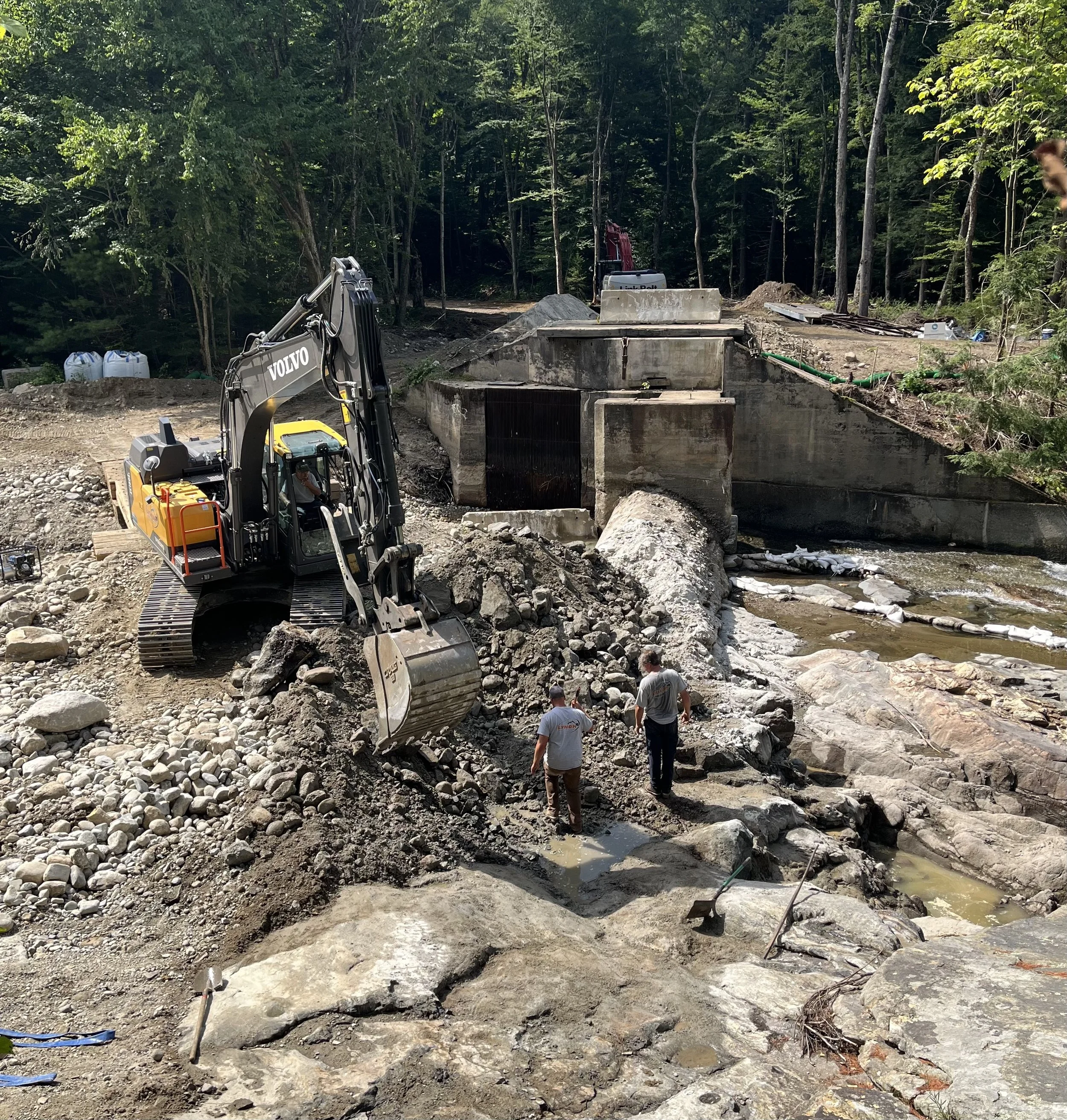
Lynch LLC crew removing concrete from old dam
Unprepared Hikers To Be Billed For Rescue
Last Friday, August 14 New Hampshire Fish and Game was notified at 8:48 p.m. that four hikers were stuck on Franconia Ridge. When contacted by phone it was learned that they did not have lights, were low on water and food and were not properly dressed for the conditions.
Due to the strong winds and cold temperatures above 5,000 feet a rescue call was made. Five volunteers from the Pemi Valley Search and Rescue Team responded to the trailhead along with a Conservation Officer. The Pemi volunteers left the trailhead at 10:35 p.m. They hiked over 4.2 miles to Franconia Ridge and then to Mount Lincoln where they located the four unprepared hikers at 1:15 a.m. on Saturday morning.
The unprepared hikers were given lights, food, water, and warm clothing and then guided to the summit of Mt. Lafayette and then down the Old Bridal Path back to the trailhead arriving at the trailhead at 9:07 a.m. on Saturday morning. The hikers were all 18 years old from New Jersey. They had started their hike at 3:30 p.m. and did not have headlamps, or enough food and water to complete the 7-9 hour hike. Due to the hiker’s lack of preparation, the New Hampshire Fish and Game Department said they intend to bill the hikers for the cost of the rescue.
I would remind them that Stupid Kills.
Bits and Pieces
The Ammonoosuc Conservation Trust has announced the conservation of 44 acres on Dyke Road in Sugar Hill, now known as the Hadley Hill Conservation Area.
This community-funded project protects open field and regenerating forest, strengthens a larger 1,600-acre undeveloped corridor near Bronson Hill and Cooley-Jericho Community Forest, and may support a future trail connection.
***
The NH Fish and Game Commission will meet on Tuesday, September 15 at 1 p.m. at the New Hampton Fire Station, 26 Intervale Drive/Fire House Lane in New Hampton. This is a change of venue for the meeting, which will be open to the public.
Meetings of the New Hampshire Fish and Game Commission take place on the third Tuesday of each month, unless otherwise scheduled and are open to the public. As they become available, meeting agendas, minutes, and recordings can be viewed by visiting www.wildlife.nh.gov/about-new-hampshire-fish-and-game/nhfg-commission.
***
New Hampshire’s fall hunting seasons kick off on Monday, September 1, with the opening of black bear and gray squirrel seasons. Archery seasons for turkey and white-tailed deer get underway on September 15, and the statewide resident Canada goose hunt runs September 1–25.
***
Apprentice hunting licenses are an option for people age 16 and older who want to try hunting but have not taken Hunter Education, or who have not been able to schedule a field day. The apprentice hunting license allows unlicensed people to hunt under the guidance of a licensed hunter age 18 or older. Apprentice licenses are available only at NH Fish and Game Headquarters, 11 Hazen Drive, Concord. Learn more at www.wildlife.nh.gov/hunting-nh/hunter-education/apprentice-hunting-licenses.
***
The NH Fish and Game Department asks hunters not to use natural urine-based deer lures. These products can potentially spread chronic wasting disease (CWD), a neurological disorder that is always fatal to white-tailed deer and moose. Synthetic lures are suggested. Do your part and help keep our deer herd free of CWD. Learn more at www.wildlife.nh.gov/wildlife-and-habitat/wildlife-related-diseases/deer-diseases.
***
Hunters who travel outside Vermont to hunt moose, deer or elk need to follow a regulation designed to protect Vermont’s deer and moose from chronic wasting disease.
Chronic wasting disease (CWD) is a fatal disease that affects the brain and nervous system of deer, elk and moose. Abnormal prion proteins produce lesions in the brain that cause disorientation and emaciation in conjunction with other abnormal behaviors. For the latest information on CWD, check the Vermont Fish and Wildlife website, https://www.vtfishandwildlife.com/ and www.cwd-info.org.
The potential exists for CWD prion proteins to be introduced to the environment through the body parts of CWD-positive deer, elk or moose and then persist in the environment for extended periods of time.
A fine of up to $1,000 and loss of hunting and fishing licenses for one year are applicable for each animal imported illegally.
Vermont Fish and Wildlife is also reminding hunters that using any type of natural deer urine-based or deer body fluid attractant scents is prohibited in the state because of the CWD threat.
***
Deer hunters who applied for a Vermont antlerless deer permit by the July 22 deadline can now go to the Vermont Fish and Wildlife website, https://www.vtfishandwildlife.com/ to see if they won a permit.
Permit winners are listed in two categories, regular lottery winners and landowners. Landowners who apply for a landowner antlerless permit are prohibited by law from posting their land against hunting.
Permit recipients will need to reprint their licenses which have been reformatted to include their antlerless permits.
“Harvesting antlerless deer affords Vermont hunters the chance to secure locally sourced food for their families. It also helps the department balance the deer population with the available habitat,” said Nick Fortin, deer and moose project leader for the Fish and Wildlife Department.
***
Vermont’s resident Canada goose hunting season will be held September 1 through September 25 to help control Vermont’s resident Canada goose population prior to the arrival of Canada geese migrating south from Canada according to the Vermont Fish and Wildlife Department.
The season will be open statewide with a daily bag limit of five Canada geese in the Connecticut River Zone and eight in the rest of Vermont.
A second Canada goose hunting season for resident and migrant birds will be held October 10-November 23 with a daily bag limit of three Canada geese in the Lake Champlain Zone and Interior Vermont Zone.
In the Connecticut River Zone, the second Canada goose season will be October 13-November 11, and November 25-December 24 with a daily bag limit of two Canada geese.
For a fourth year, a late Canada goose season will be held targeting resident birds. Within the Lake Champlain and Interior zones, the season will be held from December 1 to January 4, with a five-bird daily bag limit. The season will run December 25 to January 4 in the Connecticut River zone and applies only to the lands of the zone, not Connecticut River waters.
***
The public comment period for proposed changes to Vermont’s bear hunting regulations is open through September 4. A press release two weeks earlier gave an incorrect date.
***
Mark Breen reports in the Fairbanks Museum's Skywatch Almanac that on August 28, 1971: “Tropical Storm Doria soaked northern New England; 5.56 inches on Mt. Mansfield.
This Friday, August 28: “A nearly Total Lunar Eclipse from 9:30 to 3 a.m. 96 percent of the Moon within the Earth’s shadow from midnight to 12:30 a.m.”
Parting Shots
I was saddened to learn my old friend Charlie Barry of North Haverhill passed away on Wednesday, August 19.
Charlie was 89 and had a good life and a career of public service.
He had a 28 year career with the New Hampshire Fish and Game Department first as a conservation officer and then eight years as Executive Director.
Following his retirement from Fish and Game, Charlie could not sit still. He was elected Sheriff of Grafton County and served in that position for 15 years.
I had known Charlie as a conservation officer but we became good friends when I became Vermont’s Commissioner of Fish and Game in January 1983. Living not far apart on opposite sides of the Connecticut River, we often traveled together to the International Association of Fish and Wildlife Agencies, the Northeast Association of Fish and Wildlife Agencies, the Atlantic Flyway Council and other meetings that the two states participated in.
We also often bounced ideas off each other that we did not yet want to go public with.
Over the years since I left Fish and Game, I would stop to chat with Charlie and Becky and listen to his stories of being a conservation officer which was his first love having followed in the footsteps of his father.
I will miss him.
***
Linda and I celebrated out 56th anniversary Saturday.
***
Mark Beauchesne, Landowner Relations Coordinator for the New Hampshire Fish and Game Department said, “Remember that access to private land is a privilege provided through the generosity of the landowner.” He added, "Practicing good landowner relations is key to maintaining access to private property now and for future generations.”
What he says is also true for Vermont and I will again remind people the future of hunting is up to them.
Ask permission to hunt on someone’s land even if they gave it last year. They may have a youth hunting this year and want others to stay away from a particular area.
Never block roadways, driveways, trails, crossings, or gates. Leave all gates and barriers as you found them.
Be sure you know and follow the regulations involving tree stands and game cameras.
Syndicated columnist Gary W. Moore may be reached by e-mail at gwmoore1946@icloud.com or at Box 454, Bradford, VT 05033. copyright 2026 Gary W. Moore