
The Civilian Conservation Corps Did Much For The Region
By Gary Moore

President Franklin Roosevelt’s “New Deal” did many things to relieve the poverty and unemployment of the Depression. The Civilian Conservation Corps (CCC) was one of those things and it began on March 31, 1933.
I have long had an interest in the CCC, especially the many projects it undertook in Vermont and New Hampshire. A few years ago I went to Plymouth to the Museum of the White Mountains to hear Dave Govatski speak about the camps in NH. Impressed, I vowed to interview him in the future. Much intervened but last month it finally happened when he appeared on my show on WYKR.
Govatski is a forester who retired from the White Mountain National Forest in 2005. His interest in the CCC has lead him to visit all the camp sites in the White Mountains and most in Vermont. He can expound on the details of each, bringing to life a period in our history that many know little about.
He told me there were 30 camps in New Hampshire and 30 in Vermont. Generally they housed 200 men, 50 to a barracks.
Earlier this spring I wrote about my interview with Robert W Averill who wrote Corps of Granite with Kris Pastoriza. The book tells us a lot about the camps that existed in Grafton County and the region.
The Caledonian Record has recently been running stories from Marty Podskoch’s book, The Vermont Civilian Conservation Corps Camps: History, Memories and Legacy of the CCC.
I highly recommend both books to anyone interested in the history of the CCC in the twin states. Designed to provide jobs and training for mostly young, unemployed men, the CCC trained three million men by 1942 when it was disbanded as the men were needed at the start of WWII.
Most of the young men came from the cities where the unemployment was highest. They were housed, fed and paid $1 a day. They only received $5 for the month as $25 of the $30 went home to support families. They worked 5-1/2 days with Saturday afternoon and Sunday off. The standard tour they could sign up for was six months and they could do four tours by which time it was hoped they had marketable job skills.
The CCC camps were an economic driver for the towns in which they were located and the surrounding areas. Money was spent locally buying materials, food and equipment such as vehicles to transport the men. Local tradesmen such as plumbers and carpenters were hired to build the camps and others to work with and teach the trades to the young men.
The Green Mountain State was originally allocated just four CCC camps, but thanks to the aggressive lobbying of State Forester Perry H. Merrill, the State of Vermont received more assistance than many other states. Merrill’s foresight to develop long-range conservation, flood control, and forest management activities, and his lobbying of CCC National Director Robert Fechner, attracted substantially increased funding of CCC activities in Vermont. Thirty CCC camps operated in Vermont in 1937, and between 1933 and 1942, a total of 40,868 individuals worked in Vermont CCC camps.
Workers built trails, roads, campsites and dams, stocked fish, built and maintained fire tower observer’s cabins and telephone lines, fought fires and planted millions of trees, built the flood control dams in East Barre, Wrightsville and Waterbury and most famously, the ski trails on Mt. Mansfield.
Locally, the Burke CCC camp built the road to the summit of Burke Mt. and some of the ski trails. The Brunswick camp built the Maidstone road and much of what is now the Maidstone State Park. The Rickers Mills camp in Groton and the camp in Marshfield built roads, trails and campgrounds in what is now Groton State Forest. There was also a camp in Thetford where the Thetford State Park is now, perhaps best known for the cross county trail Thetford Academy maintains and is used for the state and New England meets.
The projects in New Hampshire were similar resulting in ski trails on Cannon, Moosilauke and Black Mountain as well as the road connecting North Woodstock and Warren.
I was most interested in the Wildwood, Warren and North Woodstock, camps which I had long known about.
Wildwood, located off Route 112 in East/Benton had the distinction of being the first camp in New England. The camp constructed the North South Road, the Tunnel Brook Road and the Lone Pond dam as well as ski trails.
After three years, it moved to North Woodstock to help build the road over the shoulder of Moosilauke to Warren.
I was intrigued to learn the Black Mountain CCC camp off the Lyme Kiln Road in Haverhill was different. It was a camp for women who where taught, what in my high school days, we called home economics. Camps for women were pushed by Eleanor Roosevelt, who history shows, did much to elevate the status of women.
Should you wish to listen to my interview with Dave Govatski, go to:
https://www.wykr.com/the-forgotten-program-that-built-new-england.
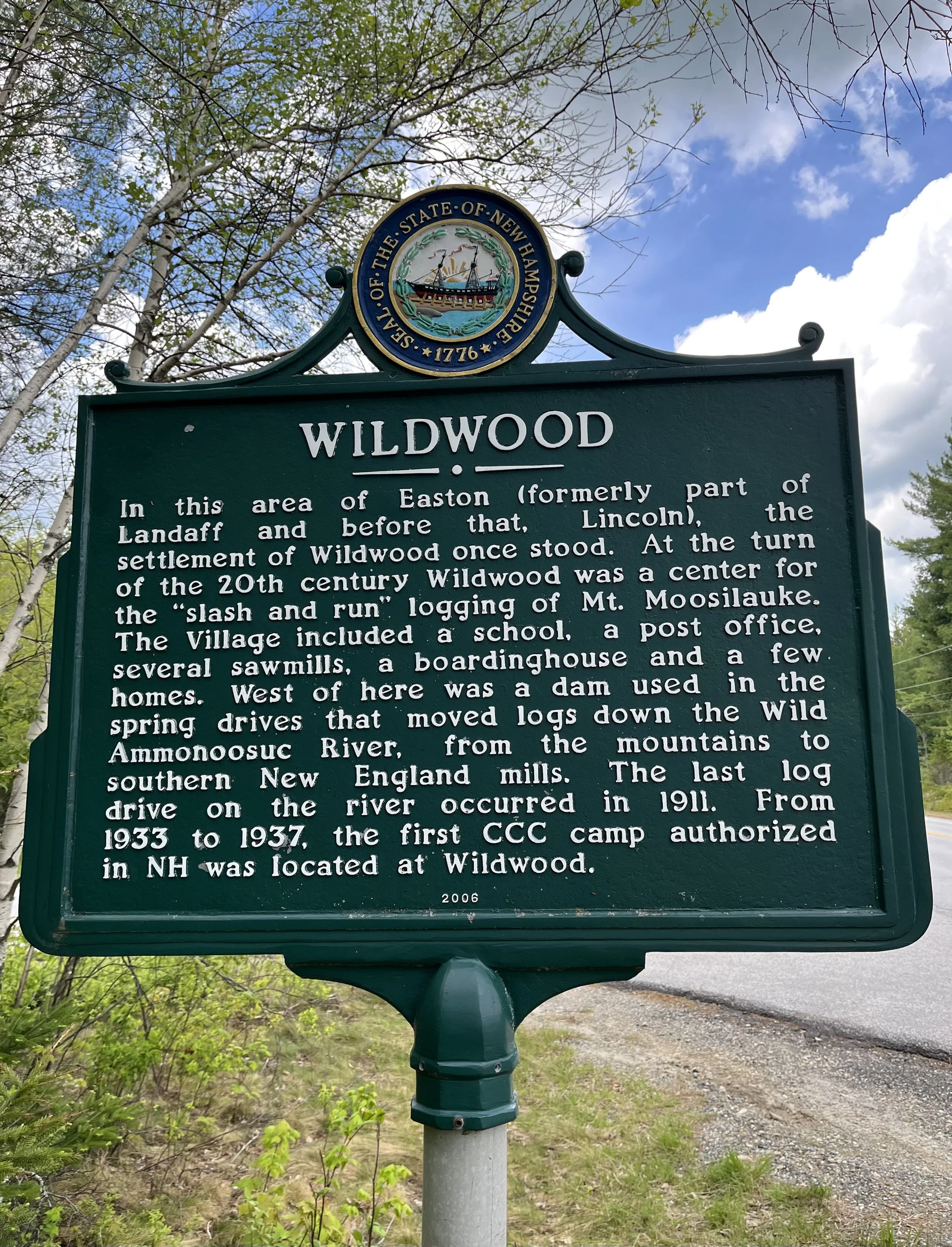
The sign beside Route 112 in Easton commemorates the Wildwood CCC camp
Bits and Pieces
The importation, sale or possession of a pond slider turtle, including the popular red-eared slider, is prohibited, according to the Vermont Fish and Wildlife Department.
Pond slider turtles are the most popular turtles sold in pet stores nationwide. They are also an invasive species that competes for food and habitat with native species like the familiar painted turtle and the endangered spotted turtle.
People who acquired pet pond sliders before July 1, 2025 are allowed to keep their turtles. “If your pet slider was adopted before last July, you do not need to do anything different,” said Luke Groff, the lead reptile and amphibian biologist. “Just keep taking good care of your pet and never release it into the wild.”
If you have a pond slider that you can no longer care for or that was acquired after July 1, 2025, reach out to the Vermont Fish and Wildlife Department for guidance. The department has permitted two stores to accept and rehome unwanted pond sliders.
Releasing pond sliders into the wild is prohibited and potentially dangerous to our native species.
If you see a pond slider in the wild, snap a picture and report your sighting to the Vermont Reptile and Amphibian Atlas, vtherpatlas.org.
***
Join long-time Christmas tree grower Nigel Manley for a session on shearing, basal pruning, cone removal, weed control, mowing, and monitoring for insect and disease issues. Pesticide licensing and plant quarantines affecting Christmas trees will also be discussed.
Presenters will also include, from UNH Extension, Rachel Maccini (Field Specialist, Pesticide Safety Education) and Jim Frohn (Grafton County Forester), along with Morgan Dube (Entomologist, NH Department of Agriculture, Markets, and Food).
The session will be held July 22, 4-6 p.m. at South Farm, 575 Profile Road, Bethlehem.
Registration deadline is Monday, July 20. To register, go to https://bit.ly/Trees-Info-0726
***
Congratulations to Clark Colby of Lunenburg who was honored by the Vermont Land Trust with a Land Steward Award. Nine other students across the state also received awards and $500.
***
The Annual Side X Side Shooting Party is scheduled for August 22 this year at Northeast Kingdom Skeet & Sporting Clays Club in Burke.
For information contact Jack Dudley, at woodcockone@yahoo.com or 207-751-1233.
***
Mark Breen reports in the Fairbanks Museum's Skywatch Almanac that on
July 1, 2004: “Powerful thunderstorms dumped 1 to 2 inches of rain, whipped up some damaging winds, and dropped golf ball-sized hail in Underhill, VT.”
July 8, 1816: “The Year Without a Summer; frost in Middlebury, Williamstown, and Windsor Vermont. Little damage was noted to crops.”
Parting Shots
The oppressive heat and humidity have left me in a funk. I have so much to do in the woods and around the property that the conditions are making difficult. For example, Friday morning I was up at 5, my usual time. I then listened to the news on the tv, read the Caledonian Record and Valley News on line, checked my emails that arrived over night, had my coffee and a couple of raised doughnuts, then headed to the woods to cut up some of the logs I had skidded out last fall.
By 8:30, I had to quit. Despite frequent breaks to drink water and rest, I could not continue to run my chainsaw. I simply had no more energy.
A half hour later I was refreshed after a dip in our very cool pond.
It was up to my office to work with a fan blowing on me and in the afternoon in my shop in the cellar which I always cool.
***
Why do I have to press one for English when you're just going to transfer me to someone I can't understand anyway?
Syndicated columnist Gary W. Moore may be reached by e-mail at gwmoore1946@icloud.com or at Box 454, Bradford, VT 05033. copyright 2026 Gary W. Moore