
By Gary Moore
Many of us anxiously wait all year for the opening of the firearms deer seasons in Vermont and New Hampshire.
The wait is over or about to be. New Hampshire’s regular firearms season opened November 11 and closes December 6 except in WMUA when I closes a week early on November 29.
Hunters need to know what WMU they are hunting in as each has differing times when either sex deer may be taken and when it is antlered only.
The muzzleloader deer season in New Hampshire opened October 31 and continues through November 10. It is my favorite deer season in the twin states.
Successful deer hunters have the option of registering their harvest online. To register your deer online, or to learn more about what to do following a successful harvest, visit www.wildlife.nh.gov/hunting-nh/deer-hunting-new-hampshire/how-register-your-deer. Physical registration stations also remain an option for those who prefer the experience of registering in person.
To allow for collection of biological data, online registration will be not be available during the first 3 days of firearms season, November 11, 12, and 13. Hunters must register their deer in person at a registration station on these days. Visit www.wildlife.nh.gov/hunting-nh/check-stations-registration for a list of registration stations in New Hampshire.
Vermont’s firearms season opens this Saturday and continues through November 29.
New rules this year allow hunters with an antlerless deer permit to take antlerless deer during this season. Antlerless permits were distributed by lottery earlier this year. Hunters without an antlerless deer permit cannot take antlerless deer during this season.
Vermont hunting licenses include a buck tag for this season and a late season bear tag for Nov. 14-22.
Information on the use of tags is included with other rules on Fish and Wildlife’s website home page under White-tailed Deer Hunting.
The definition of a legal buck depends on the Wildlife Management Unit. A map of the WMUs is on pages 24 and 25 of the 2026 Vermont Hunting & Trapping Guide available from license agents and highway rest areas.
In WMUs C, D2, E1, E2, G, I, L, M, P, and Q a legal buck is any deer with at least one antler three inches or more in length.
In WMUs A, B, D1, F1, F2, H, J1, J2, K, N, and O a legal buck is any deer with at least one antler with two or more antler points one inch in length or longer.
Hunters who get a deer on November 14 or 15 can help Vermont’s deer management program by reporting their deer at one of the biological check stations operated by Fish and Wildlife Department personnel.
These area reporting stations will have a biologist present on November 14 and 15: R&L Archery in Barre, Wright’s Enterprises in Derby, Maplefields in Plainfield and The Concord Station in Concord.
Hunters who do not go to a biological reporting station are asked to provide a tooth from their deer. Tooth envelopes and tooth removal instructions are available at all big game reporting stations. Each tooth will be cross sectioned to accurately determine the deer’s age, and the results will be posted on the Fish and Wildlife website next spring.
The Vermont Fish and Wildlife Department is asking hunters to participate in its annual deer hunter effort and sighting survey which will be available on Fish and Wildlife’s website after the start of the regular season on November 14.
The survey asks hunters to record how many hours they hunted and how many deer, moose, bears, or other wildlife they saw each day they hunted. This information helps the department evaluate how hunting pressure and the number of these animals varies around the state.
“This survey is a great opportunity for hunters to let us know what they saw and to help inform management of deer and other wildlife,” said Nick Fortin, Fish and Wildlife’s deer and moose project leader. “If we hear from more hunters, our population estimates will be more reliable, and our management will be more effective.”
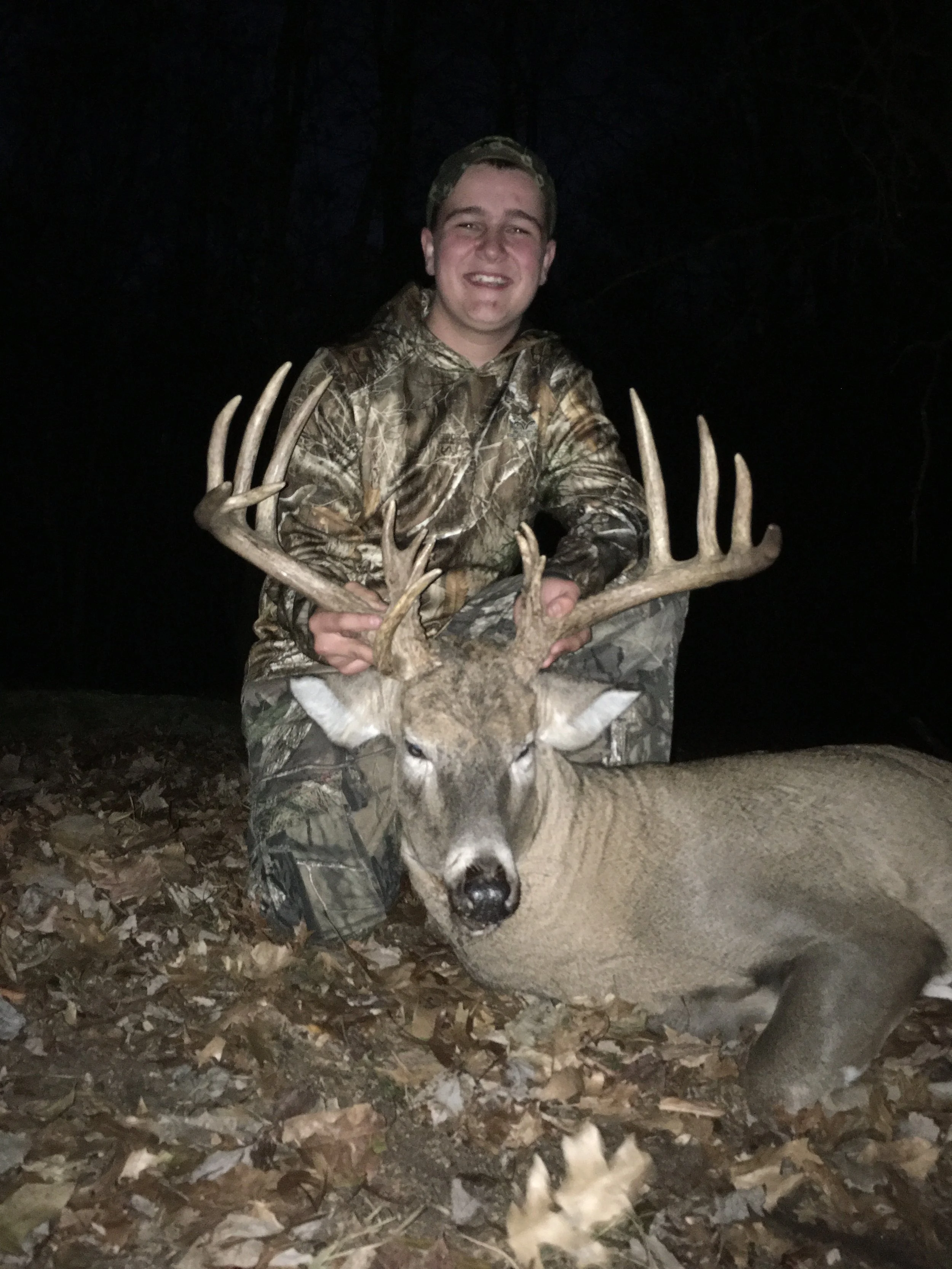
Michael Jolley and his trophy buck
Bits and Pieces
Vermont has a new cold-weather boating law that requires anyone on the open deck of a vessel underway to wear a properly secured, U.S. Coast Guard-approved life jacket (PFD) from November 1 through May 1 each year.
The law includes motorboats, sailboats, fishing boats, pontoons, kayaks, canoes, and paddleboards.
Senate Bill S.326, the annual omnibus transportation bill, included the boating law and became law this summer.
I believe it will save lives. Plunging into cold water this time of year can soon be debilitating and lead to death.
***
Now in its seventh season Vermont Fish and Wildlife is once again offering a virtual program for classes from kindergarten through eighth grade designed to get kids outside with their teacher, while also learning about Vermont’s local wildlife.
Scat and Tracks is a 4-week program that gives educators plans and support to lead nature hikes on school or nearby grounds. Each week highlights a different Vermont species paying particular attention to their individual habitat needs and signs they leave behind such as tracks and scat. This year the program will be highlighting moose, long tailed weasel, red fox, and eastern cottontail.
Classes participate by first watching a pre-recorded video that highlights the species of the week. After the video the classroom teacher then leads the students on a nature hike to search for signs of the species discussed while also emphasizing the particular habitat needs of the species.
Teachers can structure the walks based on their schedule and grade level and add additional content at their discretion. In 2027 the program will begin the week of January 3.
Registration is required by December 15 and can be completed at the Scat and Tracks webpage on Vermont Fish and Wildlife’s website.
Questions can be directed to Education Specialist Corey Hart by emailing him at corey.hart@vermont.gov, or calling him at 802-505-5562.
***
Mark Breen reports in the Fairbanks Museum's Skywatch Almanac that on November 13, 1946: “The first cloud-seeding experiment over the Berkshires of Massachusetts, producing a local snow shower.”
November 16, 1933: “The coldest weather so early in the season dropped thermometers to 2 degrees in St. Johnsbury, and 6 below zero in Woodstock, VT.”
Parting Shots
I find it difficult to understand how any reasonable person could vote a straight party ticket.
I have never done so despite having served as Republican town chair, county chair and member of the state committee in the past.
It boggles my mind that anyone could believe that every candidate listed on the ballot from a particular party was the best. Do they do the research and pay attention or simply swallow the cool aid of a particular party?
Syndicated columnist Gary W. Moore may be reached by e-mail at gwmoore1946@icloud.com or at Box 454, Bradford, VT 05033. copyright 2026 Gary W. Moore