
Explore The Conte National Wildlife Refuge’s Nulhegan Basin And Pondicherry Divisions
By Gary Moore
We are lucky that northeastern Vermont and Northern New Hampshire are home to two divisions of the Silvio O. Conte National Wildlife Refuge. The two provide a wide variety of habitats and miles of roads and trails to explore as I have written in past years.
I interviewed Wildlife Refuge Manager Steve Agius for my program on WYKR and for this column. I have known Steve since he first took over as manager and have appreciated his dedication to the refuge and to providing public access. The Wheelock resident is a research biologist by training who has worked in many parts of the U.S. and even in Antartica during his career.
The Silvio O. Conte National Fish and Wildlife Refuge was established in 1997 to “conserve, protect and enhance the abundance and diversity of native plant, fish and wildlife species and the ecosystems on which they depend throughout the 7.2 million acre Connecticut River watershed.” Currently, the refuge is comprised of nearly 40,000 acres within parts of the four watershed states of New Hampshire, Vermont, Massachusetts, and Connecticut.
The refuge includes ten divisions and twelve units that represent a wide variety of unique habitats. Many opportunities exist for visitors to explore the diverse landscapes of the Connecticut River watershed.
Agius is responsible for the Refuge’s Nulhegan Basin and Pondicherry divisions. I joked that he would find no penguins in either to benefit from his experience working with the birds in Antarctica.
There are three full time employees including Agius to do all the things required to meet the goals of the refuge. That means they all have to be flexible and do things not necessarily in their job descriptions. I know from my many visits to the Nulhegan Basin Division that they do it all, do it well, and take pride in what they are able to accomplish.
Agius proudly stated, “I have a very skilled and dedicated staff” and I agree.
The Nulhegan Basin Division is located in the towns of Brunswick, Ferdinand, Bloomfield, and Lewis. The division headquarters and visitor contact station is located on Route 105 in Brunswick. Refuge lands consist of more than 26,600 acres of conifer and deciduous forest interspersed with forested wetlands, peatlands and shrub swamps, and contain three of the four tributaries of the Nulhegan River. The lands are within a working forest landscape exceeding 150,000 acres.
The basin’s vegetation most closely resembles that of the northern Appalachian Mountains, interspersed with elements of the boreal forest to the north. The division is known for abundant songbirds, particularly boreal species and warblers, and has been designated an Important Bird Area by the National Audubon Society. It is open to the public for hunting, fishing, wildlife observation and photography, environmental education, and interpretation.
The visitor center is open daily from 8 a.m. to 4:30 p.m. and admission to the exhibits is free. A scenic overlook behind the visitor center is a great nice to relax and get an idea of the vast area to the north that is the refuge. My favorite overlook is above Lewis Pond which provides panoramic views of the Nulhegan Basin and is a great place to have lunch.
The division has 40 miles of roads that provide access to five elevated board walks. One is named for Molly Beatie the former Vermont Commissioner of Forest, Parks and Recreation and the first woman to become Director of the U.S. Fish and Wildlife Service.
Agius is excited about the large-scale habitat management research project with the University of New Hampshire, the University of Vermont and the University of North Dakota that is underway on the Nulhegan Basin division. They are conducting a 500 acre variable density project, thinning with brush saws between the Four Mile and Lewis Pond Roads. The focus is on snowshoe hare, spruce grouse, rusty blackbird, blackburian warbler and Canada warbler.
I was most interested to learn that they are trapping and radio/gps collaring 50 plus snowshoe hare to better understand habitat utilization of hare pre- and post-treatment.
There are 14 students living on site doing data collection to assist in the several studies underway.
Small clear cuts for woodcock early successional habitat are being created and woodcock are being tagged to better understand where they go from Atlantic Canada to mid coast U.S.
Each year 16,000-19,000 red spruce and white pine seedlings are planted. Also thinning is being done to allow for better growth for a shift back to spruce fir which was once prominent in the sub boreal habitat. Agius said we will be judged by, “how successful are we at improving and restoring biodiversity.”
I was surprised to learn that there are many autonomous recording devices for bird songs. That provides a way to better understand what birds are on the refuge and when they come and go.
There are other projects underway as well including the North Branch bridge replacement, installation of two large arch culverts on the Lewis Pond and Tim Carrol Roads, road upgrades and roadside mowing.
The Pondicherry Division, at 6,405 acres, is located in Jefferson, Whitefield, and Carroll, New Hampshire.
The area, including Cherry and Little Cherry Ponds and the surrounding complex of wetlands and swamps, has long been known for its high quality habitat and rich, diverse assemblage of wildlife species, particularly birds. In 2004, the Pondicherry area was designated the first “Important Bird Area” in New Hampshire for its rich variety of breeding and migrating birds.
There are five trails located within the Pondicherry Division. The Mud Pond Trail is a 0.6 mile wheelchair accessible trail. The Little Cherry Pond Trail, the Shore Path Trail, and the Rampart Path are located in the center of the division and are accessible from the Presidential Recreational Trail managed by the New Hampshire Bureau of Trails. This rail-trail can be accessed from trail heads on Airport Road and Route 115A in Jefferson.
I like to wander the network of trails with binoculars to better view the many bird species found in the refuge. There is an observation platform at Cherry Pond that is an ideal place to watch for birds.
The Nulhegan Basin Division And Pondicherry Division should be on everyone’s bucket list. Over the last few years, they have been trying to improve options for mobility and many sites are wheelchair accessible.
The two refuges and the Brunswick visitor center are great resources for teachers. As along time educator, I can attest your students will benefit from a visit.
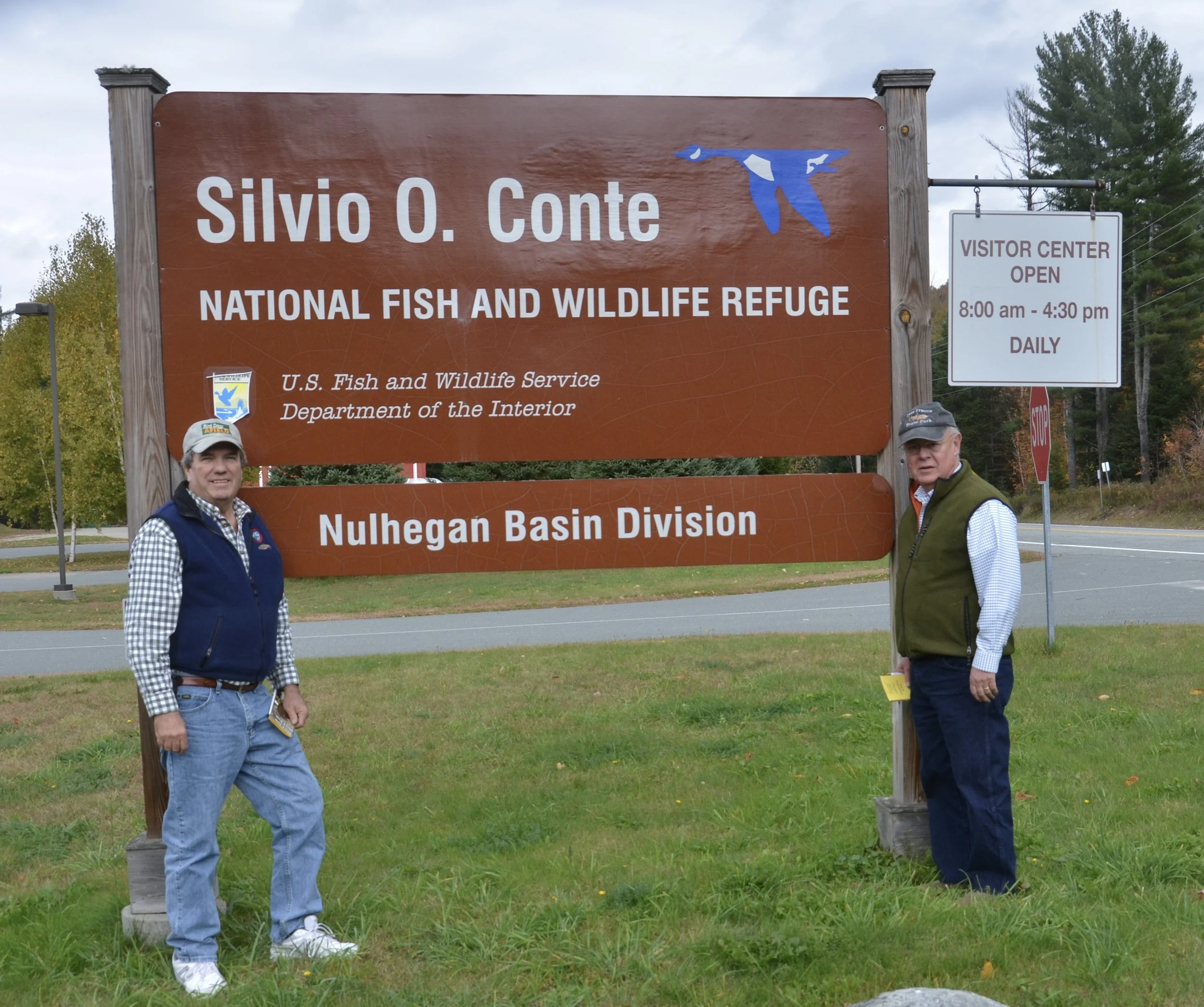
Journalists Stu Bristol from Maine and Tom Fuller from Massachusetts visit Conte Refuge
Bits and Pieces
Vermont’s black bear population is estimated at 7,500 to 8,900 bears based on 2025 data, the most recent available, according to the Vermont Department of Fish & Wildlife. This marks the fifth consecutive year that the bear population estimate is above the state’s objective of 3,500 to 5,500 bears.
“Our model shows the bear population has remained above our goal of 3,500 to 5,500 bears since 2021,” said Jaclyn Comeau, the department’s lead bear biologist. “Increasing frequency and severity of human-bear conflicts during this time also support the model results of a growing bear population.”
“With all signs pointing to sustained growth in Vermont’s black bear population and the number of severe human-bear conflicts reported to our department each year also increasing, we implore Vermonters to redouble their efforts at proactive coexistence with our bears,” said Comeau. “Keeping trash secured where bears cannot get it, protecting backyard chickens with an electric fence, keeping birdfeeders down until there is consistent snow on the ground and following bear-aware composting guidelines are the basic responsibilities of living in bear country. Advice on how to put these coexistence measures in place is available https://www.vtfishandwildlife.com/learn-more/living-with-wildlife/living-with-black-bears and from our partners at BearWise.org.”
***
The Vermont Fish and Wildlife Department now has information on its website, https://www.vtfishandwildlife.com/, about the 2026 controlled waterfowl hunts at Dead Creek Wildlife Management Area in Addison and at Mud Creek Wildlife Management Area in Alburgh.
***
Mark Breen reports in the Fairbanks Museum's Skywatch Almanac that on August 1, 1842: “Randolph, VT had a maximum of 50 degrees according to William Nutting’s diary; ”kept fire in the office all day.” Flurries in Quebec City.”
August 3, 1970: “Waterspout came ashore at St. Albans, VT, injuring seven people.”
August 4, 1918: “Temperatures fell to the 30s, including 38 in Woodstock and Cavendish, VT, with scattered frost likely in the colder mountain valleys.”
August 13, 1955: “The remnants of Hurricane Connie soaked southern VT; Weston, 8 inches, Readsboro, 8.08 inches, and Whitingham, 8.29 inches.”
August 17, 1879: “An early winter surprise in Bolton, VT ; 2 inches of snow!”
Parting Shots
Do you spend time hiking in Vermont or New Hampshire but don’t have the time or interest in helping with trail maintenance?
You can join one of the many organizations that maintain the trails you use. I seldom have the time to help so I pay dues to the Appalachian Mountain Club, the Green Mountain Club and the Dartmouth Outing Club. It is a way to help support the trail maintenance work.
You can also help support your local trail network that is town owned and volunteer maintained.
Syndicated columnist Gary W. Moore may be reached by e-mail at gwmoore1946@icloud.com or at Box 454, Bradford, VT 05033. copyright 2026 Gary W. Moore