
Cutting Wood Is Good For The Body And The Psyche
By Gary Moore
I enjoy cutting and splitting wood. It provides a worthwhile way to work off frustrations and satisfaction in knowing that my oil bill will be reduced. Getting my wood supply in for the winter also provides exercise that I need.
I am reminded of what Aldo Leopold had to say in A Sand County Almanac.
“There are two spiritual dangers in not owning a farm. One is the danger of supposing that breakfast comes from the grocery, and the other that heat comes from the furnace.
“To avoid the first danger, one should plant a garden, preferably where there is no grocer to confuse the issue.
“To avoid the second, he should lay a split of good oak on the andirons, preferably where there is no furnace, and let it warm his shins while a February blizzard tosses the trees outside. If one has cut, split, hauled, and piled his own good oak, and let his mind work the while, he will remember much about where the heat comes from, and with a wealth of detail denied to those who spend the weekend in town astride a radiator."
We have three wood stoves, two of which are in use 24/7 November through mid April. That means we burn quite a bit of wood, 7-8 cords a winter actually.
All of that wood comes from our own land with the only actual cost being gas and oil for my chain saws and wood splitter and diesel fuel for the tractor. The rest is sweat equity.
I do not take extra fuel to the woods for the saws as I find that by the time I have used up a tank and have cut, skidded and piled the results, it is time to head home. I have had plenty of exercise but have not been at it long enough to be too tired.
Often I will be working in the office and staring at my computer screen with little to show for it. That is the time to grab my saws and tractor and head to the woods for an hour or so after which I return with mind clear and often able to be productive.
Over the years I have found cutting wood to be good for my marriage. You know how it is when you return home from work or a meeting in a mood that is not conducive to dealing with issues on the home front. An hour of cutting and piling wood seems to relieve my stress and I return home with a much more pleasant personality.
The past year my wife’s cancer has occupied my thoughts all the time and, when it all seems overwhelming, I head to the woods to work and that helps a lot.
Cutting wood is enjoyable because I can see what I have accomplished at any time. Most of what I do is deal with people and their problems or situations that take weeks or months or even years to bring to fruition. At the end of the day, it often seems like I have accomplished nothing. That is not the case with my wood cutting. I can see how high the pile of logs I skidded out is and the height of the pile of wood I cut and split. There is satisfaction in that.
As I cut my wood a year ahead, I seldom feel pressured to cut more or longer. I try to have the next year’s wood cut, split and piled before winter arrives. Thus all the wood we burn has dried at least a year and much of it close to a year and a half.
I pile the wood in single rows along my network of roads and cover it with tin. That allows air to freely circulate through the wood and helps season it. It remains in the woods until the late summer or early fall when I bring it in to fill the two woodsheds.
Thoreau wrote in Walden, "Every man looks at his woodpile with a kind of affection. I loved to have mine before my window, and the more chips the better to remind me of my pleasing work.”
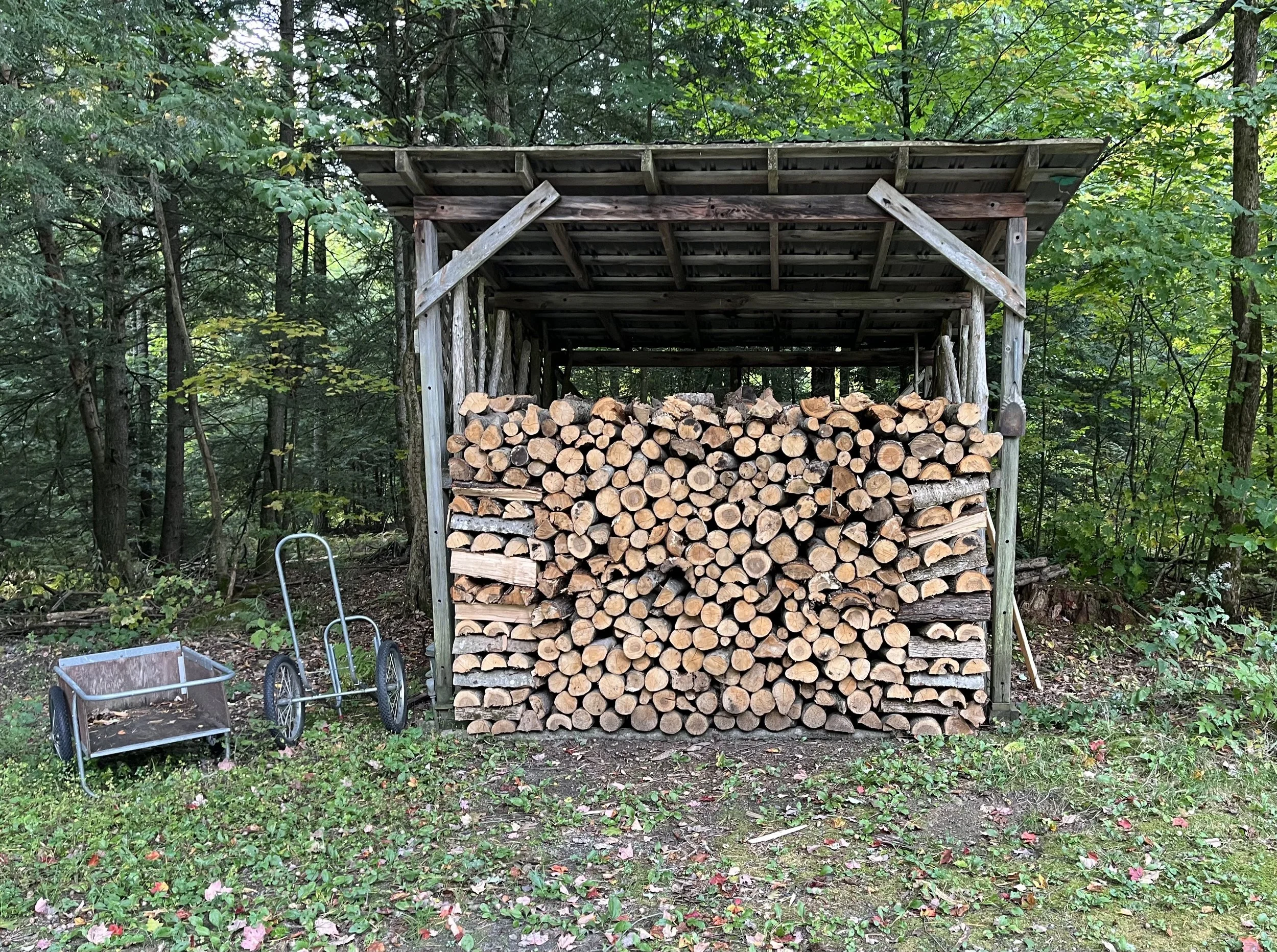
There is satisfaction in a full woodshed
Get The Lead Out
The Vermont Fish and Wildlife Department encourages hunters to voluntarily use non-lead ammunition.
“Choosing non-lead ammunition is a smart choice for hunters,” said Fish and Wildlife Commissioner Jason Batchelder. “Avoiding lead bullets and shot is beneficial to wildlife and safer when we put game on the table.”
Lead bullets scatter lead fragments well beyond the point of entry as they expand. These fragments can be ingested by wildlife when they scavenge carcass remains or gut piles. Even small amounts of lead can cause health problems and death for wildlife, especially for birds such as bald eagles, crows, ravens, and vultures that feed on these remains.
“Finding non-lead ammunition used to be difficult because it was not widely manufactured,” said Batchelder, but non-lead big game ammunition with copper or copper alloy bullets is now produced by most ammunition companies, and it provides consistent expansion as well as excellent weight retention and penetration. It does cost a little more, but it is a healthy choice.”
Non-lead shotgun shells have been required by the U.S. Fish and Wildlife Service for waterfowl hunting since 1991.
To learn more about switching to non-lead ammunition, visit the North American Lead-Free Partnership online.
Bits and Pieces
Remember, Vermont Fish and Wildlife Department and New Hampshire Fish and Game are reminding hunters of a regulation designed to help keep deer healthy by banning the use of any deer lure containing deer urine or other deer bodily fluids.
The infectious agent of Chronic Wasting Disease (CWD) is 100 percent fatal to deer and moose.
Nearly all urine-based lures are produced in captive deer facilities, where CWD is most likely to occur. CWD has not been detected in Vermont or New Hampshire but has been in New York.
***
The New Hampshire Fish and Game Department reminds hunters that the Granite State’s 7-day fall turkey shotgun season opens October 12 and runs through October 18. Eight of New Hampshire’s Wildlife Management Units are open to fall shotgun hunting this year: D2, H1, H2, I1, J2, K, L, and M.
New Hampshire also offers a statewide fall archery season for wild turkey from September 15 through December 15 in WMUs B through M, and through December 8 in WMU A.
***
Winter is on its way, and free in-person Snowmobile Safety Education Classes are now being scheduled in the Granite State. To operate a snowmobile or off-highway recreational vehicle (OHRV) in New Hampshire, any person age 12 or older must have either a valid motor vehicle driver’s license or have successfully completed an approved OHRV/Snowmobile Safety Education class. These classes are taught by instructors and staff trained by the New Hampshire Fish and Game Department. To learn more or to sign up for a class, visit www.wildlife.nh.gov/highway-recreational-vehicles-ohrv-and-snowmobiles/ohrv-and-snowmobile-safety-education.
***
Mark Breen reports in the Fairbanks Museum's Skywatch Almanac that on October 3, 1780: “The first of two October snowfalls brought a “light snow about 3 inches deep” to Pomfret, VT, from in Jonathan Carpenter’s diary.”
October 6, 1836: “Second of three early snowfalls whitened the Green Mountains. Rain mixed with snow at Bennington, VT, and Williamstown, MA.”
Parting Shots
As my lead story explains, my woodsheds are full with eight cords of dry wood that was cut over a year ago. Friday I finished skidding out next year’s wood to my road network where I will spend the next few months cutting it up, splitting it, piling it and covering it with tin to dry.
I am behind this year because of so much time devoted to hospital appointments for Linda and me. For example, she has three this week and I one. Last week I had two and the week before I had three and Linda two.
Throw in the usual board and committee meetings, teaching for the Fire Academy and hazmat team and I have had little free time to hunt, fish or hike.
***
Every time I fill up one of our vehicles at the pump, even more so when I buy diesel fuel for my tractor, I cringe. I can’t help but think back to what I paid for both prior to Donald Trump’s attack on Iran which he said would be over in days.
I can just imagine how difficult it is for all the farmers around the country trying to harvest their crops and for the truckers who haul almost everything we need.
Syndicated columnist Gary W. Moore may be reached by e-mail at gwmoore1946@icloud.com or at Box 454, Bradford, VT 05033. copyright 2026 Gary W. Moore