
Piermont student water testing performed for traces of manganese
The alert was set off several years ago by a social media comment noting that a medical professional in Warren had begun a study of the possible high incidence of cancer among some residents living along Route 25C and 25 from the Piermont area over Ore Hill and into Warren.
By Bernie Marvin
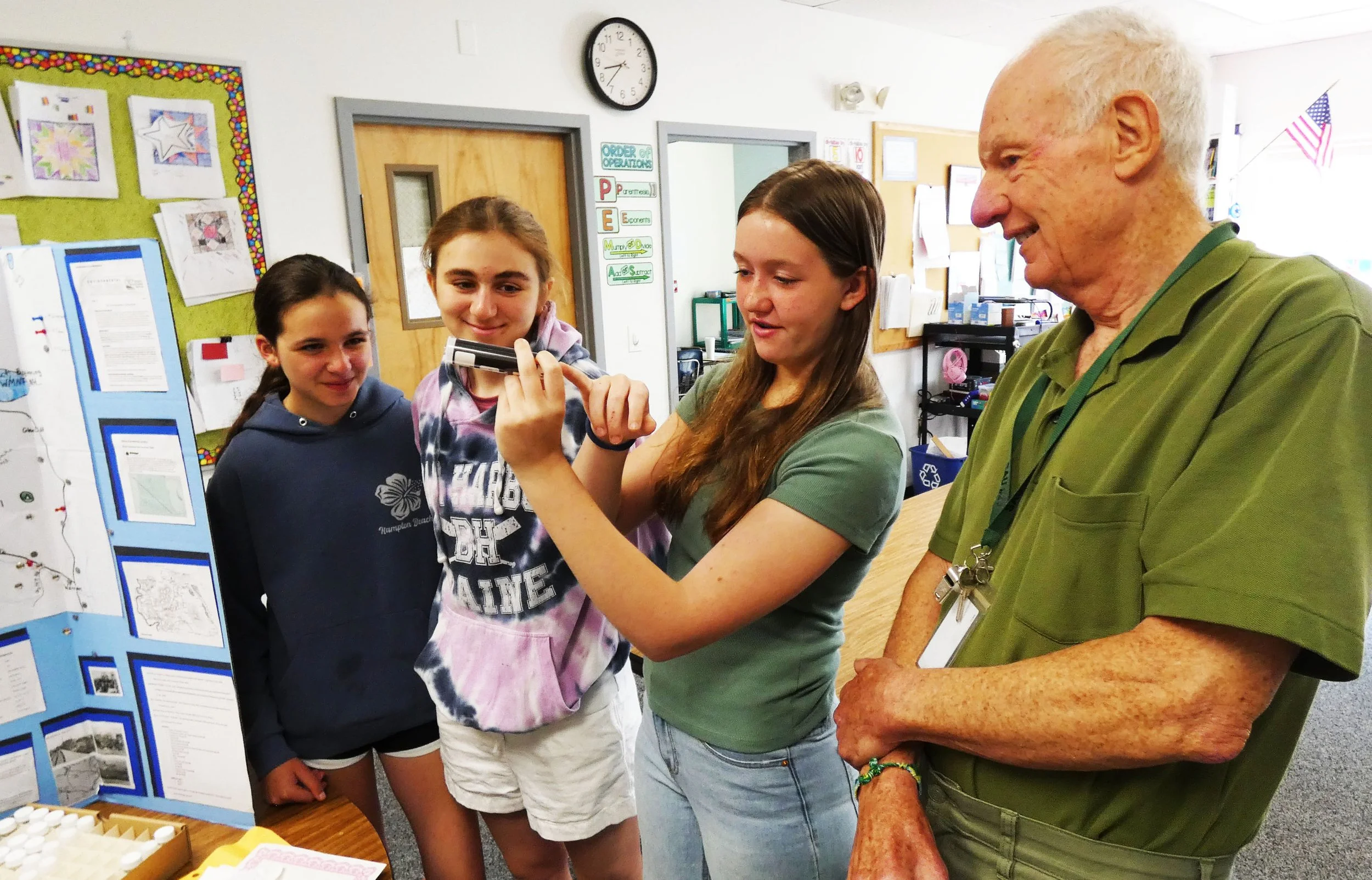
Piermont Village School students, left to right, Sam Hogan, Isabelle Spooner and Kate Donnelly show Science Teacher Geoff Ashworth how they measured water samples from properties in the Haverhill, Piermont and Warren areas for manganese content. Those results were used by the students as the subject of a New Hampshire Middle school Science Fair exhibit held last month at the New Hampshire Technical Institute. Samples from two locations in Warren revealed there were .3 parts per million of manganese in the water. Residents of those two locations were notified of the findings. The Bridge Weekly/Bernie Marvin.
Piermont, NH – A group of science class students and their teacher from the Piermont Village School recently tested several groundwater and well sites along Route 25C between Piermont and Warren, and along sections of Route 10 and 25 in Haverhill, a large area where mining was once conducted. They were concerned about the presence of manganese in the area's water sources, which could have been released when the mines were abandoned many years ago.
Piermont Science Teacher Dr. Geoffrey Ashworth, who has been at the Piermont Village School for six years, and three students, Kate Donnelly, Isabelle Spooner, and Sam Hogan, were alerted to the possible presence of harmful chemicals in the water being consumed by residents in the three towns, where, between them, lies Ore Hill, the site of a large mining operation many years ago.
The alert was set off several years ago by a social media comment noting that a medical professional in Warren had begun a study of the possible high incidence of cancer among some residents living along Route 25C and 25 from the Piermont area over Ore Hill and into Warren.
Mining on Ore Hill many years ago, the writer indicated, could have been the culprit behind contaminated drinking water caused by poor excavation practices in the area. With that in mind, the three Piermont students spoke with Dr. Ashworth about conducting some research into the possible presence of manganese in the water.
At the same time, plans were being made for the school to have a presence at the New Hampshire Middle School Science Fair at the Technical Institute in Concord on May 21, 2026. They decided that studying the harmful chemical would be a strong topic for their Science Fair project.
Dr. Ashworth told The Bridge Weekly in a recent interview at the school that water from areas where students lived was tested. Scientific research testing equipment was purchased by the school, with other supplies being donated to the experimenters by the New Hampshire Academy of Science at the Crossroads Academy in Lyme.
He said the sample bottles they received were placed with the families, and water testing samples were drawn. He said the group was pleased that there was little manganese present across the entire range of properties tested and that only two homes in Warren were found to have more than a trace amount of manganese, measured at the .3 parts per million limit. The families were notified of the chemical's presence by the school, Dr. Ashworth said.
He noted that he would recommend that the two residences where manganese was found have a full water test conducted by the state to determine whether there are more chemicals in the water beyond a trace of manganese.
Dr. Ashworth said that student Sam Hogan came up with the idea to do the water testing program. The group talked about how they would perform the testing and find the results for each water sample submitted by the residents in the three-town area that was being tested. The information about the water testing program was presented graphically on a large cardboard sheet and displayed in the science fair exhibit.
At each test site, a tap or well water sample was gathered. The group found only two samples from the Route 25 area that measured manganese at 3 parts per million. The testing program remained blind throughout, with the sample bottles being numbered. Dr. Ashworth said the samples were tested for color depth, which corresponded to the manganese percentage in each sample.
That would determine just how much manganese was contained in the water sample. Dr. Ashworth said he and the three students traveled to the May 21 science fair, where there were 60 or more exhibits being judged. He said the judges' comments to the Piermont team were superb; they received high ratings, but unfortunately, they took home no awards.
The students and Dr. Ashworth figured that their experiment, which was presented at the fair, was probably too well done for that particular science fair. They agreed that what they had done in sampling and gathering the information was "reaL science." He said they feel good about what they did and that their science project, presented at the fair, was well done.
He said that next year Kate will move on to the ninth grade, Sam and Isabelle will be eighth graders, and he is looking forward to another great science fair exhibit. He said the students should be proud of what they did. "Real science with real people, and they got real science results," he said.
The state guidelines for manganese are set at 0.3 on the scale, and they found two cases of local water exceeding that level. "That's real science," Dr. Ashcroft said.
Piermont's Old Times Remembered by Senior Residents and Friends
All the stories were about old Piermont, including some folks now long gone who had contributed to the town's unique, close feeling of friendship, assistance, and awesome meals. Back then, just about every home had a barn and a shed and a connector building that housed a family dairy and meat-raising effort, a barn full of winter hay and warm, comfortable homes with jelly closets brimming with sweet preserves, jams, and tender pickles that many folks in Piermont still put up each year when growing season rolls around.
By Bernie Marvin
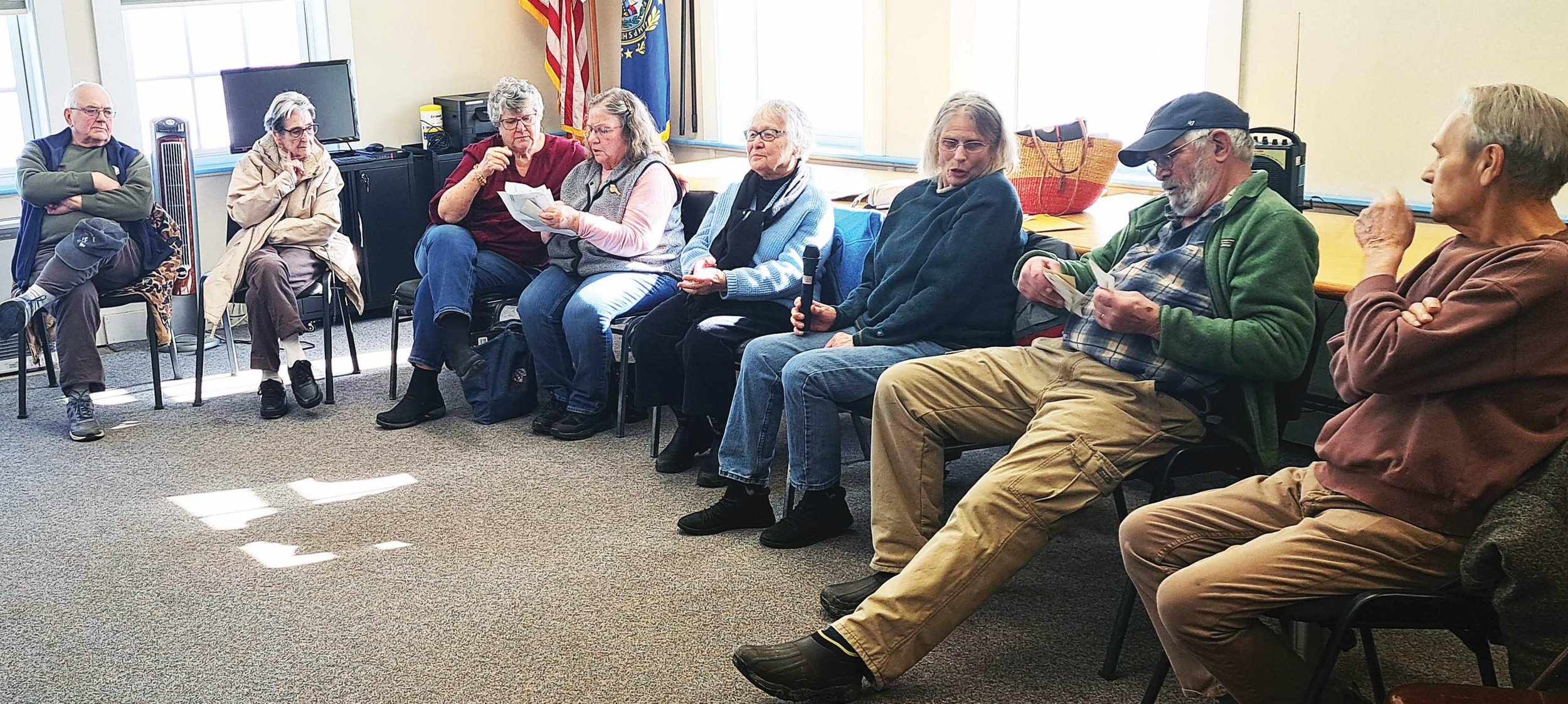
Seated in the Piermont Old Church Building recently were these folks, and others, who told of their early days in Piermont, attending school, church and raising a little Cain here and there. The program was sponsored by the Piermont Historical Society and they promised another one will be held in the future. Seen left to right are Tim Cole, Suzanne Woodard, Diane Winot, Julie Lamarre, Polly Marvin, Mary Musty, Jim Putnam and Terry Robie. The Bridge Weekly/Bernie Marvin
Piermont, NH – Town Moderator Joyce Tompkins sat in the front row at the Old Church Building on Sunday afternoon, February 15, 2026, intently listening as a group of senior residents and friends of the town recalled some of their earlier days in this small former dairy farming town.
They spoke of the times when much attention was devoted to Piermont's local church, village school, and the old dances, town plays, and delightful suppers in a failing old Town Hall that was sold off long ago and is now a classic private residence and business in the center of town.
The historic tales poured forth, some being sprung from memories of the days when the local farmers held cattle drives through the middle of town and headed east to summer grazing grounds out towards Indian Pond Road.
Speakers at this event, organized by the Piermont Historical Society, included Tim Cole, Suzanne Woodard, Diane Winot, Julie Lamarre, Polly Marvin, Mary Musty, Jim Putnam, Terry Robie, Asa Metcalf, and Will Priestly.
All the stories were about old Piermont, including some folks now long gone who had contributed to the town's unique, close feeling of friendship, assistance, and awesome meals. Back then, just about every home had a barn and a shed and a connector building that housed a family dairy and meat-raising effort, a barn full of winter hay and warm, comfortable homes with jelly closets brimming with sweet preserves, jams, and tender pickles that many folks in Piermont still put up each year when growing season rolls around.
In the days of World War 1 and 2 and before, when it was too far to go to Woodsville to shop, the stories told of a robust center of commerce in Piermont that included Gould's Store, the Post Office, the Robins Inn, and Mr. Mellin's delightful candy that included candy canes and lollipops he made in his kitchen on Church Street.
Speakers remembered when Bill Deal's Mother, Eleanor, ran the town library, which was located across Route 10 in the Old Church Building, from the present location. They fondly remembered Reverend Robert Robb and his wife, Barbara, and their sadness when the Robbs moved away.
There were always horses up and down Church Street, all cared for and ridden by Joan Osgood and her students during her 4-H horse camps held in the summer. Julie Lamarre remembered cooking for the Village School kids upstairs in the fire station, then lugging all that food down the stairs, out of the building, and across Route 10 to the school. The school kitchen was out of commission during the major school renovations. The stories continued for more than an hour.
At the conclusion, Town Moderator Tompkins, who is also the Piermont Historical Society Secretary and Program Moderator, said that it "was a lovely event" and that we all have missed the people we have lost over the years, and there was agreement that another event will be scheduled in the future to share more stories.
Piermont Historical Society member Fred Shipman said he was thrilled with the response he had to the program. He said everyone enjoyed the two full hours of stories and memories.